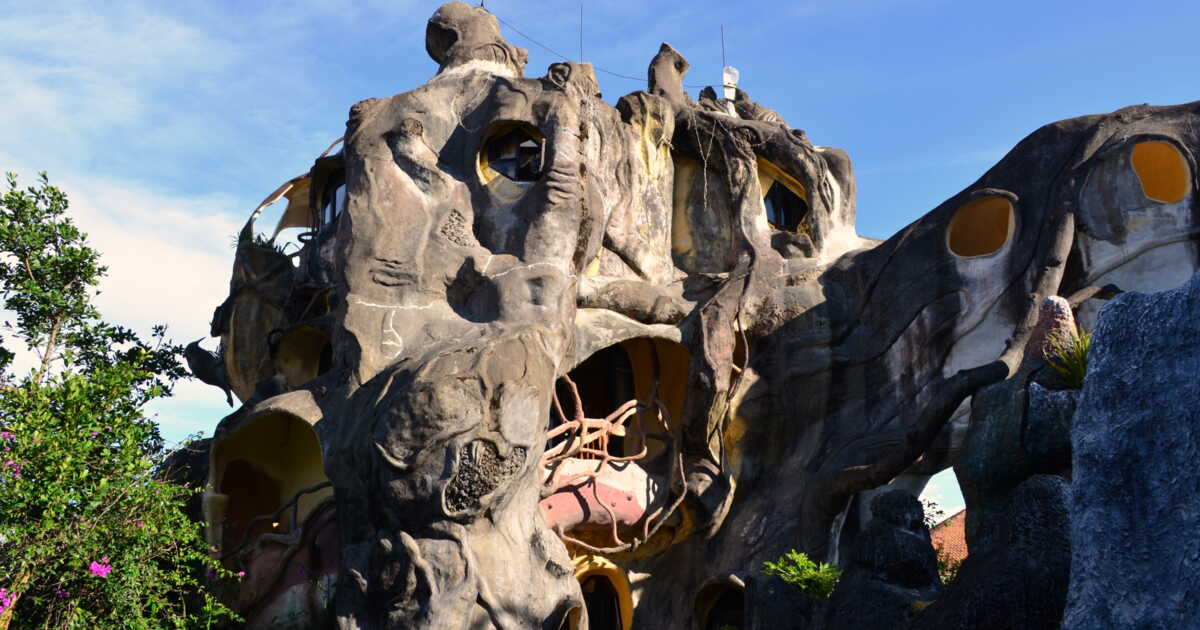
“Nature is the greatest teacher I have ever had.” With these words full of conviction, Dang Viet Nga, now 86, speaks of the work of her life: the Crazy House, whose construction began in the 1990s in Da Lat, in the southern region of Vietnam. Part guesthouse, part attraction, and a living architectural masterpiece, this place welcomes between 200,000 and 300,000 visitors each year and invites people to reconnect with nature and to respect it.
The adventure begins in the garden where colossal mushrooms loom beneath a giant canopy, then continues with an underwater immersion in the “water palace.” “Long before the emergence of modern cities, our ancestors sought refuge in caves and within forests, living in close harmony with the natural world. I wanted to recreate this bond“, explains the architect who graduated from the Moscow Institute. The buildings are conceived as enormous tree trunks and the communal spaces inspired by mountains. From chimneys shaped like bamboo stalks to animals that intrude into the rooms, the architectural details celebrating life are countless.
The fusion of a living space and a tourist site
In the Crazy House, the house becomes a tree and the tree becomes a house. Inside the trunks lie winding rooms. “I wanted people not only to admire nature, but to live within it,” explains the daughter of Hành Thiện, a small village in Nam Định province in northern Vietnam, a peaceful countryside where the air remains pure. Outside traditional hotel standards, this experience attracts an international clientele from Russia, Europe, the United States, or Asia. By merging a place to stay with a tourist site, Dang Viet Nga created an unprecedented hybrid concept that ensures the longevity of her work. “In the beginning, I funded the project myself, through loans from my family, friends, and banks. When the Crazy House began welcoming visitors and overnight guests, the revenues generated were directly reinvested into the project.”
Behind the “water palace” unfolds a darker outdoor space. Walkways crisscross, from which one can glimpse a façade bearing giant hands smeared with blood. “They symbolize violence and remind us that humanity must continue to overcome hatred and destruction.” A quest requiring perseverance that Dang Viet Nga, daughter of Trường Chinh — former general secretary of the Vietnamese Communist Party — knows well. Construction on the Crazy House began in February 1990, the site opened in April, and it welcomed its first guests in January 1991. “One day, the Ministry of Tourism informed me I had only one month to complete ten rooms”, the artist recalls. Without hesitation, she hires sixty workers. “We worked day and night to meet the deadline.”
A journey filled with obstacles
Not to mention the challenge of getting such an unusual architecture approved. “When I submitted the idea, the plans showed only a trunk-shaped structure. It was interpreted as only a landscaping element and was approved.” But as the project progressed, the work grew into a five-story building. It took the rising enthusiasm of international tourists to overcome reservations and to win over the local community. “From then on, I felt encouraged to continue my work in line with my vision”, she confides.
At the summit stands the “Villa of the Sky,” crowning a path that moves from struggle to peace. A sense of fullness that Dang Viet Nga finally achieved. The final spaces of the Crazy House were completed in 2020, and her son is today in charge of her life’s work. More than a family succession, it is a life philosophy that the architect leaves as a legacy: “It is only by respecting and protecting nature that we can lead a peaceful and balanced life. I am glad that more and more people understand that it must be preserved for future generations.”