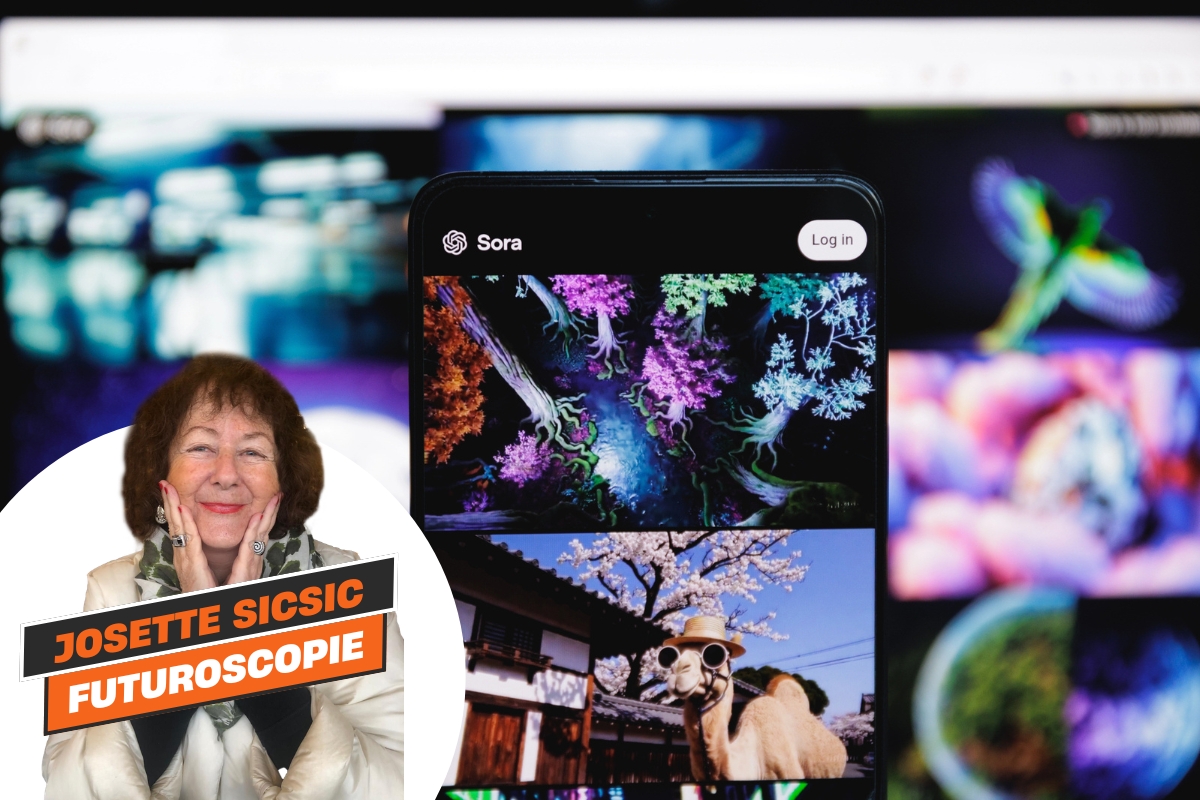


… After a dazzling start crowned by a million users, SORA would thus fall into the AI’s forgotten corners, pushing its owner to refocus on more lucrative activities, notably professional tools.
The promising experience at the outset had fizzled out. And this despite its almost magical qualities for the user. Indeed, which graphic designer, photographer, videographer, or advertiser has not succumbed to the temptation to call on an AI to produce in a few seconds a wholly artificial work where no human would recognise themselves and could claim image rights?
And no one could bill for the fees owed for its meticulous service? As for situations and landscapes, monuments and other sites… which can be transformed with impunity, they are already among the first victims of large‑scale falsification that is not always appreciated.
The promising experience at the outset had fizzled out. And this despite its almost magical qualities for the user. Indeed, which graphic designer, photographer, videographer, or advertiser has not succumbed to the temptation to call on an AI to produce in a few seconds a wholly artificial work where no human would recognise themselves and could claim image rights?
And no one could bill for the fees owed for its meticulous service? As for situations and landscapes, monuments and other sites… which can be transformed with impunity, they are already among the first victims of large‑scale falsification that is not always appreciated.
 Exemple : la campagne de Chamonix et de tant d’autres (Coca Cola, Mac Do…) ont été jugées responsables de vouloir tromper le public avec des images au rabais, manquant totalement de l’authenticité qu’elles sont censées vendre.
Certes, la mention « Image générée par l’IA, sublimée par l’homme » était visible. Ce qui n’est pas toujours le cas.
Mais tout de même, elle suggérait que tant qu’une législation très stricte n’est pas en place, la transparence des techniques utilisées pour informer et séduire une clientèle, sont douteuses et trompeuses.
Les contre offensives : Occitanie, Intermarché…
Facing such an onslaught that is technically, economically and often aesthetically unbeatable, the enemies of generative AI have stepped up to the plate.
Another example among others: Intermarché’s advertisement, in December 2025, was intent on proving its attachment to traditional advertising creation processes by having its spot produced by a team of around sixty humans!
Real artists and technicians working in a studio with their own skill and genius. Global success for the brand and for the advertising fable’s big bad wolf turned into a star!
Less known but just as commendable and convincing was the Social Media campaign proposed by the Occitanie region with the slogan: « In Occitanie we do not generate our journeys, we live them! ».
Driven by a firm intent to demonstrate that it is not a victim of machines and their approximate creativity, the region showcases its preference for real people and real sites and landscapes as it can offer visitors, and for genuine sustainable tourism!
« Out » Sora! For the moment, at least. And for those who can afford to rely on good old techniques and to preserve a sector extremely valuable for France where the cultural and creative industries (audiovisual, cinema, video games, music, live performance, books, press, radio and advertising) generated 102.7 billion euros in revenue in 2024 and directly employ around 586,000 people, with an additional 463,000 jobs indirect at suppliers and service providers!
Another example among others: Intermarché’s advertisement, in December 2025, was intent on proving its attachment to traditional advertising creation processes by having its spot produced by a team of around sixty humans!
Real artists and technicians working in a studio with their own skill and genius. Global success for the brand and for the advertising fable’s big bad wolf turned into a star!
Less known but just as commendable and convincing was the Social Media campaign proposed by the Occitanie region with the slogan: « In Occitanie we do not generate our journeys, we live them! ».
Driven by a firm intent to demonstrate that it is not a victim of machines and their approximate creativity, the region showcases its preference for real people and real sites and landscapes as it can offer visitors, and for genuine sustainable tourism!
« Out » Sora! For the moment, at least. And for those who can afford to rely on good old techniques and to preserve a sector extremely valuable for France where the cultural and creative industries (audiovisual, cinema, video games, music, live performance, books, press, radio and advertising) generated 102.7 billion euros in revenue in 2024 and directly employ around 586,000 people, with an additional 463,000 jobs indirect at suppliers and service providers!
Des émotions humaines pour et par des humains
Evidently, the war between the old and the new seems once again very much open. And it is far from calming down as the tsunami of AI’s arrival has been powerful and rapid. Is this war, for the moment, justified? Or unjustified?
While travel agents and many other professions wonder how they will be treated, or what side they may take from this unexpected, free aid that has fallen from the sky with such effectiveness, psychologists, sociologists, and other humanities specialists are trying to understand the transformations taking place in our brains and thus in our behaviours.
Among them, Bruno Patino (president of Arte) has just published a book entitled The Time of Human Obsolescence.
A serious yet easy-to-read analysis, which, like many others, compares the arrival of AI with the invention of the printing press. The latter, 500 years ago, allowed knowledge to be disseminated and recognized authors as untouchable experts.
A fortunate time of cognitive stability nourished by verified information coming from above!
And then the Internet arrived and produced a kind of chaos that indeed yields a universal library but also what the author calls a form of fragmentation. We fragment, we crumble, we sink… while believing we are freeing ourselves!
We chase the truth, believing we are equipped to discover and strengthen it. Through the constant, dripping connections on our screens, we think we participate in an uninterrupted circular conversation while we shut ourselves up with algorithms in silence and solitude, while filling data centers with millions of data that will be sold to the highest bidder and will worsen water shortages and CO2 emissions!
A Grand View Research study predicts that by 2030, the AI market should represent 1,811.75 billion dollars, i.e., an average annual growth rate of 37.3% between today and the end of this decade.
While travel agents and many other professions wonder how they will be treated, or what side they may take from this unexpected, free aid that has fallen from the sky with such effectiveness, psychologists, sociologists, and other humanities specialists are trying to understand the transformations taking place in our brains and thus in our behaviours.
Among them, Bruno Patino (president of Arte) has just published a book entitled The Time of Human Obsolescence.
A serious yet easy-to-read analysis, which, like many others, compares the arrival of AI with the invention of the printing press. The latter, 500 years ago, allowed knowledge to be disseminated and recognized authors as untouchable experts.
A fortunate time of cognitive stability nourished by verified information coming from above!
And then the Internet arrived and produced a kind of chaos that indeed yields a universal library but also what the author calls a form of fragmentation. We fragment, we crumble, we sink… while believing we are freeing ourselves!
We chase the truth, believing we are equipped to discover and strengthen it. Through the constant, dripping connections on our screens, we think we participate in an uninterrupted circular conversation while we shut ourselves up with algorithms in silence and solitude, while filling data centers with millions of data that will be sold to the highest bidder and will worsen water shortages and CO2 emissions!
A Grand View Research study predicts that by 2030, the AI market should represent 1,811.75 billion dollars, i.e., an average annual growth rate of 37.3% between today and the end of this decade.