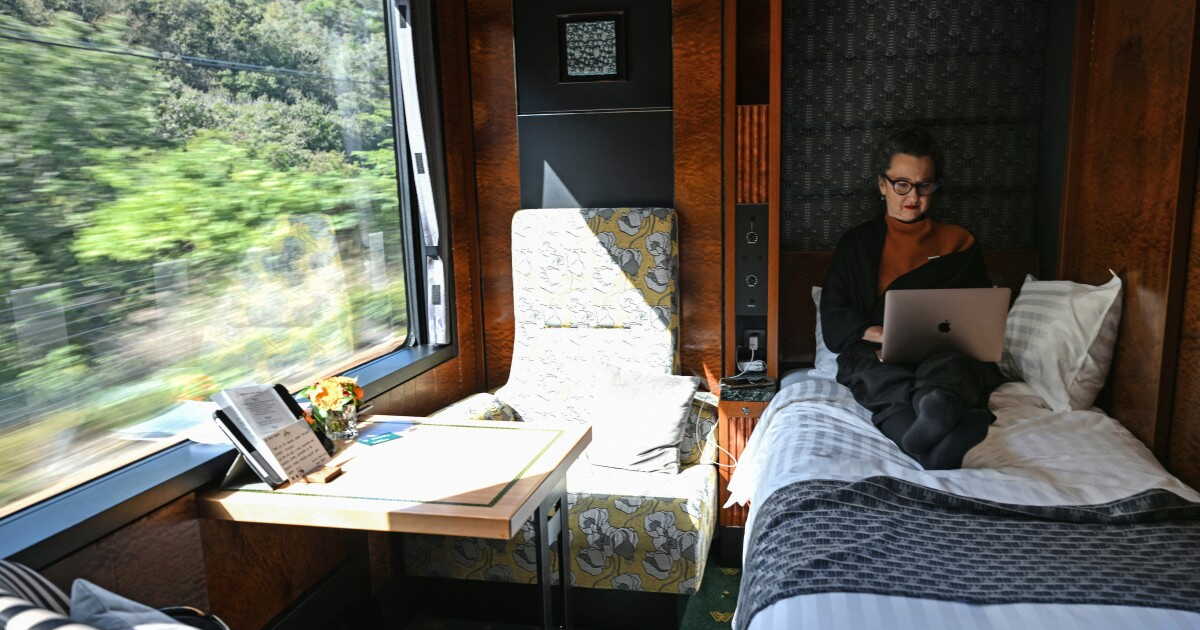
This Art Deco-style train with its bottle-green silhouette, the “Mizukaze”, will carry them Friday morning to Matsue (to the west), on the coast of the Sea of Japan: a day and a night on the rails to complete a collaborative novel of about 200 pages. “It’s a completely crazy project that brings together (these writers) in a mythical train, and whose sixteen voices must form a coherent and relevant whole”, acknowledges Muriel Barbery after a brief stop in Osaka.
A “red thread” and a general framework were discussed before departure but the plot — set within the Mizukaze itself — will be built on the train, each writer taking on a distinct character. “We were given the biography of a character, whom all the other characters will have known and who is the reason they boarded the same train”, explains the author of The Elegance of the Hedgehog, who imagined incorporating a cat into the story.
Spacious cabins, dark wood paneling, thick carpets, Lalique-like fixtures… the décor evokes the splendor of the Orient Express, while outside the Japanese countryside passes by, with its rice fields and distinctive architectures. These landscapes “will inevitably make their way” into the writing, confides Christophe Ono-dit-Biot, as he sits before a matcha dessert.
“It’s rare to be able to write, not collectively, but individually in a sort of polyphony (…) We don’t claim to write a unified novel: what will be interesting are the resonances between each of the texts”, he says. For him, “the constraint adds extra excitement. The path through the eye of the needle has already been proposed: you just have to thread it.”
Synchronised Swimming
This is the second time the French association L’écriture en mouvement has put such a project on track: a first edition had brought together local and French writers in Canada in 2015.
“There is no question of writing separate stories. We are making a novel, I am trying to find bridges between one and the other”, and some French and Japanese authors have already begun to come to terms, “reaching a consensus” after exchanging ideas and sketching, enthuses its president Anne Forrest-Wilson. Interpreters aboard are expected to smooth the exchanges.
In the spirit of Oulipo (Ouvroir de Littérature Potentielle): this movement, which began in the 1960s, invites its members — Perec being its illustrious representative — to write texts subjected to strict and playful constraints. Unsurprisingly, several Oulipo members have joined the project, including its president Hervé Le Tellier — Goncourt Prize 2020 for The Anomaly—, Paul Fournel, Frédéric Forte and the Argentine Eduardo Berti.
Claire Berest and Richard Collasse complete the group of Francophone authors. “It’s not the same to practice the craft individually and collectively. Here we’re doing a bit of synchronised swimming”, each part complementing the others, said Mr. Le Tellier to AFP before departure.
If Oulipo seems distant from Japan, Anne Forrest-Wilson draws parallels: for her, Sei Shônagon’s The Pillow Book (11th century) or haikus already belong to the Oulipo repertoire.
Deadline
Not everyone confines themselves to studying: Toh EnJoe, master of Japanese science fiction, enjoys a glass of wine in the wagon-bar while continuing to write. “It would be nice if everything eventually formed a coherent whole. Since each person draws their own part on their side, everything rests on how we will coordinate… or not”, he concedes. His character “is a bit particular: he missed the train”, he jokes.
The participating Japanese authors, who have earned the prestigious Akutagawa Prize (the Japanese equivalent of the Goncourt), showcase varied profiles: the radical-styled novelist Hitomi Kanehara, connoisseurs of French literature (Anna Ogino), a poet (Machi Tawara) …
Beyond literary and cultural sensibilities, the 16 authors will have to hand in their drafts by the morning arrival in Matsue on Friday, for a bilingual publication expected in 2027.
As Christophe Ono-dit-Biot sums up, “the deadline will be the arrival station.”