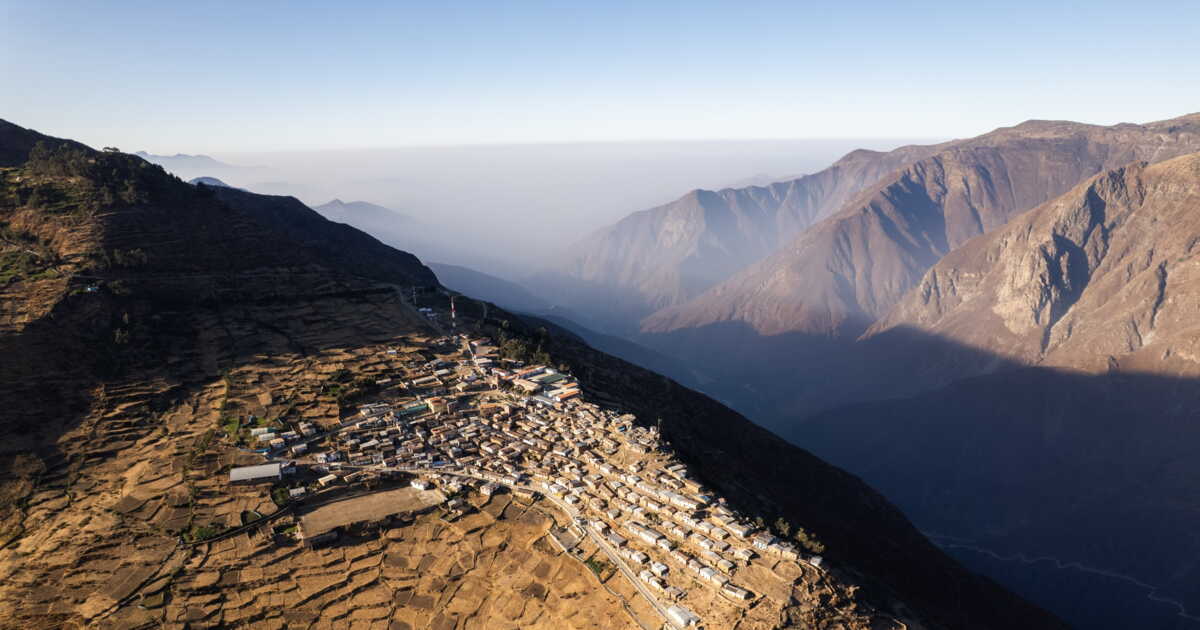
The narrow track keeps climbing and descending, winding through terraced fields planted with potatoes, beans, and corn, before reaching the bare crest where the Peruvian village of San Pedro de Casta has grown. A few dusty lanes, houses with plaster peeling to reveal red brick walls, and corrugated tin roofs gleaming in a clear sky. A highland hamlet at 3,000 metres above sea level, with one peculiarity: from there, the view dives into a surprisingly green valley, at the bottom of which fruit trees grow.
Between avocado trees, apple trees and cherimoyas—Annona cherimola, a fruit with white flesh whose taste recalls cotton candy—one can discern the short zigzags of the Santa Eulalia. This river, born in the Andes, is the main tributary of the Rímac River, which waters Lima, 70 km away by air. And if the capital (where rainfall is five to ten times less than in the Sahara) can benefit from it, it is partly thanks to the treasure of San Pedro de Casta. Eufronio Obispo Rojas, the village’s water specialist, points to a hillside where a horizontal line runs along the rock: “It’s one of the amunas that we have restored”, he says. To understand: one of the canals built between the 8th and 11th centuries by the Waris, an Andean people who inhabited the south of present-day Peru, known for their building prowess.
Discreet Traces in the Mountain
Reuse and upkeep by the Incas in the 15th and 16th centuries gave rise to small watercourses framed by stone walls, with a distinguishing feature: they were not designed solely to transport water; they also fostered its infiltration into the soil. “Some amunas are steep and the water runs down very quickly, explains Eufronio Obispo Rojas. The others, with gentler slopes, built on porous ground, are, they say, conducive to infiltration.” Here this is known as sembrar el agua (“sowing the water”). A system that stores in the underground the water that falls abundantly during the rainy season (from November to April) to use it during the dry season (June to October). In effect, the infiltrating water takes several weeks to re-emerge downstream and to feed the Santa Eulalia River. A team of scientists from Imperial College London tested this, adding a fluorescent dye to the amunas of San Pedro de Casta. Result: the liquid reappeared after an average of forty-five days, in resurgences or springs, at a lower altitude (about 1,200 metres lower).
Mostly abandoned during the 20th century—often all that remained was a trace along the mountain and a few sections of wall—these canals are being restored across the region for about fifteen years. San Pedro de Casta has already renovated 37 kilometres. Huachupampa, San Juan de Liris, Carampoma, and other hamlets in the upper Santa Eulalia valley, all between 3,000 and 4,500 metres in altitude, are following suit. In total, “more than 83 kilometres are today in service in the valley,” notes Mariela Sánchez, who runs Aquafondo, a nonprofit focused on Lima’s water security, and who has been piloting the project since 2018. “We target projects in this zone because it feeds the Rímac River, which provides 69% of the capital’s water resources. If we add the amunas from the two other basins that feed Lima, the Chillón and the Lurín, 87 km of canals are operational.”
Near the canals, a miracle: fruit trees…
Despite their ages of 74 and 76, Eufronio Obispo Rojas and Héctor Calixtro Obispo, another village resident, have no trouble climbing the three-kilometre steep path that leads to Marcahuasi, a plateau of tufa sculpted by erosion, located southeast of the village. Along the rugged path lined with various cacti and low-growing vegetation, the two men talk about what concerns everyone here: the rain. “It is much more irregular than before, sometimes you have to wait until January for the season to come, and other years it is very intense, but very short”, says Héctor. Risky for agricultural yields. But the amunas have changed the game: the surroundings of canals below 2,500 metres (above which vegetation becomes sparse) are now lush with greenery and host fruit trees that residents have managed to plant across 300 hectares.
The Marcahuasi is popular with tourists who come to camp among the imposing rock formations that have earned it the nickname “forest of stones”.
The Challenge
When it rains intermittently in dry and desert regions, part of the water that falls is wasted. Depending on geography and geology, the reasons vary. But in general, the problem is that the soil, being too dry, forms a crust hard to penetrate, or that the slope of the land causes runoff to be too rapid for the flow to infiltrate in time. Finally, ambient heat and wind can accelerate evaporation. The poorer the regions affected, the more important it is to find durable solutions based on techniques that the population can master and materials found on site.
But for the inhabitants, its wealth lies in its three qochas (water reservoirs). One of them, shaped like a small mountain lake, was created by damming a stream with large stones. Further on lies a bofedal, a high-altitude, spongey wetland, a touch greener than the surroundings and strewn with large puddles.
“Bofedales are like sponges; they catch water during the rainy season, and release it during the dry season: they regulate themselves!”
explains Norma Mónica Calixtro Salinas, 59, a farmer, beige hat and a brightly coloured shawl draped over her shoulders. Just under four hectares of the bofedal are protected from trampling by barriers. Elsewhere, with every step, the shoes sink a little into this carpet of grass and moss. In just a few minutes, the feet are drenched.
Restore, then Upkeep
Until 2018, villagers rehabilitated the canals on a voluntary basis. Now they are paid by Aquafondo, between 90 and 150 soles a day (roughly 23 to 39 euros; the Peruvian daily minimum wage is about 9.50 euros). Funding comes from voluntary contributions by large water-hungry corporations—Coca-Cola, PepsiCo and Backus & Johnston (the number one beer brand in Peru)—as well as a 1% tax levied on Lima residents’ water bills, directly relevant to them. “Work is done during the dry season,” explains Mariela Sánchez, head of Aquafondo, seated on one of the vast natural slabs that pave Marcahuasi. “At times we employ up to 180 people. Sometimes the amuna is easily accessible, so it happens quickly. But for those located high up in the mountains, you must walk for hours to reach them, and sometimes work with a harness because it’s steep.” Once a canal is up and running, the work does not stop there. “Rains can damage or clog it, so it must be maintained at least twice a year,” explains Norma Mónica Calixtro Salinas, as she climbs a dirt track to an amuna two kilometres from San Pedro de Casta, which will need cleaning at the end of October.
A Ritual for Rain
The twenty-some residents taking part in this faena (a communal farming task) travel light: one tool per person—a pry bar, pickaxe, shovel—, a head covering—hard hat, cap, hat—, and a backpack or its local version, the aguayo, a strip of fabric tied around the chest to carry everything. While some clear a fallen trunk from the canal, others move stones with a shovel. It is one of the last maintenance days before the imminent rainy season.
Earlier in the season, in San Pedro de Casta, the Water Festival, or champería, was celebrated, a tradition that exists in several villages in the region and named after the champas, the weeds that clog the channels. The seven-to-ten day program includes dances, snacks and even a horse race along the village’s steep tracks, in addition to maintenance work on the amunas. “This is the moment when we sing the Hualina, a song that calls for rain”, says Norma Mónica Calixtro Salinas. Accompanied by about ten village women, the farmer begins the opening stanzas: “White mist of the Andes, release your droplets for me, so that your waters bless my springs.” A bright sun had ruled all morning, but the mountains across the valley begin to vanish behind a layer of clouds and the temperature drops sharply. “See, now that we have sung, the clouds are coming,” she notes.
Lima Will Have to Learn to Conserve Water
According to Aquafondo, the efforts are paying off: around 300,000 of Lima and the surrounding area’s 11 million inhabitants now face fewer water outages. But even the dozens of extra kilometres of amunas that have been restored and are planned will not be enough: the sprawling capital will have to learn to conserve this precious resource, which it currently spends without restraint.
➤ Article published in GEO magazine no. 569, “Replenishing in Auvergne,” July 2026.
➤ If you enjoy GEO, then to make sure you never miss anything, discover our subscription plans to receive GEO every month at your home with ease.