

No. 23, Via Cappello is never quiet.
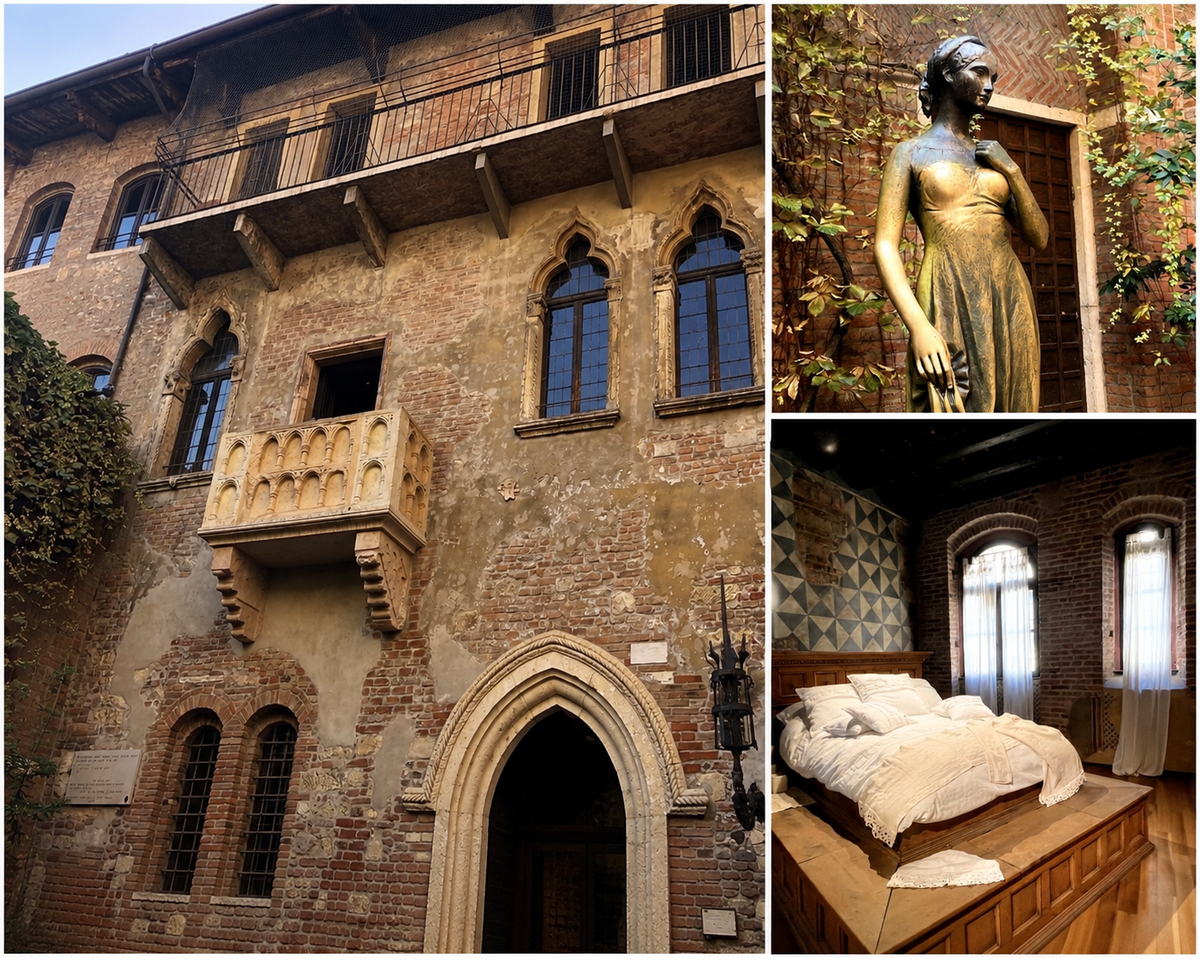
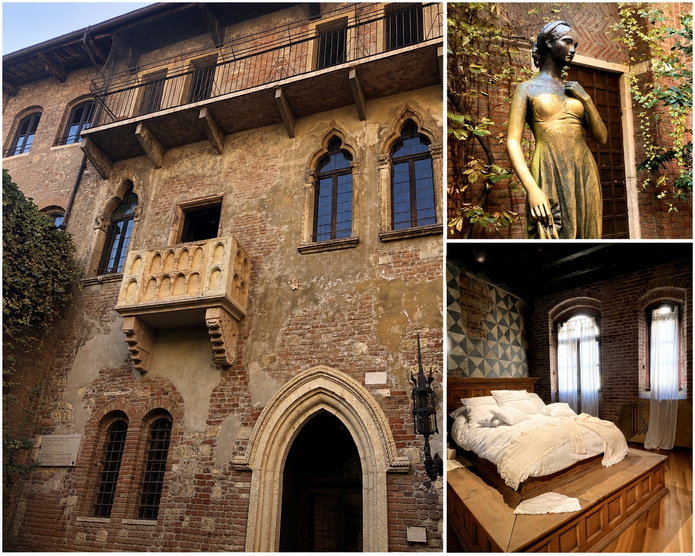
It is here that Juliet Capulet, Romeo Montague’s passionate lover, is believed to have lived, two Verona youths whose story ends in tragedy due to the hatred between their two families.
Poignant, this tragic love story is nevertheless fictional. The “Juliet’s House” is not much more authentic. Indeed, it is a 14th‑century Gothic dwelling, but the balcony Roméo is said to have climbed was added in the 20th century, as is the bronze statue of Juliet in the courtyard.
This does not stop tourists from flocking there, as the “Lovers of Verona” have been captivating figures since, in 1596—a couple of centuries after the alleged events—the English playwright William Shakespeare made them the heroes of one of his most famous plays.
It is here that Juliet Capulet, Romeo Montague’s passionate lover, is believed to have lived, two Verona youths whose story ends in tragedy due to the hatred between their two families.
Poignant, this tragic love story is nevertheless fictional. The “Juliet’s House” is not much more authentic. Indeed, it is a 14th‑century Gothic dwelling, but the balcony Roméo is said to have climbed was added in the 20th century, as is the bronze statue of Juliet in the courtyard.
This does not stop tourists from flocking there, as the “Lovers of Verona” have been captivating figures since, in 1596—a couple of centuries after the alleged events—the English playwright William Shakespeare made them the heroes of one of his most famous plays.
A Legend in Solid Gold
This drama did not originate from Shakespeare’s imagination: the story reached him after nearly a century’s journey, across Italy, France, and England, and through the hands of at least five different writers.
It was a certain Luigi da Porto who, first (the date is 1531), placed the plot in Verona. Reading Dante’s Divine Comedy, he learned that the Renaissance poet explicitly cited the Montecchi (Montagues) and the Cappelletti (Capulets) to illustrate the political struggles between rival families that stained medieval Italy, Verona in particular.
It is from these history-laden names that Da Porto and, in his wake, Shakespeare wove this story which, after them, inspired numerous books, films and performances. As for the city of Verona, it leans into this legend to boost its tourist appeal…
It was a certain Luigi da Porto who, first (the date is 1531), placed the plot in Verona. Reading Dante’s Divine Comedy, he learned that the Renaissance poet explicitly cited the Montecchi (Montagues) and the Cappelletti (Capulets) to illustrate the political struggles between rival families that stained medieval Italy, Verona in particular.
It is from these history-laden names that Da Porto and, in his wake, Shakespeare wove this story which, after them, inspired numerous books, films and performances. As for the city of Verona, it leans into this legend to boost its tourist appeal…
Two thousand years of history
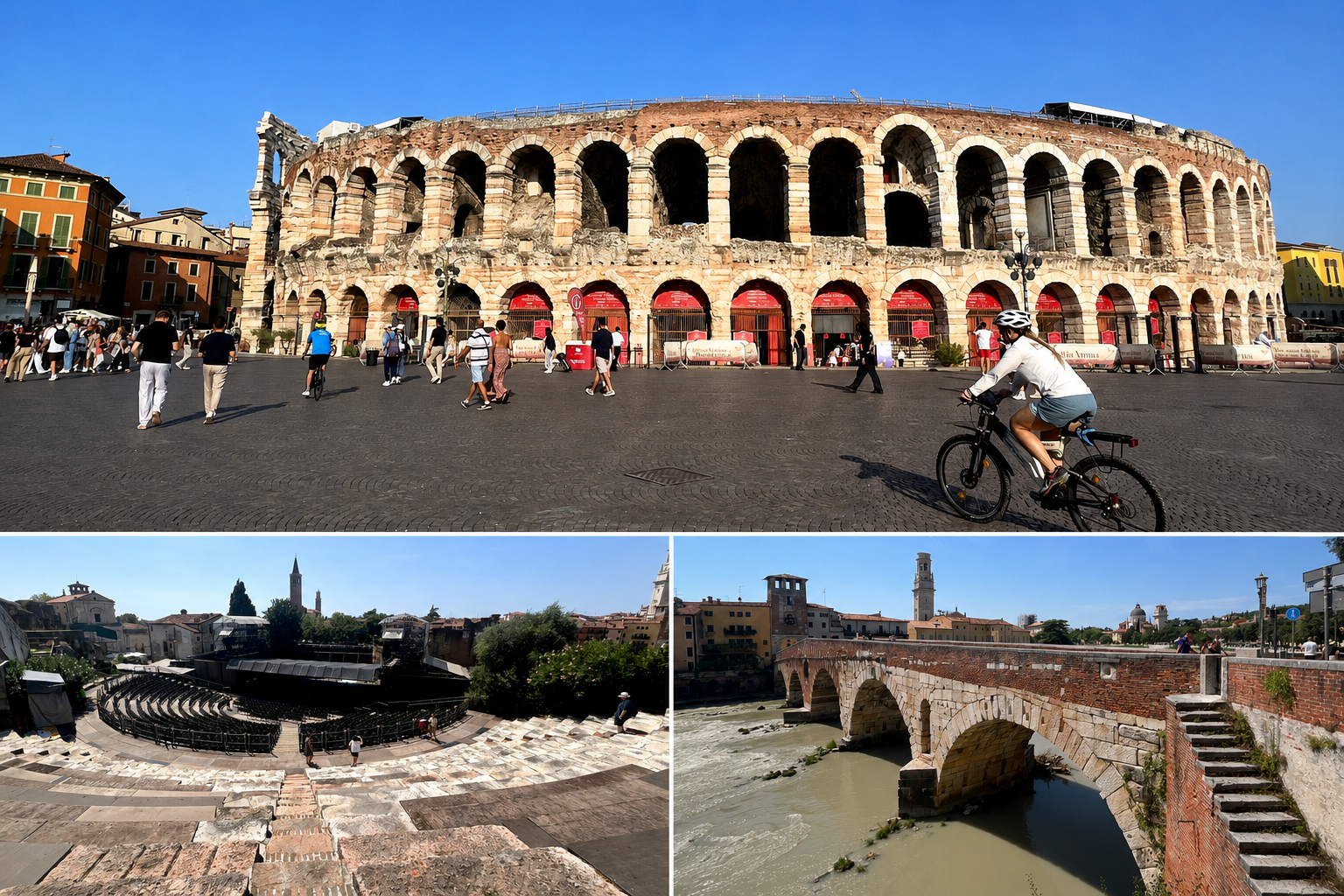
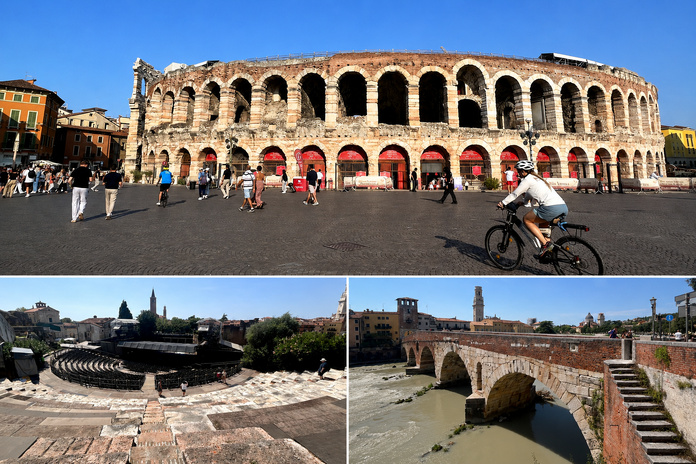
Although Juliet’s House is almost obligatory on the itinerary (15 € entry, all the same), Verona deserves to be explored for many other reasons that make one regret the myth’s heavy prominence.
Indeed, in this Northern Italian city founded by the Romans over 2000 years ago, everything is beautiful: pink marble (sourced from Valpolicella, a region best known for its wines) and the bricks used for so many palaces, the colorful façades, the carved window and door frames, the ornate balconies, the fountains, the squares, the courtyards, the countless churches…
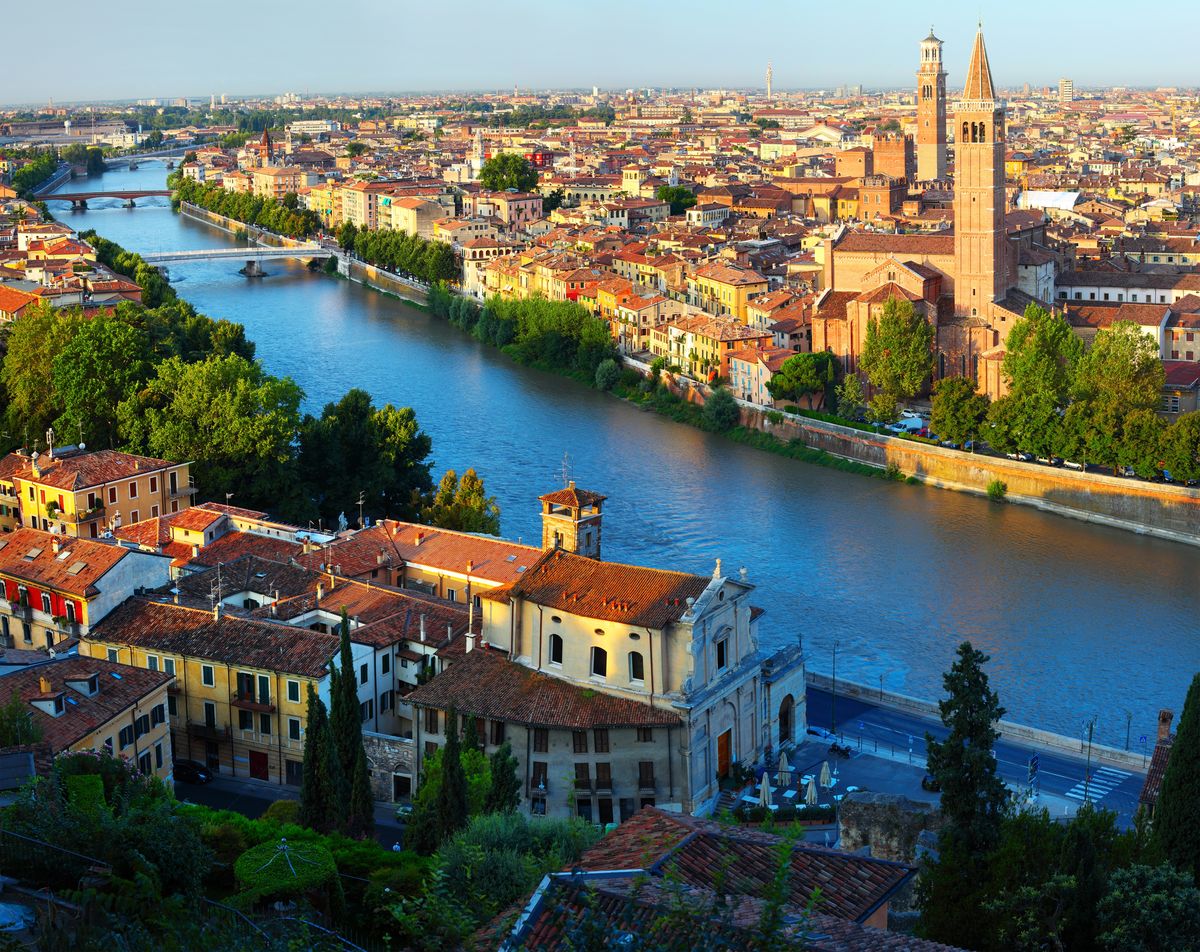
From its origins, Verona preserves many Roman remains, two gates, part of the ancient ramparts, its Ponte Pietra spanning the Adige river, and of course its ancient open-air theater perched against San Pietro hill: rediscovered in the 19th century after centuries of neglect, it hosts a Shakespeare Festival every July, while the contiguously located former monastery San Girolamo houses a rather interesting archaeological museum.
And then, on the imposing Piazza Bra, there are the Arenas which, every summer, draw in lyric artists and opera lovers from around the world.
Indeed, in this Northern Italian city founded by the Romans over 2000 years ago, everything is beautiful: pink marble (sourced from Valpolicella, a region best known for its wines) and the bricks used for so many palaces, the colorful façades, the carved window and door frames, the ornate balconies, the fountains, the squares, the courtyards, the countless churches…
From its origins, Verona preserves many Roman remains, two gates, part of the ancient ramparts, its Ponte Pietra spanning the Adige river, and of course its ancient open-air theater perched against San Pietro hill: rediscovered in the 19th century after centuries of neglect, it hosts a Shakespeare Festival every July, while the contiguously located former monastery San Girolamo houses a rather interesting archaeological museum.
And then, on the imposing Piazza Bra, there are the Arenas which, every summer, draw in lyric artists and opera lovers from around the world.
Verona: the jewels of Piazza delle Erbe
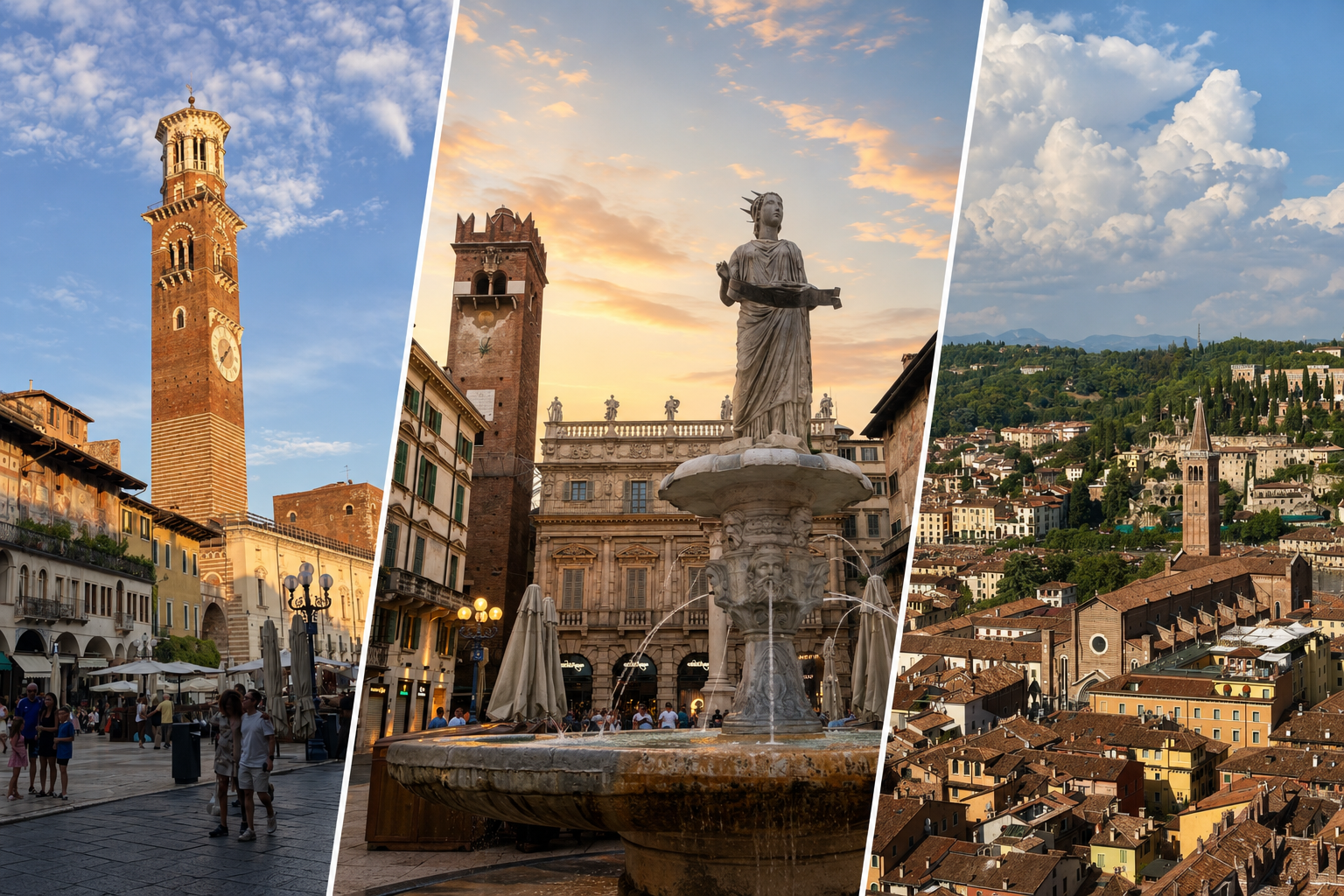
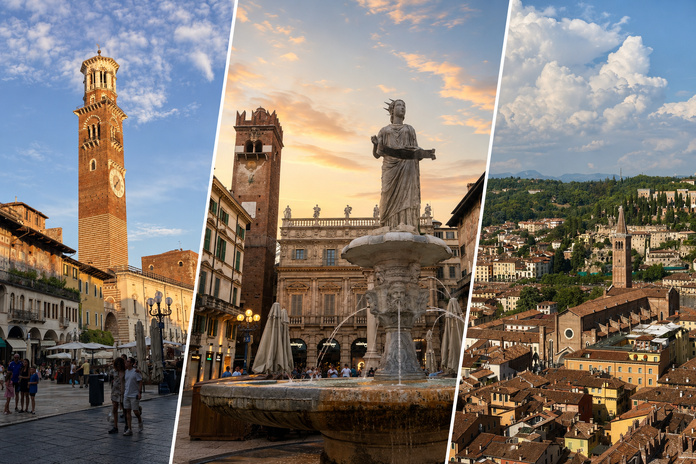
Verona today blends historic charm, cultural energy and the Italian art of living to perfection.
If, on Piazza Bra where the Arenas stand, you can admire a few palaces (Barbieri Palace, Gran Guardia Palace) before sitting under the arcades, on the prestigious Piazza delle Erbe you are spoilt for views, even though souvenir and ice cream vendors and fresh fruit stalls slightly spoil the perspective.
This square sits at the site of the ancient Roman forum and right at the intersection of the two main arteries that formed the grid of the ancient city: one axis, running east-west, connected Venice, Milan and France; the other, north-south, linked England to Rome and was long used by merchants from northern Europe.
A major commercial crossroads of northern Italy since antiquity, Verona remained so in the Middle Ages: witness the red-brick Domus Mercatorum, also called Casa dei Mercanti (House of Merchants), built in 1301 at a corner of Piazza delle Erbe.
This square is surrounded by so many magnificent historic buildings that you can almost get dizzy: Gardello Tower, completed in 1370, housing one of Europe’s oldest public clocks; right next to it, Maffei Palace, with a Baroque façade and a balustrade adorned with statues of Greek gods; then, the Mazzanti Houses decorated with splendid 16th-century frescoes; finally, Palazzo della Ragione (Palace of Reason, seat of medieval justice).
Adjacent to this palace rises the Tower erected by Verona’s wealthy noble family, the Lamberti. About 300 steps lead to its panoramic terrace (84 meters) from which the view over Verona’s rooftops is sublime. Don’t worry—the elevator is available!
In the middle of the square, the Madonna Verona fountain has displayed since 1368 its elegant red marble and its Roman statue.
If, on Piazza Bra where the Arenas stand, you can admire a few palaces (Barbieri Palace, Gran Guardia Palace) before sitting under the arcades, on the prestigious Piazza delle Erbe you are spoilt for views, even though souvenir and ice cream vendors and fresh fruit stalls slightly spoil the perspective.
This square sits at the site of the ancient Roman forum and right at the intersection of the two main arteries that formed the grid of the ancient city: one axis, running east-west, connected Venice, Milan and France; the other, north-south, linked England to Rome and was long used by merchants from northern Europe.
A major commercial crossroads of northern Italy since antiquity, Verona remained so in the Middle Ages: witness the red-brick Domus Mercatorum, also called Casa dei Mercanti (House of Merchants), built in 1301 at a corner of Piazza delle Erbe.
This square is surrounded by so many magnificent historic buildings that you can almost get dizzy: Gardello Tower, completed in 1370, housing one of Europe’s oldest public clocks; right next to it, Maffei Palace, with a Baroque façade and a balustrade adorned with statues of Greek gods; then, the Mazzanti Houses decorated with splendid 16th-century frescoes; finally, Palazzo della Ragione (Palace of Reason, seat of medieval justice).
Adjacent to this palace rises the Tower erected by Verona’s wealthy noble family, the Lamberti. About 300 steps lead to its panoramic terrace (84 meters) from which the view over Verona’s rooftops is sublime. Don’t worry—the elevator is available!
In the middle of the square, the Madonna Verona fountain has displayed since 1368 its elegant red marble and its Roman statue.
At the Heart of the Medieval Struggles
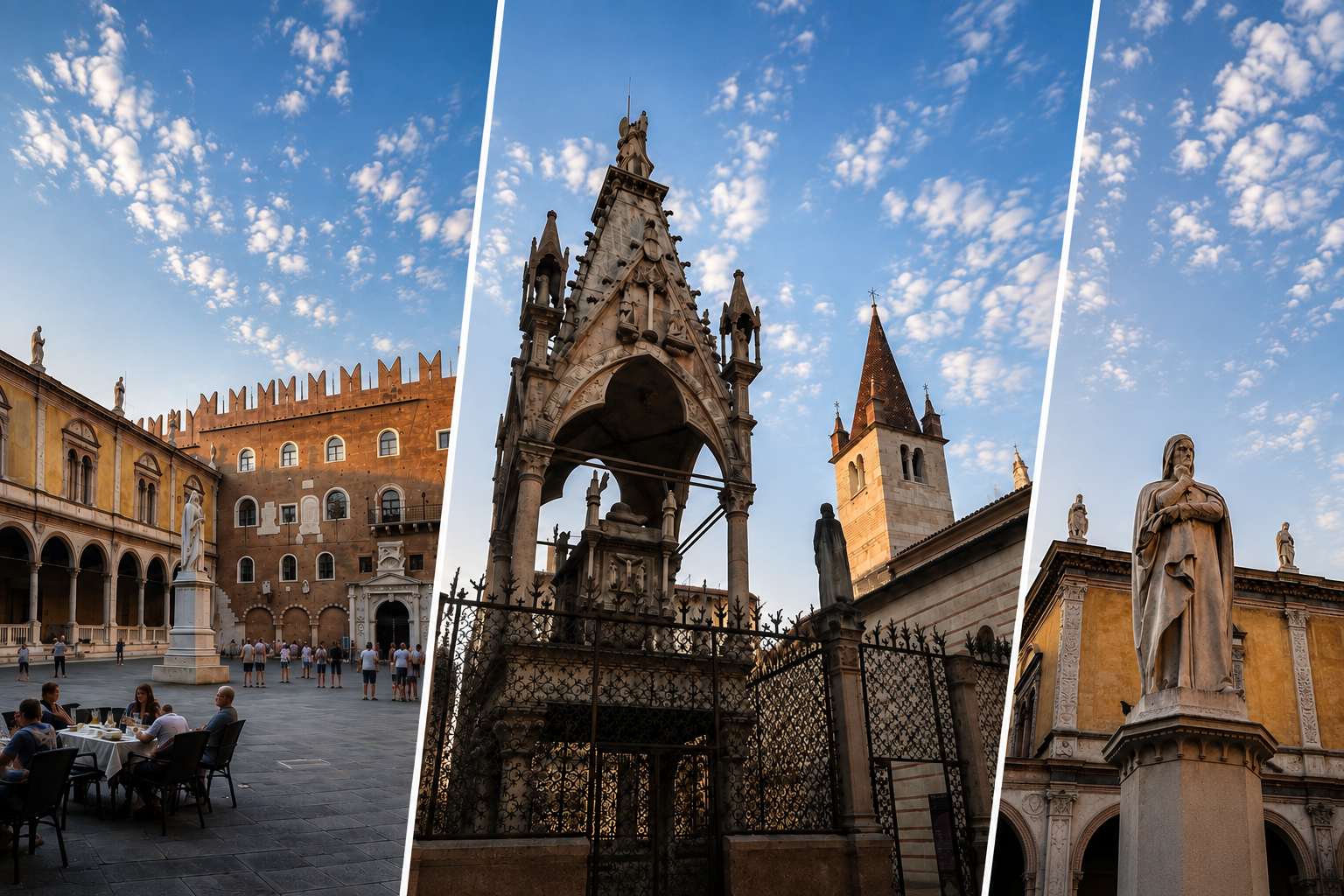
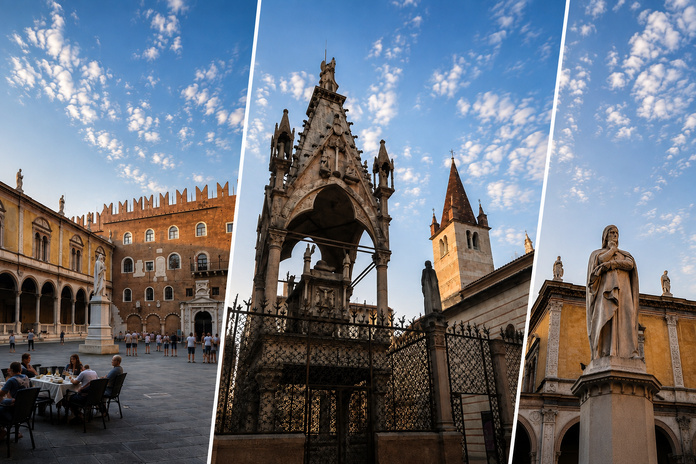
Two steps from the Piazza delle Erbe, the Piazza della Signoria — the political heart of the medieval city — houses a statue of the poet Dante, who took refuge in Verona after his exile from Florence.
All around, elegant palaces — linked together by arcaded galleries and loggias — speak of the splendor of the past. Among them, the former Residence of Cangrande I della Scala, the most prestigious figure of the powerful Scaligeri family, who, after a merciless struggle, seized power in Verona in 1262 and made it a prosperous city.
After the Scaligeri lost power in 1387, Verona lived under other dominations, notably that of the Republic of Venice (hence the column bearing the Lion of Saint Mark on Piazza delle Erbe): begun in 1405, this period ended in 1797 with Napoleon Bonaparte’s occupation during his Italian Campaign, which led to Verona’s… alignment with Austria.
Just a few steps from the Piazza della Signoria, right beside Santa Maria Antica, a Gothic funeral complex leaves one astonished: lay in marble sarcophagi the principal figures of the Scaligeri dynasty. That of Cangrande I is topped by a magnificent equestrian statue!
All around, elegant palaces — linked together by arcaded galleries and loggias — speak of the splendor of the past. Among them, the former Residence of Cangrande I della Scala, the most prestigious figure of the powerful Scaligeri family, who, after a merciless struggle, seized power in Verona in 1262 and made it a prosperous city.
After the Scaligeri lost power in 1387, Verona lived under other dominations, notably that of the Republic of Venice (hence the column bearing the Lion of Saint Mark on Piazza delle Erbe): begun in 1405, this period ended in 1797 with Napoleon Bonaparte’s occupation during his Italian Campaign, which led to Verona’s… alignment with Austria.
Just a few steps from the Piazza della Signoria, right beside Santa Maria Antica, a Gothic funeral complex leaves one astonished: lay in marble sarcophagi the principal figures of the Scaligeri dynasty. That of Cangrande I is topped by a magnificent equestrian statue!
Four churches not to miss
The Capitular Library, a genuine treasure
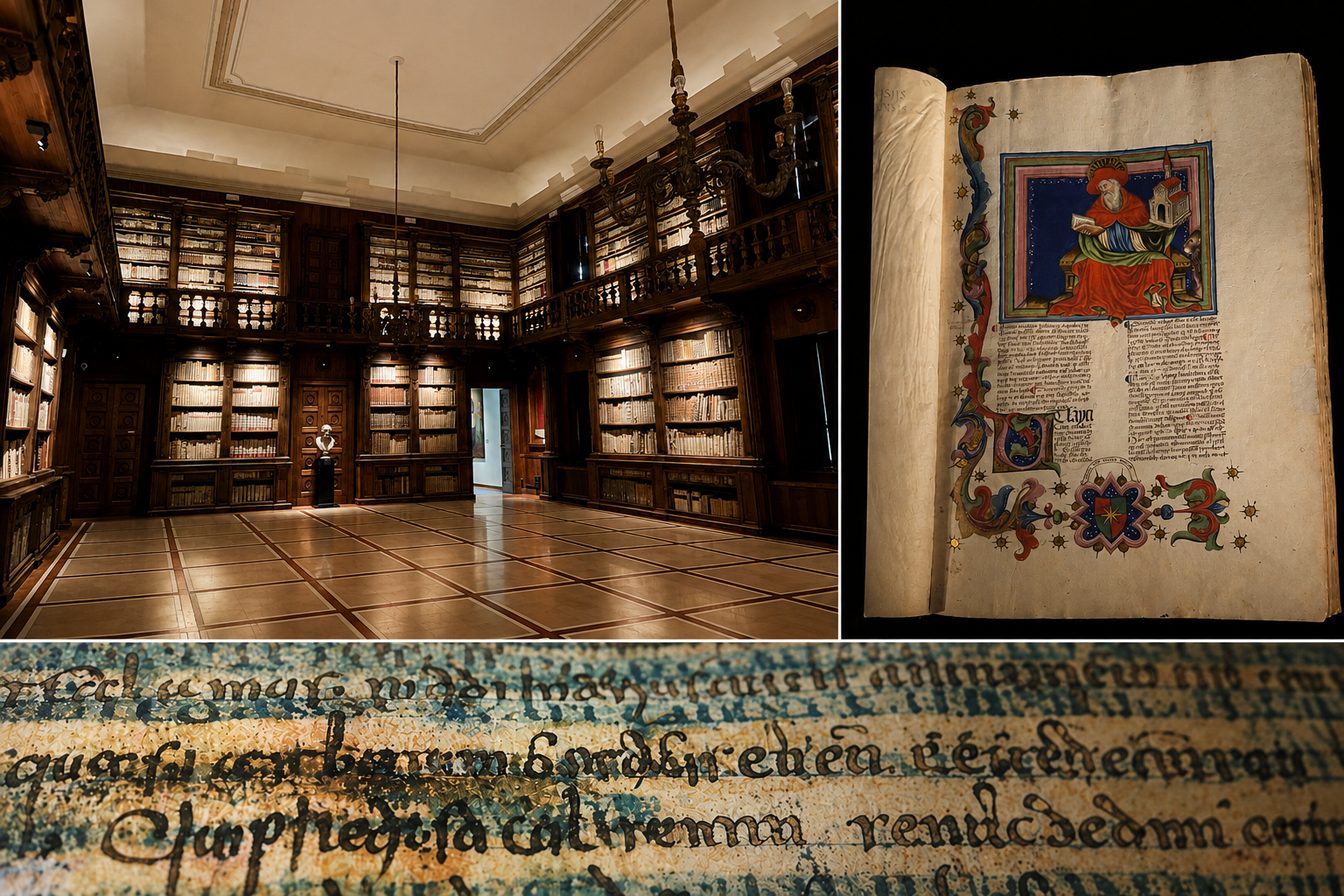
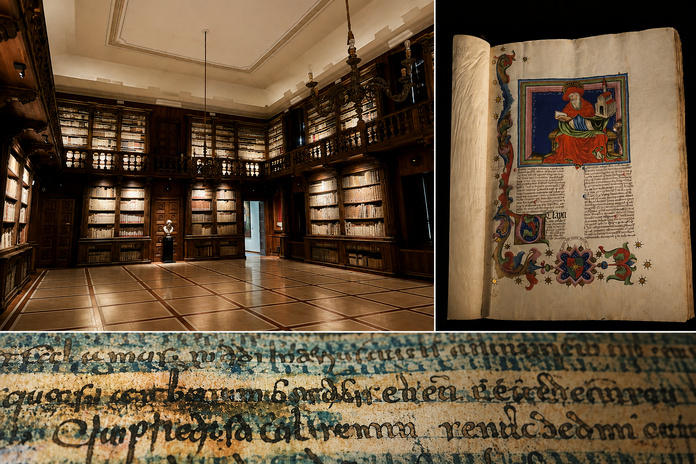
The most extraordinary jewel, nonetheless, is the Capitular Library, housed in the canonical palace just to the left of the Duomo!
Now managed by a Foundation, it was originally the study library of the Cathedral’s Chapter of canons.
“Founded 1600 years ago, it is, insists Valeria Nicolis, the conservator, the oldest library still in operation in the world”. It houses 700 rare works of art, 1200 manuscripts and 100,000 printed books, ancient and modern, spanning disciplines from theology and history to philosophy, literature, law, medicine, botany and astronomy. The main hall, with shelves from floor to ceiling, holds no fewer than 15,000 volumes.
Its most precious treasures are manuscripts, including major and unique pieces, notes Valeria Nicolis.
The oldest (the Codex Ursicinus) dates from 517! The Indovinello veronese is, itself, the oldest testimony of the transition between Latin and the vernacular Italian language. Finally, the Palimpsest of Gaius is the only text we have that attests to the foundations of classical Roman law.
No wonder scholars from around the world come to study there on site (possible since 2023)!
The general public, meanwhile, swoons over manuscripts adorned with delicate illuminations: some are displayed for a few weeks in hermetically sealed cases (temperature and humidity controlled), before a long return to the depths of the archives. Seeing originals is such a rarity!
Now managed by a Foundation, it was originally the study library of the Cathedral’s Chapter of canons.
“Founded 1600 years ago, it is, insists Valeria Nicolis, the conservator, the oldest library still in operation in the world”. It houses 700 rare works of art, 1200 manuscripts and 100,000 printed books, ancient and modern, spanning disciplines from theology and history to philosophy, literature, law, medicine, botany and astronomy. The main hall, with shelves from floor to ceiling, holds no fewer than 15,000 volumes.
Its most precious treasures are manuscripts, including major and unique pieces, notes Valeria Nicolis.
The oldest (the Codex Ursicinus) dates from 517! The Indovinello veronese is, itself, the oldest testimony of the transition between Latin and the vernacular Italian language. Finally, the Palimpsest of Gaius is the only text we have that attests to the foundations of classical Roman law.
No wonder scholars from around the world come to study there on site (possible since 2023)!
The general public, meanwhile, swoons over manuscripts adorned with delicate illuminations: some are displayed for a few weeks in hermetically sealed cases (temperature and humidity controlled), before a long return to the depths of the archives. Seeing originals is such a rarity!
A city terrifically alive
Although all these marvels leave little room for doubt, Verona is above all a city where life is good, to stroll, to savor specialties (risotto all’Amarone soaked in wine, gnocchi, sweet Pandoro…), or simply to sip an espresso or a spritz on the numerous terraces of Piazza Bra and Piazza delle Erbe! Even shopping in the charming shops of Via Mazzini, Corso Porta Borsari or Via Rosa.
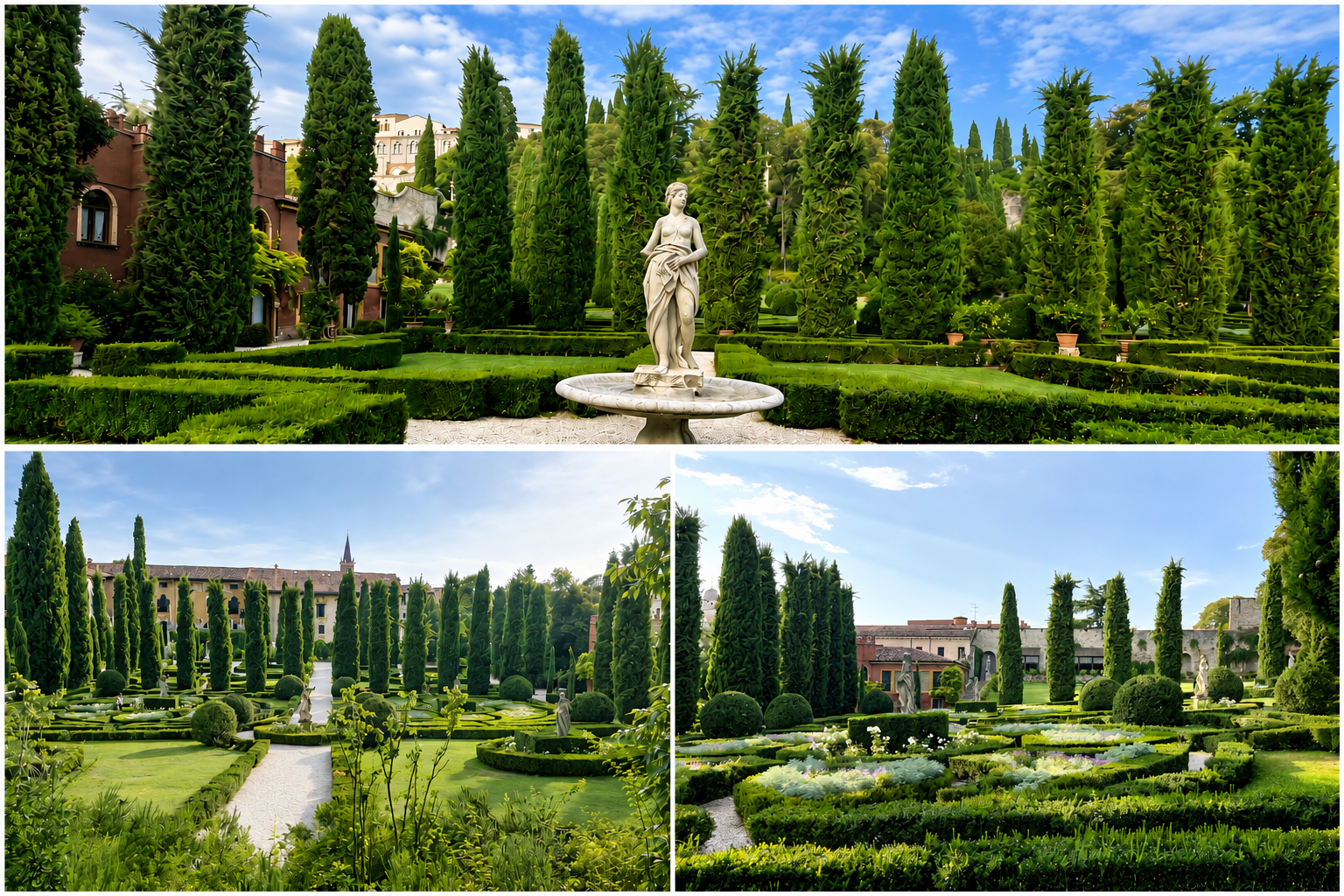
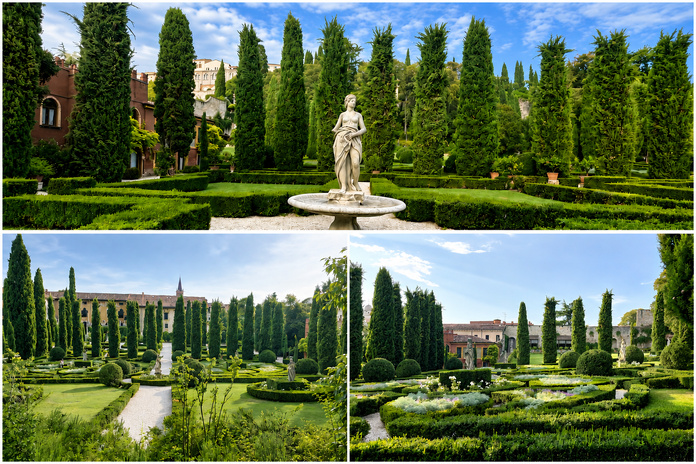
It is also pleasant to cross the Adige to explore, on its left bank, the Giusti Palace garden — one of the finest Renaissance-era parks — and the Veronetta student district, peaceful in the summer when the city center is buzzing.
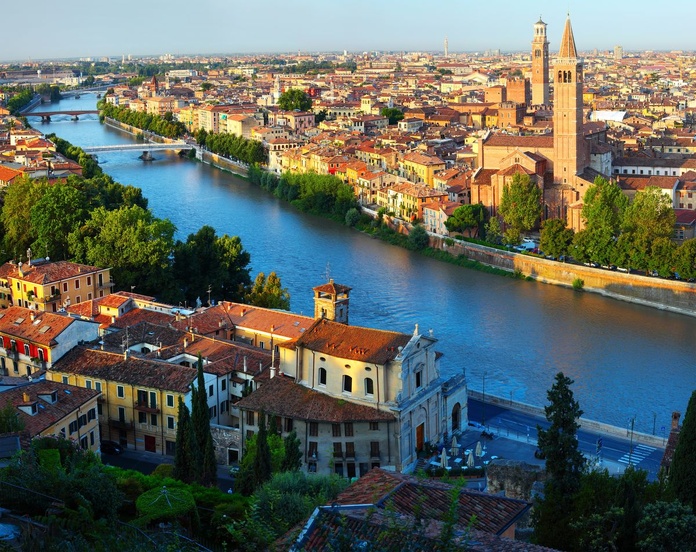
This Verona escape ends on a high note if you ascend—though you can take the funicular!—to Castel San Pietro’s belvedere. Perched on a hill, this former fortress offers an unforgettable view of Verona, especially at sunset. It is also an ideal starting point for strolling along the old ramparts or across the surrounding hills.
It is also pleasant to cross the Adige to explore, on its left bank, the Giusti Palace garden — one of the finest Renaissance-era parks — and the Veronetta student district, peaceful in the summer when the city center is buzzing.
This Verona escape ends on a high note if you ascend—though you can take the funicular!—to Castel San Pietro’s belvedere. Perched on a hill, this former fortress offers an unforgettable view of Verona, especially at sunset. It is also an ideal starting point for strolling along the old ramparts or across the surrounding hills.
 Publié par Paula Boyer Responsable rubrique LuxuryTravelMaG – TourMaG.com
 Voir tous les articles de Paula Boyer


Ajoutez TourMaG à votre flux Google Actualités