Summary
-
Lips on Fire, We Feast
-
Kampot, the Preserved
-
Plants Saved from Khmer Rouge Suppression
-
The Pepper’s Comeback
-
Under the Canopies, We Talk Pepper Varieties and Aging
-
Large Crystals and Floral Flavor
For many Cambodians, a successful stay on the coast must inevitably include a seafood feast in Kep, the dilapidated little port located about twenty kilometers from the city of Kampot. Some even make the trip just for that. But, according to those in the know, the best table isn’t the one you’d expect. Forget the row of pretty restaurants facing the bay! Head to Psah Kdam, the crab market, just nearby. Zero view of the sea, stifling heat under rickety fans, the smells of frying and tide, you dine among the stalls, perched on plastic stools. In the dim light, sheltered from the corrugated sheets, you first must buy yourself the ingredients that will make your menu.
Then you wait with your purchases in front of the two woks behind which Khim Makara, 28, the master of cooking, works. The insiders insist: no one can prepare the blue crab with green pepper better than him, the local specialty.
Lips on Fire, We Feast
“My secret is these clusters of fresh berries I add at the very end, by the handful,” explains him. On the palate, it’s a flare. The resinous and fruity bite of the peppercorn magnifies the saline notes of the crustacean. With sticky fingers and lips on fire, we feast.
In Kampot Province, a southern region that is both maritime and rural, home to 700,000 inhabitants, something endures that is rarely found elsewhere: a scent of eternal Asia, the sweetness of another era, the melancholic poetry of a fantasized Indochina, as if sprung from the pages of Pierre Loti. Geography matters here. On the edge of the Gulf of Thailand, the coast alternates between thin sandy strands, windswept mangroves, and salt marshes crisscrossed with canals. Inland, the flatlands host plantations, protected by the Elephant Mountain range, which ensures a microclimate conducive to growing one of the world’s finest peppers, but also durian, the spiked fruit sacred to Asians, and thnot, the sugar palm, the tree from which in Cambodia one makes juice, sugar, wine…
Kampot, the Preserved
At the heart of this pastoral tableau, Kampot slumbers, languid along the banks of the Tuek Chhou River, the peaceful town with 40,000 inhabitants. “The excavators forgot it and it has kept its human scale,” notes Meng Mia, guide and historian of the town. Built largely during the French colonization (1863-1953), the small town seems just waking from a long nap. For years, up to 2020, it was overshadowed by the frenetic development of Sihanoukville, the region’s main seaside resort, with skyscrapers, bars and casinos. “Today, by contrast, Kampot’s charm leaps out at you”, continues Meng.
Around the old market, houses and shops display ochre-yellow, Indian red, pistachio green façades. Along the quays, the old bank and the town hall have kept their neo-baroque architecture, making them resemble large pastry cakes. By the river, a hippocampus statue spouts water jets since 2024, and a small sandy beach has been laid out, with a few loungers under lanterns, to admire the sunset at the hour when boats go out to fish. Even the old colonial Entanou Bridge (“rainbow” in Khmer), whose arches of steel and concrete span the river, is still there. Miraculously spared from the destruction inflicted by the Khmer Rouge and nicknamed Frankenstein because of its many repairs, the structure is now only open to motorcycles, tuk-tuks, bicycles, and pedestrians. Crossing it reveals stilt fishing villages before reaching Wat Treuy Koh, a Buddhist temple forgotten away from the town.
Plants Saved from Khmer Rouge Suppression
Overall, nothing truly spectacular, just the sense of a flavorful stopover for both palate and mind. For Kampot’s preserved architecture also tells the story of the era when the small round grain became a windfall. “The pepper cultivation in the region was first mentioned by a Chinese explorer in the 13th century, explains Meng Mia. But it was only from the second half of the 19th century that producers knew a golden age, inspired by the French. These latter produced as much as 8,000 tons per year of what they sold under the name “Indochine Pepper.”
The reputation for excellence of this spice, largely destined for export, endured until 1975, when the Khmer Rouge regime ordered the uprooting of all pepper plants, seen as a symbol of colonialism, and replaced them with collective rice paddies. The growers were reduced to forced labor. Seven centuries of agricultural know-how disappeared.
The Pepper’s Comeback
Forever, or so it seemed. But they underestimated the Kampotians’ attachment to the queen of spices. At the beginning of the 2000s, farmers returning from refugee camps in neighboring countries, who had kept plants safe, revived cultivation. First cautiously in their own corner, then with the help of European investors, mainly French, and development-support organizations. A revival that led in 2010 to the attainment of a Protected Geographical Indication (PGI), the first label awarded to a Cambodian product.
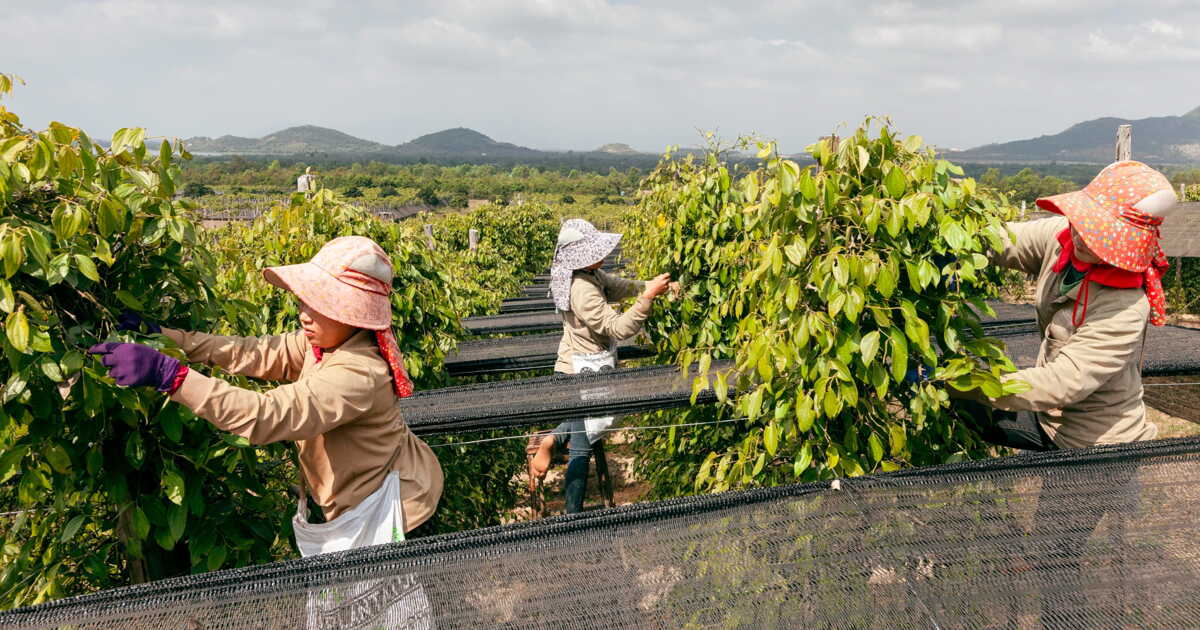
Today, the leafy vines curl around thousands of three-meter-high trellises again. In the countryside, harvesters have resumed the vocation of acrobats, perched on wooden ladders to pick one by one, with gloved fingers, the ripe clusters. And this is only the beginning of a meticulous, hands-on process that includes threshing, washing, drying, scalding, and then sorting grain by grain. The PGI Kampot accounts for less than 140 tons per year, barely 1% of Cambodia’s total pepper production. But here, they pride themselves on growing the most desirable variety, the one extolled by top chefs around the world.
“By starting with a strict set of specifications, which notably requires organic farming, the sector had the good intuition: to offer high quality for discerning gourmets,” sums up Nathalie Chaboche, 62. In 2013, this Frenchwoman and her Belgian husband, Guy Porré, abruptly left their office lives to plant 20 hectares of Piper nigrum on a derelict plot. Their first harvest arrived three years later.
Under the Canopies, We Talk Pepper Varieties and Aging
Verdict? An exceptional terroir, grains that are to peppers what Petrus is to wine. Today, their estate, named The Plantation, employs 150 people, and a portion of the profits funds education programs. It has also become a model of agro-tourism development, welcoming 150,000 visitors per year, including 90,000 Cambodians – “our greatest pride”, say the owners. Walks under the pepper trees and tasting sessions attract as much as the site itself, splendid with its Khmer-style buildings, one of which is suspended several meters above the ground to enjoy the panorama over a sea of vines.
This success sparked ideas in others. In this revived terroir, “pepper itineraries” are multiplying, as some tour operators phrase it, drawing inspiration from wine regions. The Pepper Route thus passes through the best producers, Chamkar Damnak, Sothy Farm, or Bo Tree Farm. Under the canopies, they talk pepper varieties, harvest at maturity, and aging techniques to achieve grains of different colors and flavors.
The Four Colors of Pepper
The same plant yields four berries with very different hues and flavors. Here’s why.
GREEN This is fresh pepper, not very strong but highly aromatic, with notes of resin, grass, and mint. In Cambodia, almost all of it is consumed. Abroad, it is hard to find because it oxidizes quickly.
BLACK The classic for chefs. The berry is harvested later, as it shifts from green to yellow. It is scalded and then dried in the sun. With a sharp bite, it pairs perfectly with red meat.
RED This suave jewel is fruitier than spicy. Harvested at full ripeness, the berries are dried under shaded greenhouses. They pair with white meats, fatty fish, and desserts.
WHITE Delicate and subtle, it is obtained by soaking red berries in warm water for a few days. With citrus and anise notes, it pairs wonderfully with sauces, shellfish, and fresh cheeses.
After that, all that remains is to seek the pepper’s dining companion: salt. Nature, well made, provides the other specialty of the area! Between Kampot and Kep, 4,700 hectares of salt flats form a lattice of blinding white by day, salmon color at dawn and at dusk. The kind of place that recalls the stark descriptions of Marguerite Duras. The writer, born near Saigon in French Indochina, spent part of her adolescence in the Kampot region, where her mother had squandered herself buying a barren concession at Prey Nop. Her novel The Sea Wall, published in 1950, places the area between Ram and Kam (Ream and Kampot). The coastal territory appears with dark features, with salt plains and waters where the ocean rises twice a year to destroy everything.
Large Crystals and Floral Flavor
Today, the sea, better channeled, lays down a precious lace of iodized flavor. About fifty artisans work here to harvest it. “A draining job but one that pays,” explains Meas Sovanny, 65. During the dry season, from April to May, his shoulders bear each day, in wicker baskets, hundreds of kilos of salt harvested with a rake. The region thus provides almost the entire national consumption. The coarse salt is especially used to prepare prahok, a pungent salted and fermented fish paste, the aromatic base of Khmer dishes. As for Kampot’s fleur de sel, which also earned an PGI in 2023, it aspires to follow peppers onto the world’s finest tables. Its large crystals and floral flavor work wonders on seafood. By the Kep market, the star chef Khim Makara ends up admitting it in front of his wok-blackened flames:
“That’s my other secret, this salt that still crunches on the palate after cooking… “
In the paradise of gourmets, the finest ingredients are always at hand.
They helped us produce this report
Specialists on Cambodia, Les Maisons du Voyage invite you to follow in the footsteps of our reporters with a thirteen-day, ten-night circuit, starting from 2835 euros (airfare, accommodations, visits, and a French-speaking guide included). From Kampot to Siem Reap, well away from the beaten paths, this journey traces the glorious hours of the gods-kings of Angkor. Program includes: lesser-known archaeological sites, isolated villages with ancient traditions, and encounters with the Khmer people, who reconnect with their priceless heritage. Committed to responsible tourism, the local partner ensures that each trip benefits Cambodian communities and the preservation of the heritage. maisonsduvoyage.com
➤ Article published in GEO magazine no. 570, “Cambodia”, August 2026.
➤ Do you love GEO? Then to miss nothing, discover our subscription plans to receive GEO at home every month with ease.