This autumn morning, the surface of Loch Creran lies like a tin mirror. In the threatening sky, dark clouds roll in, driven by a westerly wind. Located two and a half hours by road from Edinburgh and just twenty minutes north of Oban, this fjord marks the threshold of one of those coastal mazes the Argyll region guards so well. Here, land and sea know no neat boundary. The Atlantic seeps in, insinuates itself, and threads through the land, cutting the landscape into a multitude of lochs and islets swept by winds and enshrouded in mist.
At the roadside, beneath a small weather-beaten wooden shelter, leaned against a cluster of gorse and topped with the Scottish flag—a white saltire on a blue field—stands a simple cooler full of fresh oysters, bags of crushed shells, and a rusty metal tin. An honesty box (“trust box”), emblematic of the Highland spirit. In what other part of the world would the precious mollusk be left in open access with a temple of coins where to drop your offering, with no one stealing the box? Prices: £1.50 each, £3 for the bag of crushed shells, a calcium-rich fertilizer for the garden.
Behind the small wooden shelter, a metal gantry opens onto the path that leads to the shore. Here, on the edge of Loch Creran, with muddy feet and a black oilskin over a gray hoodie, Judith Vajk works. Her boots creak on the pebbles as she moves between her oyster cages. She turns her gaze toward the island of Eriska, where the loch meets the Lynn of Lorne, a vast channel opening out to the Atlantic Ocean.
On the West Coast, a Quiet Revolution
Covering nearly half of Scotland for barely 5% of its population, the Highlands have long been seen as a stunning yet harsh land. A land of rocks and heather that history and climate kept confined to subsistence farming, especially on the western coast, from Argyll’s jagged shores to the steep landscapes of the Hebrides. Yet it is precisely there that a quiet revolution has begun. Carried by a generation of farmers, breeders, fishers, and cooks, it does not upset the landscape but seeks to live with it, embracing the rhythm of the tides and the seasons.
Oysters grower Judith Vajk embodies this approach. Since 1995, her family operation, Caledonian Oysters Co., has cultivated Pacific oysters north of Oban. A hardy, fast-growing variety. At low tide, the two million bivalves hidden beneath the dark surface of the fjord reveal themselves. Spread over 30 hectares, this farming favors wide spaces: the iron tables on which the oyster bags rest are widely spaced to allow the current to circulate freely. A mischievous smile lights up the oyster farmer’s face as she presents her beds of oysters.
“Each has a story,” she says softly. “And their names reflect my sense of humor!” Named as she pleases, between winks at celebrities, TV shows and literary references, her plots are named Beyoncé, Blac Chyna (an American model), The White Lotus, Ishmael (the narrator of Moby-Dick)… Inspecting the bags heavy with glistening shells, Judith measures the shape of her protégés, tracks the carnivorous starfish and the attacks of pied oystercatchers. With her son Angus, she grows her seed “in the old way,” directly on the shore, alternately submerged and exposed to the rhythm of the tides. “We monitor the bags at every tide and nature does the rest,” Judith explains. “By filtering the Loch Creran water, of absolute purity, they find everything they need on their own.”
The Taste of the Open Sea
Judith snaps her fingers: a sign that it’s tasting time. Seizing a shell the size of a palm, the oyster farmer drives a knife into the hinge, turning the blade like a key in a lock. The dense, fleshy meat appears. The marine terroir explodes on the palate: notes of seaweed, a crisp salinity, and an unexpectedly fresh cucumber finish. “There is no farming more sustainable than shellfish farming,” Judith continues as she opens another oyster. “And nothing beats the pleasure of tasting them with the vast sea before you.”
Tracing the contours of the loch, the lone ribbon of asphalt in the region climbs north. After about thirty minutes of driving, beyond the hamlet of Barcaldine, the road narrows to a single lane. Welcome to the single-track roads, punctuated by passing places where you can pull in to let the oncoming vehicle pass, and where Scottish courtesy requires a friendly wave at every junction! Gradually, the last houses vanish, giving way to a wilder landscape, blanketed with ferns and heather.
A Welcome Committee with a Shaggy Edge
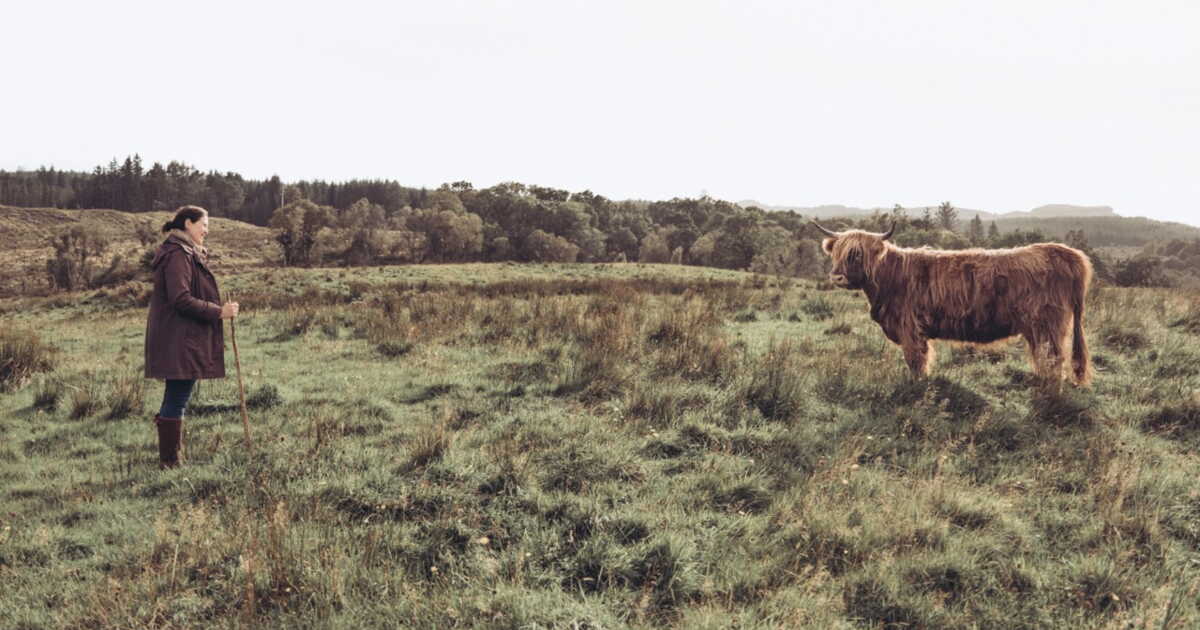
On these rugged lands lies the Achinreir farm. Jane Isaacson, 62, practices regenerative farming: by grazing on brambles and tall grasses, her cows clean the moor without brutalizing it, allowing wildflowers, insects, and birds to return. At the end of a lane lined with dry-stone walls, a rather unusual welcome committee awaits the visitor. Over the fence, around twenty pairs of eyes hidden beneath thick, shaggy bangs watch the intruder. Noble tradition obliges: the mahogany-colored cows bear Gaelic names etched in their genealogical book: Banarach Breagha III, Lady An Uiseag Rhu II… Jane Isaacson, a passionate breeder who calls herself an “old hippie,” unlocks the gate and steps onto the steep terrain, up close to these beasts with the look of prehistoric aurochs. One of them seems to have a favorite. “Lady, she is the ultimate model of the Highland cow,” she explains. “She’s athletic, quick on the hillside, protective without being aggressive. A magnificent head, an unbelievable gentleness. She is the pride of my herd.”
Around Jane, the cows’ mothers keep a careful eye on their calves. The heifers, meanwhile, display insatiable curiosity: one approaches, imposing with its massive horns, while another watches the scene with a blasé air, its gaze masked by a crimson mane.
Back in the Field: Yann Rabanier, Photographer
A first for our photographer. Before this feature, Yann Rabanier had never dragged his lens to Scotland. Two things struck him in the first days of his immersion at the edge of the Highlands. First, the warmth of the welcome, contrasting with the climate’s harshness. “People take time to chat, as if to savor the traveler, with spontaneous kindness and nothing transactional,” he recalls. Then, a weather madness: “in less than an hour I went from a t‑shirt to a rain jacket, then to a thick wool sweater.” Yet he retains most of all the spectacle offered by nature: “Never in my life had I seen so many rainbows.”
The Cream of the Cattle
Jane happily recounts the story of her family, rooted in Argyll for generations. In the 19th century, most large landowners abandoned cattle farming for sheep, more lucrative. The pastoral landscape of the Highlands was deeply disrupted: the system of shielings—summer pastures where communities settled in stone huts to graze cattle and churn butter—was gradually abandoned. “I refuse to let the Highland cow be reduced to a tourist souvenir, between plush toys and fridge magnets,” protests Jane Isaacson. She is the soul of our mountains. Scotland counted up to 6,700 shielings, and that summer cattle farming structured all social life in our villages. Today, I am reviving this memory.”
For her part, the livestock is not raised for meat. Her milk is used exclusively to make her own ice creams, marketed under the Highland Fold brand, the only ones in the world, she claims, made from Highland cows’ milk. Her secret: an absolute respect for animal welfare. At Achinreir Farm, calves are not separated from their mothers: the calves grow up with them on the pasture, and the breeder only takes one or two liters of milk from each cow each morning. With 8% fat (versus 3.5% in ordinary cow’s milk), this precious nectar gives her ice creams an incomparable velvety texture, with no additives. The result is enjoyed on-site, in the tearoom housed in a restored ancient shieling. Jane herself serves her creations with wild flavors, scented with plants gathered on her estate: meadowsweet, lemon balm, blackberries and young fir shoots.
The Ocean on the Plate
Leaving the Achinreir moor, the road descends toward the coast and winds into the Appin Peninsula, reaching the village of Port Appin. Here, the asphalt stops right in front of Loch Linnhe and the long green silhouette of the island of Lismore. At the end of the pier, a white building keeps watch over the waves: The Pierhouse. It is in this inn that the region’s gourmand heart beats. In the kitchen, Michael Leathley. On the wooden jetty, battered by the spray, this passionate chef, crowned Scotland’s Chef of the Year 2025, lifts his lobster and crab crates, submerged at the foot of the establishment. A journey of barely three meters from sea to kitchen.
For the oysters, he sources them from Judith Vajk. “Today, in the Highlands, a chef can no longer confine himself to four walls,” Michael explains as he returns to the kitchen to plate his monumental seafood platter. “When I serve a plate of mussels or Loch Creran oysters, I am not just selling a product: I am the ambassador of an entire community, sometimes a century of family toil.” On the dessert menu, he highlights the ice creams from the Achinreir farm…
On the Isle of Skye, Land as Inheritance
After three and a half hours of winding road between sea lochs and glens, including crossing the Skye Bridge, the shimmering waters of Loch Bracadale come into view. On a clear day, the sharp ridges of the Black Cuillin (992 meters) loom about fifteen kilometers away as the crow flies—the wildest massif in the country. On this stretch of Inner Hebridean land, Gaelic language and crofting—the practice of leasing small arable plots—leave their mark. Skye still hosts around 2,000 crofts in operation. Farms have often been converted into charming holiday cottages for visitors, but some crofters preserve their agricultural vocation and aim to safeguard the environment while ensuring product traceability. Even better, they now open their doors to curious travelers.
Based at Vatten, facing the loch and the MacLeod’s Tables, two flat-topped hills overseeing Skye’s west, the Maclean family’s farm embodies this new approach. Assisted by six sheepdogs, Ali (short for Alistair) and his New Zealand-born wife Glenys raise their stock on the croft handed down to Ali’s family for a century and a half. They do not seek expansion, content with 50 hardy ewes, barnyard poultry, and ten Shetland cows, a rugged slow-growing breed. “We produce on a small scale, first and foremost for the island’s inhabitants,” says Glenys. “In summer, the livestock graze on the hills, and in winter we feed them with by-products from the nearby Talisker whisky distillery.”
The Itinerant Farmyard
In a trailer converted into a slaughtering workshop, Ali, wearing a leather butcher’s apron, portions a leg of beef aged three weeks. The air smells of iron, the unmistakable scent of raw meat. With no approved abattoirs, Skye’s breeders were long forced to sell their stock live to the mainland: 97% of the meat left the region without ever being tasted locally. Since 2012, being the first to develop an on-farm processing chain, the Macleans have changed the course of history. Now, the couple’s output supplies local residents and the island’s finest restaurants.
Recognizable by his black face mask and spectacular horns, this Blackface male is crucial: the strength of Skye’s herd rests on such sires.
Continuing along the road to the cliffs battered by the Atlantic on Skye’s western tip, one comes upon Peter Gilbert’s itinerant poultry yard. A former sailor tired of industrial fishing has dropped anchor on the moor to found The Skye Egg Co. His organic eggs, with their golden yolks, have become the best-kept secret of the island’s cottages’ breakfasts and its chefs. Peter moves his caravan-egg-pod from pasture to pasture as the grass grows. Today, his hens roam freely in front of the ocean. Tomorrow, they may be scratching at the foot of a hill. In these Highlands, these highlands so aptly named, Scottish living is increasingly nourished by the riches of the land.
➤ Article published in GEO magazine no. 573, “Scotland, Generous and Proud,” November 2026.
➤ If you love GEO, then to never miss an issue, discover our subscription options to receive GEO every month at home with ease.