Summary
-
Ancient cultures and a “living” nature
-
Forest peoples who have preserved their singularity
-
The preservation of two important Cambodian ecosystems
-
A forest still inhabited and vibrant
-
Poaching, trafficking, rubber, jewels… threaten cultures and wildlife
-
Watching the nocturnal dance of phosphorescent butterflies
It is a volcanic lake 700,000 years old, 800 meters in diameter and perfectly circular. The sky reflects in it like a mirror. Although located only ten minutes by road from the small town of Banlung, capital of Ratanakiri, the water body is circled by a thick crown of jungle. Around 5 p.m., as the light begins to fade, the young Tampuans living in nearby hamlets come to bathe. This evening, purple clouds dance on the water’s surface before vanishing in splashes: the children literally leap into a fiery sunset!
Seated on the shore with a few elders, Ven Churk, in his sixties, one of the community’s wise men, watches all this with a careful eye. “Here, everyone knows it’s a sacred place”, he whispers. It’s no accident that the lake is called Yeak Laom, “the circle of giants” in Khmer. A fairy tale among others holds that it was dug by an army of giants on the orders of the king of ogres. But another tale says the basin was born from a shooting star that fell from the sky. Or that its depths harbor a kind of Asian Loch Ness monster, a white crocodile of extraordinary size wounded in the eye by a hunter’s arrow… Which story to favor? “They all have a place in our beliefs”, Ven Churk simply replies in his soft voice.
Timeless Cultures and a “Living” Nature
Timeless cultures and a “living” nature: Ratanakiri, for Cambodians themselves, is the ultimate frontier, a guaranteed change of scenery. A corner of the world that is part of the current Khmer kingdom, yet obeys a very different geography, and even more so different mindsets and ways of life.
From Phnom Penh, the capital, one must first endure about eight solid hours on a bumpy road to reach this province in the far northeast, bordered by Laos and Vietnam. Once there, meeting the Tampuans by the lake shore is only a small part of the singular experiences that lovers of off-the-beaten-path trails can have here.
Spread over 11,000 km2 (the equivalent of Île-de-France), populated by only 210,000 inhabitants (1% of Cambodia’s population), this highland plateau region forms the realm of laterite, red earth that sticks to shoes, repaints everything at the slightest gust and provides a perfect color base to make the greens of the forests pop. Here, there are no ancient temples, very few modern pagodas with their procession of saffron-robed monks. The treasures of Ratanakiri lie elsewhere. And they are accessible only by navigating muddy rivers and venturing on roads that exist only in name, as vegetation inevitably turns them into tangled, thriving cul-de-sacs.
Forest Peoples Who Have Preserved Their Distinctiveness
This situation has allowed various forest peoples to preserve their distinctiveness. The Tampuan (the most numerous, with 36,000 people), but also the Jaraï, the Kreungs, the Kavets, the Braus, the Katchoks, the Luns and the Phnongs: eight ethnic minorities, whom Cambodian authorities often group under the label Khmers Loeu (“High Khmers”), a clever way to mask regional particularism: in Ratanakiri, unlike other provinces where the population is 95% Khmer and mostly Buddhist, more than half of the inhabitants belong to these animist communities. Scattered across about one hundred villages, they have kept their languages and much of their traditions, despite the forced assimilation policy pursued during the Khmer Rouge era, starting in the late 1960s.
Today, the main struggle of these peoples is mainly to preserve the forest plots on which they have settled, sometimes for more than a thousand years. That is the case for the Tampuan. In the 2000s they mobilized to thwart various tourist complex projects along the shores of their sacred lake. They ultimately obtained the right to protect and manage the site themselves, but “threats return, alas, regularly”, laments Ven Churk, who leads the Yeak Laom defense committee.
A little further north, in the Andoung Meas district, the track leads to the Jaraï territory, a tribe that arrived from Borneo two millennia ago (they are today 20,000 living here, and 300,000 on the Vietnamese side). For them too, nature is closely linked to what ethnologists call “the rite of abandoning the tomb”. “Without the forest, our funeral practices would simply no longer be possible, and it would be the death of our culture”, explains Kalan Fin, 30, with onyx hair and a solemn gaze. This mother, who has just lost her father, is about to demonstrate the very particular tomb where she vigilantly watches over for several hours each day, in silence. Away from dwellings, at the edge of the woods, the deceased was buried in a fenced enclosure with dozens of objects that filled his daily life: his transistor radio, his machete, the last opened cigarette pack… Relics guarded by stern wooden statues placed at the four corners of the burial. In a few months, when they deem the time right, Kalan Fin and her family will stop coming to pay their respects here and will gradually let nature swallow it all: a return to the forest!
The Preservation of Two Important Cambodian Ecosystems
The minorities are the unwavering guardians of Ratanakiri’s wild beauty. They are largely responsible for the preservation of two of Cambodia’s most important ecosystems.
- In the northeast, straddling Laos and Vietnam, the Virachey National Park forms one of the largest protected areas in Southeast Asia (3,300 square kilometers), home to the clouded leopard (Neofelis nebulosa), the gaur (Bos gaurus, a wild buffalo), and the Malayan sun bear (Helarctos malayanus).
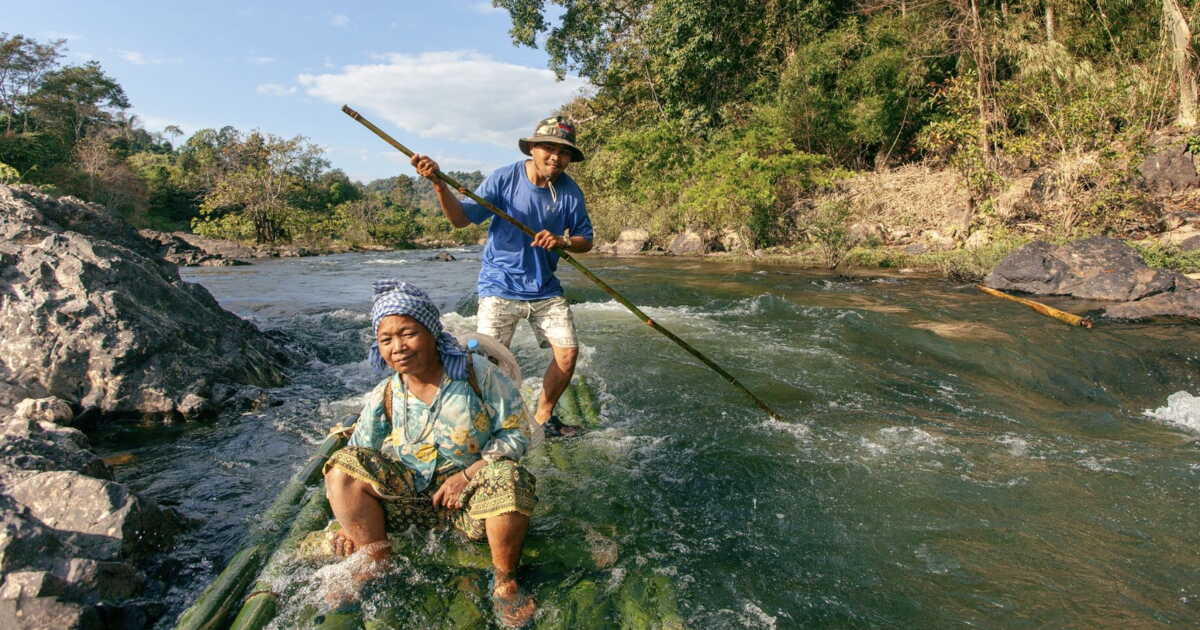
- In the northwest, Veun Sai-Siem Pang National Park unfolds across nearly 600 square kilometers a staggering mosaic of forests threaded with countless waterways navigable by bamboo rafts. For an extraordinary two-, three-, or four-day trek, this is the place to go. With the chance to perhaps spot the furtive muntjac (Muntiacus, a small barking deer), the hornbill (Buceros bicornis, a helmeted toucan), and the yellow-cheeked gibbon of the North (Nomascus annamensis), a species formally identified only in 2010 by German primatologists.
So, depart from Banlung by Jeep at dawn. Destination: Veun Sai, a river village perched on the Tonlé San, whose green waters glide slowly toward the Mekong. From there, a boat ride to cross to the opposite bank – essentially another world. The crossing lasts less than five minutes but is followed by about an hour of driving aboard a koyun, a “mechanical cow,” as they say here, before reaching the heart of the forest. The average speed of this strange agricultural all-terrain vehicle is ten kilometers per hour. At the front, a sort of rattling cultivator with a long curved handle and cogged wheels to pass mud and shallows. At the rear, an old-fashioned hitch, planks forming a platform where passengers and provisions are stacked. At the edge of the woods, a forest guard appears from nowhere, keeping a register of hikers — barely half a dozen entries per day.
A Forest Still Inhabited and Very Much Alive
From there, the journey continues on foot, across the Kreung country, bold jungle wanderers. One of them has taken the lead of the expedition: Sakal Ngaem, 30, shaved temples and high cheekbones, clearing vines with a machete, spotting insects and rare birds, pausing at a medicinal plant…
The Ratanakiri is exceptional in that its forest is still inhabited and very much alive. Proof of this are the “love huts,” also called bachelor houses, that can still be seen here and there in the heart of Kreung villages. These stilted huts above ten meters offer teenage daughters a place to “try” their suitors before marriage, under the watchful eyes of their parents…
Further on, in a clearing, a camp where only a dozen people live. It’s a day of celebration: a baby was born the day before. The men prepare to roast a wild pig. The young mother sleeps in a “birth house“, a small shed where, as tradition dictates, she will stay alone with her newborn for several weeks…
Poaching, Trafficking, Latex, Jewels… Endanger Cultures and Wildlife
How long will all this continue to exist? Poaching and illegal trafficking of precious woods are already wreaking havoc in some areas. To this is added the uncontrolled spread of rubber plantations. Stretching into the distance, neat rows of tapped trunks ooze a sticky latex with a pungent odor, and these rubber tree fields gradually replace the region’s broad-leaved forests.
To the north of Banlung, another activity also causes damage. The area has long been known for its blue zircons, plain stones that, when heated to very high temperatures, take on the brilliance of diamonds and the hues of distant seas. Rubies and sapphires are also found. The name of Ratanakiri, meaning “mountain of jewels”, comes from there. For at least a century and a half, Jaraï miners have prospected here. But in recent years, everything has accelerated: bands of Khmers from the plains, poor farmers from central Cambodia, have joined in. The scene is somewhere between a tropical Germinal and a great gold rush…
Also emblematic of the retreat of the forests is the elephants. “They find less and less space to feed”, explains Pierre-Yves Clais, 57. A Francophile who arrived in Cambodia in the 1990s, when the country was emerging from the Khmer Rouge nightmare, he never left and settled in the region most remote with his Cambodian wife and their three children. Ten years ago he founded the Airavata Foundation – named after the mythical white celestial elephant with three heads, the mount of the Hindu god Indra. Its aim: to save about a hundred hectares of pristine nature a few kilometers from Banlung, to enable a family of elephants to live and feed there. The area now serves as a retreat and pantry for Bokva, Kamsen and Ikeo – weighing 5, 3.8 and 3.6 tons respectively – and for Noëlle, a 4-year-old calf weighing one ton, “These animals are the heirs of a long history that blends with the very identity of Cambodia,” emphasizes Pierre-Yves. In fact, at the height of the Khmer Empire, in the 12th century, King Suryavarman II possessed more than 100,000 elephants, used both for military campaigns and for the construction of Angkor Wat.
Today, there are barely 400 left in the wild, and fewer than 100 born in captivity or long domesticated. The latter are often the shared property of several families from the highlands, who use them in turn for forest work. Sadly, it is becoming increasingly difficult for them to find areas around villages that are wild and vast enough to feed these herbivores who spend up to eighteen hours a day chewing foliage – up to 150 kilograms for an adult.
Observing the Nocturnal Dance of Phosphorescent Butterflies
After several hours of trekking through Veun Sai-Siem Pang National Park, these threats seem almost to belong to another world. Far from civilization, the campsite where one arrives tonight has something of an everlasting Eden. The bags are placed near a crystal waterfall to bathe in ice-cold water. On the riverbank, porters prepare dinner. They cut meat, vegetables and fresh herbs with machetes to prepare the prom, a stew cooked in a wide bamboo tube set over embers.
Night falls; the guide Sakal Ngaem lights headlamps to observe the nocturnal dance of insects: giant ants, spiders with formidable bites, fireflies and phosphorescent butterflies parade under the beam. When it is time to sleep in a hammock suspended about one meter above the ground, you double-check that the mosquito net is properly closed. Lying there, eyes turned to the starry sky, sleep is hard to come by. Under the almost-full moon, the tree crowns create silhouettes like Chinese shadows. One recalls the popular saying heard earlier at Banlung Market: “In Ratanakiri, the red earth clings to your feet by day, and enters your dreams at night.”
Field return
Sébastien Desurmont, journalist: “I left my pair of shoes there, the GEO photographer did too!”
“Ratanakiri is pure adventure!, testifies our journalist Sébastien Desurmont. Proof: I left my shoes there, and the photographer did too! Between the red dirt tracks, bamboo rafts that take on water and the jungle’s tall grasses, they couldn’t withstand the journey.”
Our reporters were lucky to be joined on their expedition by a colorful character, Pierre-Yves Clais: “This Frenchman touched me with his love for this province, and his attachment to the local minorities, says Sébastien. And by the bond he has woven with the elephants. It’s the first time I’ve seen humans cuddle them and then bathe with them!”
➤ Article published in GEO magazine no. 570, “Cambodia”, August 2026.
➤ Do you love GEO? Then to miss nothing, discover our subscription options to receive GEO monthly at home with ease.