Summary
-
First strokes
-
Since our departure, we zigzag awkwardly
-
“The purest of ways”
-
Like pirates, we slip through a tucked canal
-
The fishermen’s refuge
-
The secret lagoon
-
The Venice of painters
-
Venice by night
Broad-shouldered and bearing the accolades of a Venice-style rower, Elena Almansi, 34, gives her directions in a calm voice. “Your oar must pierce the water like the edge of a knife. Then you pivot it by moving your body forward. Simple, right?” Yes… if you are a true Venetian, cradled from childhood by the lagoon’s sway. For others, like me, the Venetian boat, at first, is a slog. Making this traditional craft of the Doge’s City move in a straight line, even for a few meters, is no small feat.
First Strokes
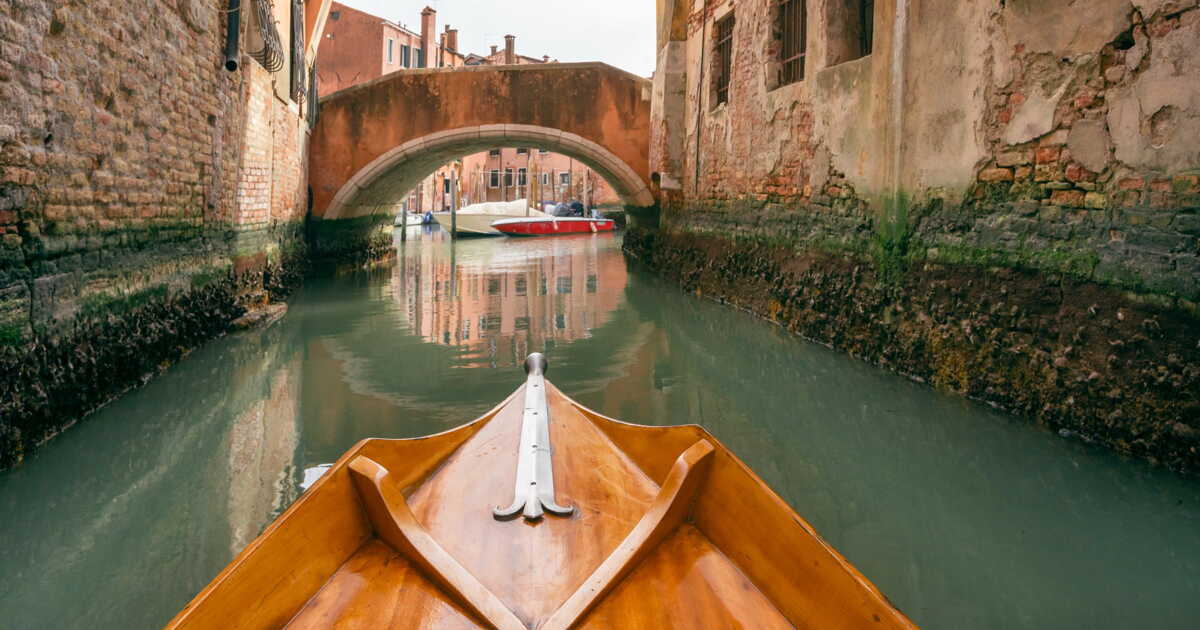
Hefty as an anchor, my oar measures three meters in length. I must sway it within the hollow of the forcola, a wooden socket with a labyrinthine shape, to propel my craft while steering it. And this while standing, eyes toward the bow, with a head held high, resistant to the splashes. To avoid peeling off into the water, one must add a deft undulation of the hips, legs slightly apart, the way a surfer balances on his board. A balancing pose that has allowed Venetians to roam the lagoon for ages, watching far ahead, above the fog and the reeds. Today, that stance also helps anticipate a crossing with a speeding water-taxi in a narrow canal—sweaty business for sure!
Thus begins my introduction to paddling in lagoonal waters, aboard an authentic local transport boat, distinct from the slender black gondolas that tourists now ride—though the steering technique remains the same. My boat is sturdy, carved from a pale blond wood, measures 7.5 meters, and can carry two to three passengers. Experts call it batela a coa di gambero, “shrimp-tail boat.” My trainer Elena and her partner Jane Caporal, a British woman who has lived here “almost always,” have run these initiations for several years for Row Venice, their 100% women’s rowing club. The proceeds fund the training of young rowers, and the best among them go on to compete in the year’s bustling regattas alongside Elena. For me, this water-level foray is mainly a way to rediscover the City of the Doges away from the crowds, and from a fresh angle, after twenty years of visiting it!
Since our departure, we zigzag awkwardly
For now, I am far from being able to navigate alone. Since we cast off our moorings near Ponte della Sacca in Cannaregio, we have been zigzagging awkwardly. “Our sessions take place in this corner because traffic remains manageable; it’s perfect for learning,” notes Jane, while Elena corrects my hesitant movements. Nevertheless, one must keep an eye out. Le Corbusier imagined Venice as an ideal city, with water routes on one side for the transport of people and goods, and pedestrian streets and quays on the other. The problem: the Venetian stroller I am begins to realize that shifting onto the water routes means… no longer being a stroller. You meet all kinds of craft there, not for a stroll—ambulance boats, others that collect garbage or make deliveries.
“The purest of ways”
There is even a code for the canal, a blend of ancient rules and exceptions. “Officially, we navigate on the left, but there are many moments when that’s simply impossible,” explains Jane Caporal. Furthermore, in theory, non-motorized boats have priority. In practice, it’s case by case. To handle such situations, there are words from the Venetian dialect you must know. I strive to remember them. Thus, a Venetian boatman will shout “a premando” before turning to port. If he plans to turn to starboard, he will say “a stagando”. If he goes straight ahead, “a delongo”. Even more useful is the call, “ohe”. It signals your presence to those who cannot see you: at a blind intersection, when emerging from under one of the city’s 350 bridges, or before entering a riello, a channel so narrow that only one boat can pass at a time.
After two hours of training, I return safely to our starting dock. My two instructors assure me that I have progressed. Not enough to venture alone onto the Grand Canal, the city’s main artery, a four-kilometer stretch churned by a constant ballet of boats. But I am no longer just a generic tourist. “You have begun to move through the city in the purest of ways, the way that should assert itself more strongly, given how motorized boats shake the foundations of our city” remarks Jane. An old adage says it: “As long as Venice rows, Venice will live.” Hence the locals maintain a deep respect for those who wield a paddle in their hands.
Like pirates, we slip through a tucked canal
It is another benefit of this way of exploring the city: you shed, in the eyes of its remaining 50,000 inhabitants, a bit of being a lost foreigner in the water-based Disneyland that hosts 28 million visitors a year. You blend, so to speak, into the lagoon’s ecosystem. This is even truer when you venture away from the historic center. Exhausted, I head toward Burano, the old fishing village with pastel houses, located on an island about an hour by vaporetto from St. Mark’s Square. I have an appointment at the mythical remiera (rowing club) Vogaepara. The walls bear yellowed photos of famous rowers, pennants, trophies. In the hangar, racing gondolas painted red like Ferraris. Filippo Quintavalle, 56, a club member, organizes kayak outings in the surrounding lagoon.
“For me, it’s first and foremost a way to promote more sustainable tourism”,
he insists. Because in high season Burano and its 2,000 residents are overwhelmed, with records of up to 10,000 visitors per day. Landing on this enchanting island, one quickly wonders if a little solitude can still be found, and how locals cope with all of it.
The fishermen’s refuge
The answers come after a few minutes of paddling. Filippo in his kayak, me in another, we glide like pirates through a tucked canal. Approaching Mazzorbo, the neighboring little island, another world reveals itself. Yes, the lagoon’s peace, made of lapping water and birds’ chirps, still exists! To discover it, you simply take a little distance and choose the most furtive mode of transport there is. While I paddle, Filippo tells me about his archipelago: “On the left, on the quay, the church Santi Pietro e Caterina, with its mighty bell that wakes the inhabitants every day. On the right, the soccer field where I used to play as a child. It has become a vineyard, producing a wine with almost saline notes.” A little further, we enter a maze of lilliputian islets linked by canals. “The refuge of the last fishermen”, announces my guide. There are still about ten of them there, guiding nets and traps, while maintaining their wooden huts surrounded by small gardens. We land at Domenico Rossi’s place, 55, blue eyes, with a look that could pass for that of an actor. He had gone out at dawn to haul his nets. “Everything is done by hand, standing in the boat”, he says. Alas, the fish are scarce. The same goes for the moeche, those soft-shelled lagoon crabs that used to delight gourmets and provide a good income. Today, hardly any are caught. The blame falls on the blue crab, a predator that arrived in the cruises’ holds… Nevertheless Domenico continues to work each morning with his father Bruno, 83.
The secret lagoon
Farther on, here is Santa Cristina, a private island, secluded and crowned with a beautiful Venetian house. A new landing, and a meeting with painter Allison Zurfluh. “Every day, I come here to set up my easel, at the heart of wild beauty”, explains this bright woman in her forties who decided about fifteen years ago that she would never leave the lagoon. Some here call her the “Burano’s passionate one”, because she also works with the fishermen’s association Barena, named after the shallow shoals that surface all around.
“If we don’t protect them, the lagoon will disappear beneath the sea”,
she insists. These chalky banks, festooned with halophilic plants and teeming with mollusks, act as Venice’s guardians. Preserving them helps slow the erosion caused by rising waters. Yet 70% of these semi-submerged spaces have already vanished. The main culprit: the constant passage of fast boats, which create waves with devastating effects.
“In a kayak, at least you don’t harm anything”, she concludes. Back on the water, he guides me toward zones inaccessible to the naked eye, called ghebi, micro-canals barely sketched out and lost among the reed beds. Behind us, the last piling marking a channel recedes. We progress into Venice’s no-man’s-land. “We are heading toward the Canal of Paradise”, whispers my guide. The expression comes from writer Ernest Hemingway, who loved to get lost here, alone with his boat, preferably in winter. The scents of humus, iodine, and marshland, dragonflies flitting about, ducklings chirping among the gorse… finally, the Torcello island emerges, “The first Venice, as Filippo recalls. In the seventh century, that is where the Veneti people arrived, fleeing barbarian advances.” The lagoon of origins would have looked like this flat watery plain.
The Venice of painters
After parting ways with Filippo and Burano, I take the vaporetto again to immerse myself in another Venetian era: that of vedute, those ultra-detailed views of the city painted in the eighteenth century, notably by the famous Canaletto. “Apart from the engine noises, the scenery hasn’t changed much”, notes Nicolò Caoduro, 35. A bearded man with the frame of a brawler, he could step out of one of those paintings. He wears the blue-and-white cassock of the Real Società Canottieri Querini, a historic rowing club in the Castello district. His hangar opens onto the wide. From the jetty, the view is stunning of the San Michele cemetery island. I try a joke: “Let’s hope we don’t end up there…” My new guide half-laughs. Because the sailing conditions are poor: a northerly wind has risen, and waves roughen the pass to the Arsenal. And that’s where we’re headed… by kayak. Once, the Serenissima built its mighty fleet there. Now the old shipyard is occupied by the Italian Navy. Access is forbidden, except for members of the RS C. Querini, who hold a pass, officially for training purposes.
Venice by night
Entering the Arsenal by sea is a risky undertaking, requiring you to thread your way through the never-ending traffic of vaporettos. Yet the reward is commensurate: inside, behind the tall red-brick walls, you glide on an emerald basin beside which sits an authentic submarine of the Italian Navy! And the best is yet to come. For my last evening, I have a very special plan: a night stroll with a collective of young kayakers, through Venice’s canal labyrinth by the light of a headlamp. The operation is like a Mission Impossible episode. The address is sent by text at the last minute, for a rendezvous at precisely 8 p.m. Down a dark alley, a cul-de-sac opens onto the water of a canal. In the shadows, you locate a hidden door, then a lion-headed doorbell…
The gate opens onto the courtyard of a palazzo, whose real entrance is via the canal, reached by a stone jetty. That is where we launch. The dashing Mattia Biserni, a film student, leads the expedition. Our kayaks skim a thick, inky liquid, reflected by uncertain glints into an impressionist canvas. The smells are strong, a mix of seaweed and sewer. Under the bridges, the paddle rings like a drum. A suspended, magical moment. In the quiet, we peer into the intimate lives of palaces with their immense chandeliers, behind the scenes of restaurants, the feet of Venetians sipping an ombra (a glass of wine) on a dock. Despite the cold, the nocturnal stroll passes in a flash, more spellbinding than ever in a Venice that seems to glow at night. It’s already 11 p.m., but I feel I could paddle until dawn.
5 Ways to Discover Venice by Rowing
1. Learn the art of voga alla veneta
On the Cannaregio canals, the Row Venice association offers courses in Venetian oarcraft in a real “shrimp-tail” boat. They also run aperitivo strolls and evening excursions on the Grand Canal. From €100 for 2 people. rowvenice.org
2. Slip through the forbidden Arsenal
The French-speaking guide Nicolò Caoduro, a member of the RS C. Querini, the venerable rowing club of Castello, offers kayak outings, including one through the nearby Arsenal. From €49 per person. caorio.com
3. Glide through the Venetian night.
The 2.5-hour nocturnal circuit starts from an old palace, then winds through Cannaregio’s canals. An unforgettable experience. From €140 per person. venicekayak.com
4. Paddle with the last fishermen
From Burano, Filippo Quintavalle guides you through the secret lagoon: Mazzorbo, Torcello, the fisher’s islets, Hemingway’s “Paradise Canal”… From €150 per person. WhatsApp : 0039 327756 2206
5. Explore the northern lagoon by paddle
Laguna Kayak offers various excursions from Punta Sabbioni, to the east of Venice. The longest (5–6 hours) sails the northern lagoon via Sant’Erasmo, the San Francesco del Deserto monastery island, Burano, Torcello… €50–€150 per person. lagunakayak.com
➤ Article published in GEO HS No. 134, “Great Escapes at Low Speeds,” August-September 2026.
➤ If you love GEO, then to miss nothing, discover our subscription options to receive GEO online every month.