Funny place for a meal on the go! It’s around 6 p.m. on this Wednesday in May when a white van careens up to the wooded shores of Furnas, on the eastern part of São Miguel, the largest and most populated island in the Azores. The side door swings open in front of a cluster of large earth mounds that puff white smoke. The air carries strong whiffs of sulfur. A municipal worker coming from a nearby shack strolls casually toward one of these curious mounds, and pulls off the sign stuck there, bearing the name of a restaurant, A Terra, located in the village of Furnas, three kilometers away. The man digs through the earth until he reveals a wooden board, which itself hides a hole in the ground. With the help of two metal hooks, he extracts a large cauldron wrapped in white cloth. Inside, a mixture of pork, beef, and chicken, with potatoes, yam, carrots and cabbage, has simmered for six hours, steamed and tender: this is the cozido das Furnas, a hearty stew with a smoky flavor that this corner of the island has made its specialty. “There, there’s about 10 to 15 kilos!” notes Alessandro Costa, a staffer at the restaurant, before getting under way immediately, for dinnertime is approaching…
Furnas, at the Heart of a Living Volcano
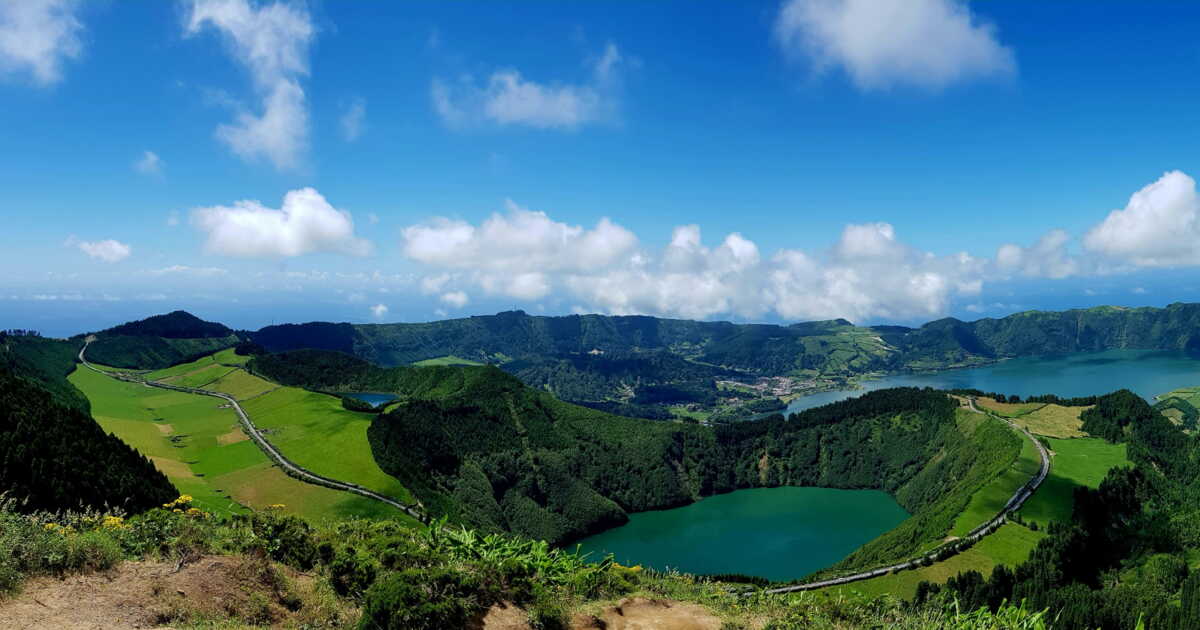
Where do these peculiar natural ovens where you can cook your meals come from? To understand, you must climb along a winding road to the Pic de Fer overlook. From up there, the view embraces the entire Furnas caldera, a vast basin with steep sides born from a sequence of eruptions and collapses over the last 800,000 years. In the relief, beneath dense vegetation, the practiced eye reads the traces of that turbulent past: scoria cones, lava domes… And in the foreground, the old crater turned lake, bordered by a field of fumaroles, where plumes of gas and water vapor rise. It’s there that these cozido holes were laid out. For the volcano still throbs: its magma, bubbling kilometers below, fuels these ardent surface phenomena. In the village of Furnas, where low houses with red-tiled roofs nestle within the caldera, residents have lived for centuries with this buried monster. The monster, as it waits to wake one day, provides them with valuable resources.
To begin with, that heat enables hearty dishes to simmer. The cozido das Furnas has become a must. The A Terra restaurant even offers a workshop to pile the ingredients into the pot yourself, before burying it. But for a long time, islanders have been cooking with geothermal energy. “In my family, we’ve been making cozido since at least my grandparents’ time,” explains Paulo Costa, 39, chef at Caldeiras e Vulcões, a restaurant in the village center. “They used to prepare it in the old way, without a pot, wrapping the ingredients in fabric. It makes it a bit drier, because the juices escape, but some people prefer it that way.”
Cakes and Rice Pudding Cooked on a Field of Fumaroles
Today too, for special occasions, families in the area cook dishes in the forty-some “hot holes” dug along the lake’s edge, which everyone can access according to availability. “For instance, when relatives come back for the holidays [one million Azoreans live outside the archipelago, versus 240,000 on-island], or during our annual July festival, the whole village gathers there to cook,” continues Paulo Costa. On his menu, the master chef also offers a feijoada (pork and red bean stew), a bacalhauada (shredded cod) and a vegetarian cozido cooked with geothermal heat. Some locals also like to prepare volcanic desserts, arroz doce (rice pudding) or cakes…
But Furnas’s real draw is water—and more precisely, its waters. Downhill from Paulo Costa’s restaurant, at the eastern edge of the village, another field of fumaroles, even more striking than the first, splits the earth into a chaos of mud, bursts of steam, and boiling pools. Surrounding it, there are no cooking holes, but about fifteen small fountains arranged in low walls and along slopes, from which emerge sources with different properties: hot or cold, fizzy (carbonated) or not, rich in iron, sodium, or sulfate… Their name and sometimes their temperature are inscribed on pretty little ceramic tiles. The origin of these miraculous waters? The volcano, of course. The abundant rains on the Azores seep into the caldera’s subsoil, absorb heat to varying degrees, and pick up gases from deep within the earth before surfacing.
In the Botanical Garden, an Orange-Tinted Basin at 36 °C, Perfect for Lounging
“These waters spurred Furnas’s settlement after the volcano’s last eruption, in 1630,” explains Cidália Costa, 55, from the tourism office. “In the old days, residents used them for almost everything, including healing. When I was a baby, I had a very bad cough. My mother made me a remedy based on Agua Santa, believed to have medicinal properties. Apparently, it worked!” Among the roughly forty springs that make up Furnas’s “hydropolis,” some also feed thermal baths, created as far back as the late 18th century. Today, people still splash in ferruginous, dark waters in a luxury hotel near the fumaroles. At the far end of the village, Furnas’s Terra Nostra park botanical garden—often cited as one of the world’s most beautiful—boasts a lush mosaic of 1,800 plant species, including magnificent camellia, cycad and bromeliad collections… But it is also renowned for its circular basin built in the 1930s, where bathers soak in orange water that swells between 36 and 40 °C—a boon for the skin, they say.
Yet Furnas is only the epicenter of São Miguel’s “volcanic culture.” The island, 60 kilometers long and dominated by three active stratovolcanoes, draws on the gifts of its giants. At its heart rises Fogo (“fire” in Portuguese), the grandest of them all, famous for its crater lake spread at an altitude of 600 meters, in the heart of wild nature. On descending the road that winds along its northern flank, one first comes to Caldeira Velha, a sequence of hot-water basins crowned by a photogenic waterfall and tucked into an impressive forest of tree ferns.
The Power of the Volcanoes, a Risk Inherited
A few kilometers farther down, the scenery shifts completely: amid the meadows stands a curious ensemble of silver pipes. The Pico Vermelho power plant is one of São Miguel’s two geothermal power stations. Built in the 1990s and 2000s, these plants generate electricity from subterranean heat drawn up to the surface as water and steam via boreholes. The island is especially amenable to this renewable energy, explains Graça Rangel of the public company Eda Renováveis: “Here, the geothermal gradient [the temperature rise with depth] is very high. At 400 meters depth, we’re already at 200 degrees Celsius! These are values you’d expect to find only in countries with intense volcanic and tectonic activity, like Iceland or Japan.” A third plant is under construction right next door. “We will then be able to cover 60% of the needs of the 130,000 inhabitants with geothermal energy,” predicts the geologist. This is what the volcanoes offer—almost endless…
Even a few shivers… cold ones? Twenty kilometers away, on the third floor of Ponta Delgada’s university, vulcanologist Fatima Viveiros opens a chart on her computer summarizing the probabilities of major natural disasters in the Azores, based on observations since the archipelago’s first settlement, nearly six centuries ago. “Statistically, we should expect a major earthquake about every eighteen years and a eruption roughly every twenty years,” says the 48-year-old, who heads IVAR, the institute that studies the archipelago’s volcanoes at the junction of the American, African and Eurasian tectonic plates.
Sensors to Read the Volcanoes’ Pulse
Fatima also oversees, with civil protection, a warning center that reads their pulse in real time, thanks to sensors spread across the terrain. On a giant screen in her control room, a map records every tremor, as frequent as they are faint. Computers monitor ground deformation, but also gas emissions—a constant danger, because volcanoes continuously release carbon dioxide through the ground, which can sometimes seep into homes. All this equipment is meant to spare Azoreans the tragedies that haunted their forebears, such as the 1522 Vila Franca do Campo earthquake and landslide that wiped out the old capital of São Miguel and killed 5,000 people. Or the 1980 quake that devastated Terceira, in the center of the archipelago, taking 73 lives… “But an event that would have claimed about a hundred victims a century ago would probably not today, the expert notes. Our buildings are sturdier, we have monitoring, and we have the capacity to respond.” So the islanders and their visitors can sleep soundly and enjoy the good sides of the magma that gurgles beneath their feet.
With Whom to Go?
The travel agency Les Maisons du Voyage, which helped us put this dossier together, offers its intimate knowledge of the Azores to your service, to follow in the footsteps of our reporters on a 12-day itinerary (from 2,650 euros, including flights, accommodations and a car). From São Miguel to Pico, via São Jorge and Faial, the islands unfold one after another without ever looking alike: calderas overgrown with vegetation, cliffs battered by the Atlantic, fishing villages with unchanged Portuguese influences… This archipelago remains a destination apart, wild, warm, and deeply alive. maisonsduvoyage.com and 0156813830.
➤ Article published in GEO magazine no. 572, “The Azores, Nine Islands, Nine Worlds to Explore,” October 2026.
➤ If you love GEO, then to make sure you miss nothing, explore our subscription plans to receive GEO every month at home with ease.