Table of Contents
-
1. Delve into Petra’s history
-
2. Stroll through the streets of Amman
-
3. Relax at the Dead Sea
-
4. Discover the Wadi Rum desert
-
5. Explore Aqaba’s waves
-
6. Revisit the past at Jerash
-
7. Admire the mosaics of Madaba
-
8. Go canyoning in Wadi Mujib
-
9. Uncover the secrets of the Desert Castles
-
10. Traverse the King’s Highway
-
11. Soar to new heights at Mount Nebo
-
What budget should you plan for 10 days in Jordan? An accessible trip structured by priorities
-
How long does it take to visit Jordan? Structuring an itinerary between heritage, nature and rest
-
What to do in Jordan with children? A destination suited for gentle adventure and cultural learning
-
Is visiting Jordan dangerous? A safe destination provided there is a structured framework
In a few days, a journey to Jordan can take you from Jerash’s Roman ruins to the saline waters of the Dead Sea, before continuing to the reefs of the Red Sea. A diversity that allows for a multitude of discoveries, without covering very long distances.
Before any international travel, we remind you that it is useful to consult the travel advice of the Ministry of Foreign Affairs to understand security and health risks specific to certain areas, and the administrative steps to undertake before your trip.
1. Delve into Petra’s history
Classified as a UNESCO World Heritage Site since 1985, the ancient city of Petra, in Jordan, constitutes one of the most spectacular archeological sites in the Near East, and ranks among the New Seven Wonders of the World. Former capital of the Nabataean kingdom, it bears witness to a unique architectural know-how, where temples, tombs and monumental façades were directly carved into the rose- and ochre-colored sandstone. Access to the site is via the Siq, a narrow gorge over a kilometer long, whose imposing walls lead to the famous facade of the Treasury (Al-Khazneh), an emblematic masterpiece of Petra.
But the city extends far beyond this monument: it holds theatres, sanctuaries, rock-cut stairways, and troglodyte dwellings that testify to the sophistication of this merchant civilization. Night visits, lit by hundreds of candles arranged along the Siq and in front of the Treasury, offer a rare sensory and symbolic experience, where silence and light give the place a quasi-mystical dimension. Between millennial history, a masterpiece of ancient engineering, and a landscape immersion out of time, Petra remains an essential site for any traveler eager to understand the grandeur of Jordan’s ancient heritage.
2. Stroll through the streets of Amman
Amman, the capital of Jordan, embodies a harmonious blend of centuries-old history and vibrant modernity. The city center, with its bustling souks, constitutes a true crossroads of cultural exchanges where spices, traditional textiles, and everyday objects mingle. The Citadel of Amman, perched on one of the seven historic hills, offers a dive into the layers of history—from the temple of Hercules to Byzantine ruins—while the Roman Theater, superbly preserved, testifies to the region’s ancient influence.
At the end of the day, the view from these heights reveals a striking panorama of Amman’s urban sprawl, especially at sunset when the light gilds the city’s stones. For an authentic culinary experience, a stop at Hashem, a local institution, lets you enjoy a traditional mezze—particularly falafel or hummus—in a friendly atmosphere. Between imposing history and a bustling daily life, Amman stands as an ideal gateway to explore the Jordanian soul.
3. Relax at the Dead Sea
The Dead Sea, located about 434–440 meters below sea level, holds the record for the lowest land surface on Earth. This saline basin, with an exceptionally high mineral content, allows for a natural buoyancy that is surprisingly effortless, even for non-swimmers. In addition to this unique physical experience, the mineral-rich muds are prized for their therapeutic and dermatological properties.
A shore excursion along the Dead Sea can be enriched by a cultural foray to Madaba, famed for its Byzantine mosaics, or to Mount Nebo, where, according to biblical tradition, Moses is said to have viewed the Promised Land. A place of rest, well-being, and spiritual resonance, the Dead Sea is a must for any discovery of Jordan, combining relaxation with historical exploration.
4. Discover the Wadi Rum desert
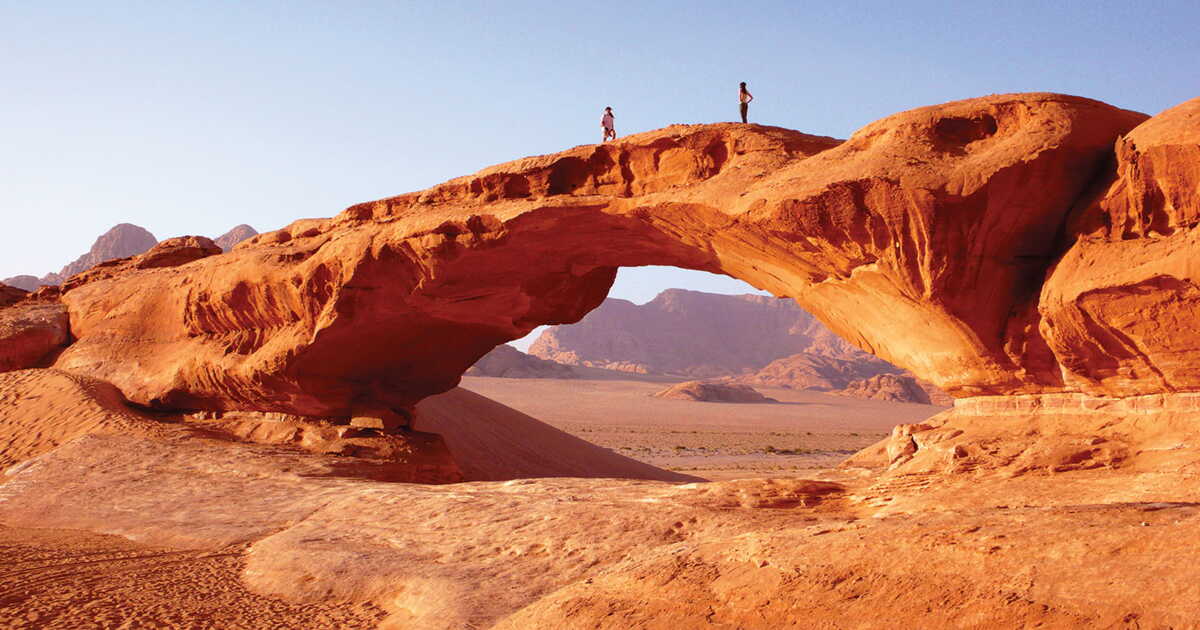
The Wadi Rum, nicknamed the “Moon Valley”, offers spectacular desert landscapes shaped by wind and time, with its red sandstone massifs, natural arches, and endless dunes. Inscribed on the UNESCO World Heritage List, this iconic Jordanian desert is ideally explored on a 4×4 tour, allowing access to its emblematic sites such as the Um Fruth rock bridge or the Nabataean inscriptions.
Extend the experience by sharing a traditional Bedouin meal cooked under the sand, and spend the night in a nomadic camp, for an immersion in a lifestyle rooted in ancient traditions. A place that has served as a backdrop for many films, such as Lawrence of Arabia or The Martian, embodies a rare authenticity, blending natural grandeur with millennial hospitality, making Wadi Rum a must-see stop for any journey in Jordan.
5. Explore Aqaba’s waves
Aqaba, Jordan’s sole coastal resort, serves as an ideal gateway to the underwater riches of the Red Sea. Renowned for its preserved coral reefs, the region attracts divers and snorkelers eager to explore remarkable biodiversity, including multicolored fish, turtles, and teeming corals.
The waters are calm, warm, and clear, making it an accessible spot even for beginners. For those who prefer to stay on land, Aqaba’s beaches provide a relaxing setting with views of the surrounding mountains. Whether you come for marine exploration or simply relaxation, Aqaba beautifully and sun-soakedly complements a Jordanian itinerary rich in cultural and natural discoveries.
6. Revisit the past at Jerash
Jerash, regarded as one of the most remarkable ensembles of ancient Roman architecture preserved outside Italy, offers a striking immersion into the Greco-Roman past. Its Hadrian’s Arch, its well-preserved theatres, Corinthian columns, and amphitheaters testify to the wealth and power of ancient Jerash.
Every stone seems to tell the story of a time when the city flourished as a regional trade hub. Walking the site means stepping into a living stage of antiquity, where monumental remains and cobbled streets converse with the present, captivating visitors sensitive to history and the archaeological heritage of the Near East.
7. Contemplate the mosaics of Madaba
Madaba, nicknamed the “City of Mosaics,” is renowned for hosting one of the oldest known Byzantine mosaic maps, visible in the Church of Saint George. This archaeological treasure, depicting the Holy Land with remarkable precision, is a centerpiece of Jordanian heritage. As you wander the town, your gaze is continually drawn to other murals scattered across its religious buildings and museums.
Yet Madaba is not limited to its ancient art: its generous cuisine, typical of the Jordanian plateau, continues the sensory experience, offering visitors an authentic culinary discovery, between aromatic mezze, grilled meats, and local sweets.
8. Take the plunge into canyoning at Wadi Mujib
The Wadi Mujib, a spectacular gorge carved into the foothills of the Dead Sea, offers a privileged playground for fans of aquatic hiking and canyoning. This biosphere reserve—the lowest in the world—combines steep cliffs, refreshing waterfalls, and natural basins, in a setting where water and rock meet with power.
The most famous route, the Siq Trail, leads visitors through narrow passages and swift currents, sometimes requiring the use of hands to progress. The experience, accessible to those in good physical condition, promises a total immersion in a wild and pristine nature, where the variety of landscapes continually surprises.
9. Uncover the secrets of the Desert Castles
The Desert Castles of Jordan, erected between the 7th and 8th centuries by the Umayyads, shed valuable light on the nascent Islamic art and urban planning. Among them, Qusayr Amra, listed as a UNESCO World Heritage Site, stands out for its remarkably well-preserved wall paintings depicting hunting scenes, constellations, and human figures—a rare feature in Islamic art.
These multi-purpose buildings—relay points for caravans, residences, or hunting pavilions—are scattered across eastern Jordan’s steppe. Visiting them offers a captivating cultural exploration, ideal for fans of historic architecture, ancient paintings, and overlooked heritage.
10. Sillonnez la Route des Rois
Over nearly 400 kilometers, the King’s Highway unfolds an emblematic Jordanian route, linking major heritage sites through a landscape of arid plateaus, fertile valleys, and steep gorges. An ancient commercial and strategic road, this millennial route allows you to connect Amman to Petra while passing through historic places such as Madaba, Kerak, or the Wadi Mujib.
Two days are enough to soak up this historical and geographical dimension, a true throughline of a country where every turn reveals a new facet of its identity. An essential itinerary for those who want to combine cultural discovery and natural wonder.
11. Take to the heights at Mount Nebo
Towering above the Jordan Valley, Mount Nebo is a spiritual and historic focal point that attracts both pilgrims and heritage lovers. According to biblical tradition, this is where Moses is said to have gazed upon the Promised Land before his passing.
The remains of the ancient Byzantine basilica, the carefully preserved mosaics, and the panoramic view that stretches all the way to Jerusalem on a clear day offer a contemplative and cultural experience.
As a pilgrimage-worthy stop on Jordan’s routes, Mount Nebo embodies the country’s unique ability to blend sacredness with landscapes, echoing memories of sacred texts and the quiet of the highlands.
What budget should you plan for 10 days in Jordan? An accessible trip structured by priorities
Planning a budget for 10 days in Jordan involves accounting for fixed elements (entrance fees, domestic transportation) and variable ones (accommodation, meals, guided services). For a classic itinerary combining Amman, the Dead Sea, Petra, the Wadi Rum desert, and Aqaba, the average budget ranges from €1,500 to €2,200 per person, including flights.
Entry to Petra can be expensive but may be offset with the Jordan Pass, which simplifies site access while including visa fees. Accommodations range from budget hostels to boutique hotels set in exceptional natural surroundings.
With proper logistical planning, Jordan offers a dense experience with a cost that can be adjusted without compromising the quality of immersion.
How long does it take to visit Jordan? Structuring an itinerary between heritage, nature and rest
Visiting Jordan in good conditions requires at least a week, but ideally ten days to include the major stops without rushing. A well-structured itinerary will include Amman, Petra, the Wadi Rum, the Dead Sea, and a seaside stop in Aqaba. The travel pace remains sustainable thanks to the country’s relatively compact size and the quality of its main roads.
In ten days, a traveler experiences Jordan’s diversity: Greco-Roman ruins, ancient cities, the red desert, salt baths, and coral reefs. The country also lends itself to longer stays, allowing rural experiences, hikes, or desert retreats. Jordan is best discovered slowly rather than in a rush.
What to do in Jordan with children? A destination suited for gentle adventure and cultural learning
Exploring Jordan with children offers a balanced mix of wonder, historical discovery, and nature contact. Petra, though expansive, provides family-friendly routes with visits adjustable to the children’s ages. In the Wadi Rum desert, Bedouin camps allow for a gentle, safe, and highly supervised immersion.
The Dead Sea amuses with its unusual buoyancy, while Aqaba and its beaches add a playful dimension to the stay. Jordanians show natural hospitality toward families. With reasonable distances between sites and reliable tourist services, Jordan is a viable family destination, provided you plan your itinerary carefully.
Is visiting Jordan dangerous? A safe destination provided there is a structured framework
The question of whether visiting Jordan is dangerous often arises due to regional geography. Yet, Jordan ranks among the most stable countries in the Middle East. The government maintains solid security measures, particularly around tourist zones. Incidents against travelers are rare, and the local population is welcoming and respectful.
The Jordan Pass, professional guidance, and high-quality tourist infrastructure all attest to a strong commitment to ensuring visitors’ safety. By avoiding sensitive border areas and following usual precautionary recommendations, travel proceeds in very good conditions. In short, traveling in Jordan is safe, provided you respect conventional cautions and preparation guidelines.
This article was written with the help of artificial intelligence, then corrected, expanded, and validated by the newsroom journalists.