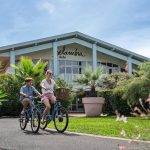



Created in the wake of paid vacations and a France rebuilding itself, discovering leisure and its territories, the FUAJ operated about thirty establishments in France and employed 317 staff, until its liquidation with continued activity, announced on March 2.
After more than two months of uncertainty, the teams and the hostels now know more about the upcoming summer and their future.
The court designated the consortium formed by ONLE FAC Habitat and GSE to take over almost the entire network, with the exception of the establishments at Beaugency and Beaulieu-sur-Dordogne.
“It is a relief, because there is no social upheaval.
99 % of the employees keep their jobs, the hostels are maintained and will be developed by a group that has a solid financial base, which we lacked. This is the best possible scenario that could have been chosen.
The buyers intend to continue the project, to develop it and to renovate the hostels.
And if such an actor steps forward, it is because, despite our weaknesses, we were not so bad at what we did and the product is interesting
FUAJ: 10 million euros to secure the takeover
“That was the only offer proposing to take over 50% of the headquarters staff. We are dealing with a benevolent and humane actor“, he describes to us.
For those who do not know the group behind the takeover of the FUAJ, ONLE FAC Habitat is an association that belongs to SMERRA.
The student health mutual, created in 1970, developed by aggregating services for young French people, such as insurance and housing.
Before this takeover, it owned 12,000 student housing units distributed across 100 social residences located in numerous university towns in France.
With the United Federation of Youth Hostels, it will probably further diversify its activity.
We also find in the LOGIFAC dossier, another housing management entity owned by SMERRA.
“We are dealing with an actor philosophically close to the spirit of the hostels.
How they are handling the file today makes me optimistic. They want to ensure the continuity of the network, while adopting a very humane and firm approach, meaning that they will focus on the business side, because they are putting more than 10 million euros on the table.
They naturally expect results, and that is perfectly normal,” confirms David Le Carré.
For now, nothing is definitive as to the network’s use.
Youth Hostels: a fragile economic model…
“They are giving themselves three years to carry out the economic turnaround of the structure, which seems reasonable.
They will take the time to understand the network and how it operates before making decisions about possible changes in the use of the residences.
After that, I think they want to create bridges between their student-focused activity and hostel activity.
At least for 2026, they are pursuing a continuity of activity. Then, there will probably be things to do, with the transformation of some establishments into student residences“, says David Le Carré.
Read: From the youth hostel to Generator: a whole history
The buyers did not disclose their strategy to the court. They emphasized above all that their primary objective was to ensure the network’s longevity and to prevent the disappearance of a historic actor.
This takeover on the stand is also an opportunity to reflect on the path traveled by the United Federation of Youth Hostels, but also on the relatively lively vitality of social tourism, abandoned by public actors.
When the person who is now the ex-general manager took command of the FUAJ, it was placed under court-ordered restructuring. It was 2018, and despite the work done, it never managed to recover.
“The FUAJ began to lose money as early as 2005.
And at that time, the emergence of new-generation hostels with a higher-end positioning had not yet occurred.
We did not have the funds to transform the network and renovate. We relied on our own funds, which was not sustainable without banking partners.
It is crucial to understand how youth hostels operate, because the economic model is hard to sustain. It does not make a huge profit and every euro spent must be controlled, sums up the leader.
Nevertheless, the arrival of The People, Jo&Joe, Meininger and Generator had an impact on the historic players, who faced a drained cash flow.
Auberges de jeunesse : The People, Jo&Joe, Meininger… ont fragilisé les acteurs associatifs
The arrival of profit-driven players, while we were an association, pushed the sector toward upgrading, thus toward investments, and therefore toward higher prices.
We forget all the primary missions of youth hostels. I can tell you that establishments in their historic format, as we knew them, I do not know any that earn thousands. In fact, even these new players do not rake in much money.
I think what happened to us is far from trivial for others“, recounts the former DG.
Like social tourism actors, the federation had to face a shift in model and a withdrawal by the State.
Until last century, the model developed thanks to volunteering, very modest rents, government aid, and assisted contracts…
Then it tightened when it was necessary to hire, end volunteer work, while local authorities no longer provided premises for free or at low cost, and no longer contributed to investments.
“If you do not have a financial, institutional actor or an investment fund backing you, you are left with nothing but your own eyes to cry on.
When the new players arrive with super nice, Instagrammable buildings, it quickly becomes difficult. In cities with high pressure, it becomes complicated.
Our business model meant that establishments in Paris, Lyon or Bordeaux funded Pontarlier, Pontivy, or other secondary towns.
If we want access to tourism for everyone, everywhere in France, then the carrying territories must finance those that are less so. But that was no longer possible.
We tried to work with Bpifrance, but the doors were closed. We fell into the boxes of its tourism accelerator program, but since we were in a continuation plan following our restructuring, it was not possible for them to fund us.
We faced the same fate with the Banque des Territoires and the Caisse des Dépôts. The actors who finance the profitable sector do not really fund social tourism“, he reflects on the difficulties of the FUAJ.
Tourisme social : “The State supports the project philosophically, but no longer financially”
This example is not merely a warning for this sector in particular, but another alert for social tourism, which experiences great difficulties in widespread indifference.
“The State philosophically supports the project of the right to holidays for everyone, but it no longer does so financially.
Associations are left financially on their own.
I understand that the State has other priorities.
We have in the UNAT some very vocal people on this theme of public support, of affordable rents… but I fear it may be a lost cause given the current economic context in France“, laments David Le Carré, who is among the people who will be laid off in a few days.
So it is the closing of a 70-year-old history book, and the opening of another, with more resources and the desire to safeguard the missions of social tourism.