The question remains: what to do in Siena, Tuscany, to make the most of your stay? In this article, we explore a variety of activities that will satisfy the expectations of every traveler.
1. Discover the Piazza del Campo
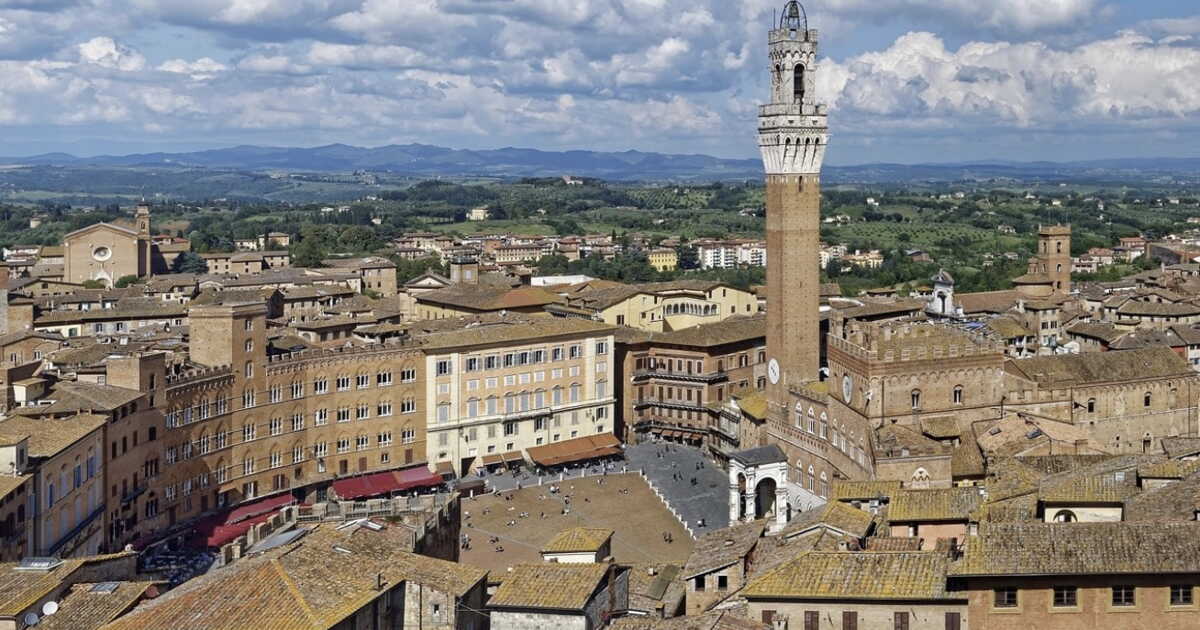
Discovering the Piazza del Campo means entering the heart of the city of Siena and its historic center, listed as a UNESCO World Heritage site. This iconic square, recognizable by its shell-like shape, represents a unique example of medieval urban planning. It hosts the famous Palio di Siena, or Palio delle Contrade, each summer during Palio season, transforming the square into a living theater of centuries-old traditions. Flanked by exceptional buildings, including the 15th-century Palazzo Pubblico, also known as Siena’s Public Palace, this historic square houses the Museo Civico and masterpieces of the Sienese school, such as Duccio’s Maestà.
2. Visit the Siena Cathedral and the Piccolomini Library
The Siena Cathedral, or Duomo di Siena, is a remarkable example of Italian Gothic religious architecture. Located in the heart of the historic center, it impresses with its blocks of white marble, its richly decorated interior, and its floor inlaid with biblical scenes. Inside the Siena Cathedral, the Piccolomini Library stands out for its vividly colored frescoes depicting the life of Pope Pius II. The site also includes the San Giovanni Baptistery, whose interior baptismal fonts reveal Renaissance goldsmithing and sculpture. Access to the rooftop panorama allows you to embrace the view over the Tuscan countryside and the palaces with the city’s characteristic architecture. A Opa Si Pass facilitates visiting the entire complex, which also includes the Museo dell’Opera. It is an essential stop for any first visit to Siena.
3. Climb the Torre del Mangia
Climbing the Torre del Mangia, located as an extension of the Palazzo Pubblico on the Piazza del Campo, offers a vertical view of Siena’s urban layout. This 15th-century tower rises to more than 100 meters and requires a climb via narrow but steady steps. At the top, the view extends over the city of Siena, the on-site dwellings, the green bands of the contrade, and the harmonious line of terracotta roofs stretching to the Tuscan countryside. This ascent is as much an architectural experience as a visual one, allowing you to connect the city’s emblematic structures—from the public palace to the Fonte Gaia—in a single perspective. It is a privileged moment to grasp the spatial coherence of this historic center, where every building seems to dialogue with the others.
4. Explore the Santa Maria della Scala Museum Complex
The Santa Maria della Scala Museum Complex, located opposite Siena Cathedral, represents one of the city’s most comprehensive cultural sites. A medieval hospital converted into a museum, it traces the history of hosting pilgrims and public welfare. Today, its underground galleries and inner courtyards host classical and contemporary art exhibitions, as well as archaeological remains tracing Siena’s evolution since antiquity. This indoor passage through a historic building helps to better understand the city’s social foundations, its structure around hospitality and care, and its place in the network of medieval Italian city-states. This itinerary is suitable for a one-day excursion with strong educational and patrimonial value.
5. Savor the local cuisine
Sampling Siena’s local cuisine is a sensory gateway to Tuscan culture. In the trattorias of the historic center, visitors can savor pici, thick artisanal pasta often served with ragù or a garlicky sauce, as well as ribollita, a countryside soup made from vegetables and bread. For dessert, ricciarelli, almond-soft cookies, and panforte, a dense fruit-and-spice cake, illustrate Siena’s ancient gastronomic traditions. A meal can be accompanied by a glass of Chianti, produced locally in the surrounding Tuscan countryside.
6. Stroll through Siena’s medieval alleyways
Wandering Siena’s medieval alleyways means diving into the very texture of its historic center. Each narrow, cobbled lane links the contrade, these historic districts with strong identities, marked by symbols, green bands, and oral traditions carried forward during the Palio delle Contrade. Far from the main tourist routes, these passages reveal religious buildings, small ancient properties, and discreet heritage elements such as the Loggia della Mercanzia or the sober façades of Sienese houses. This slow walk provides a meaningful way to discover Siena at its own pace, without artifice, and to better understand the relationships between its residents, their traditions, and their urban environment.
7. Enjoy the green spaces at the Fortezza Medicea
The Fortezza Medicea, an old defensive structure transformed into a park, now offers a lush public space just a short walk from Siena’s historic center. Designed in the 16th century as a strategic fortress, it is today a favored spot for strolls, outdoor activities, and cultural events. Its tree-lined avenues allow you to contemplate the soft lines of the Tuscan countryside while staying within an urban frame. From its ramparts, the view of Siena’s rooftops and its religious buildings provides a soothing contrast after the density of the center. This green space contributes to the city’s balance, offering visitors a breathing space during a stay in Siena, whether short or long.
8. The Palio di Siena: a traditional horse race
The Palio of Siena, or Palio delle Contrade, is much more than a horse race: it is an emblematic event rooted in the city’s soul. Held twice a year on Piazza del Campo, during the Palio period, it draws thousands of visitors each summer to witness this spectacular medieval celebration. The Palio is the living expression of neighborhood spirit and a centuries-old rivalry between the contrade, or historic districts. This moment suspended in time recalls Siena’s deep identity, from its historic center to its traditions. Participating in the Palio or understanding its stakes captures the essence of a city proud of its history, possessive of its heritage, and eager to pass it on with fervor. A visit to Siena during this period offers a unique cultural experience, worth including in any Tuscan itinerary.
9. Explore the Palazzo Pubblico and the Museo Civico: major witnesses to Siena’s history
The Palazzo Pubblico, located on Piazza del Campo, is one of the most remarkable Gothic architecture palaces in Italy. Built around the turn of the 15th century, it houses the Museo Civico, where visitors can admire the masterworks of the Sienese school, notably the Maestà by Duccio and Ambrogio Lorenzetti’s frescoes. These works illustrate the civic and moral foundations of a city oriented toward the collective ideal. The building is also distinguished by its tall tower, the Torre del Mangia, which offers a panoramic view of the Tuscan countryside and the historic center. The interior of Siena’s public palace allows a comprehensive reading of Siena’s political, artistic, and urban history through the centuries.
10. Strolling through the Centro Storico di Siena
The Centro Storico di Siena, UNESCO World Heritage-listed, is ideally explored on foot, from Piazza del Campo to the far reaches of its walls. This is where the heart of Siena beats, with narrow streets, religious buildings such as the Basilica of San Francesco, the Siena Cathedral, and iconic fountains, including Fonte Gaia. Visitors can follow the green bands indicating the contrade, or let themselves be guided by the unique atmosphere of Siena’s dolce vita. By taking time to explore the interiors of buildings—such as the San Giovanni Baptistery or the Piccolomini Library—one discovers a rich, subtle, and ever-living heritage.
Siena is a city full of activities and discoveries for all types of travelers. From its historic sites to its gastronomic delights, through its breathtaking views, this Tuscan city guarantees a rich and diverse experience. By visiting Siena, you dive into a history filled with culture and emotion. Whether your stay is short or extended, Siena leaves you with precious memories and an irresistible desire to return.
Siena and its flavors: which culinary specialty to discover during your visit?
During a stop in Siena, it is essential to discover the culinary specialties that testify to the city’s authenticity and the richness of the Tuscan countryside. Panforte, a cake of dried fruits and spices dating from the Middle Ages, embodies Siena’s gastronomic heritage. Another must: ricciarelli, almond-based biscuits, sweet emblems of the Tuscan dolce vita. These products can be savored in the enchanting setting of the Piazza del Campo, the main square where local conviviality and the tranquil rhythm of the historic center surface.
Discover Siena with family: which cultural and playful activities to prioritize?
The Palazzo Pubblico, also called Siena’s Public Palace, houses the Museo Civico and displays frescoes by the Sienese school, including the famous Maestà by Duccio. The visit can continue at the National Gallery of Siena, where children and adults discover 15th-century art in a palace with remarkable architecture. Not far away, Siena Cathedral impresses with its blocks of white marble, its sculpted interior, its own fountain, and the fascinating Piccolomini Library, all elements to observe together. Families can also linger at Fonte Gaia, the Baptistery fonts, and inside the San Giovanni Baptistery, to complete a busy yet accessible day.
What to do in Siena when it rains: exploring the city’s indoor treasures
The Siena Cathedral, with its striking interior, inlaid floors, the interior of the San Giovanni Baptistery, and the Piccolomini Library, offers a complete visit sheltered from the weather. The Palazzo Pubblico welcomes visitors in its rooms adorned with frescoes illustrating the city’s history, including those dedicated to Saint Catherine. Nearby, the Opera Museum, the Public Palace, the Loggia della Mercanzia, and the Basilica of San Francesco provide a rich artistic journey.
This article was written with the help of artificial intelligence, then corrected, supplemented, and validated by the journalists of the editorial staff.