Quieter, sometimes forgotten by traditional circuits, Banteay Srei, Neak Pean, Banteay Samrè, or Phnom Kulen reveal another grandeur of Khmer civilization: refined architecture, centuries-old places of devotion, and landscapes steeped in mystery.
Banteay Srei, a jewel of pink sandstone
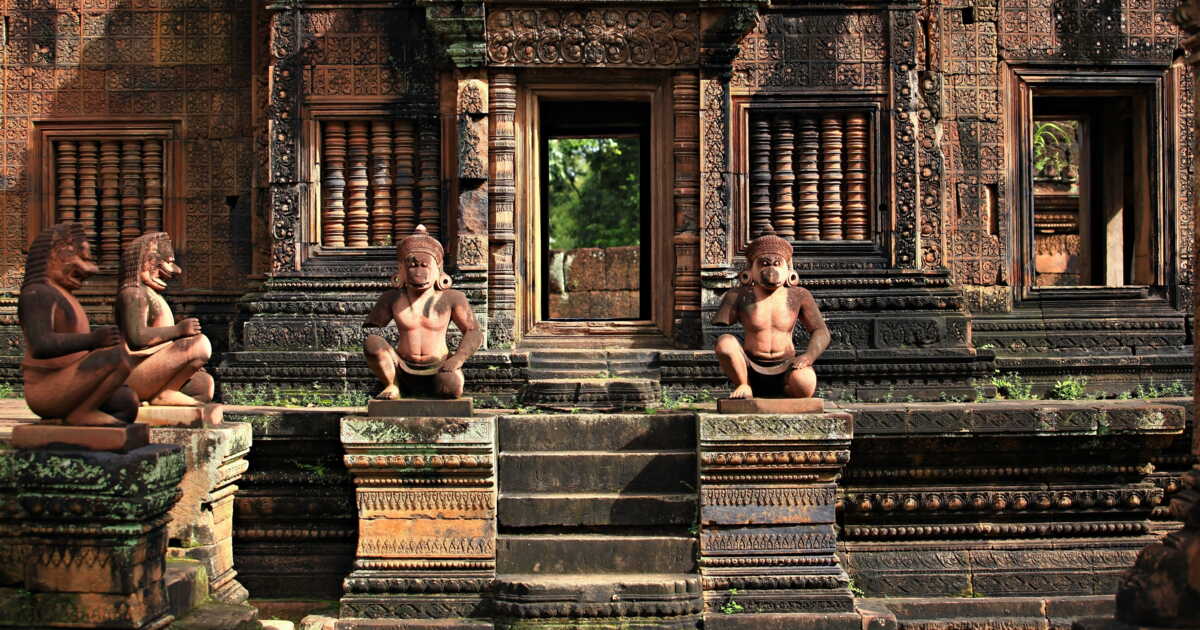
Guardians with monkey heads (photo) or lions, graceful dancers, garlands of delicate flowers… Located far from the beaten tracks, 30 km from the main site, Banteay Srei is one of the rare temples that was not commissioned by a king, but by a high dignitary, in the year 967. It is nonetheless legendary in more ways than one. First, because it was built in pink sandstone, and secondly… because André Malraux once borrowed its bas-reliefs, in 1923! Go at opening (7:30 a.m.), when Cambodians come to burn incense.
Neak Pean, the island of waters that heal
On the Grand Circuit, do not miss a stop on the northern bank of Jayatataka Baray, an artificial reservoir. From there, a wooden footbridge spans the water to lead to Neak Pean, a XIIth-century Buddhist complex. This island-sanctuary remains sacred in the eyes of Cambodians. Its basins, designed to recreate on Earth the mythical lake Anavatapta, located in the Himalayas, house waters with healing properties, into which pilgrims would splash themselves to ward off diseases.
Banteay Samrè, the little brother of Angkor Wat
It’s one of the best-kept secrets of the archaeological park. No one goes there, and yet this XIIth-century temple is exceptional. Moreover, Banteay Samrè will remind you of something: here is the miniature copy of the most famous Khmer temple, Angkor Wat! The same elegance, the same play of symmetry, the same lotus-bud shaped sanctuary tower. Combine its visit with that of Banteay Srei, and take the opportunity to stop in a village along the roadside to taste artisanal palm sugar.
The Roluos Complex, the cradle of Khmer art
Any visit to the archaeological park should always begin with this fabulous site of the first Angkorian art from the 9th century, located near the village of Roluos, 15 km east of Siem Reap. This complex indeed tells the crucial transition from brick-and-wood constructions to those in stone (gray sandstone). Three temples to explore: Lolei, Preah Ko, and Bakong. The latter, in remarkable condition, is flanked by a modern monastery. The monks’ psalms are a delight…
Phnom Kulen, the Mount Olympus of Cambodia
At 487 m in height and 50 km from Siem Reap, Phnom Kulen is more than a mountain dominating the virgin forest. The country’s independence as an empire was proclaimed here in 802. On this spiritual mountain, one meets monks in saffron robes, families in festive attire, and hermits seeking to meditate. A “river of a thousand lingams” (phallic symbols) and waterfalls flow here, where one enjoys bathing. Do not miss the grand reclining Buddha, in the small temple at the summit.
The most beautiful spots to admire sunrises and sunsets
After living the euphoria of a dawn at Angkor Wat, experience another early wake-up call, this time away from the crowds, at the mount temple of Phnom Bakheng, a site that opens at 5 a.m. We climb in the dark on this natural hill where a gray stone pyramid sits. An exceptional view of the sun rising from the foliage, with Angkor Wat in the distance, seen in silhouette. In the evening, around 5 p.m., head to Pre Rup, dedicated to Shiva, with its imposing towers that rise above the forest.
They helped us produce this report
Specialists in Cambodia, Les Maisons du Voyage invite you to trace the footsteps of our reporters, with a thirteen-day and ten-night circuit, from 2835 euros (flights, accommodations, visits and a French-speaking guide included). From Kampot to Siem Reap, far from the mapped routes, this journey tells the glorious hours of the gods-king of Angkor. The program includes little-known archaeological sites, isolated villages with ancestral traditions, and encounters with the Khmer people, who are reconnecting with their invaluable heritage. Committed to responsible tourism, the local partner ensures that each journey benefits Cambodian communities and the preservation of the heritage. maisonsduvoyage.com
➤ Article published in GEO magazine no. 570, “Cambodia,” August 2026.
➤ Do you love GEO? Then to miss nothing, discover our subscription options to receive GEO monthly at home with ease.