

Across a patchwork of major events, from Tahiti to the Marquesas, the Polynesian people rekindle their spiritual strength: Mana. More than a simple festive calendar, these gatherings are acts of cultural resistance, moments of pure transmission where dance, sport, the sacred, and craftsmanship fuse to affirm a multifaceted identity. It is the time of year when neighborhoods empty out for rehearsals, when families gather around the crafts of weaving, and when the scent of tipanier and the tiare pervades every commune. It is a journey where every gesture, every war cry, and every song becomes a living word addressed to the ancestors. The Ma’ohi heritage is not a relic, it is a breath that never fades.
Heiva i Tahiti: The Fury and the Grace
The Heiva doesn’t begin under To’atā’s lights; its roots reach back months earlier, in the shadowed neighborhoods, where bodies wear themselves out during nocturnal rehearsals after long days of work. There, between sips of water and Tahitian jokes, the group becomes a family. There, they prepare the “rebirth”: that of a culture that nearly vanished and now explodes into a discipline that reads like military training.
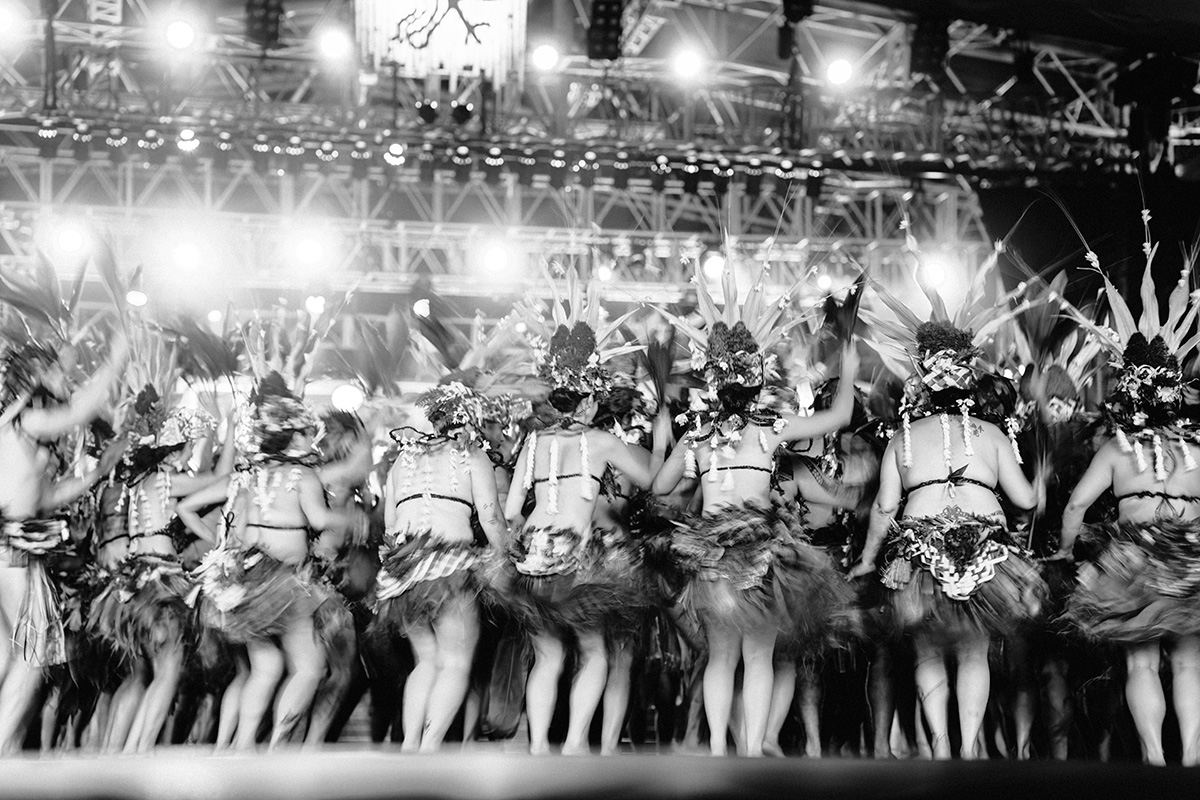
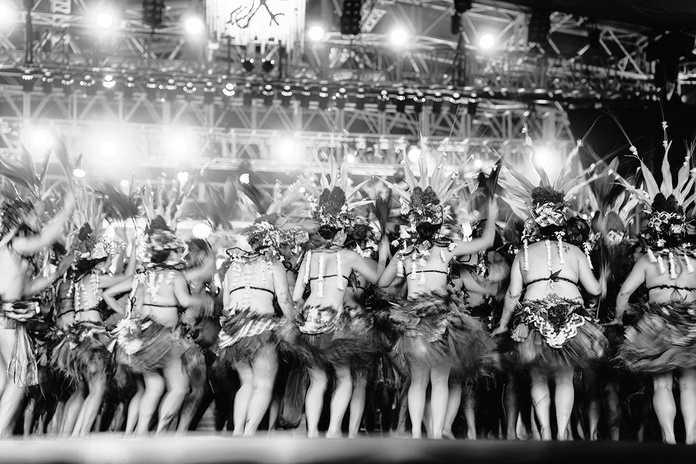
On the night of the competition, backstage is a furnace of green. The monumental headdresses are adjusted, the bark skirts that weigh on the hips are tightened, and the skin is coated with oil to gleam under the lights. Then, silence falls. From the first strike on the to’ere, energy takes on a different nature. It is no longer merely dance; it is a dialogue with the unseen. The percussion erupts, the hymene voices rise in powerful surges that send shivers down your spine, and suddenly one understands that every hip swirl and every foot stomp is a signature: “We are here, we stand, and our land is alive.” It is this pure thrill, this identity that cannot be explained yet is felt in the heart, that one experiences at the Heiva.
On the night of the competition, backstage is a furnace of green. The monumental headdresses are adjusted, the bark skirts that weigh on the hips are tightened, and the skin is coated with oil to gleam under the lights. Then, silence falls. From the first strike on the to’ere, energy takes on a different nature. It is no longer merely dance; it is a dialogue with the unseen. The percussion erupts, the hymene voices rise in powerful surges that send shivers down your spine, and suddenly one understands that every hip swirl and every foot stomp is a signature: “We are here, we stand, and our land is alive.” It is this pure thrill, this identity that cannot be explained yet is felt in the heart, that one experiences at the Heiva.
The Heiva’s Satellite Events
The Umu Ti, the pact with fire
For those seeking contact with the unseen, walking on fire unsettles certainties. It isn’t a show; it’s a communion. Over forty-eight hours, a vast blaze consumes the air. Basalt stones store heat that can reach 600°C. Under the guidance of the Tahua (priest), armed with protective Auti leaves, participants cross the flames barefoot. It is raw proof that Mana, invoked with humility, can transcend the laws of matter.
The Tu’aro Ma’ohi :
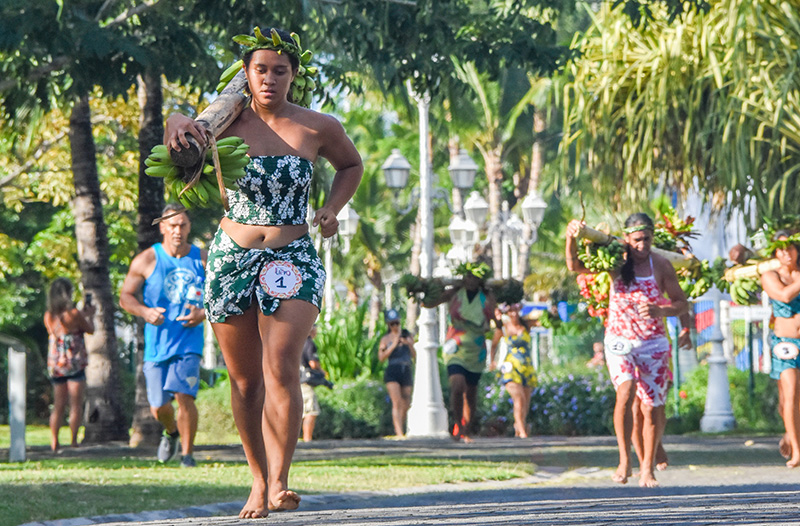
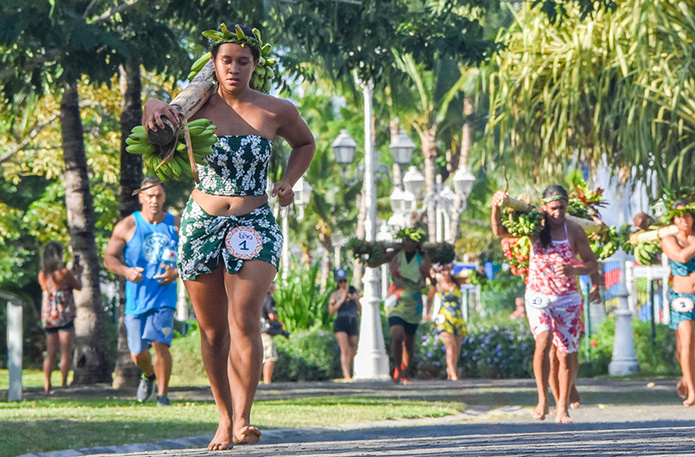
The ancient Polynesian athleticism has its own Olympic Games. Here, the vital gestures of old become athletic feats: climbing a coconut tree at staggering speed, hurling a javelin (Patia Fa) at a coconut perched nine meters high, or even shelling coconuts. The most spectacular remains the fruit-bearer race, where athletes sprint with 30 to 50 kg on their shoulders. This elevated physical vigor is elevated to the rank of national art.
The Heiva Va’a Matai’eina’a :
The ballet of the Va’a canoes is the umbilical cord that ties the Polynesians to their ancestral navigators. Far from modern technology, this Heiva esteems pure gesture. The rowers, in pareo and plant-based adornments, turn the lagoon into a living tableau. Whether racing in single-outrigger or crews of sixteen, every paddle stroke honors the cohesion of a water-loving people.
The Heiva Rima’i: When matter comes to life
One cannot truly understand the Heiva costumes without witnessing the titan’s craft behind them. At the Heiva Rima’i pavilion, craft is not a tourist souvenir; it is the realm of the “golden hands.” It is here that the richness of each archipelago is grasped: the astonishing weave of Rurutu, the strength of rosewood carved in the Marquesas, or the glow of the Tuamotu’s mother-of-pearl. To see these creators turn a simple plant fiber into a royal adornment is to understand that every object is a piece of history held in the hands.
The Tuifara at the Marae Arahurahu: The awakening of the sacred
If To’atā is the temple of spectacle, Paea’s Marae Arahurahu is the temple of the soul. Here, with the Tuifara festival, the glare of spotlights gives way to pure spirituality. Imagine the voices of pupu hīmene resounding against the high basalt walls… the acoustics are natural, almost mystical. On this sacred site, dancers aren’t on a wooden stage; they make the very earth tremble with the power of their ancestors. It is a moment outside time, a meeting between past and present in a theatre of greenery.
For those seeking contact with the unseen, walking on fire unsettles certainties. It isn’t a show; it’s a communion. Over forty-eight hours, a vast blaze consumes the air. Basalt stones store heat that can reach 600°C. Under the guidance of the Tahua (priest), armed with protective Auti leaves, participants cross the flames barefoot. It is raw proof that Mana, invoked with humility, can transcend the laws of matter.
The Tu’aro Ma’ohi :
The ancient Polynesian athleticism has its own Olympic Games. Here, the vital gestures of old become athletic feats: climbing a coconut tree at staggering speed, hurling a javelin (Patia Fa) at a coconut perched nine meters high, or even shelling coconuts. The most spectacular remains the fruit-bearer race, where athletes sprint with 30 to 50 kg on their shoulders. This elevated physical vigor is elevated to the rank of national art.
The Heiva Va’a Matai’eina’a :
The ballet of the Va’a canoes is the umbilical cord that ties the Polynesians to their ancestral navigators. Far from modern technology, this Heiva esteems pure gesture. The rowers, in pareo and plant-based adornments, turn the lagoon into a living tableau. Whether racing in single-outrigger or crews of sixteen, every paddle stroke honors the cohesion of a water-loving people.
The Heiva Rima’i: When matter comes to life
One cannot truly understand the Heiva costumes without witnessing the titan’s craft behind them. At the Heiva Rima’i pavilion, craft is not a tourist souvenir; it is the realm of the “golden hands.” It is here that the richness of each archipelago is grasped: the astonishing weave of Rurutu, the strength of rosewood carved in the Marquesas, or the glow of the Tuamotu’s mother-of-pearl. To see these creators turn a simple plant fiber into a royal adornment is to understand that every object is a piece of history held in the hands.
The Tuifara at the Marae Arahurahu: The awakening of the sacred
If To’atā is the temple of spectacle, Paea’s Marae Arahurahu is the temple of the soul. Here, with the Tuifara festival, the glare of spotlights gives way to pure spirituality. Imagine the voices of pupu hīmene resounding against the high basalt walls… the acoustics are natural, almost mystical. On this sacred site, dancers aren’t on a wooden stage; they make the very earth tremble with the power of their ancestors. It is a moment outside time, a meeting between past and present in a theatre of greenery.
Matavaa o te Fenua Enata: The Awakening of the Land of Men
Born out of a vital urgency, Matavaa did not arise from a simple desire to entertain, but from a need to survive. In the 1970s, the Marquesas archipelago faced a frightening cultural decline. It was under the impulse of the Motu Haka association, in 1986 at Ua Pou, that this rallying cry rang out. Today, the festival marks 40 years of identity reconquest. Its strength lies in its itinerant nature: every two years, it travels between Nuku Hiva, Hiva Oa, and Ua Pou, while mini-festivals keep the flame alive on the more isolated islands like Fatu Hiva or Ua Huka.
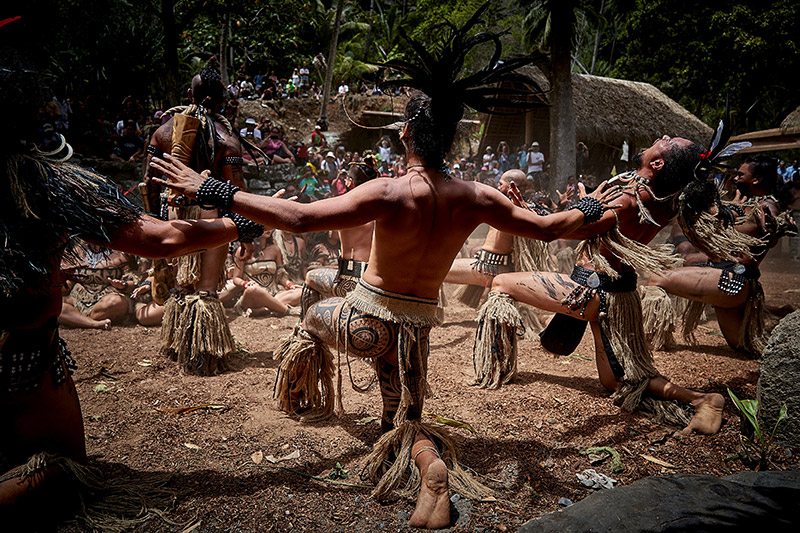
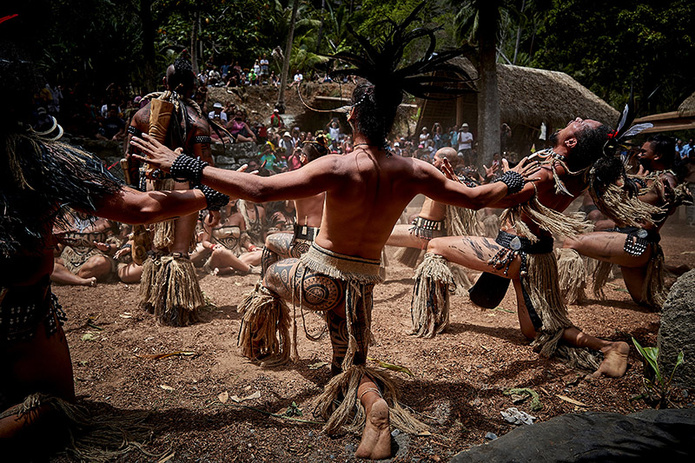
The raw basalt energy, whose aesthetics sharply break from Tahitian gentleness. The setting is that of stone cathedrals and deep valleys. The performances unfold on the Tohu’a, these vast stone plazas. Under the muffled beat of the Pahu Nui, the ground seems to tremble. The festival deploys warrior dances of unprecedented intensity, such as Maha’u (the pig dance) with its powerful breaths, or the Haka where the fixed gaze asserts the clan’s vigor.
Tattooing, or Patutiki, is central there. It is not ornament, but a writing on the skin telling a genealogy. The carved-wood decorations and rooster-feather adornments complete this look of elegant yet solemn “savagery.”
A collective victory with no single winner: the Matavaa’s hallmark is the complete absence of competition. People come for the Me’ae, for sharing. For several days, modern life stops: Ka’aku is prepared and foods are cooked in enormous Umu (underground ovens). It is the triumph of unity across a proud archipelago, proving that the Mana of the Land of Men is among the Pacific’s most indomitable.
The raw basalt energy, whose aesthetics sharply break from Tahitian gentleness. The setting is that of stone cathedrals and deep valleys. The performances unfold on the Tohu’a, these vast stone plazas. Under the muffled beat of the Pahu Nui, the ground seems to tremble. The festival deploys warrior dances of unprecedented intensity, such as Maha’u (the pig dance) with its powerful breaths, or the Haka where the fixed gaze asserts the clan’s vigor.
Tattooing, or Patutiki, is central there. It is not ornament, but a writing on the skin telling a genealogy. The carved-wood decorations and rooster-feather adornments complete this look of elegant yet solemn “savagery.”
A collective victory with no single winner: the Matavaa’s hallmark is the complete absence of competition. People come for the Me’ae, for sharing. For several days, modern life stops: Ka’aku is prepared and foods are cooked in enormous Umu (underground ovens). It is the triumph of unity across a proud archipelago, proving that the Mana of the Land of Men is among the Pacific’s most indomitable.
Source: Destination Marquises
Travel with Moana Voyages: Your Gateway to Authenticity
Experiencing the Heiva or the Matavaa is not merely ticking a box on a vacation itinerary; it means letting yourself be transformed by the Fenua’s energy. These moments of grace, when time stands still to make way for the sacred, require a travel approach that is respectful and profound.
At Moana Voyages, our mission is to open the doors to this vibrant Polynesia for you. As experts based in the heart of these archipelagos, we do not simply organize getaways: we weave connections between you, this land, and its people. Whether you wish to move to the beat of To’atā drums or tread the mystical basalt of the Marquesas, we will accompany you so that your immersion is total, fair, and unforgettable.
At Moana Voyages, our mission is to open the doors to this vibrant Polynesia for you. As experts based in the heart of these archipelagos, we do not simply organize getaways: we weave connections between you, this land, and its people. Whether you wish to move to the beat of To’atā drums or tread the mystical basalt of the Marquesas, we will accompany you so that your immersion is total, fair, and unforgettable.