Like in a dream… Plunged into darkness, about ten people wait in a vast room for something to happen. As their eyes adjust to the dim light, screens lining the space from floor to ceiling become visible. Suddenly, the show begins. Around them, wavy lines resembling strands of DNA coil, converge and then explode into a galaxy of glowing points. Dreamlike shapes fuse, disperse, cross and drift away in a ballet that, at first glance, seems somewhat chaotic. But upon closer inspection, these shapes move together, symbolizing the electrical signals of a brain in frenetic activity: that of architect Antoni Gaudí. Then one feels swept into a luminous tunnel, with screens all around projecting details of stone columns, stained glass – those of the famous Sagrada Família.
Suddenly, a leaf motif becomes a stained glass window
Bienvenue dans The Dreams of Gaudí, une installation immersive créée par un artiste turco-américain de 40 ans, Refik Anadol, au sein de la Casa Batlló (prononcer “balyo”). Cet immeuble d’habitation, rénové entre 1904 et 1906 par Gaudí, est l’une des œuvres phares de l’architecte. Au numéro 43 du Passeig de Gràcia, avenue chic de la bourgeoisie barcelonaise du XXe siècle et vitrine des créations du modernisme catalan, la Casa Batlló se distingue par sa façade aux couleurs arc-en-ciel, tout en relief, avec ses balcons en forme de masques et ses colonnes évoquant un squelette, qui lui ont valu le surnom de Casa dels Ossos, la “maison des os”. Son toit est parcouru de formes ondulantes, recouvertes de tuiles de céramique mauves, bleues et vertes représentant le dos du dragon terrassé, selon la légende, par saint Georges (Sant Jordi, patron de la Catalogne). Mais surtout, l’édifice abrite des expériences immersives utilisant les toutes dernières technologies numériques. L’exploit : faire entrer les visiteurs dans la tête du génial Catalan !
As a child, Gaudí suffered from acute rheumatic pains and spent his days observing nature. A nature that would greatly inspire him later. So the moment you enter sets the tone. The visitor’s tour begins in the basement, in the building’s old coal cellars, inside a dome-shaped room, plunged into darkness. There, a scene lights up, reconstructing a forest – with ambient sounds, exposed roots, a pond, pebbles… – and a luminous stream projected on the floor. The walls and ceiling are covered with a thousand tiny screens displaying details of turtle shells, butterfly wings, flowers…
Gaudí’s Architecture: A Total and Organic Art
Suddenly, a branch becomes a column; a leaf motif transforms into a stained glass window. Entitled The Genius’s Inspiration, this creation by producer and director Miguel Alonso, creative director of Casa Batlló, puts the visitor in Gaudí’s shoes. The images on the screens draw on the architect’s work—hundreds of thousands of contemporary documents, manuscripts, plans, archive photos. The animations of the Dreams of Gaudí are renewed, meanwhile, thanks to artificial intelligence. The result, the show evolves perpetually.
“For us, immersive experiences are not just a trend, explains Gary Gautier, the general manager of Casa Batlló. They help us better understand Gaudí’s distinctive vision, who conceived architecture as a total, organic art connected to nature. If visitors leave here with the sense of having understood not only a building but a way of seeing the world, then we will have achieved our goal.”
This innovative approach earned Casa Batlló the 2022 award for Best International Exhibition, a museum Oscar handed out by the prestigious British society Museums + Heritage.

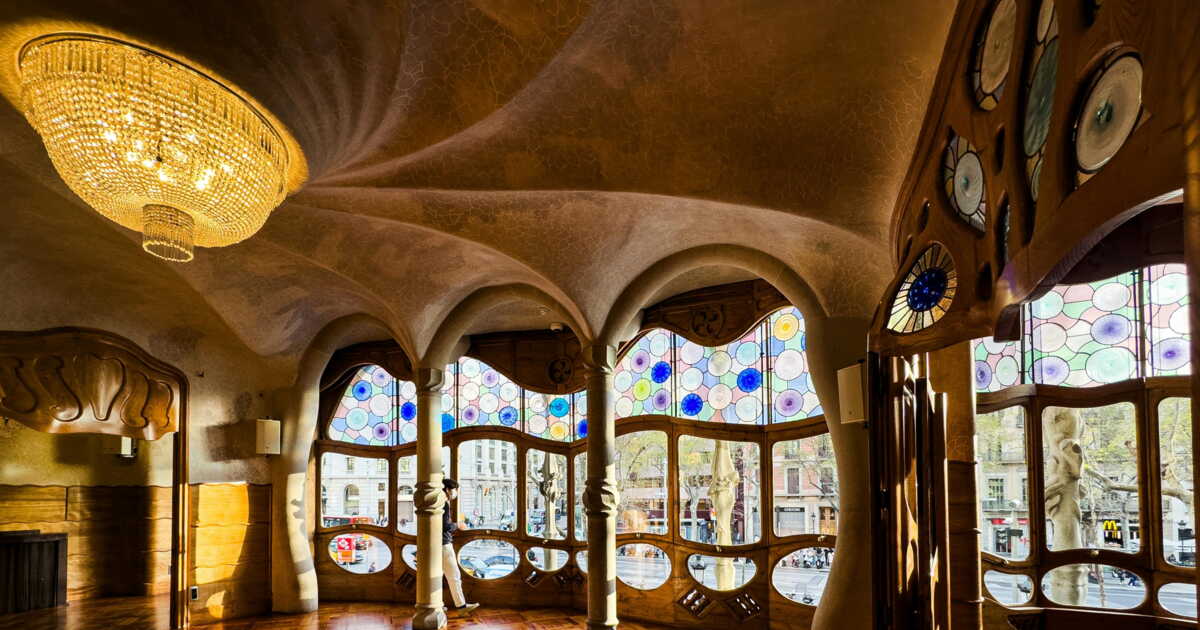
More traditional and no less fascinating is the tour of the other floors, magnificently restored. Most of Gaudí’s original furniture, designed for Casa Batlló, is today housed in various Barcelona cultural institutions, such as the National Art Museum of Catalonia, but tablets allow visitors, thanks to augmented reality, to visualize the rooms adorned with period furniture. And in some rooms, there is no need for this device: the furniture has been meticulously reproduced. This blend of virtual and real succeeds in creating the illusion of a journey through time and the daily life of the Catalan bourgeoisie in the early 20th century.
A Mushroom-Shaped Alcove
On the noble floor, above the ground floor, you enter the imposing office of Josep Batlló i Casanovas, a businessman who made his fortune in textiles and had entrusted Gaudí with the renovation. Next to it, in the apartment’s grand salon, are a globe and a wooden gramophone. The adjoining alcove, mushroom-shaped, is a small, astonishing reception space. Inside, a fireplace, with, on one side of the hearth, a double bench to accommodate the eldest daughter of the Batlló family and the parade of suitors who came courting her and, on the other side, a simple bench to welcome her chaperone!
Access to the upper floors is via a monumental work: an old service staircase reinvented in 2021 by the renowned Japanese architect Kengo Kuma, who dressed it with tens of thousands of aluminum chains, like a second skin. At the top floor, surprise: one enters into attics like no other, where sixty-odd chain-link arches in flawless white support the roof, evoking the rib cage of an animal. This floor, once used as a laundry, was imagined by Gaudí as a living organism: the white walls, coated with antiseptic lime milk, catch the light, while a system of slots and channels vents moisture from the laundry. The air circulates freely, like a natural breath, turning this utilitarian space into a gallery of breath and light, as functional as it is poetic.
We depart with the odd impression of having visited both a decorative arts museum and a futuristic exhibition. An experience in the image of Antoni Gaudí himself, who was at once a man of his time and a visionary creator.
Practical tips
- Plan about an hour and a quarter to explore the venue.
- Tickets from €29 (free for under 12s).
- Book in advance to get the best rates on casabatllo.es/fr
➤ Article published in GEO magazine No. 568, “Barcelone, l’atelier à ciel ouvert d’Antoni Gaudí,” June 2026.
➤ You love GEO? Then to miss nothing, discover our subscription plans to receive GEO every month at your home with ease.
