He was one of the most famous explorers in history. In search of a new route to the Indies, Christopher Columbus crossed the Atlantic Ocean and, in 1492, established enduring contact between Europe and the Americas.
After his death, it was his remains that began an extraordinary voyage. Today housed in Spain, his tomb remains at the heart of a controversy that spans centuries.
A Life of Exploration
Christopher Columbus, a Spanish navigator of Genoese origin, is remembered for opening Europe’s path to the discovery of America in 1492. During his life, he undertook four voyages funded by the Spanish monarchs between 1492 and 1504.
During his first voyage, he reached the Bahamas, then explored Cuba and Hispaniola, convinced he had landed in the Indies, which is why the encountered populations were called “Indians.” His second expedition, far more ambitious, led to the founding of a colony in Hispaniola and the continuation of Caribbean exploration, while hundreds of Arawaks were taken to Spain. In 1498, during his third voyage, he first approached the South American continent, along the coast of present-day Venezuela. His return was marked by sharp political tensions: accused of mismanagement and abuse of power, he was arrested before being vindicated. His fourth and final voyage, between 1502 and 1504, took him along the coasts of Central America, from Honduras to Panama, never finding the maritime passage to Asia that he had sought.
A Traveling Remains
Having gradually lost influence, Christopher Columbus died on May 20, 1506, in Valladolid, Spain, alone and poor. He was initially buried in a Franciscan convent. A few years later, his remains were moved to the chapel of the Santa Maria de las Cuevas monastery where the body of his son Diego joined him, likely around 1526.
Columbus’s wish was to be buried on the island of Hispaniola, today shared by Haiti and the Dominican Republic, the site of the founding of his first colony. His wish was honored in 1537 thanks to his daughter-in-law, Maria de Toledo, who had the two coffins transported to the Cathedral of Santa Domingo. They remained there until 1795, when the Basel Treaty ceded Saint-Domingue to France. On December 20 of that same year, the remains of Christopher Columbus, after having for the first time received joint official honors from the Spanish and French navies, were transported aboard the San Lorenzo to the Spanish colony of Cuba.
But in 1898, a new twist: Cuba became independent following the Spanish-American War. The explorer’s remains were moved again and placed aboard a ship heading for Spain… and more specifically Seville! The remains were then laid to rest in a sumptuous mausoleum within the cathedral.
An Imposing Mausoleum
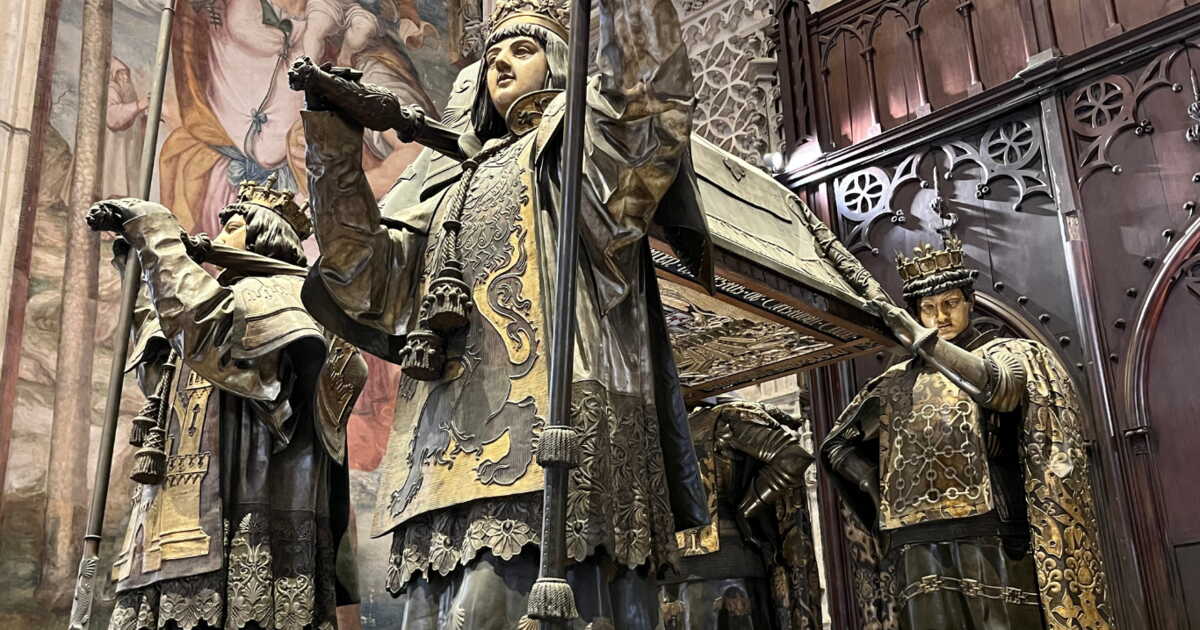
Located at the entrance to Seville Cathedral, Christopher Columbus’s tomb is a monumental tomb on the right side of the nave, impossible to miss. It is supported by four figures, four allegorical personages representing the four historical kingdoms of a unified Spain at the end of the Middle Ages:
- to the front left, León: identified by the crowned lion, a symbol of courage, sovereignty, and kingship, he bears a cross signifying the victory of Christianity over Islam;
- to the right, Castile is represented by the castle on its coat of arms, a heraldic emblem of the former Kingdom of Castile. It symbolizes territorial power, the fortresses of the Reconquista, and the dominant kingdom of the Spanish union;
- to the rear, Aragon: bears the four red bars on a gold field (the “four bars of Aragon”), emblem of the Crown of Aragon and its Mediterranean expansion;
- and finally Navarre: bears the gold chains, a reminder of the legend of Navarre’s victory at the Battle of Las Navas de Tolosa and a symbol of independence and valor.
The feet of the carriers positioned in front of the coffin are strangely polished: a legend says that touching the right foot will make you marry, while touching the left will bring you back to Seville! Each knight wears attire inspired by the era of the Catholic Monarchs, reinforcing the link with Spain in 1492, the year of Columbus’s first voyage. The bronze monument, created by Arturo Mélida at the end of the 19th century, was installed in the cathedral in 1899.
An Enduring Enigma
The location of Christopher Columbus’s remains remains a subject of ongoing dispute between Spain and the Dominican Republic. In 1877, workers unearthed in the Cathedral of Santo Domingo a lead box bearing an inscription referring to “Don Cristóbal Colón.” This discovery led Dominican authorities to claim that the true bones of the explorer had never left the island and that the Spaniards had taken the wrong bones in 1795.
DNA analyses conducted from 2002 onward by a Spanish team and published between 2006 and 2024 have, however, confirmed that the remains kept in Seville Cathedral are authentic and compatible with Columbus’s identity. The researchers do not rule out that other fragments of his remains could be located in the Dominican Republic, where authorities to this day refuse any genetic testing. In the meantime, the Columbus Lighthouse in Santo Domingo houses remains that the Dominican Republic presents as those of Christopher Columbus. This attribution remains controversial as it has not been scientifically confirmed.
Want to discover Seville ? Do not hesitate to contact the Turismo de Sevilla and Turismo de Andalucía offices, which organized our on-site visits, including the cathedral.
