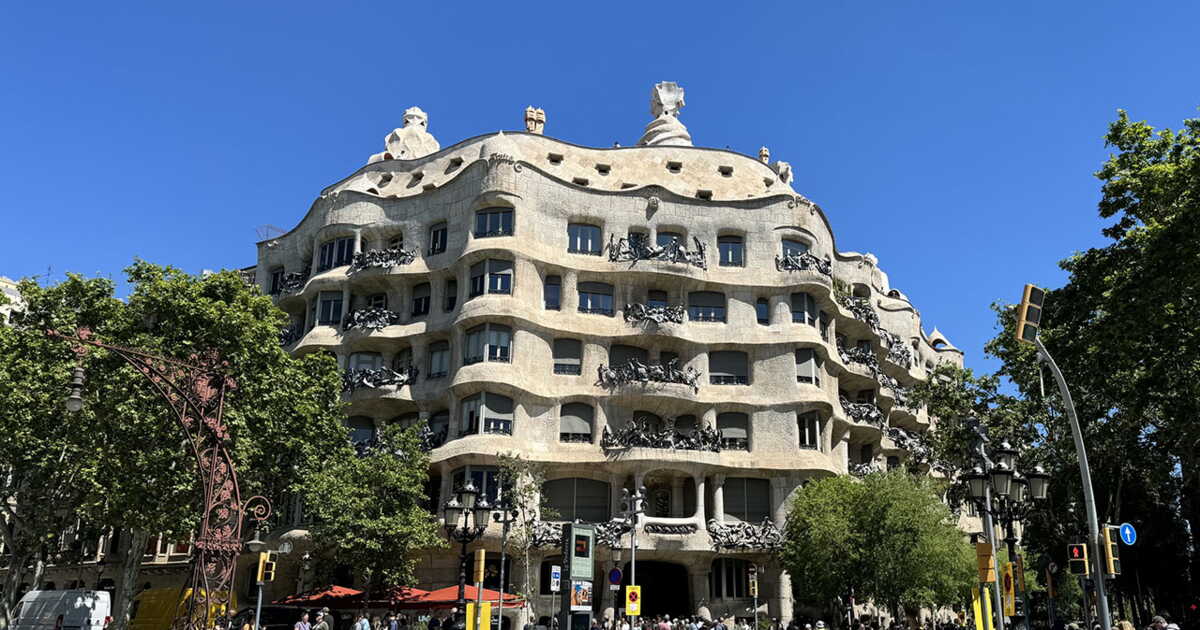
To enter her apartment, Ana Viladomiu, 71, must regularly push her way through, arms full of groceries, among a crowd of tourists queuing at the entrance of her building. Each year, more than a million people flock to 92 Passeig de Gràcia in Barcelona to visit Casa Milà. Referred to as La Pedrera (“the quarry”), because of its austere limestone façade, this structure is a masterpiece of the Catalan Modernism conceived by Antoni Gaudí between 1906 and 1912.
Ana, a writer who has lived here for forty years, has written novels set at La Pedrera and shares her daily life in this unusual place on Instagram; she would not move for anything in the world.
The Privilege of Living in Gaudí’s Pedrera, a Masterpiece of the Catalan Modernism
GEO magazine: How did you end up living in such a monument?
Ana Viladomiu: By chance! It was in 1986, I fell in love with a man, Fernando Amat, who had been living at La Pedrera for years. He first occupied the top floor, under the attic. There was a whole series of duplex studios of about 30 square meters, lit by the two rows of skylights visible at the top of the façades. These kinds of lofts formed an artistic epicenter frequented by famous Barcelona figures, such as the photographer Leopoldo Pomés. They have since been transformed into an exhibition space of plans and models on Gaudí’s work. Then, four years before our meeting, Fernando managed to rent a 340-square-meter apartment that had become available on the fourth floor.
Did you imagine you would stay there so long?
Not at all! Fernando and I got married, had two daughters, and the lease was put in our names. It’s an old rental agreement at a very low rent, which provides that the tenant can stay for life. After our separation, Fernando moved to another neighborhood and I stayed here. The apartment has four bedrooms, two bathrooms, and long balconies where I grow cacti. The east-west exposure allows the sun to pour in fully everywhere; it’s a marvel. What more could one ask for? When I was young, I wasn’t aware I was living in a place with exceptional architecture. In hindsight, I realize the gift fate offered me!
What did the place look like when you moved in here in 1986?
Originally, the La Pedrera apartments each contained around twenty small beige rooms separated by partitions, as bourgeois customs dictated. Later, these partitions were knocked down. When I arrived, my apartment already had generous spaces, with a very large living room. My husband had painted the walls in bright colors, the living room in dark blue, the hallway in green… Years later, fashion changed, and we repainted everything white, and the rooms became even brighter.
You were able to repaint the walls even though the building has been on the UNESCO World Heritage list since 1984?
It’s no longer possible to remove partitions or add new ones, but I am allowed to do what I want with the cosmetic aspects: I can place furniture I like, carpets, general decoration, and change paint colors. However, I am strictly forbidden to touch the floors, which date back to 1912, as well as the radiators connected to the central gas heating, the sanitary facilities, the windows, the switches, and the outlets…
What happens if you damage something?
In a building this old, you must handle things with care. Recently, a friend who was visiting me turned a brass door handle the wrong way and broke it in two. I called La Pedrera’s maintenance team, which is on call 24/7. Its supervisor referred me to a specialized locksmith, who had to order a new handle from a workshop in Zaragoza. The mechanism was remade to measure, and I paid for the repair. Last summer, an air-conditioning unit installed on the rooftop terrace failed. It caused a flood and water damage in two bedrooms of my apartment, in the middle of August. I wasn’t there. It was the maintenance team that took care of things, under the authority of the private Catalunya La Pedrera Foundation, which took over the walls in 2013 from Caixa Bank. The owner handles major problems. Like in any building!
One of La Pedrera’s peculiarities is that the interior walls are all curved, with no right angles. How does that affect daily life?
Installing shelves or even carpets has sometimes been a headache. I had a few custom-made pieces, like the bookcase in my study, and I opted for a minimalist design. Over time, I’ve come to accept it. It’s the architecture that counts here, not the furniture. My daughters, for their part, struggled to come to terms with living in this modernist home. As children, they had a mix of love and hate for this apartment with curved walls, stone columns, and ceilings sculpted in waves. At school, they were ashamed to say they lived here!
Today, you are down to only three residents in this building. Is it burdensome to live alongside crowds of tourists?
Sometimes I dream of settling by the sea, in a quiet little house surrounded by a garden. Yet that idea fades as quickly as it arises. The constant presence of tourists is the price to pay for living in one of Gaudí’s most beautiful houses. When I enter the building, I must of course push my way through the crowd. The same goes for friends who visit me, who must show ID to security before taking the elevator! At first, I closed my shutters to hide from the tourists. I eventually grew used to their presence and understood that they kept me company, now that my daughters have grown up and moved away. Sometimes people ring my door, but I don’t answer. From my windows, I watch them wander on the roof and take selfies in front of the chimney conduits, and it amuses me…
Gaudí, the Catalan Modernist Architect
1. Who was Antoni Gaudí?
Antoni Gaudí was a Spanish architect born in 1852 in Catalonia. He is famous for his unique style inspired by nature, organic shapes, and religious art.
2. What is his most famous work?
His most famous work is the Sagrada Família in Barcelona, a basilica still under construction today.
3. To which architectural style did Gaudí belong?
Gaudí belonged mainly to the Catalan Modernist movement. His buildings blend colors, mosaics, curves and natural forms.
4. Where can Gaudí’s works be seen?
Most of his works are located in Barcelona, including:
- Park Güell
- Casa Batlló
- Casa Milà
5. Why is Gaudí still famous today?
He is admired for his imagination, architectural innovation, and the originality of his creations, which attract millions of visitors every year.
➤ Article published in GEO magazine no. 568, “Barcelona, Antoni Gaudí’s open-air workshop”, June 2026.
➤ Do you love GEO? Then to never miss a beat, discover our subscription plans to receive GEO every month at your home with ease.
