

The coastline attracts the bulk of foreign tourists visiting Albania, a new Mediterranean frontier opened up by European tour operators in under ten years.
To the south, the Albanian Riviera, along the Ionian coast where the mountains literally plunge into the sea, houses the country’s finest sandy beaches. Vlora serves as the gateway to this coastline, with a planned airport, ferry links to Italy, and modern developments.
Radhima, Orikum, the Karaburun Peninsula (and its beaches accessible only by boat), Dhërmi and Himara are other popular resorts.
Farther south, opposite the Greek island of Corfu, near the site of Butrint, Saranda, Ksamil and Manastiri, host family hotels, villas and residences, but the whole area sadly lacks cohesion.
As for Durrës, further north, its coast, marred by anarchic construction and a polluted sea, is crowded in the summer by Albanian communities and neighbors from Kosovo.
To the south, the Albanian Riviera, along the Ionian coast where the mountains literally plunge into the sea, houses the country’s finest sandy beaches. Vlora serves as the gateway to this coastline, with a planned airport, ferry links to Italy, and modern developments.
Radhima, Orikum, the Karaburun Peninsula (and its beaches accessible only by boat), Dhërmi and Himara are other popular resorts.
Farther south, opposite the Greek island of Corfu, near the site of Butrint, Saranda, Ksamil and Manastiri, host family hotels, villas and residences, but the whole area sadly lacks cohesion.
As for Durrës, further north, its coast, marred by anarchic construction and a polluted sea, is crowded in the summer by Albanian communities and neighbors from Kosovo.
Shkodra Lake and its 240 bird species
Lakes also offer their share of attractions. In the north, Shkodra Lake, bordering Montenegro, is an officially protected area that shelters 240 species of birds.
The lake expands or recedes with rainfall. To the south, the saline Butrint Lake, naturally linked to the Ionian Sea, sits at the heart of the eponymous national park, made up of plains, forests, wetlands and mountains.
The lake expands or recedes with rainfall. To the south, the saline Butrint Lake, naturally linked to the Ionian Sea, sits at the heart of the eponymous national park, made up of plains, forests, wetlands and mountains.
Magnificent Lake Ohrid, bordering North Macedonia
It also shelters nearly 250 species of birds, as well as reptiles and amphibians, and offshore, the Mediterranean monk seal can be found.
To the southeast, bordering North Macedonia, the magnificent Lake Ohrid, a UNESCO World Heritage site, is a retreat and vantage point, enjoyed around the town of Pogradec.
To the southeast, bordering North Macedonia, the magnificent Lake Ohrid, a UNESCO World Heritage site, is a retreat and vantage point, enjoyed around the town of Pogradec.
The Mountains and the Theth Valley
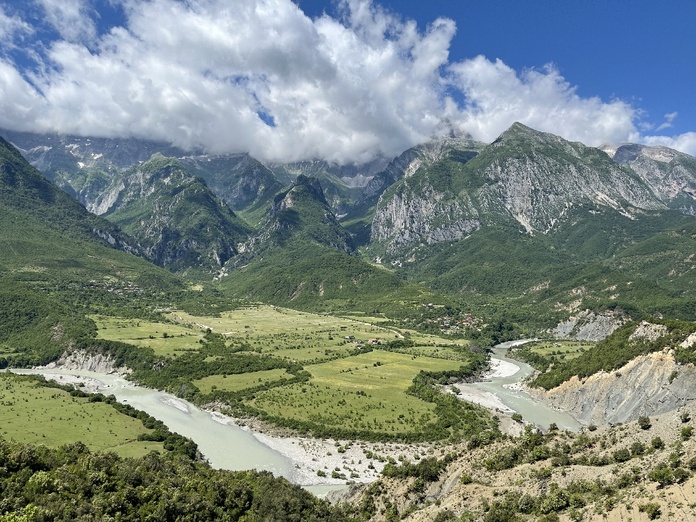
The other major draw of a stay or a tour in Albania, perhaps even greater than the coasts, is the mountains. Woven with rushing rivers, they cover 70% of the country and promise secret itineraries through valleys and villages tucked away. In the north, these are the Dinaric Alps, near Montenegro and Kosovo. They conceal the secluded Theth Valley.
Several ranges then extend toward the Greek border, with the country’s highest point at the border with North Macedonia, Mount Korab (2,751 m).
Many hikers choose Berat as a base camp before venturing to explore the surrounding mountains. The southern reliefs are especially alluring.
In a wild setting of grassy slopes and narrow passes, where one encounters many flocks of sheep watched over by shepherds (there are also wolves and bears), the narrow road between Gjirokastër and Korçë is spectacular, traversing landscapes that are pristine and punctuated by rare villages.
Several ranges then extend toward the Greek border, with the country’s highest point at the border with North Macedonia, Mount Korab (2,751 m).
Many hikers choose Berat as a base camp before venturing to explore the surrounding mountains. The southern reliefs are especially alluring.
In a wild setting of grassy slopes and narrow passes, where one encounters many flocks of sheep watched over by shepherds (there are also wolves and bears), the narrow road between Gjirokastër and Korçë is spectacular, traversing landscapes that are pristine and punctuated by rare villages.
Resurgence of the Bistritza River
It is a pity that ecological practices have not yet become the norm. Whether coastal or mountainous, nature still suffers far too much from the presence of illegal dumps and litter scattered on the ground without a second thought.
One can also explore the Vjosa valley, the only river still regarded as wild because it is not dammed — though a project is underway.
The Bistritza River, for its part, presents a curiosity. One of its sources is a resurgence. After a pleasant approach hike (accessible to all) through high wooded slopes, one encounters this stream of fresh, translucent water bursting from beneath the mountain. The Blue Eye, that is its name, embodies in its own way the country’s natural wealth.
One can also explore the Vjosa valley, the only river still regarded as wild because it is not dammed — though a project is underway.
The Bistritza River, for its part, presents a curiosity. One of its sources is a resurgence. After a pleasant approach hike (accessible to all) through high wooded slopes, one encounters this stream of fresh, translucent water bursting from beneath the mountain. The Blue Eye, that is its name, embodies in its own way the country’s natural wealth.
