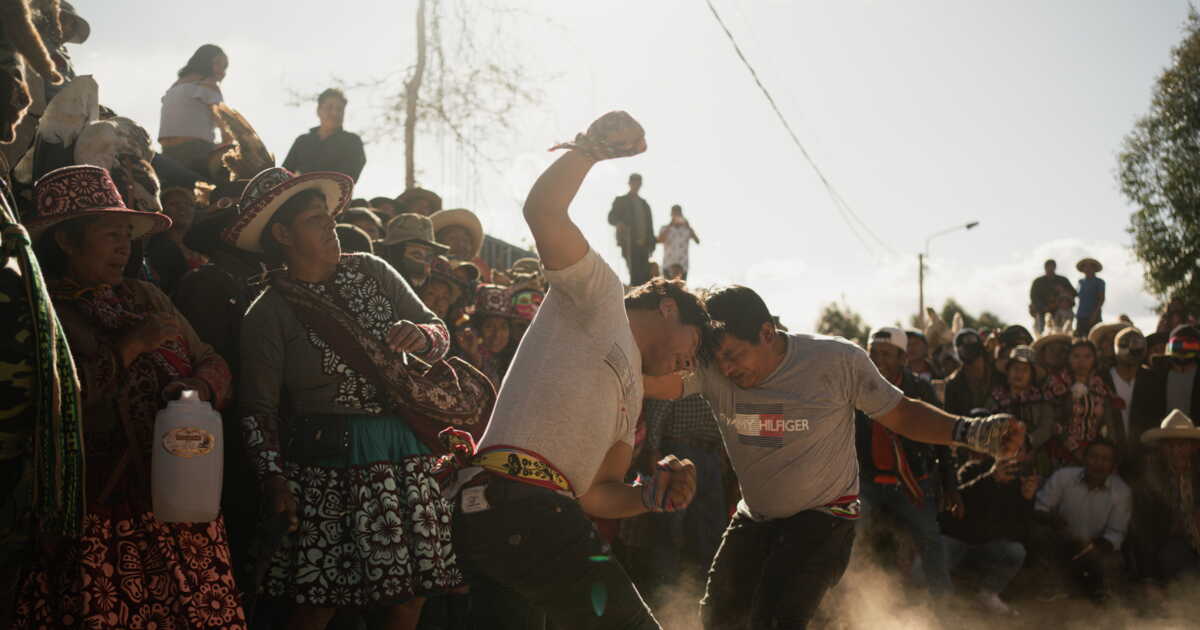
While in most French households the mood is one of family merriment with presents under the tree and roasts in the oven, the residents of the small town of Santo Tomás celebrate the birth of Christ in their own way. It is in the Chumbivilcas region, tucked away in the Peruvian Andes, that between five and six thousand people gather in the arena usually used for bullfights to watch the bouts. The clashes run from 10 a.m. to 6 p.m., non-stop. A French expert on the subject, photojournalist and filmmaker Simon Ruiz, told Geo how the idea of making a film about this tradition came to him: “While I was scrolling Tik Tok, I came across a video of women fighting bare-handed in the middle of a large crowd.”
Speaking with his fixer on the ground, he quickly understood that this is a living tradition. He then decides to fly in to arrive on Christmas Day, equipped with his trusty camera. “For more than ten years I have been interested in Indigenous communities,” he explains, “I have come to realize the complexity of their situation: they are not simply communities living deep in the forest, subsisting on the river and the mountains. There are many deeper and more modern issues at stake.”
A ritual of uncertain origins
Simon Ruiz thus approaches the subject with the greatest respect and becomes interested in everything that surrounds the blows inside the arena. The Takanakuy is indeed part of a broader festival called Wayliya. In the days leading up to the fights, the festivities are organized with detailed disguises featuring traditional garments, but also masks and the stuffed remains of animals—antlers and condors—used as impressive headgear. Alcohol flows freely during these days of preparation for the Takanakuy, but this is no reason to forget the purpose of the celebration: Jesus and the Virgin Mary.
Hours of prayer are numerous and solemn. On the morning of December 25, the time is for hymns of praise to Jesus. Traditional Christianity takes precedence over times of dance and song, before 10 a.m., the time of the rendezvous inside the arena. The fighters’ aim is not to “win” a fight, even though there is always a dominant and a dominated one. All blows are allowed until one of the two opponents falls to the ground, at which point the hostilities are immediately halted by the referee, as Simon Ruiz relates.
In 2025, he chose to lay down his camera when invited to take part in a fight. He found himself facing one of the men he had known over the years while he came to film and photograph Takanakuy for the French press. To prepare and document his approach, he stayed for a month and a half in Santo Tomás and interviewed many people, including the village intellectual Víctor Laime Mantilla. The village representative defines it as “a pre-Hispanic tradition whose history has been passed down orally from generation to generation.” These testimonies take on various shapes and forms, and today it is difficult to determine with certainty where Takanakuy truly comes from.
The main theory, according to Víctor Laime Mantilla, goes as follows: this historical ritual may have begun in the time of the Inca emperors as a chance to display one’s courage in combat outside of actual battles. For Simon Ruiz, who has heard other voices from other Chumbivilcanos, there is also the possibility that this tradition originated in an even darker context: “After the arrival of the colonizers, perhaps some slave traders forced men to fight to choose the strongest…a bit like cockfights.” One must imagine that each story holds a grain of truth.
Modernity versus tradition
Whatever the origin of this tradition, one thing is certain: today it is deeply embedded in the Peruvian landscape. To the point of continuing to evolve with contemporary mores. Initially strictly reserved for men, the fights now see women stepping into the arena. According to Simon Ruiz, nearly one in two bouts today is fought by women.
The competitors have earned the right to fight among themselves, on equal footing with men, for reasons that the photojournalist finds surprisingly feminist: “Young women went to study in big cities, where equality is talked about a lot, and then returned with progressive demands.”
Not everyone’s cup of tea, but they have been present for several years now, albeit in a somewhat less official manner than the men. For Víctor Laime Mantilla, this is part of the nature of any tradition: it must adapt to survive. That doesn’t mean everything is rebuilt from scratch. Among the disguises you still find the majeños, the negros, the qara capas, the langostas, and the qarawatannas, variants of minors, crustaceans and slaves who dance all in praise of the Virgin Mary and Jesus in the streets and in the arena on December 25.
In Santo Tomás, Takanakuy is not simply a sequence of spectacular bouts. It reflects a society that negotiates its legacies, tensions, and transformations.