In Valais, we like to remind people that we enjoy an average of 300 sunny days per year. But that isn’t the only record… Here, everything is spectacular. The region sits among Europe’s rooftops, with 45 summits over 4,000 meters (out of 48 across Switzerland). Dazzling with its cascade of steep valleys and its authentic little villages perched on the mountains, this territory is a concentrate of intense emotions. “Our journey quickly took on the air of a grand spectacle,” confirm Lou and Matt, who explored the canton. “From the first hairpins, the air changes,” Lou notes. “We leave the plain to enter a world where verticality reigns. And we loved that!”
The Soul of the Old Chalets
The adventure of Lou and Matt begins in Champéry, at 1,050 meters above sea level. A breathtaking view of the Dents du Midi and the Dents Blanches. Here, a central street lined with chalets and toothed balconies. “The atmosphere is that of a village that has managed to keep its soul,” observe our travelers. The village sits tucked away in the Val d’Illiez and in winter asserts itself as a ski hotspot, part of the Franco-Swiss Portes du Soleil ski area. In the warmer months, it is its bucolic charm that draws visitors. One can find one of the last bell foundries in Switzerland still in operation. Above all, it is a place perfect for experiencing Switzerland in a nature-forward version, thanks to numerous hiking trails.
Heading to the Barme Plateau, an enchanted site, easily accessible, ideal for family outings. “We climbed there in the afternoon. Herds of cows, Hérens breed, typical of Valais, tinkled their bells. A truly unique moment,” remembers Lou. Add to that the stop en route at the Cantine des Dents Blanches, to feast on the quintessential cheese crust. In the evening, another delightful surprise: the night unfolds at the Cantine de Barmaz, another institution in service since 1891. The large wooden chalet sits in the middle of pastures, surrounded by a conifer forest and facing the amphitheater of the high mountains. “Sleeping in a wooden-walled room, with a balcony open to this fabulous setting, watching the stars, is to feel incredibly lucky,” says Matt. The next day, for the return journey, the duo sets off on the Sentier des Contrebandiers. The route winds along the crest toward the Col de Cou, the border with France, and offers dizzying views, notably of the Dents du Midi and their seven sharp summits that seem to tear the sky.
Freshness and Vertigo at the Durnand Gorges

Lower down, toward the plain, it is at the Durnand Gorges, near Martigny, that one cools off. The contrast is striking: after the harsh light of the peaks, here you descend along the sheer walls into a damp and mysterious world, carpeted with mosses and ferns. Walkways, ladders, and wooden paths let you admire fourteen cascades.
On the Vineyard Trail

The Valais holds another, subtler record: as the premier wine producer in Switzerland. Here, the Rhône traverses the valley, lined with terraced vineyards clinging to sunlit slopes, drawing a landscape like no other. Vines stretch endlessly, which you can explore on foot (65 km) or by bike along the Vineyard Trail (82 km). Lou and Matt wandered happily through the hills—“Here you discover how strong Valais’s hospitality tradition is,” they tell us. The “old country,” as locals sometimes call it, has been a throughway for centuries, and you can feel it as soon as you stop at the producers. In Plan-Cerisier, mazots (small wooden granaries) have become places to savor a glass of Petite Arvine while tasting some regional specialties.

Around the town of Sion, you travel through a true oenoparc. Here, a lookout hut perched to offer a magical view; there, cellars with contemporary architecture; further on, magnificent terraces to admire the sunset while sipping a glass. A recommended stop in Saillon for the panorama from Bayart tower. The hill on which this keep stands houses the smallest vineyard in the world: 3 vines on 1,618 m²! The current owner is the Dalai Lama, who was given the land.
Evening holds another unique experience for our explorers: a stop at the Marécottes. Opened in 2024, on three hectares, the place is a hotel, but not only… It is also the highest Alpine zoo in Europe, with the possibility of observing mountain animals, including bears, from one’s room. Magical!
Emotions at Emosson

A new day of vertigo. This time, aboard the red-and-white carriages of the Mont-Blanc Express. An extraordinary line that connects Martigny to Chamonix, crossing the spectacular terrain of the Trient valley. On the Swiss side, the panoramic train dives into wild gorges, skirts raging torrents, and reveals breathtaking landscapes.
The journey continues with the Verticalp Emosson: a vertigo-inducing route combining a funicular — one of the steepest in the world with an 87% slope —, a panoramic miniature train, and a mini-funicular, up to the Emosson dam, suspended between sky and rock.
At 1,965 meters above sea level, the arrival feels unreal. The gaze meets a colossal 180-meter-tall wall, holding back the country’s second-largest reservoir. On this mineral ridge, one proceeds as if balancing on the edge of the void, entranced by the lake’s almost surreal reflections. In clear weather, the view extends to the Mont Blanc Massif. “The kind of place where you feel incredibly small,” confesses Matt.
Zermatt, the Fabulous Theater of the Matterhorn

The next day, another cog railway lifts Lou and Matt to Zermatt, a time-warped resort where the famed Matterhorn towers at 4,478 meters, one of Switzerland’s most iconic postcards. In Zermatt, once a simple alpine village, history shifted in 1865 with Edward Whymper’s ascent of the Matterhorn, propelling the commune into alpine legend. Even today, the absence of cars preserves this mountaineering sanctuary, where silence is only broken by the soft clop of carriages and the discreet glide of electric shuttles. Yet higher still, a new chapter in this journey is written: the Gornergrat Railway. Put into service in 1898, this mountain train—one of Europe’s oldest—has wound its way for over 125 years along the face of peaks to link Zermatt with the heights of the Gornergrat. A true technical achievement for its era, it still offers a timeless voyage, suspended between glaciers and summits, facing the Matterhorn. For Matt and Lou, it’s “the absolute favorite.”

The spectacle unfolds at altitude, Lou and Matt explain. We boarded the Gornergrat train, which lifts visitors to 3,039 meters, delivering a panorama of 29 peaks over 4,000 meters. At their feet, the Gorner Glacier unfurls its blue tongue. “It’s one of Europe’s most sublime settings,” says Lou. “We’re in the heart of a ice amphitheater.” “We had chosen to ascend step by step, to see the landscape in several ways,” recalls Matt. “We first descended one station before the terminus, toward the Riffelsee lake. There, the Matterhorn’s pyramid silhouette reflected itself like in a mirror. And since we rose very early in the morning, the light was magical. Unforgettable!”
A Roman Bath

To recover from such emotions, nothing beats Leukerbad, the largest spa resort in the Alps. The town has been known for it since ancient times. Every day, 3.9 million litres of natural thermal water gush at 51 degrees. Once cooled, the waters feed the baths. Several establishments dot the resort, each with its own style and atmosphere. “Don’t miss the nighttime and outdoor swimming sessions… An experience as unreal as it is enjoyable,” advises Lou.
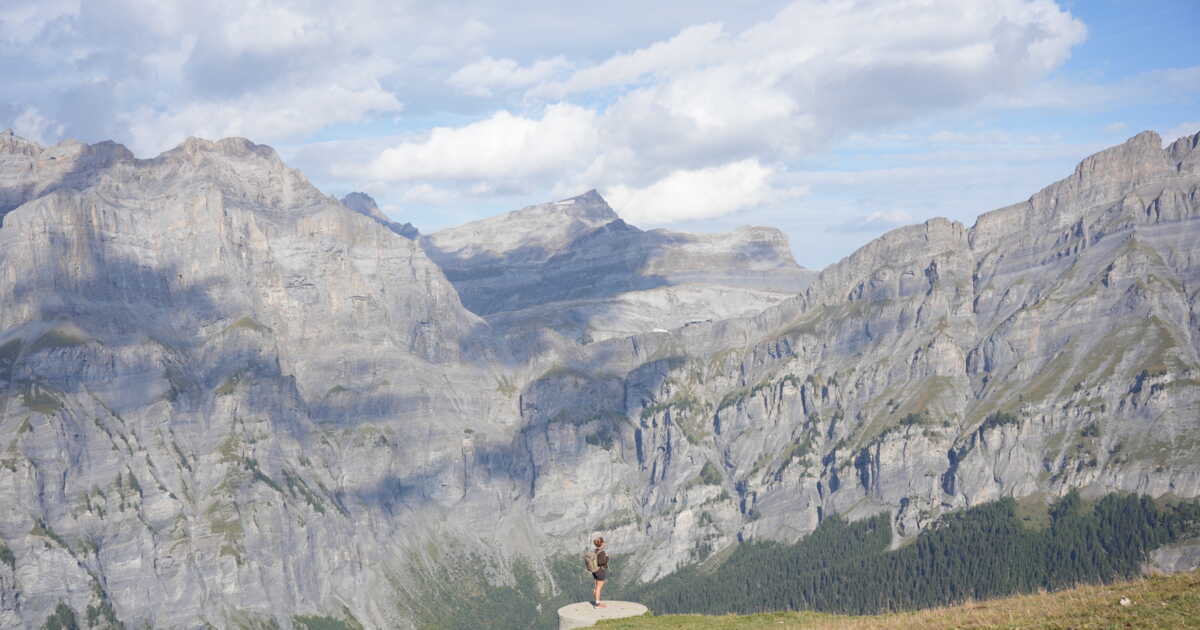
A perfect evening before tackling the journey’s final ascent. Head to the Gemmi Pass, via the Gemmibahn cable car. Up there, at 2,350 meters, the landscape takes on a lunar feel. Silence barely interrupted by the wind’s whistle. A panoramic platform, a true glass balcony cast into the void, again offers a breathtaking view of the Valaisan Alps. A balcony in the land of the giant Alps.
IN PRACTICE.
Planning a trip to Switzerland.
Get informed
https://www.myswitzerland.com/fr and valais.ch
Getting there
TGV Lyria operates daily links between France and Switzerland from Paris Gare de Lyon to Geneva, Lausanne, Basel or Zurich (about 4 hours).tgv-lyria.com
Getting around
By train, with the Swiss Travel Pass. A comprehensive ticket aimed at foreign visitors that opens the doors to Switzerland’s public transport network.