GreenGo: Short Getaways Loved by Travelers This Summer


GreenGo : les escapades courtes plébiscitées par les voyageurs cet été - Depositphotos.com, nblxer

MSC Croisières


As autumn approaches, GreenGo presents an initial assessment of the summer season of 2026.

As of August 17, the platform’s data show a summer marked by short getaways, a certain stability in budgets, and an increased use of last-minute bookings.

According to these first figures, still partial and to be completed in early September after consolidating August bookings, couples account for 60.8% of bookings made on GreenGo this summer.

The average duration of stays reaches 2.9 nights, down 3% compared with the reference period. More than six stays out of ten (62.5%) are now between one and two nights.

This shift reflects a trend toward prioritizing several getaways over a single extended trip during the summer. The average budget stands at 367 euros per stay, a modest 1% decline. The median price reaches 112 euros per night, up 2%.

Bookings made shortly before departure are also on the rise. 34.2% of getaways were booked within the 14 days prior to arrival, confirming the weight of last-minute decisions in the observed summer behaviors.


L’Ardèche, les Côtes-d’Armor et le Finistère en tête

On the destination side, GreenGo’s ranking highlights three regions: Ardèche, Côtes-d’Armor, and Finistère.

These results fit with the platform’s positioning, launched commercially in 2021, which now lists more than 26,000 selected accommodations in French regions.

Gîtes, bed and breakfasts, cabins, unusual lodgings or even tiny houses make up its catalog.

GreenGo also reports 150,000 travelers since its launch, as well as an average rating of 4.8/5 based on more than 29,000 reviews analyzed continuously. The platform also notes having recorded more than 460,000 overnight stays.


GreenGo focuses on local travel and gentle mobility

Beyond the summer figures, GreenGo continues to develop an offering centered on local tourism and reducing the environmental footprint of stays.

The platform claims a deliberately tighter selection of its accommodations: fewer than 30% of candidate lodgings are intended to be listed. Each accommodation is evaluated according to a 113-criteria framework and undergoes an eco-score and a CO2 score calculation.

Since 2023, GreenGo has also developed mobility-related features. Its filter “car-free compatible” enables identifying accommodations reachable by train or public transport and offering activities feasible without a vehicle. The platform states it counts more than 1,500 hosts compatible, representing nearly 3,000 accommodations.

Its “Explore” engine also allows users to search for a destination based on the starting point, mode of transport, and the maximum desired travel time.


A France off the beaten tourist paths

To accompany this trend toward locally oriented travel, GreenGo also highlights its guide ‘The destinations you won’t find in guides’, devoted to less frequented territories.

The content offers three territories and nine stops, with walks, villages, natural spaces, recommended eateries, and addresses suggested by the hosts.

This approach aligns with GreenGo’s stated ambition since its creation: to promote discovery of French territories and to provide alternatives to the most visited tourist destinations.

The platform now intends to continue its development and has the ambition to become a European reference for local travel.


Amelia Brille Published by Amelia Brille TourMaG.com Editor
View all articles by Amelia Brille

  • picto Linkedin
  • picto email
Add TourMaG to your Google News feed Google Actualités icône  

GreenGo in the City: A Quest for Fame and Profitability


GreenGo vise la rentabilité en 2027 - Crédit photo : Joga

Top of Travel


After a record-breaking year in 2025, GreenGo has no intention of resting on its laurels.

During the previous financial year, the startup recorded 70,000 travelers, for over 200,000 overnight stays, marking a 100% growth. 2026, while more challenging due to the Middle East conflict and a cautious mood among the French, appears to continue on this trajectory.

Growth at any cost is no longer the standard, as GreenGo has chosen the path of “profitable growth”, in order to present a positive financial statement as early as 2027.

Our booking volumes are beginning to look promising, as in 2026 we should cross the €15 million mark, then exceed €20-25 million in 2027.

It’s really exciting, but it requires a lot of work. It’s tough, but there are numbers that don’t lie.

We currently have an average rating of 4.87 out of 5, so we’re hitting the mark. And happy customers come back, which is cheaper than running marketing campaigns
“, shares Guillaume Jouffre.

And yet, for the first time in its history, GreenGo will step off the screens to become visible in France’s largest cities, in an unexpected format.


GreenGo: “We have a brand-awareness challenge”

Since May 21, 2026, the startup has been appearing in major cities across France.


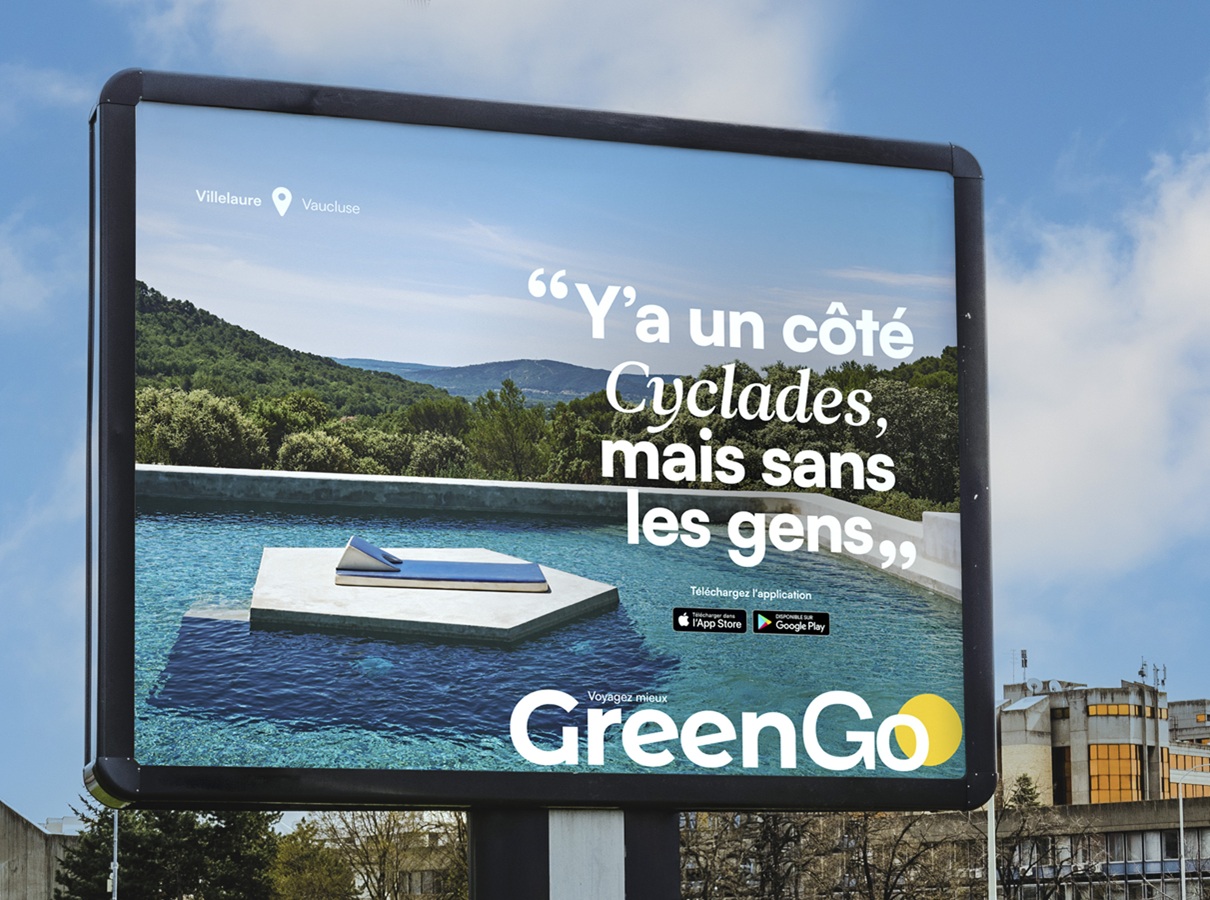
Wanting to establish itself as an alternative to American platforms and market giants, GreenGo decided to run a disruptive outdoor advertising campaign, aiming to dispel the myth of long-haul travel.

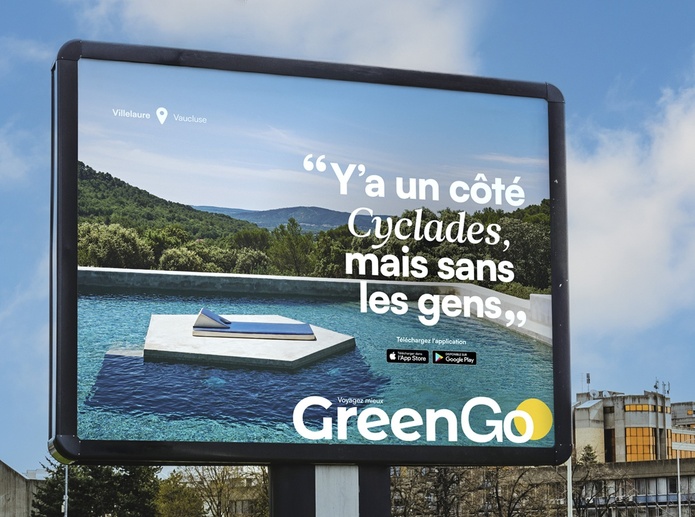
The visuals feature French locations, well-known or not, that closely resemble famous tourist sites around the world, with short phrases intended to catch the eye of pedestrians, drivers, or cyclists, such as: “This is like Canada, with eight hours less of flying” or “There’s a Cyclades vibe, but without the people.”

A large-scale marketing campaign for a company of around twenty people, going against the grain of a digital-native firm, since it is deployed on billboards and at bus shelters.

This is a major action for us at our scale, allowing us to be visible in hundreds of places in cities like Paris, Lyon, Toulouse, etc. We must acknowledge that this is our first awareness campaign. Our starting premise is simple: we see that GreenGo resonates with people, that individuals identify with the idea of traveling better. When they know us and try us, they come back“, explains the platform’s founder.

Early in the year, the startup conducted a brand tracker to measure its awareness among the general public. In the survey, French people were asked to name travel brands they knew from a provided list.

And surprise, GreenGo appeared in 5% of cases.

It’s not nothing, but it’s not a lot either. We therefore have a brand-awareness challenge, and to improve this, there is no secret: we must invest in marketing.


GreenGo inaugurates its first outdoor advertising campaign in cities and bus shelters

This is how the idea of placing outdoor boards in the urban centers of France came about.

But why choose this route for a platform that launched online in 2021?

We also invest a lot in social networks and Google. To be honest, we work across 15 different acquisition channels. We needed to diversify our communication channels and move toward offline channels.

We could have chosen among outdoor advertising, radio and television, but these media are not very accessible to us.


For people to know us more broadly, we must invest, while being prudent to avoid burning through cash. After all, this is a first step, the beginning of what we plan to roll out in the coming years
“, hopes he.

And ultimately, to gain visibility, GreenGo will multiply its presence by ensuring physical and visual visibility in French cities, while also deploying the same campaign on social networks and through influencer actions.

To read: From France’s roads to Argentine glaciers… Guillaume Jouffre’s transformative travels

It is therefore a comprehensive effort to be visible to a large portion of the French population.

The theme we’ve chosen is that you don’t need to travel to the far corners of the world to enjoy your holidays. It’s like the United States, but without Donald Trump.

We do not foreground the environmental aspect, even if it is underlying, but rather the side of desire and longing. Our mission is to encourage people to travel locally or not too far, to reduce the impact of holidays
“, analyses Guillaume Jouffre.

Incidentally, note that another site has also undergone a transformation by stepping away from digital to advertise in the Paris metro. Founded in 2016, Kombo launched its first offline campaign during the last two weeks of April.


Summer 2027: GreenGo expects a ketchup effect on bookings


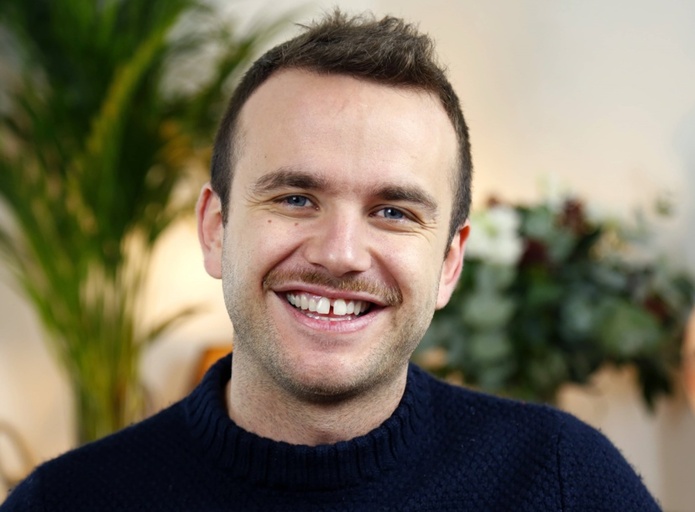
Guillaume Jouffre, fondateur de GreenGo - Photo GreenGO

Matthieu Marquenet, founder of Kombo, feels that his company has evolved from a simple website into a well-known brand. An achievement that will probably not immediately boost revenue, but rather in the medium and long term.

This will likely also be the case for GreenGo, even if the challenge remains to successfully navigate a summer that appears to be complicated. According to many professionals, including specialists on France, the summer season is presently in the background.

The economic context is peculiar and we observe a rather strange trend, with the booking window shrinking. In March and April, it shortened by more than a week: we went from 67 days to 60 days between booking and stay.

Moreover, we observe that the average order value is slightly down, by about 3 to 4%, and the number of nights is also decreasing.


I don’t think the French will drastically cut their vacation budgets or their desire to travel. I bet they simply shifted their booking window due to the conflict. There is a lot of hesitancy. We are waiting for the ketchup effect; the question is when it will occur“, estimates the gastronome Guillaume Jouffre.

The ketchup effect was popularized by footballer and economist Cristiano Ronaldo, who stated in 2010 that “Goals are like ketchup: when they come, they all come at once.

The expression has since been used in the Harvard Business Review to describe a product, a market, or an asset that struggles to find its audience, before suddenly accelerating.

So, will tourism experience its ketchup moment? No one knows for sure, but the entire industry hopes so. It will depend on Trump and his willingness, or not, to end the conflict, on oil prices, and on a potential economic crisis.

In any case, this hesitation does not seem to scare GreenGo’s teams.


GreenGo: “We no longer want to be dependent on fundraising”

We continue to sign up new hosts, almost 1,000 locations per month, while maintaining our level of rigor, meaning accommodations that are committed and with a certain degree of uniqueness“, continues the leader.

And despite everything, the satisfaction rate remains high, with an average rating of 4.87 out of 5.

The startup’s audience is looking for an offering that isn’t industrialized, with character, where human touch remains important, all without necessarily being premium.

A development, as with gift cards, made possible by the capital opening completed with 772 micro-shareholders. In just three days, it raised €1.6 million.

We feel the wind has shifted, that funding in the startup field is more complex, and when you run a company focused on eco-responsibility and travel tech, it’s even harder.We have entered a phase where we must be capable of reaching profitability next year. For the first time, we anticipate break-even at a scale that is already ambitious, and that pleases us.

This is not an indispensable path; we could choose to raise funds, but it is our strategic choice. The venture capital market has certainly cooled, and we no longer want to be dependent on fundraisings that force burning cash. We want to build something solid“, states the founder, setting the course.

Nevertheless, nothing guarantees that another fundraising round won’t occur in the coming months.

In a way, the teams want to take a breath after several sprint-like efforts to ensure GreenGo’s growth.

Europe remains an ambition, but a bit farther off, as its conquest requires funds. It will partly depend on the next fiscal year. What about developing a purpose-driven company for a more sustainable world in a rather unfavorable context?

Like everyone else, I’m observing this backlash, which really coincides with Donald Trump’s election. It is much harder to talk about ecology in the media and reach is lower even on social networks.

I belong to those who think we should not cling to these topics at all costs, but rather shift the communication strategy. We must use the desirability angle and say that our product has a positive impact, instead of talking about urgency and saying it’s a catastrophe.

We must stay engaged, while steering toward more broadly acceptable themes, such as domestic production (made in France) on our side