
Year 10 Internship and Summer Camp: Anglais in France Launches Several New Features (Video)


TourMaG – You are the founder of Anglais in France, but before that you were a teacher. What was your journey?

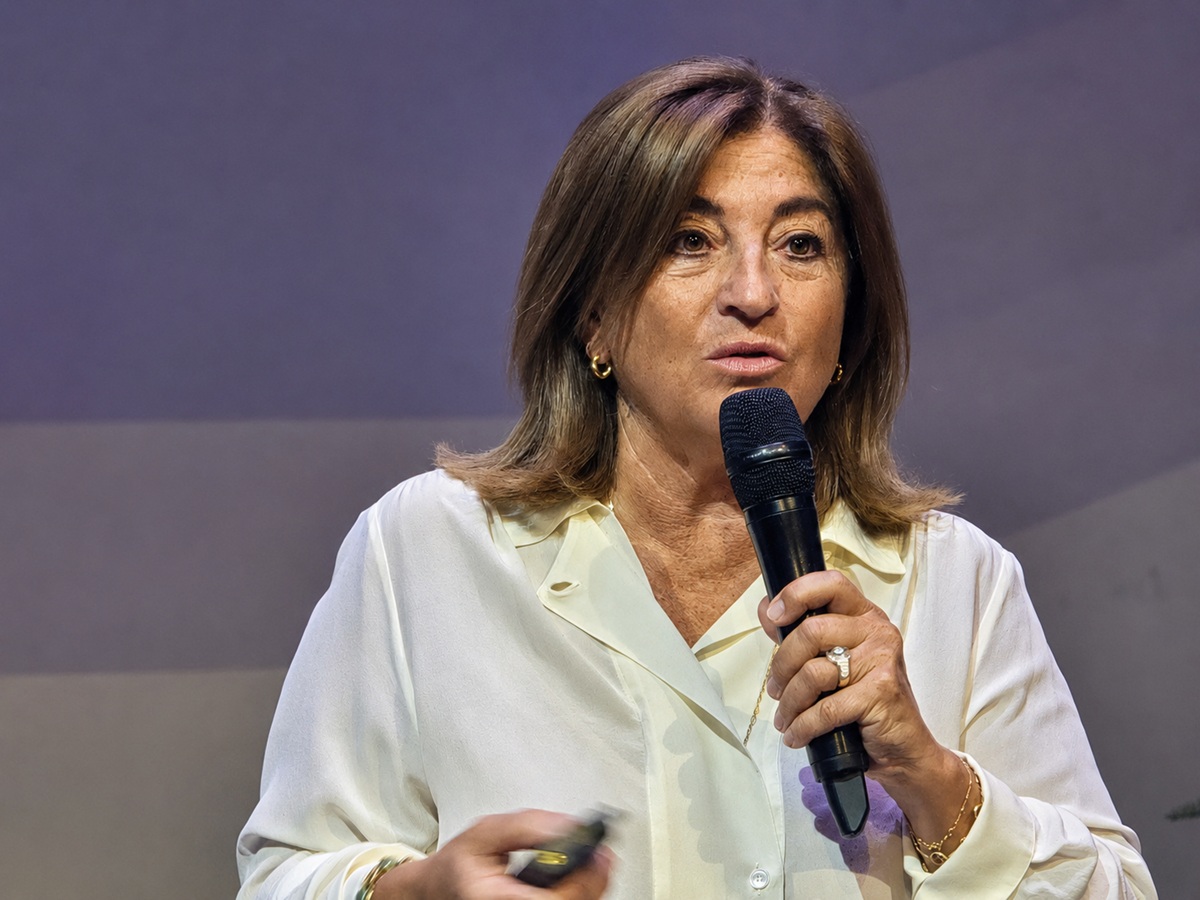
Jennifer Laur :
The path is fairly straightforward. I hold a licence in English and civilization, then I worked as a teacher, both with the national education system and at the Ministry of Agriculture. Later, this led to the creation of Anglais in France in 2008.

TourMaG – How did the idea of creating this agency come about?

Jennifer Laur :
With my family, we were host families for English girls coming from a Welsh secondary school. I really enjoyed welcoming these girls into our home and I found this work very interesting.

My mother was in contact with someone who had set up an agency in Versailles, and I already found that sector interesting. Then, with the rise of the Internet, I thought it was the right moment to take action.

TourMaG – At what point did you realize there was a real market?

Jennifer Laur :
Being a former civil servant, I didn’t really think in terms of a market. I mainly aimed to do something enjoyable for myself and to please people who wanted to learn English differently.

I also wanted to enable English speakers, mostly British, living in our rural areas to share their culture and their new life in France with the residents of their host country.


We launched a second-year internship called “Bridge’nWork”

TourMaG – Your concept is unusual: 100% English… but in France. How does it work?

Jennifer Laur :
The starting idea was to allow French people to connect with Britons living in France who hold a qualification to teach their language. As a teacher, that pedagogical aspect seemed essential.

The goal is to live an “English way” of life without crossing the Channel. These British families also understand cultural differences very well since they themselves are immigrants in France. They know how challenging certain situations can be when you don’t fully master the language or the cultural codes.

TourMaG – Do you address both young people and adults?

Jennifer Laur :
Yes, absolutely. The stays start from 12 years old and go up to 80, including students and professionals.

TourMaG – Do you learn English just as well in France as abroad?

Jennifer Laur :
It’s not necessarily the same approach. People who choose our stays often seek something very cocooning. We see more and more young people who refuse to go abroad for a first stay and who prefer to stay relatively close to home.

They need to feel reassured, to know they are only a few hundred kilometers from home and that they will be cared for all week within a family setting. There are no transportation logistics to manage, everything happens within a family environment.

TourMaG – What new features are you launching this year?

Jennifer Laur :
We have launched a second-year internship called “Bridge’nWork.” It allows high school students to come to our agency in Vazerac, in Tarn-et-Garonne, to practice professional English.

They meet British partners with whom we work daily and discover how Britons build their activity in France: administrative difficulties, language barriers, but also the entire Anglo-Saxon culture of associations.

For example, we have 100% English-language charitable bookstores or associations devoted to protecting stray cats. All of this associative fabric around animals is very developed in the United Kingdom and also represents an interesting cultural contribution.


Summer camps for the younger participants

TourMaG – And for the younger ones?

Jennifer Laur :
We have also created a mini summer camp in Vazerac, with a maximum of six youngsters and a native English-speaking animator.

There is always equestrian activity, English outings, and a very rural, family setting. It’s designed for youths who don’t yet feel ready to go abroad on a full family immersion on their own, and who want a first step before a more intensive stay.

TourMaG – CPF training programs are now capped at 1,500 euros. Is that a barrier for you?

Jennifer Laur :
Yes, clearly. It compels people to fund a larger portion of their training themselves. We can offer shorter trainings, but it’s a pity because a full week yielded very good results.

We already have an advantage by offering immersion in France. The trainers must have an activity number and be based in France. If they are not auto-entrepreneurs or micro-entrepreneurs, they must hold Qualiopi certification, which is very challenging for language schools located abroad.

TourMaG – Does offering stays in France shield you more from the current geopolitical context?

Jennifer Laur :
Yes, without a doubt. We haven’t seen a drop in demand; on the contrary, we think it could rise this year.

Our clients look for something very specific. The market has matured: people know exactly what they want and what they don’t want. Usually, when they contact us, they book a stay.

TourMaG – Yet the language-stay market has struggled since Covid…

Jennifer Laur :
Yes, the sector is generally struggling, but it depends a lot on destinations and the types of stays offered. We are in a period of transformation. Young people may want something different today, and we must reinvent the language stay of tomorrow.

TourMaG – How do you specifically imagine the language stay in ten years?

Jennifer Laur :
Very honestly, I don’t foresee it clearly. We discuss this a lot with my colleagues at UNOSEL, and it’s hard to project. Everything evolves very fast, just like travel agencies or tour operators. We must stay attentive to market evolutions and try to sense where the wind is blowing. Today, projecting ten years ahead is difficult.

TourMaG – And how do you see your company evolving?

Jennifer Laur :
We picture ourselves remaining a two-person team. We don’t aim to expand the agency beyond measure. The idea is above all to continue doing what we enjoy and to satisfy our clients. We like developing new products to adapt to the market, but we want to stay in France, notably to preserve the closeness with the host families we meet in person every two years. Human quality and tailor-made experiences remain essential for us.

TourMaG – Are your clients loyal?

Jennifer Laur :
Extremely so. Today we welcome younger siblings, cousins of former participants, and the like. Families find us mainly through Google and increasingly via AI. But more than anything, people want to speak directly with the founders. They seek that human contact.

We simply explain what we do, and if they connect with the concept, they book a stay.

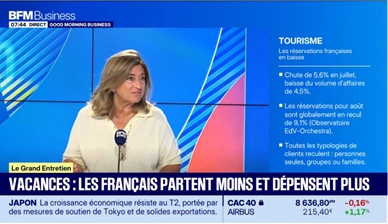
EDV Barometer: Orchestra – Reservations Fall 18% in May as Summer Slowdown Widens

French Vacation Observatory — June 2026

The Travel Agencies of France — Orchestra / Travelsoft

June 2026

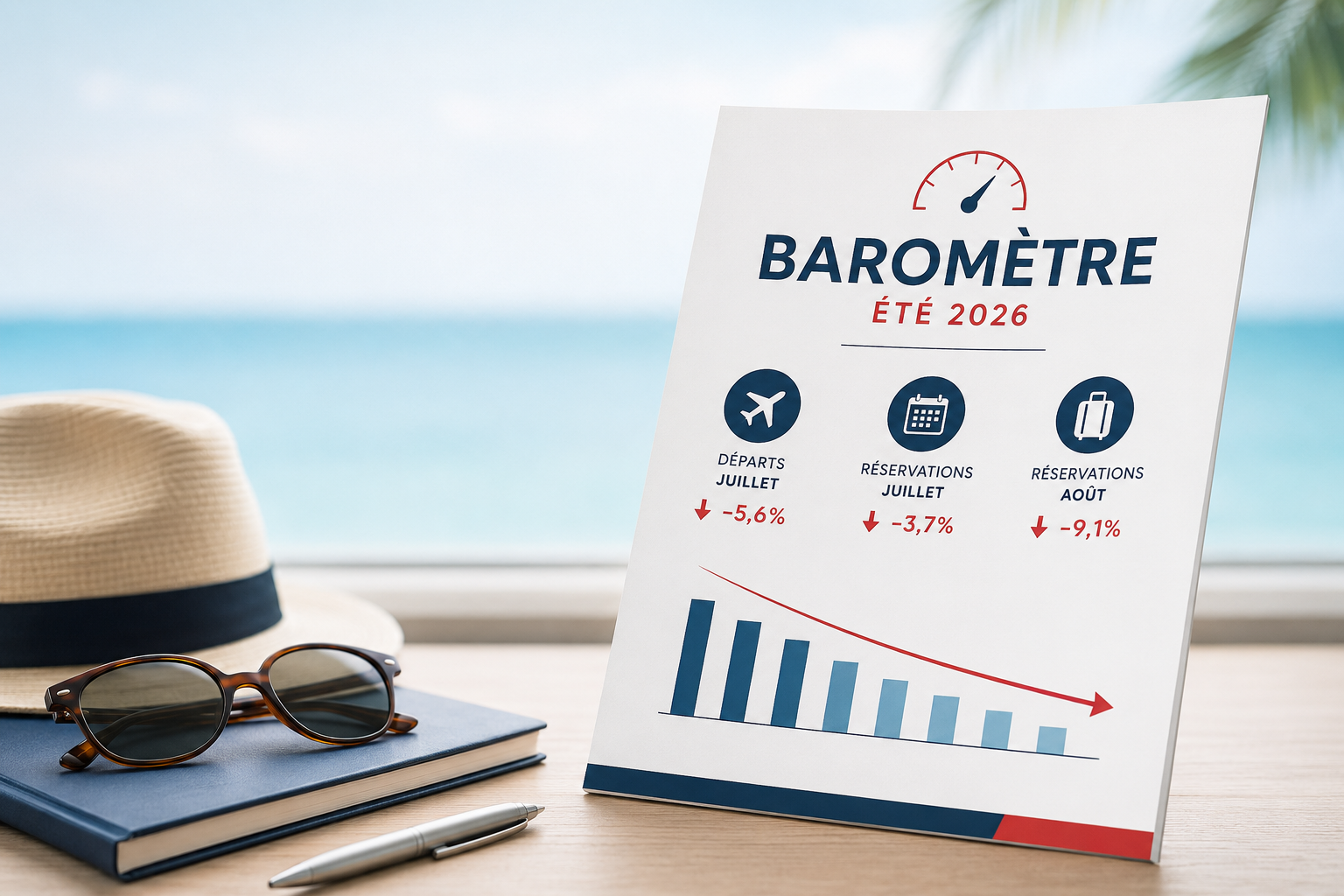
The summer of 2026 looks set to be challenging for travel distributors. The latest edition of the French Travel Companies Observatory (EdV) and Orchestra confirms a clear slowdown in bookings. May departures still temper the overall drop.

Regarding departures through the end of May, the number of files is down 1.7% compared with the same period in 2025, while the business volume falls by 1.3%. The average basket edges up slightly by 0.4% to reach €1,555. It is worth noting that a significant portion of May travel had already been booked before the worsening situation in the Middle East.

France itself even records a 6.4% increase in business volume, while the medium-haul segment remains broadly stable. By contrast, the long-haul sector remains under pressure, with the number of files down 11.5% and turnover down by nearly 10%.

Destinations in the United States (-34.3%), Mexico (-22.7%), and Cape Verde (-12.6%) are among the hardest hit. Conversely, Albania (+342.6%), the Dominican Republic (+14%), and Croatia (+12.6%) continue to grow.

Summary:
– Bookings plunge in May
– An ever more retreating summer

Observatory — June 2026

Departures in May 2026

Market activity shows a slight dip: files down 2%, business volume down 1%, and the average basket nearly steady at €1,555. It should be noted that a significant share of May departures had already been booked prior to the deterioration in the Middle East situation.

Key indicators for departures through the end of May:
– Business volume: -1.3%
– Number of files: -1.7%
– Average basket: +0.4% (€1,555)

Geographic zones — departures May 2026 vs 2025

Top 20 destinations — departures May (number of dossiers vs 2025)

Note: A geographic breakdown and the list of top destinations are shown to illustrate regional and market concentration, with France and major outbound corridors highlighted.

Section 2 — May 2026 Reservations

Reservations in May 2026 show a sharp retreat: business volume down 21%, number of files down 18%, and the average basket down 4% to €1,632. The average lead time also contracts to 63 days, down 4 days versus 2025, signaling that bookings are being made increasingly closer to departure amid geopolitical uncertainties.

Key indicators for reservations in May 2026:
– Business volume: -21.3%
– Number of files: -17.9%
– Average basket: -4.3% (€1,632)
Lead time to departure: 63 days (-4 days vs 2025)

Geographic zones — reservations May 2026 vs 2025

Top 20 destinations — reservations May (number of dossiers vs 2025)

Geographic patterns and popular destinations for May reservations are presented, illustrating shifts in demand by region and corridor.

Section 3 — Summer Holidays 2026

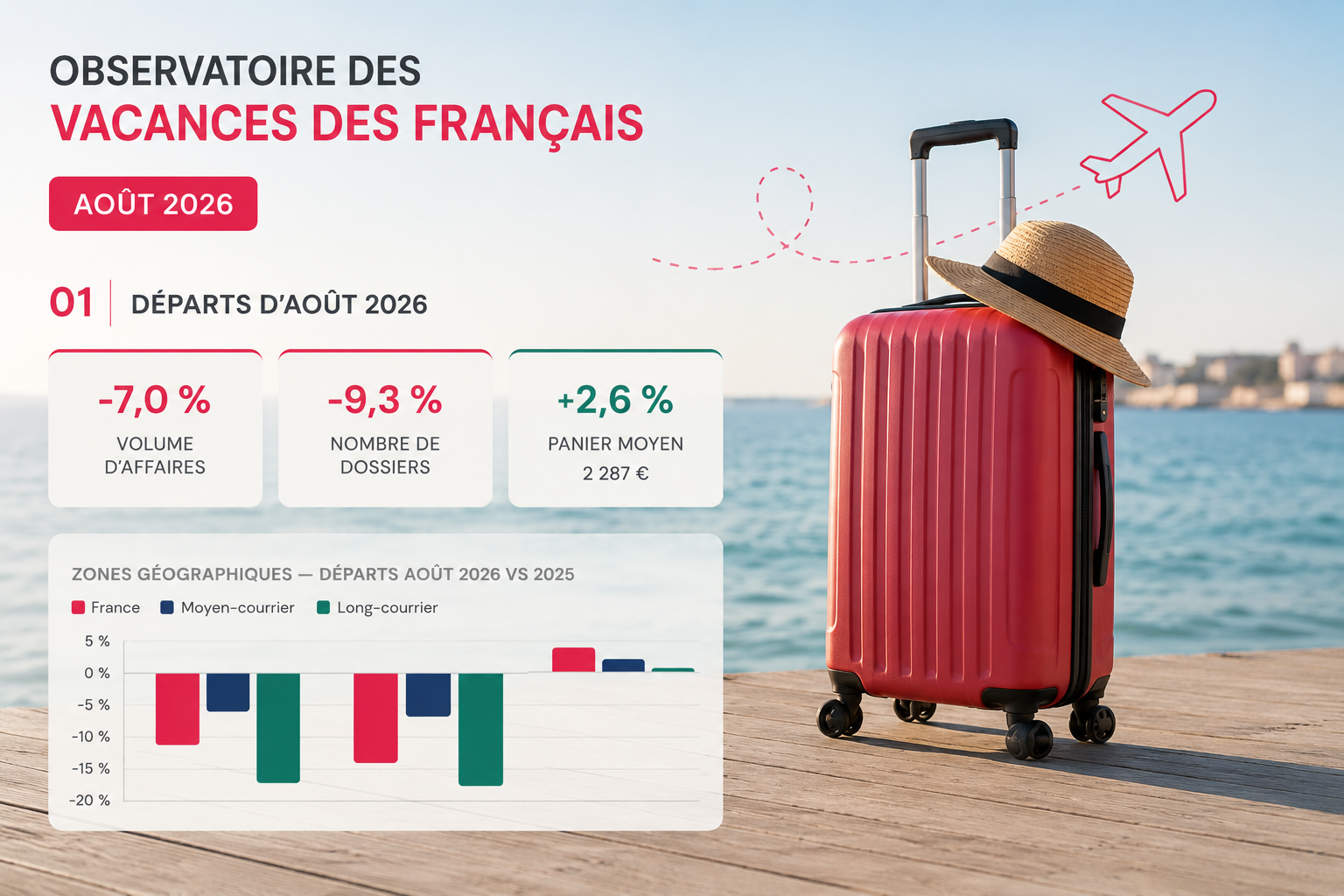
Summer 2026 (July–August) reservations are down by 10.5% compared with 2025, both in terms of dossiers and business volume. The average basket remains stable at €2,710. All zones show declines, with long-haul the most affected, posting a 20% drop in dossiers.

Key indicators for Summer 2026:
– Business volume: -10.5%
– Number of dossiers: -10.5%
– Average basket: +0.0% (€2,710)

Geographic zones — reservations summer 2026 vs 2025

Typologies of travelers — Summer 2026

A snapshot of traveler types for the summer shows the following profiles:
– Solos: 3.1% of dossiers; -15.7% in dossiers; €1,700 on average
– Duos: 34.3% of dossiers; -11.8% in dossiers; €2,302 on average
– Families: 48.0% of dossiers; -10.1% in dossiers; €2,753 on average
– Groups: 14.5% of dossiers; -7.6% in dossiers; €3,748 on average

Categories of stays — Summer 2026

The distribution of stays by category for the summer shows:
– Packages: -9.8%; Basket up 1.2% to €2,772
– Accommodations: -11.8%; Basket up 0.1% to €1,141
– Circuits: -15.9%; Basket down 3.9% to €5,823

Top 10 destination cities — Summer 2026

Top 10 destination cities for the summer of 2026 are presented, illustrating the geographic spread of demand across leading urban and resort destinations.

Footer

Source: Observatoire des Vacances des Français — The Travel Companies of France (Les Entreprises du Voyage) · Orchestra / Travelsoft — June 2026
Data drawn from travel agencies using the Orchestra platform (20+ brands, minimum of 2 years).

6 Breathtaking Scenic Hiking Trails for Your Summer Vacation

Summer often means vacation. While some prefer soaking up the sun by the pool, others choose to use their free time to recharge by reconnecting with nature through hiking. These active holidays are appealing to more travelers, but you still need to find the ideal place to indulge in this small pleasure. Fortunately for you, The Guardian recently highlighted six hiking trails across Europe that are worth a detour. All that remains is to pick your favourite.

Jungfrau, a mythical summit of the Swiss Alps

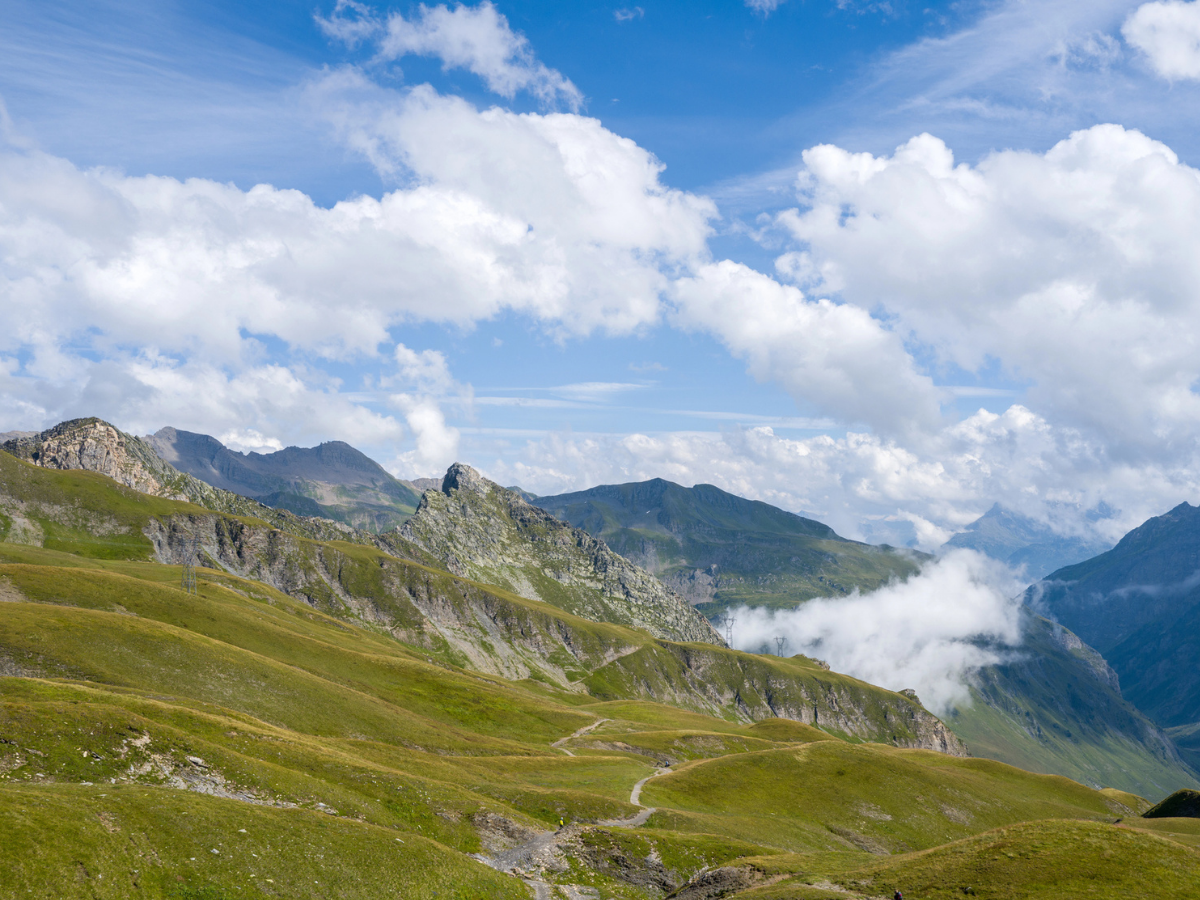
If you decide to tackle this hike, plan between 3 and 9 days to cover up to 119 km. Along the way you will encounter sparkling lakes, waterfalls cascading from fairy-tale valleys, and picturesque villages perched at dizzying heights. Another advantage: the entire route is served by an efficient network of postal buses, cable cars, mountain trains, and of course clearly marked trails, making progress stress-free and free to roam.

Summer is the best season to embark on a hike there, especially since trails are snow-free, huts are open, and the weather is typically stable. The new Cicerone hiking guide, The Bernese Oberland, recommends a 119 km circuit (in nine stages in the Jungfrau region, a stunning intermediate-level loop starting from the village of Grindelwald). Lodging is plentiful, and it is even possible to reserve hut spaces in advance.

Alpe Adria, a perfect blend of the Austrian Alps and Italian charm

To complete this hike of over 725 kilometers, plan between 7 and 9 days, or more. It begins at the foot of Grossglockner, Austria’s highest peak, and stretches to the Adriatic shores. If you don’t have enough time to finish it in full, a week in the Slovenian Julian Alps is an excellent alternative.

Despite breathtaking landscapes and more affordable prices than those in Switzerland or France, the Slovenian mountains tend to be quieter than other summer hotspots. It’s time to lace up your hiking boots and discover these marvelous vistas.

The Portuguese Way, ideal for reaching Santiago de Compostela

It’s wise to budget around two weeks to complete this trek and fully savor it. This coastal route leads all the way to Santiago de Compostela. The Portuguese Way to the tomb of Saint James is the third most frequented, offering a friendly atmosphere among pilgrims while remaining less crowded than the French Way. Atlantic breezes keep the air fresh, and there are plenty of chances to swim.

It crosses fishing villages and expansive stretches of golden sand, all the way to Caminha, where a boat can cross the Minho River to reach Spain. However, pilgrim inns in town cannot be booked in advance, so it’s wise to reserve hostels and private hotels ahead of time, especially in summer.

Along the Lech, a wild Alpine river between Austria and Germany

Plan between 7 and 10 days to complete this hike. This trail, rated easy to moderate, is the first to have earned the Leading Quality Trail label from the European Ramblers Association, guaranteeing the quality of its infrastructure and waymarking.

It follows the Lech from its source in the mountains, at 1,793 meters above sea level, near the Formarinsee lake in Austria, to the Lechfall waterfall in Füssen, in the Bavarian Alps of Germany, and is fully accessible from mid-June to early October. Along the way, numerous facilities line the route, including mountain villages offering comfortable accommodations, as well as historic churches and local artisans who keep traditions alive, from beer to cheese.

The Beara Way, a particularly immersive Irish hiking route

If the heat is hard to take, this hike is for you. The Beara Peninsula, in the southwest of Ireland, offers a true refuge from summer temperatures, softened by Atlantic breezes that bring a welcome natural coolness. Moreover, located below the more famous Dingle and Iveragh peninsulas, Beara partly escapes the crowds. The full Beara Way, starting and ending in Glengarriff, can be completed in about ten days.

You can also dedicate a few days to exploring a selection of the 15 circular hikes that make up the route. Among them, Ireland’s only cable car that crosses the sea to Dursey Island, for a 14.5 km loop around this largely desolate island, or the ferry crossing from Castletownbere to Bere Island, an open-air museum island housing Martello towers, cannon batteries, a lighthouse and a Viking-fortified harbor.

The impressive Kuststigen coastal trail in Sweden

A hike that will reveal Sweden like never before. The Kuststigen isn’t a continuous route along Bohuslän’s coast in western Sweden, but a collection of 44 well-marked stages, some linked together, others not, and most are easily reachable by ferry or bus.

The route highlights sapphire waters, pink granite outcrops, fishing villages with colorful façades, and part of the roughly 8,000 islands and reefs that make up this exceptional coastline. To enjoy a touch more serenity, it’s best to visit at the end of August or the beginning of September, or even in June, when temperatures stay mild and the coast is less crowded.

Air France-KLM and Transavia Offer Free Changes on Summer Tickets


Air France-KLM, Transavia dégainent des billets modifiables sans frais pour l'été - Depositphotos.com

CroisiEurope


As the summer season approaches, the Air France-KLM group affirms that its airlines Air France, KLM, and Transavia will be able to transport all of their customers this summer.

Already at the Travel Companies Congress in Disneyland Paris at the start of May, Henri Hourcade, Senior Vice President France of Air France-KLM, stated: “Our summer program will be kept. No flight will be canceled for reasons related to the price of kerosene”.

In a press release published on Tuesday, June 3, 2026, the group indicates it is actively preparing for the peak summer period and wishes to assist travelers who have not yet booked their holidays.

Benjamin Smith, Chief Executive Officer – Air France -KLM, declared: During this period, our airlines will operate nearly 2,200 flights per day to more than 320 destinations around the world. Our teams are fully mobilized to welcome our customers, who have already travelled massively in May on the occasion of the various long weekends in France and the Netherlands

This statement comes as “questions about fuel availability have filled the media space”, notes the group. Air France-KLM nonetheless asserts that its airlines have the means to ensure their flight program and transport their passengers during the peak season.

The group also specifies that whatever the purchase date, Air France, KLM and Transavia commit to not seeking any fare adjustments in the event of rising fuel costs for bookings already confirmed and paid.


Air France – KLM, Transavia: Tickets Modifiable at No Charge for the Summer

Afin d’encourager les réservations et d’offrir davantage de souplesse aux voyageurs, Air France, KLM et Transavia lanceront à compter du 3 juin 2026 une campagne promotionnelle sur les voyages au départ de la France.

Dans ce cadre, les clients pourront bénéficier de billets modifiables sans frais, une mesure présentée par le groupe comme un moyen d’apporter davantage de flexibilité dans l’organisation de leurs déplacements estivaux.

Air France-KLM précise ainsi vouloir rassurer les voyageurs et les accompagner dans la préparation de leurs vacances alors que débute la période de forte activité du transport aérien.

Airport: Expect Long Lines This Summer

The new European border management system, called EES (Entry/Exit System), has come into operation on 10 April 2026. It is a European database enabling the digital collection of personal data from third-country nationals, whether visa-exempt or not, upon their entry into and exit from the 29 Schengen-area countries. This device was introduced to modernize controls at Europe’s external borders.

It gradually replaces the manual passport stamp with a digital record of non-European travelers’ entries and exits, including biometric data such as a facial photograph and fingerprints.

However, since its rollout at airports, the system has caused disruptions, notably long queues for travelers. Indeed, according to a recent Financial Times statement, several affected countries placed late orders for the biometric data-collection machines required to implement this device, which could significantly disrupt travel during the peak summer season.

A new European border system that could disrupt air travel this summer

Marco Troncone, the head of Rome Airports, recently told a British media outlet that he was “very worried about the summer” and that “the EES system must be suspended to avoid a catastrophe.” Indeed, the situation has already caused concern in Switzerland, Portugal, Belgium and Greece, where authorities have sometimes suspended biometric checks to prevent airport saturation, while American and British holidaymakers prepare to flock to the continent. Olivier Jankovec, head of the airport industry association ACI Europe, meanwhile warns that the “system is not functioning”.

Originally, the automated system was designed to process each passenger in less than a minute. But when it is out of service or malfunctioning, customs officers must revert to manual checks, including fingerprint collection. This is why wait times can grow substantially for travelers, especially since many airports require a single queue for all passengers.

According to ACI Europe’s findings, drawn from 45 airports across 20 countries, passengers wait up to three and a half hours to be served. Smaller airports have been particularly affected by the new device, notably the Greek islands of Corfu and Zakynthos, which require travelers to wait on the tarmac. According to Olivier Jankovec, the European Commission “from the start, ignored the operational implications of the device. For weeks and months, they refused to see that we had problems”, he revealed.

European airports adapt their strategies to address EES-related challenges

To mitigate the difficulties related to implementing the EES, some member states are organizing as best they can. Malta has announced a contract with an Italian company specializing in artificial intelligence for installing facial-image capture kiosks, while the Czech government awarded a contract for fingerprint readers at Prague Airport. Meanwhile, Ryanair has asked Spain to suspend its entry authorization system, described as “half-baked” after complaining of “excessive” queues that can reach up to an hour at passport controls.

Switzerland has already had a glimpse of the disruptions the EES could bring this summer, its airports having faced long delays during the winter ski season. At Geneva Airport, queues for non-EU passengers reached up to two and a half hours, prompting authorities to double staff in the arrivals hall. The European Commission, for its part, has repeatedly stressed that the system is functioning correctly and that member states have the flexibility to temporarily suspend biometric checks until September.

According to Commission figures, the new system has already logged more than 108 million entries since October and has denied access to 42,000 people, including 1,100 deemed security risks. Moreover, a Commission spokesperson recently reaffirmed that it is up to member states to ensure proper deployment of the border-management operating system on the ground. The smooth operation of borders must be guaranteed by member states through a sufficient number of border guards and automated solutions, such as self-service kiosks and electronic gates.

Costa Guarantees Mediterranean Fuel Prices All Summer


© Costa Croisières

CroisiEurope


Fuel Guarantee: Transparency and Commitment

First differentiating element, and probably the most impactful today in the customer journey: the guarantee of no fuel-related price increase after booking on the maritime portion. In a context where energy fluctuations remain on everyone’s minds, Costa chooses transparency and commitment. Specifically, for Mediterranean departures this summer, the price displayed at the time of booking is final for departures through September 30, 2026. No surcharge will be added as departure approaches. For travel agents, this promise radically changes the commercial dialogue. It immediately removes a frequent objection and builds a climate of trust. The customer knows where they are going, and, most importantly, how much it will cost, with no surprises. In a competitive market, this price stability becomes a strong competitive advantage capable of tipping the decision.


Flexibility: Free Changes Before Departure

Alongside this price control, there is a direct answer to another key traveler need: flexibility. Costa thus offers free changes up to 31 days before departure. A flexibility that fits perfectly with current expectations, especially among hesitant clients or those planning ahead. Booking no longer means rigid commitment, but securing an opportunity while keeping the ability to adjust the plan. For sellers, this approach greatly facilitates conversion: it helps encourage immediate decision-making by reducing the sense of risk.


Modifiez sans frais © Costa Croisières


“Today, the true value when choosing a vacation lies in the ability to plan it with complete serenity. Travelers who book in advance seek both simple solutions and the freedom to adapt their plans if circumstances evolve. This is what our ‘Modify without fees’ offer makes possible,” says Aurélie SOULAT, France Commercial Director of Costa Croisières. “This flexibility is part of a broader approach of transparency and reassurance, with notably our guarantee of a locked-in price, with no fuel-related increases after booking. In a context where budget control is essential, it is fundamental to be able to offer our clients a clear view of the final price of their holidays, with no surprises.”

But beyond price and flexibility, Costa also provides a concrete answer to a very operational constraint: access to the departure port. On this point, the cruise line enriches its offering with simple and attractive solutions, notably around the Costa Pacifica. For certain departures from La Seyne-sur-Mer, a free train option is offered from Paris and Lyon. An initiative particularly relevant to broaden the catchment area, attract an urban clientele or meet the expectations of travelers who want to avoid driving. This ease of transportation fits into a seamless customer journey mindset, where every step of the trip is designed to be simple.


Train gratuit au départ de Paris & Lyon © Costa Croisières


Enhanced Accessibility: Train, Car, and Alternatives to Flying

Simultaneously, departures from Marseille also enjoy excellent accessibility. The port is easily reachable by train, with direct connections from many French cities, and also by car, providing great scheduling freedom. This plurality of options lets agents tailor their messaging to the client profiles, highlighting the most relevant solution according to their travel habits.

Ultimately, Costa builds a coherent and especially effective proposition: a secured price, flexible booking, and simplified access. Three elements that directly meet market expectations and give travel agents tangible, immediately actionable arguments at the point of sale. In a context where reassurance has become a key conversion factor, this approach not only facilitates the sale but also positions cruising as a clear, calm, and controlled choice.


A Clear, Readable, and Accessible Pricing Policy

Beyond the fuel guarantee, Costa also strengthens its appeal with a powerful promotional offer: -50% off the second passenger until June 8, 2026.

This promotion helps reposition cruising as a product that is both competitive and transparent. The client perceives real value: a fair and controlled price.

By combining a guaranteed price on the cruise portion, an immediate discount, and flexibility, Costa offers a pricing narrative that is clear, reassuring, and engaging. A strategy that perfectly meets current market expectations and makes the act of purchasing easier than ever.


Portugal in Summer: Unique Opportunities for Unforgettable Experiences


Aveiro © Shutterstock

CroisiEurope


It’s precisely this diversity that makes the country an irresistible proposition for those seeking authentic and unforgettable experiences.

In a world where travelers increasingly seek personalization, authenticity, and connection, Portugal presents itself as the ideal setting for incentive programs, corporate events and tailor-made trips. At IN TOURS PORTUGAL, our mission is to transform every journey into an intimate encounter with the true Portuguese spirit, especially when summer is in full swing.


A Summer of Tradition and Discovery

It is easy to fall in love with Portugal in summer. Of course, the beaches of the Algarve, the Costa Vicentina, and Comporta remain iconic, but the true charm also lies in discovering less obvious corners, in living traditions and in experiences that go far beyond the crowds.

During the summer months, historic villages come alive, local markets overflow with fresh produce and the streets light up with local celebrations. Everywhere, there is a celebration. In Lisbon, the aroma of grilled sardines blends with the music of neighborhood fêtes, while in Porto the sky is illuminated by the colorful balloons of the São João festival. In Alentejo, the warmth invites serenity, long outdoor dinners and leisurely strolls between vineyards and golden fields.

For travelers seeking authenticity, Portugal in summer offers a lifestyle that encourages slowing down. There is time to enjoy a glass of wine on a riverside terrace, time to explore villages where tradition remains intact, and time to admire unforgettable sunsets from rooftops overlooking historic cities.


© Shutterstock


A Destination to Experience

Summer in Portugal is an invitation to active discovery. Sailing trips on the Tagus or the Douro, exclusive regattas on the Atlantic, hikes along cliffs or bike rides through vineyard valleys, the country offers a wide variety of experiences blending nature, adventure and well-being.

For those who prefer a more cultural summer, the historic centers of Portuguese cities are true open-air museums. In Lisbon, the Alfama and Mouraria districts preserve the soul of the city with their labyrinthine lanes, centuries-old azulejos and hidden miradouros. In Porto, Ribeira remains a living postcard, but it is in creative workshops, wine caves and renovated markets that the city reveals its most contemporary face.

At IN TOURS PORTUGAL, we craft these authentic and tailor-made experiences with meticulous attention to detail, tailored to each group and objective. We offer personalized itineraries that showcase the best of Portugal in summer—whether through exclusive dinners in historic palaces, private sunsets in secret venues, outdoor activities or gastronomic programs celebrating the season’s flavors.


The Value of Human Encounters

What truly makes Portugal special is the warmth of its people. Summer is the season when the country opens its arms even wider, with sincere hospitality and smiles freely offered.

More than destinations, IN TOURS PORTUGAL offers encounters. We work with local producers, artisans, chefs, guides and hosts who are passionate about sharing their stories and culture. It is these people who make the difference and render each program unique and unforgettable.

Portugal, especially in summer, is a place where human connections naturally form—around a shared table at a local market, during a tile-painting workshop, on a sunset boat ride, or in spontaneous conversations with those who know how to tell their country.


Santo Antonio à Lisbonne © Shutterstock


A Strategic Destination for Travel Agencies

Today, Portugal is a highly competitive destination for travel agencies and event organizers. Its air connectivity, quality infrastructures, safety, award-winning gastronomy and wide range of unique experiences make it a strategic choice for leisure and business tourism.

Portugal is a destination suited to both small exclusive groups and large-scale events, with options ranging from charming boutique hotels to contemporary venues and outdoor spaces offering spectacular views.

At IN TOURS PORTUGAL, we provide travel agencies with our in-depth knowledge of the country, our creativity and our network of trusted partners. We work closely with our clients to create personalized programs that surprise and add value, while ensuring dedicated and flexible service.


Best Summer in Canada for Groups | Receptour


© Receptour by Canva

CroisiEurope


A Signature Summer Stay to Discover the Best of Eastern Canada

Shining the spotlight on the “In the Heart of Summer” program, which will grant travelers an authentically Canadian experience. From the bustling streets of Toronto to the historic banks of Quebec City, passing through cosmopolitan Montreal and the capital Ottawa, the story of Eastern Canada unfolds. With the majestic Niagara Falls or the Thousand Islands National Park, natural treasures also await guests. Not to mention the warm and authentic ambiance of the traditional sugar shack.

In addition, for a total immersion in a Cabane au Canada-style experience, this eight-night itinerary includes two nights at L’Auberge du Cap au Large. A warm accommodation at the heart of preserved nature, on the shores of the Saguenay Fjord. The ideal option for travelers seeking a complete stay while keeping to a budget thanks to the sharp prices offered by the group travel specialist.

To meet travelers’ expectations, this itinerary is available from June to October, for a discovery under the summer sun or guided by the magic of autumn colours.


© Niagara Tourism


The Auberge du Cap au Leste: An Exceptional Accommodation

Although all accommodations offered in the “In the Heart of Summer” stay are of high quality and comfortable, a special mention goes to the Auberge du Cap au Leste. At Receptour, this typically Québécois establishment perched on the heights of the Saguenay Fjord is a standout lodging. A nature gem par excellence with some of the most breathtaking panoramic views in Quebec, it welcomes guests for a unique outdoor immersion.

The enchanting setting of the place is worth a detour by itself, as are its breathtaking sunsets. In addition, the rooms, all renovated in 2025, feature rustic décor and a cozy ambiance. Travelers will stay in large shared chalets, with a private bathroom in every room.

Here, guests have every opportunity to explore the kilometers of boreal forest thanks to leisure time designed to enjoy the inn and its facilities (spa, pool, bike rental, paddle…). Ideal before sitting down to savor the tasty dishes, prepared with local products by the chef, and to spend evenings around the fire under starry skies of unmatched clarity. In short, the assurance of living the essence of Quebec with a program designed to meet their expectations and much more!


© CAL


A Turnkey Summer Stay Designed for Professionals

To simplify marketing and facilitate the sale of this group circuit to professionals, Receptour Canada offers it in a Ready-to-Sell (PAV) format. The concept is simple. The agency provides dates with stock available immediately, thanks to allocations already negotiated with all the partners along the itinerary.

This turnkey stay format becomes a real sales lever for agencies. These are pre-established dates, availability, and negotiated rates guaranteed in advance. In other words, the assurance of the best prices, not to mention immediate confirmation at all times.

On the experience side, inclusions are plentiful. Between culturally guided activities led by local guides, an immersive sugar shack experience, or meals at the Auberge du Cap au Leste… The “In the Heart of Summer” program has been designed to offer a subtle balance between discovery, culture, and a concentrated dose of pleasure for travelers.


Authentic and Tailor-Made Programs Across Canada!

Thanks to its solid network of carefully selected partners, as well as a community of expert local guides and a team of enthusiasts, the Montreal-based agency can boast a rich and varied travel offering. Far from specializing in a single geographic region, Receptour conducts bespoke summer trips across all of Canada to suit clients’ desires.

Adventure in the Alberta Rockies and their turquoise lakes, journeys along the windswept coast of the Maritime Gaspé with its unmatched hospitality, a getaway on Vancouver Island to encounter orcas, or immersion in Indigenous culture in Western Canada: everything is possible!

From nature-centered, innovative stays to programs that check all the must-see boxes, including urban escapes for the city-dwelling adventurer, the receptive agency invites you to discover its entire Summer 2027 offering through its inspiring catalog.


© Receptour by Canva


Nordic Island With Caribbean Vibes Becomes a Timeless Zone Every Summer

While Norway often evokes rugged fjords, snow-covered mountains, and Arctic landscapes, a small island in the north of the country defies all clichés. Located above the Arctic Circle, Sommarøy surprises with its white-sand beaches and turquoise waters, earning it the nickname of the “Caribbean of the North.” But this unexpected scenery is not its only asset. Each summer, a spectacular natural phenomenon transforms the daily life of its inhabitants and offers visitors an extraordinary experience.

An Arctic Island That Resembles the Tropics

About thirty kilometers west of Tromsø, often considered the gateway to the Norwegian Arctic, Sommarøy has only a few hundred inhabitants. Yet this small fishing community attracts more and more travelers intrigued by its singular landscape. Here, the pristine beaches contrast with the usual image of the High North.

The origin of this scenery is very different from that of classic tropical beaches. In the Caribbean, the sand is mainly composed of crushed quartz. But on Sommarøy, it comes from the accumulation, over thousands of years, of fragments of shells and calcareous algae. This particular composition gives the seabed a very light color. Since the waters around the island are shallow, sunlight reflects off this white bottom and creates these turquoise and emerald hues that recall tropical destinations.

The very name of the island also means “summer island.” Historically, fishermen would come to this place during the good season to exploit the abundant shoals of herring present in the surrounding waters. Today, while fishing remains important, tourism occupies an increasing place in the local economy.

When the Sun No Longer Sets

If Sommarøy is today known far beyond the borders of Norway, it is in large part thanks to an initiative that earned worldwide attention in 2019. The inhabitants proposed turning the island into a kind of “time-free zone,” or “hourless” area, during the summer. An idea inspired by the midnight sun: for 69 consecutive days, the sun never sets.

In this light-filled, day-and-night landscape, usual benchmarks fade away. A midnight hike, a night-time kayak excursion, cycling, paddling between islets, or a late swim become perfectly ordinary activities. The residents summed up this mindset by saying they wanted “do what we want, when we want”.

Subsequently, it became clear that the proposal to remove schedules was never intended to be applied in practice. The operation was in fact part of a promotional campaign aimed at making the island known internationally. A staging that nonetheless rested on a tangible reality: in Sommarøy, the midnight sun allows enjoying the scenery and activities at any hour of the day or night.

Note that the winter period offers an equally impressive spectacle. When the sun disappears for long weeks, the northern lights take over and regularly illuminate the sky. The island’s terrain also enables skiing with a view of the ocean.

To extend the experience, travelers can stay at a local hotel equipped with large bay windows opening onto the surrounding landscapes. The cuisine highlights Arctic resources, notably seafood, reindeer meat, mushrooms, and wild berries. A way to discover another facet of this surprising island.

Best Train Trips in the United States This Summer

Traversing the Rockies, skirting the Pacific Ocean, or reaching the Grand Canyon aboard a historic train… In the United States, several rail lines turn travel into a true journey experience. While summer holidays often herald crowded airports and saturated highways, train travel is attracting more and more travelers who seek slower pace and spectacular scenery. This renewed interest is far from incidental: Amtrak, the U.S. public railway company, logged 34.5 million passenger trips in the latest fiscal year. From panoramic cars to steam locomotives, certain American routes offer journeys among the continent’s most impressive landscapes.

From the Rockies to the Pacific, routes carved for the great outdoors

In the western United States, several lines let visitors discover iconic scenery without taking the wheel. Among them, the Canyon Spirit, formerly known as the Rocky Mountaineer, links Moab to Denver in two days, threading the Rockies and the red rock formations of Utah and Colorado. The itinerary passes through Glenwood Canyon, carved by the Colorado River, and provides access to Arches National Park. On board, travelers enjoy glass-dome panoramic cars, spacious seating, and meals inspired by regional specialties. Nights are spent in hotels along the route.

Further north, in Alaska, the Coastal Classic of the Alaska Railroad connects Anchorage to Seward in 4 hours and 30 minutes. This seasonal line, operated from mid-May to mid-September, runs along Turnagain Arm before traversing the wild landscapes of the Kenai Peninsula. Glaciers and waterfalls punctuate the journey to Seward, the gateway to Kenai Fjords National Park.

In California, Amtrak’s Pacific Surfliner remains one of the country’s most popular itineraries. The line runs from San Diego to San Luis Obispo along much of the Pacific coastline, with stops in several seaside towns, including Santa Barbara. “The train journey itself is breathtaking, winding along the southern California coast and offering fascinating views of the Pacific Ocean”, said Jason Abrams, head of public relations at Amtrak, to Travel + Leisure.

The Amtrak network is also betting heavily on this line this summer. New connections have been added between San Diego and Los Angeles to coincide with the FIFA World Cup, further boosting the Surfliner’s appeal for summer travelers.

Historic trains that hark back to the Golden Age of American rail

Other routes appeal mainly for their heritage value. This is the case of the Grand Canyon Railway, which runs daily between the town of Williams, Arizona, and the south rim of the Grand Canyon. The trip lasts about 2 hours and 15 minutes in each direction and then travelers spend more than three hours on site before the return. A distinctive feature of the journey: some rotations are operated by vintage locomotives, recalling the glory days of American rail.

In Colorado, the Durango & Silverton Narrow Gauge Railroad traverses some of the state’s most spectacular mountain scenery. This historic line links Durango to Silverton in 3 hours and 30 minutes aboard a narrow-gauge train classified as a National Historic Landmark, a designation given by the U.S. government for exceptional historical significance. Up to three departures are offered each day during the peak season. Travelers then have a few hours to explore Silverton, an old mining town perched in the mountains.

Another emblematic line is the Cumbres & Toltec Scenic Railroad, straddling New Mexico and Colorado. Considered one of the best-preserved steam railways in the United States, it follows the meanders of a canyon before crossing a viaduct rising 42 meters high. This route operates six days a week from late May to late October.

Finally, long-distance enthusiasts can board the Amtrak Cascades, which connects Eugene, Oregon, to Vancouver, Canada, in a little over ten hours. The journey traverses the Columbia River Gorge and affords views of Mount St. Helens. Jason Abrams also noted to Travel + Leisure that Amtrak’s new Airo trains were set to enter service on this line this summer, with “new levels of physical comfort, a more coherent travel experience, upgraded equipment and dining services meeting today’s travelers’ expectations”.