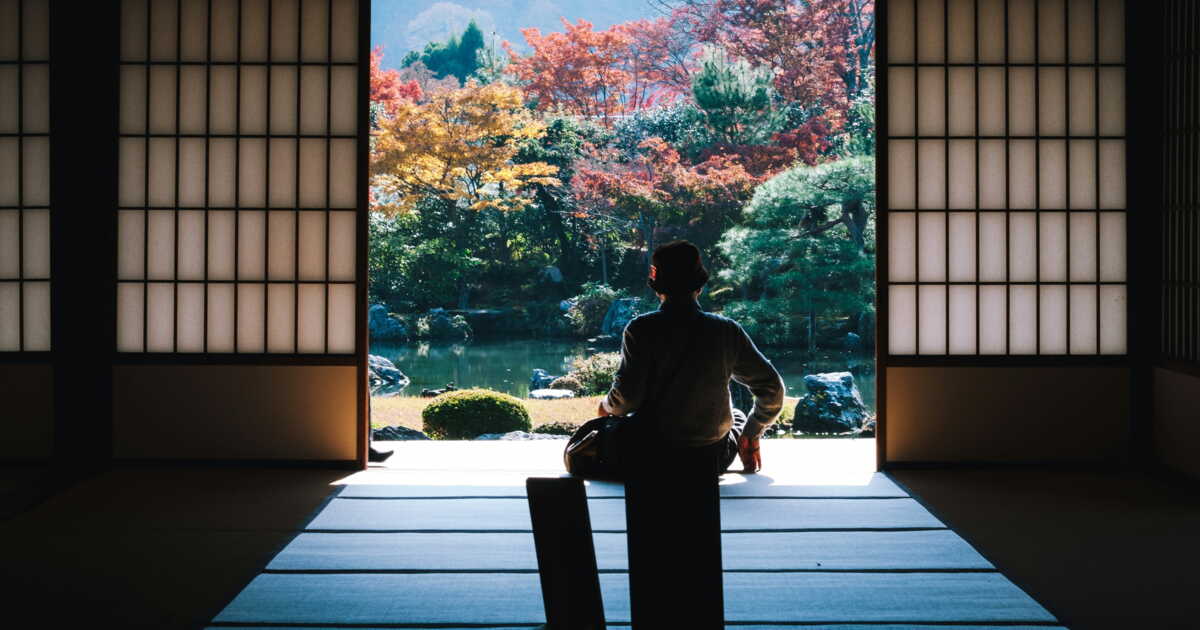
Tokyo is brimming with stories that send a chill down the spine. Ryua experiences one on a daily basis. From her very first visit to this apartment in the Japanese capital, the young woman recounts to the BBC, on Friday, October 30, that she sensed something was off. She recalls that a man stood there, fixing her with a dark gaze. The real estate agent, for his part, saw absolutely nothing. Rather than flee, this young aidoru, or performer in the entertainment world, decided to move in anyway.
“I’m a bit of a nonconformist, so I decided to befriend this peculiar male ghost,” she explains. Four years later, she still lives in the same studio where she hears spectral voices and footsteps. Far beyond Halloween folklore, Japan holds a singular relationship with spirits, such as the yōkai.
No Hiding the Property’s History
In the Land of the Rising Sun, there is a whole vocabulary tied to paranormal phenomena and even a term for those tormented spirits who refuse to leave: yuurei. These wandering souls are thought to be people who died under violent or tragic circumstances, who took their own lives, fell victim to murder, or died alone in their homes. For buyers or tenants who aren’t particularly superstitious, this belief opens the door to advantageous deals.
When searching for housing in Japan, it isn’t surprising to come across a category of discounted properties, the jiko bukken (literally “stigmatized or incident-related properties” in French). In line with government guidelines in force since 2021, real estate agencies are required to disclose to buyers any tragedy that occurred there resulting in a disappearance.
This transparency, mandatory for three years for rentals and indefinitely for sales, makes a big difference for the wallet. In Ryua’s case, she had been told clearly that a man had committed suicide in her 25-square-meter studio, located in the trendy Setagaya district. She pays 45,000 yen per month, about 254 euros, versus the usual 62,000 yen asked for such a property. A discount of nearly 30%!
Oshimaland, a site specialized in these transactions
The Tokyo-based real estate agent Erik Oskamp confirms that Japanese people are particularly reluctant when faced with these offers. If an apartment near a cemetery struggles to find a buyer, it’s even more difficult when the dwelling is one in which someone has died by suicide. When they learn about it afterward, most tenants quickly pack their bags.
This cultural reluctance sometimes benefits different profiles, such as Diane Tincher, an American who has lived in Japan for nearly forty years. In Kagoshima’s rural region in the southwest, she was able to acquire a large three-bedroom house for about half the usual price, solely because an elderly woman had died there. She says she does not believe in ghosts, but concedes that the Japanese do hold firm beliefs about them. “If there is a ghost, I am grateful to it every day… to live in such a splendid and affordable house”, she jokes in a BBC interview.
To hunt down this rare gem, Diane Tincher turned to the Internet. Launched in 2005, Oshimaland is a site dedicated to crowd-sourced listings of these “stigmatized properties” across Japan, and now also internationally. In the past, these homes had little appeal, but the surge in real estate prices and the cost of living has given them renewed visibility. A 2025 survey reveals that more than half of Japanese people today say they would be willing to rent a jiko bukken if the rent remains sufficiently enticing.
I am someone who tends to be fairly rational. In the X-Files series, I feel closer to Dana Scully, the FBI scientist who always has a logical explanation at the ready, than to Fox Mulder, who believes in paranormal phenomena with all his heart.
But some reports—whether about a supposedly haunted plantation in Louisiana or ghost-hunting expeditions in Île-de-France—have taught me to pause my Cartesian mind. So, when GEO invited me to go explore a ruin self-proclaimed as “the most haunted castle in Ireland,” I packed my bags and let myself be carried away. Sometimes, the truth lies elsewhere…
Origins of Leap Castle’s Sinister Reputation
To reach this strange place, you have to venture deep into the Irish countryside, wandering Offaly’s lanes, halfway between Dublin and Galway, and show some nerve. The roads are treacherous, concealing false flat stretches and perpendicular turns. The light of this autumn afternoon lengthens the shadows. One might almost expect a puca to rise from every glowing hedgerow, that little demon who can assume the form of a black horse, a deer or a fox to play tricks on the farmers.
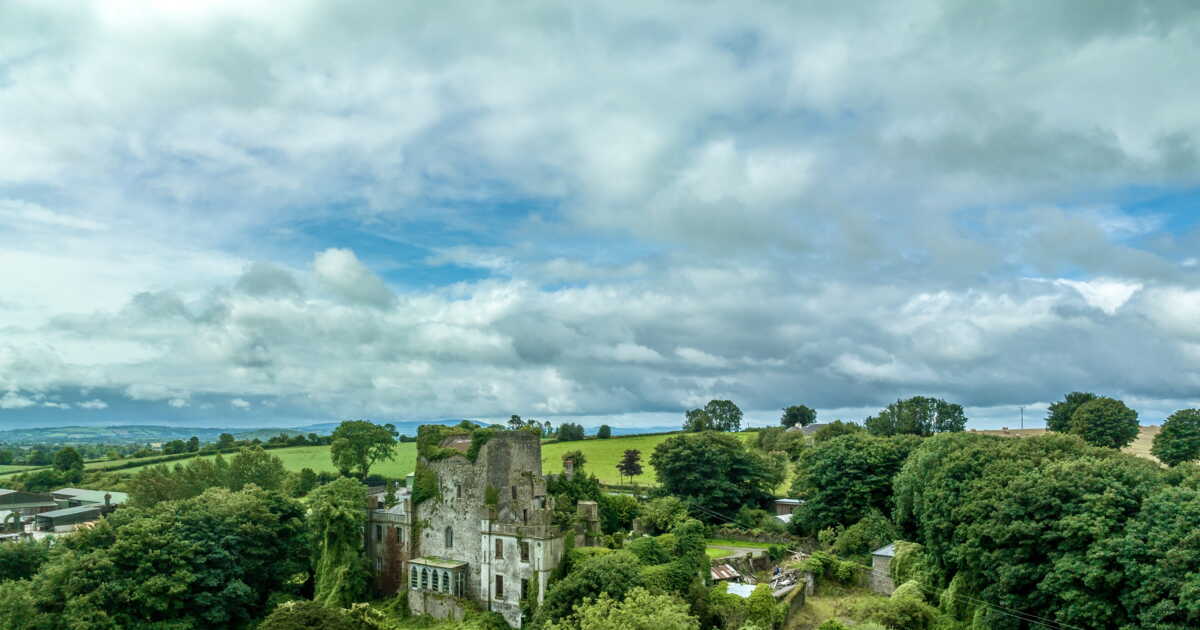
In this frontier between reality and imagination, from the narrow R421 road between the towns of Roscrea and Birr, Leap Castle suddenly looms on the summit of a hill, its cadaverous silhouette rising. The castle’s dark reputation echoes across the southern half of the country. To occupy the last stretch, I replay its macabre history in my mind.
People say it sits on a site where secret initiation rites were once held. They also say its unusual name, “leap,” derives from a deadly challenge. In the 15th century, two O’Bannon brothers supposedly tested who would lead the clan: they leaped from a promontory, and the survivor is said to have built a fortified stronghold right where the loser breathed his last.
The O’Bannon лords were vassals of another clan, the O’Carrolls, who later seized Leap Castle after years of brutal conflicts. Brutal and torn by internal strife, the O’Carrolls cast the castle into horror. They are blamed for the massacre of around forty members of a rival family, the MacMahon. Invited to a reconciliation banquet, they were poisoned, run through, and cast into the oubliettes.
A Dungeon and the Bones
After the castle fire in 1922, restoration work cleared access to a dungeon and unearthed the bones of around a hundred bodies. Enough to fill three wagons. With my mind darkened by these thoughts, I almost forget that I have arrived. I risk crossing the wrought-iron gate marking the entrance, passing the keepers’ cottage, and stealthily driving my vehicle down the path.
Even though I am expected, I feel unwelcome. The trees are tall, the wind whistles in concert with a swarm of screeching ravens. Facing the low sky, my gaze climbs to blind windows, battlements worn by time encircling a not-so-inviting keep. There is a distinct sense of being watched from above.
On the door, a skull-shaped knocker topped with a wireless bell, fixed to double-faced tape. I knock. I am invited in. The heavy door swings open to a large vaulted room, furnished in an anarchic fashion: trinkets, chairs upholstered in medieval style, mementos from distant journeys. Hunting trophies, tapestries, and shields line up beneath the beams supporting the high ceiling. The waning daylight struggles to filter through the few ground-floor windows.
On the mantelpiece, an authentic reduced head seems to watch from the depths, the wall opposite adorned with masks of the commedia dell’arte. The dying embers in the fireplace aren’t enough to banish the thrill that runs down my spine. Seated before the glass door overlooking pastures where cattle moo, the owner Sean Ryan greets me more than he welcomes me.
Long white hair spilling from a wool hat, a stern figure, pale, piercing eyes, he is at first gruff, even downright surly. One could think the spirit of the place has rubbed off on him. Reluctantly, he shares a little more about “his” castle. He bought these ruins, unoccupied for six decades, in 1991. Year after year, he has developed a small part, leaving the rest to brambles and ravens.
Have been seen, heard… or felt
Glowing orbs, in the Bloody Chapel, fragments of the soul of a priest murdered by his brother.
“The Thing”, a humanoid silhouette exuding a smell of sulfur and decay.
The specter of the Lady in Red, wandering the corridors with the blade with which she ended her life.
The tormented soul of Captain Darby, seeking his war treasure everywhere.
Voices speaking Gaelic, attributed to the spirits of the MacMahon murdered within these walls.
The Spirit of the Ogre, a humanoid entity with distorted features, said to have been summoned during an occult rite.
“We Are Not Alone,” Says the Lord
The brave septuagenarian doesn’t much appreciate journalists who, in search of juicy stories, bother him too often. But he has learned to deal with it: tourists also knock at his door first to meet his spectral roommates rather than to learn the place’s history. The money left by visitors on the table helps fund the work. After all, this allure of the supernatural is part of the site’s destiny.
The gothic novelist Mildred Darby, the last resident of the castle before its fire, used to host séances and black magic there, a pastime much enjoyed by the upper classes of the era. She claimed to regularly encounter specters in the corridors, notably the one she called “The Thing” in The Occult Review, in 1908, where she wrote:
Her dull eyes, which seemed half decayed and had an incredibly repugnant look, fixed mine, and the horrible odor that had previously offended my nostrils, a hundred times more intense, rose to my face, filling me with mortal nausea.
From those old sightings to the numerous articles, podcasts, and YouTube videos that flourish today, there is but a step. Sean Ryan even rents the place out for the night to groups of paranormal investigators hoping to capture, with their high-tech tools, some echoes of the beyond.
But does he believe in these famous ghosts? “I live here with my wife, it’s our home and we feel comfortable… But clearly, we are not alone”, he says with a shrug, as if these spirits are part of the backdrop, as much as the battlements and embrasures appear to be.
I sometimes hear, on the ground floor, a gathering of people, like a banquet. They talk but I don’t really understand them; it’s Old Gaelic or Old English.
He also recounts spotting whispers whose source remains elusive. And then there are lights, like fireflies, halos, flashes. Nothing extraordinary, downplays our host, who explains that he grew up, like many Irish, in a world where the supernatural is part of daily life, where people avoid certain spots—hedges, stone circles in fields—to avoid disturbing beings that might dwell there.
The spirits trapped in the walls of this castle are victims of the old clans, not criminals. We cohabit, that’s all. We leave them alone, they leave us alone.
As I burn with both fear and a desire to confront these specters, the owner tells me about the time he played the whistle across the country, and even in France. And he treats me to a demonstration, singing a Celtic ballad on his tin whistle that makes the bowels of the castle tremble.
The Ravens’ Cry Brings Me Back to Life
A group of Americans has just emerged from a corridor, flashlight in hand. Of Irish descent, they live in Saint Augustine, Florida, a city where ghost stories are legion. It is now my turn to visit the site. They hand me the torch and I gather my wits, while Sean Ryan gives me one last pragmatic piece of advice:
When you come down from the Bloody Chapel, be sure to close the latch properly. I don’t want pigeons to bother us.
Noted. The Bloody Chapel… the most sinister room in the building. On the death of the clan patriarch, in 1532, a succession dispute erupted between his two sons. While the elder, Thaddeus, a priest by profession, was conducting the service in the chapel, eerily located on the top floor of the keep, his brother Teige the Blind stabbed him in the chest, leaving him to die on the altar before the rest of the family.
I begin by taking, in near-total darkness, a very narrow staircase. I sweep the walls with my torch as I move through a stone passage worn smooth by the backs and hands of thousands who pressed through. A first room opens to the left. From the eastern window, two stone rings can be seen in the field below. The ceiling is lined with cobwebs.
To the north, a stairway descends into the oubliette where so many souls have been lost. I do not know if it is my imagination, but a heavy sadness washes over me. As if the memory of the events, ingrained in the walls, envelops me in melancholy. I take a few photos to capture the anguish gripping me.
That is when I distinctly feel something brush against the back of my neck. The Dana Scully in me would rather attribute this to the autumn wind rushing into the room than to accuse Thaddeus’ specter. Or perhaps it is simply my imagination? Probably a bit of all three.
Do you want to scare yourself?
Open Monday to Saturday, from 10 a.m. to 5 p.m. Just send an email to [email protected], or call (353868690547). No entry fee; you leave what you want as you depart. The owner’s mood is not guaranteed.
➤ Article published in GEO HS magazine no. 131, “Journeys into Lands of Mystery,” February–March 2026.
➤ Are you already loyal to GEO’s content? Then to miss nothing, explore our subscription plans to receive GEO at home every month with ease.
Every October 31, for Halloween, it’s the same refrain: a parade of the most “beautiful” costumes, a candy hunt, a horror film, and for the bravest, an adrenaline shot in a place nicknamed “haunted.” An habit that did not escape the national vacation rental search engine Likibu, which, for the occasion, unveiled its list of the most haunted locations in France.
To do this, the site analyzed data collected from October 19 to 24, 2023. The estimated number of queries corresponds to searches conducted monthly on Google by Internet users.
Which haunted places are the most searched in France?
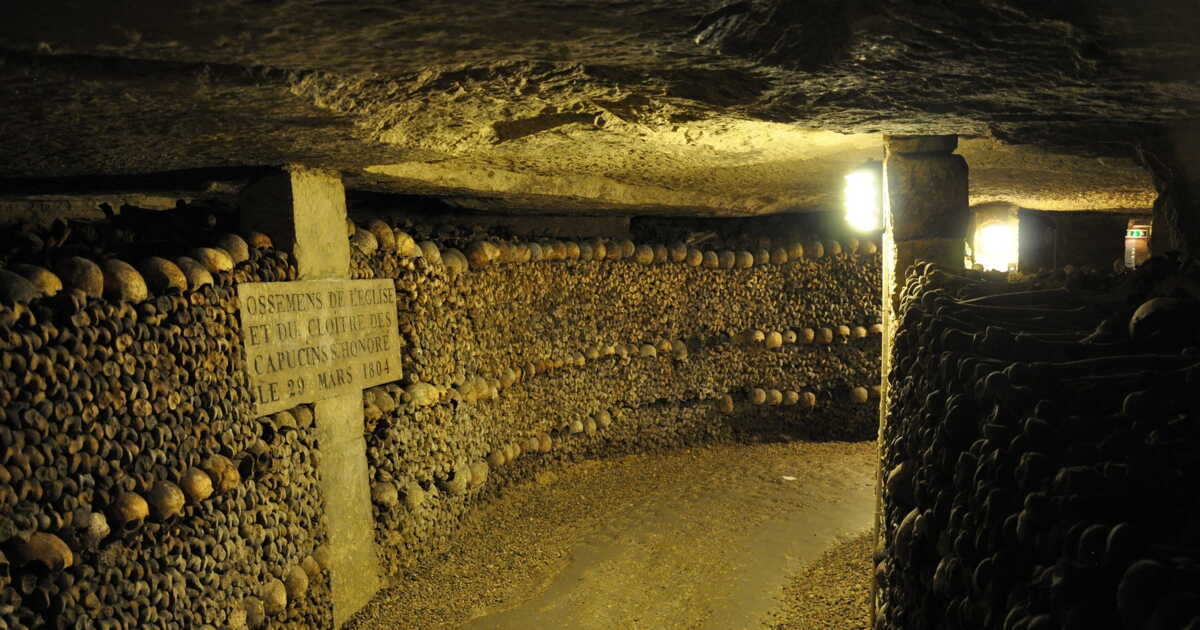
Catacombs of Paris (Île-de-France), with 157,830 searches
Padirac Abyss (Lot), with 150,410 searches
Brocéliande Forest (Ille-et-Vilaine), with 75,850 searches
Lake Paladru (Isère), with 54,350 searches
Fougeret Castle (Vienne), with 34,860 searches
Carnac Menhirs (Morbihan), with 34,030 searches
Commarque Castle (Dordogne), with 21,520 searches
Trepassers’ Bay (Finistère), with 18,110 searches
Rennes-le-Château (Aude), with 17,840 searches
Brissac Castle (Maine-et-Loire), with 16,830 searches
Bonaguil Castle (), with 13,260 searches
Tiffauges Castle (Vendée), with 12,190 searches
Plessis-Bourré Castle (Maine-et-Loire), with 12,060 searches
Montségur Castle (Ariège), with 10,900 searches
Combourg Castle (Combourg), with 10,410 searches
Veauce Castle (Veauce), with 7,980 searches
Reignac Iron Fortress (Tursac), with 6,690 searches
Puymartin Castle (Marquay), with 6,640 searches
Gisors Castle (Gisors), with 5,130 searches
Carrouges Castle (Carrouges), with 4,820 searches
Haunted castles, favorite places for Halloween
With 75,850 monthly searches, the historical Broceliande Forest reappears in the spotlight. Inspire for many films or fairy tales, it invites walkers to trace the steps of the fairies Viviane or Morgan, or to head toward Comper Castle, and perhaps, to pull Excalibur from its stone.
But what stands out most from this ranking is the French enthusiasm for haunted castles. Among the most favored castles, Fougeret Castle (34,860 monthly searches) is extolled as the “hauntedest place in France” and cherished by all paranormal and supernatural enthusiasts.
With 21,520 monthly searches, Commarque Castle also stirs curiosity among the French. Legend has it that it is inhabited by the ghost of the horse belonging to the lover of the daughter of the Count of Commarque (are you following?). During the Hundred Years’ War, the lord supposedly laid a trap for the beloved of his daughter, who died within the castle walls, sealing the fate of the horse’s phantom, which has appeared there since, on every full moon.
Another castle, another tale: with Brissac Castle (16,830 monthly searches), nicknamed the “giant of the Loire Valley.” Those who visit the site venture into the lair of the Green Lady, Charlotte of Valois, her true name, who was killed by her husband in 1477 after the discovery of her infidelity. Since then, she is said to haunt the castle’s walls day and night…