

Spain was equipping itself with a Puy du Fou, Germany was attracting a new Parc Astérix, while London rode the visibility of its Harry Potter park by announcing the creation of an Universal Studios by 2031.
Then Emmanuel Macron received Mohammed bin Salman, known as MBS, this Monday, August 24, 2026.
The President of the Republic did not linger on arms contracts, preferring to unveil the signing of a “framework agreement” that validates Saudi Arabia’s investment of six billion euros in France, for the construction of three theme parks… in Île-de-France.
“If we are still the world’s leading tourist destination, it’s thanks to Disneyland Paris, otherwise that would no longer be the case.
Strengthening this power is extremely smart. It is all the more so because we are well positioned geographically, Paris is the only major European metropolis and we have a large portion of mobility infrastructure.
This will shine a new light on Paris, and that’s very good“, remains optimistic Jean Viard, author of the book “The Book of Holidays… And What They Say About Us.”
“What would the headlines have been, if they had decided to invest in Spain ?”
On the other hand, a senior civil servant with a deep knowledge of tourism tempers the president’s enthusiasm a bit.
“Between the political announcement, with the 6 billion euros and the three parks, and what will actually happen, there could be a gap. The projects will be refined; it is a long process.
After that, we are still dealing with dimensions that are at least spectacular.
I understand investors, because profitability, image and prestige are in Paris, but this will concentrate tourism in a large region, Île-de-France, even if it radiates to Hauts-de-France
According to this very knowledgeable industry insider, the first whispers began circulating at the top about a year ago.
So this announcement would not be smoke and mirrors, but a real project.
Moreover, Saudi Arabia is investing in France, but our country will continue to participate in the Kingdom’s development.
Alongside the discussions between the two leaders, the French Agency for the Development of AlUla (AFALULA), chaired by Jean-Yves Le Drian, saw its contract extended to 2035 to continue building this new world destination. Soft power would thus be bilateral.
“I do not want to minimize the French government’s action in the ongoing search for investors, but this file is essentially led and pushed by the Saudis.
The Saudis have identified France as a priority country to invest in tourism and everything around culture, soft power, etc.
Contrary to what is said, France remains very attractive to investors.
Imagine what our discussion would have been like, and what the headlines would have been if they had decided to invest in Spain? It is still a positive point that they are considering investing here rather than elsewhere“, continues this person, who preferred to remain anonymous.
“The death certificate of France as the world’s leading destination for sustainable tourism”
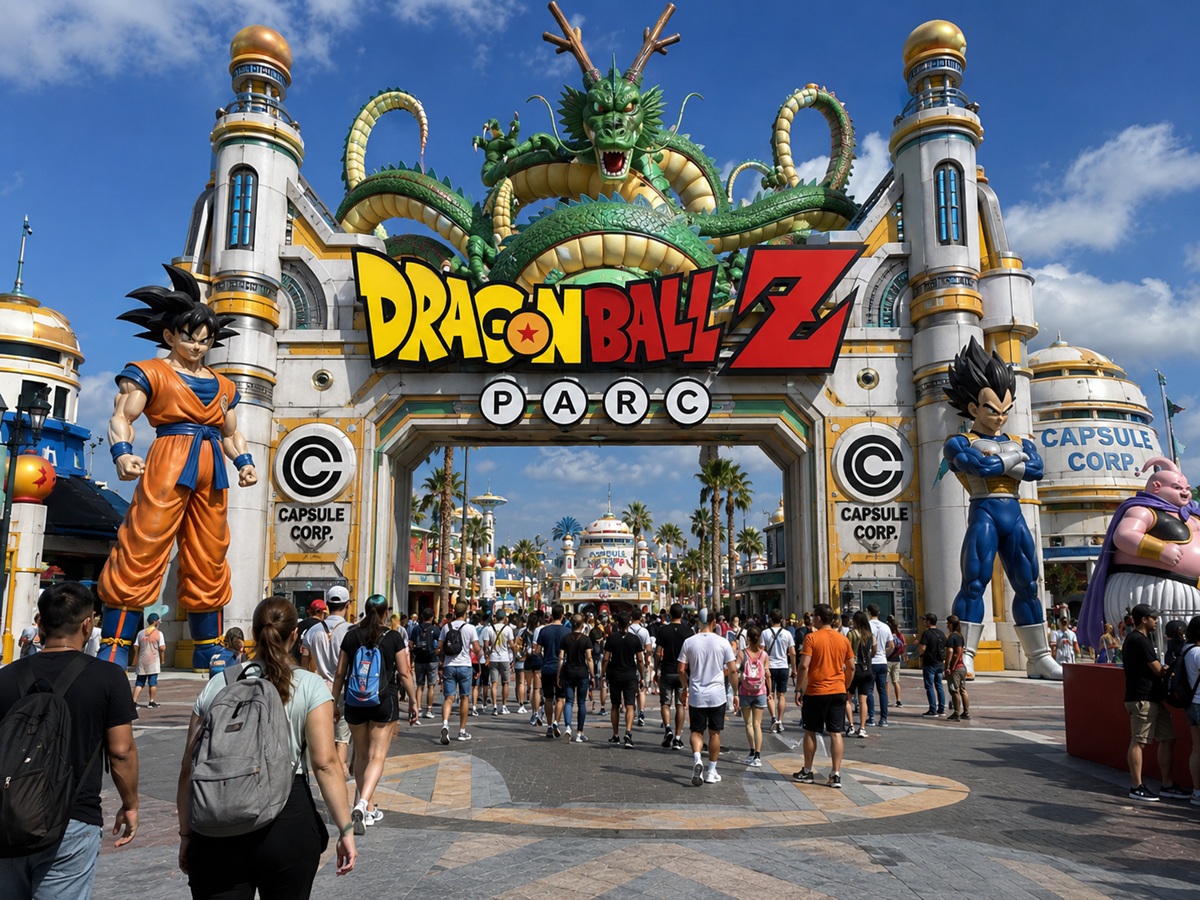
With the exception of the Dragon Ball Z park, which is expected to rise on the site of the ephemeral Mirapolis, closed only four years after its opening in 1991, nothing has leaked about the themes of the other sites.
“I believe more that this is a coup, taking advantage of an opportunity, rather than a proper policy. In any case, I see neither vision nor coherence, but only a willingness to do what can be done in the context we find ourselves in.
On the one hand, we do not really have a tourism policy, if the words have any meaning; on the other hand, everything happens as if climate warming did not exist.
This is a decision that could have been justified in the 20th century]i”, laments Rémy Knafou, geographer and author of the book “Hypertourism, Tourism Tested by Its Excess”.
This announcement naturally raises questions about its funding by a state not really respecting human rights overall, nor freedom of the press.
To read: Emmanuel Macron: “Become the first sustainable destination by 2030”
Moreover, this project runs counter to French aspirations, reaffirmed by Serge Papin, to make France the world’s leading sustainable destination. An accolade whose measurement remains unknown, even as our country seeks ever more international travelers.
“Thus, this is the official death certificate of the declared will to make France the world’s leading destination for sustainable tourism, because there are contradictions that cannot be hoped to overcome.
While I can understand that, given the budgetary situation we are in, one is not picky about the available solutions.
But then, we must stop banging on about sustainable tourism and admit that tourism is, for the State, merely a tool to rebalance the balance of payments and a crutch to compensate for macroeconomic policy mistakes“, denounces him.
“As soon as there are grand projects, everyone says they should not be done”, according to Jean Viard
For reminder, last year the Paris Île-de-France destination drew nearly 50 million visitors, including 23 million international visitors, out of the 102 million welcomed in France.
“On the subject of financing these parks and given the very limited means of the French State, it would be better to put them into hospitals, schools, research, thus into the essential missions of the State.
It must be clear, we would have dreamed of a structural project for our regions.
There exists, moreover, a point in favor of this investment: building on the Mirapolis site, which collapsed 35 years ago.
It is fallow. There is a need to awaken this place, which could be structuring for Val-d’Oise and northern Paris, but also for Hauts-de-France, I insist
“”, this senior official asserts positively.For Jean Viard, even more enthusiastic, it is important to celebrate these announcements.
Already, at the Aix-en-Provence Economic Meetings, the sociologist had drawn the audience’s attention, notably the many political leaders present, to the indispensable reinchantment of our future, in order to make it desirable and to give hope to the younger generations.
While the media regularly discuss a possible war with Russia, a global economic crisis, France’s decline or even AI that could replace many jobs, this announcement appears as a breath of fresh air.
“The great danger in France is that whenever there are grand projects, everyone says not to do them, for various reasons. The project will create many jobs, it will reuse a site that collapsed, this is sustainable tourism development.
We cannot live without pleasure, and a society lives around these moments of pleasure. Without that, it collapses.
After that, we can try to ensure they have less environmental impact, or at least different kinds of impacts. Then the previous big park is none other than Euro Disney, which, with modern technology, valorizes European tales of the 18th and 19th centuries. With Dragon Ball Z, we are in modernity, with a newer theme.
These are places of the future
“Competition with Disney and Astérix is a sensitive point”
Are we moving toward a standardized tourism industry?
“The center of social bonding has shifted from work to leisure time. So, in a century, we have invented a whole range of activities, such as amusement parks. What draws people to these places is a complete product, family-friendly, that speaks to both parents and children. You can sleep there and eat there.
Moreover, these are safe places; that’s what is sold, a bit like holiday villages.
This will also help increase tourist revenues. The problem in France is that we have not managed to create activity around tourism. Americans have very few tourists, but it brings in twice as much money as ours.
We have not managed to modernize our facilities since the creation of ski and seaside resorts. We must shake all this up, even if it means with foreign capital
“, analyzes Jean Viard.Moreover, for the sociologist, this type of investment should also help bring cultures closer, offer greater openness to Saudi Arabia and, who knows, one day fight climate change, because it will be everyone’s business.
While we await that miracle, the construction of three new parks, in the direct orbit of Disneyland Paris and Parc Astérix, raises questions for Dominique Hummel, former president of Futuroscope.
“The question of competition with Disney and Astérix is one of the sensitive points.
The project is evidently aimed at several million annual visitors. Certainly, the chosen positioning will likely target new audiences, grow the global market, and boost the attractiveness of the Île-de-France area.
Parks operate in an offer-driven economy! But there will also be cannibalization. And among the success factors, accessibility finally matters
“, concludes the former executive of the Compagnie des Alpes.