Three New Parks in France: Tourism Boom or Ecological Conflict? The Debate


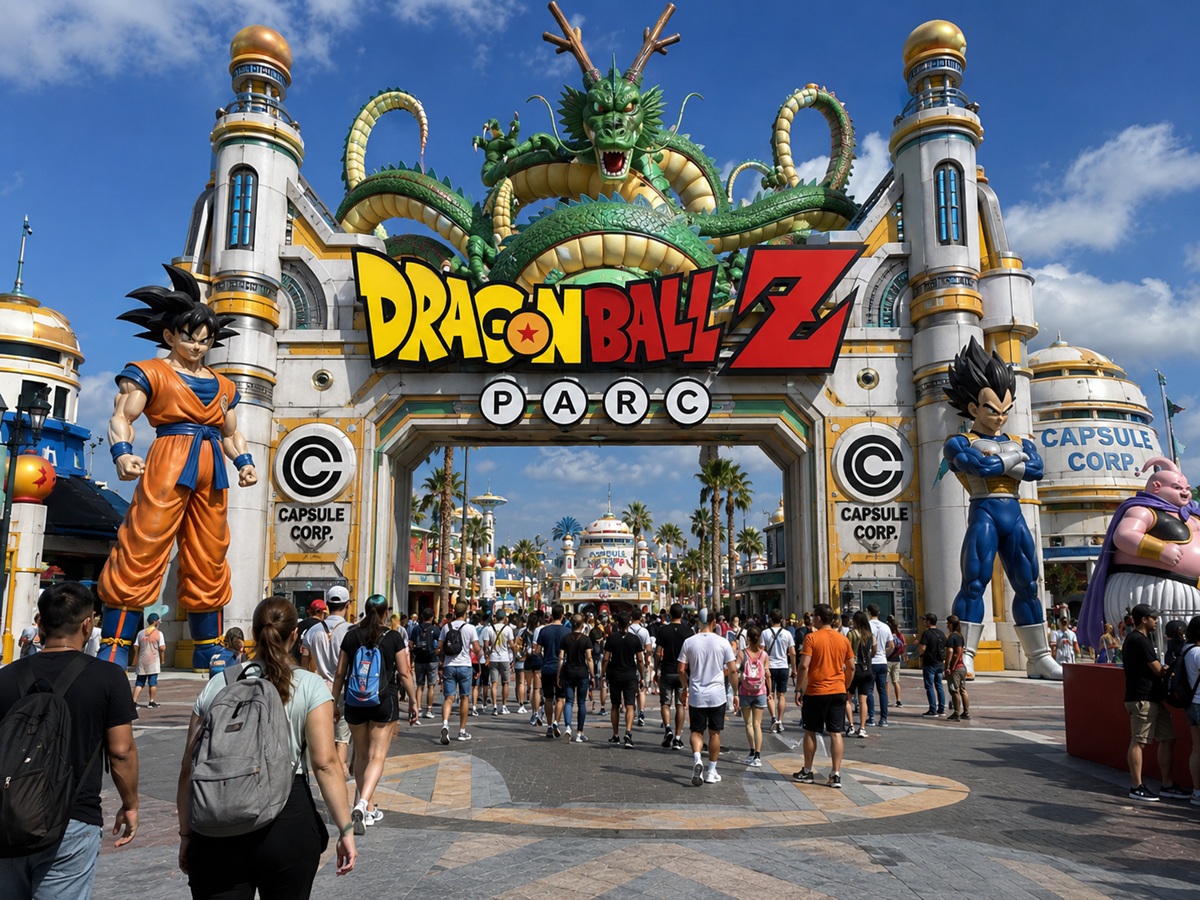
L'annonce des 3 nouveaux parcs "acte de décès de la France comme 1ère destination mondiale du tourisme durable" selon Rémy Knafou - Visuel généré par l'IA

MSC Croisières


In recent years, and despite the success of Disneyland Paris, which has finally become profitable, France seemed to be losing ground in the appeal of theme parks.

Spain was equipping itself with a Puy du Fou, Germany was attracting a new Parc Astérix, while London rode the visibility of its Harry Potter park by announcing the creation of an Universal Studios by 2031.

Then Emmanuel Macron received Mohammed bin Salman, known as MBS, this Monday, August 24, 2026.

The President of the Republic did not linger on arms contracts, preferring to unveil the signing of a “framework agreement” that validates Saudi Arabia’s investment of six billion euros in France, for the construction of three theme parks… in Île-de-France.

If we are still the world’s leading tourist destination, it’s thanks to Disneyland Paris, otherwise that would no longer be the case.

Strengthening this power is extremely smart. It is all the more so because we are well positioned geographically, Paris is the only major European metropolis and we have a large portion of mobility infrastructure.

This will shine a new light on Paris, and that’s very good
“, remains optimistic Jean Viard, author of the book “The Book of Holidays… And What They Say About Us.


“What would the headlines have been, if they had decided to invest in Spain ?”

And moreover, in Emmanuel Macron’s own words, cited by Libération, we are living a moment “without precedent, unlike anything since Disneyland Paris“.

On the other hand, a senior civil servant with a deep knowledge of tourism tempers the president’s enthusiasm a bit.

Between the political announcement, with the 6 billion euros and the three parks, and what will actually happen, there could be a gap. The projects will be refined; it is a long process.

After that, we are still dealing with dimensions that are at least spectacular.

I understand investors, because profitability, image and prestige are in Paris, but this will concentrate tourism in a large region, Île-de-France, even if it radiates to Hauts-de-France“, says he.

According to this very knowledgeable industry insider, the first whispers began circulating at the top about a year ago.

So this announcement would not be smoke and mirrors, but a real project.

Moreover, Saudi Arabia is investing in France, but our country will continue to participate in the Kingdom’s development.

Alongside the discussions between the two leaders, the French Agency for the Development of AlUla (AFALULA), chaired by Jean-Yves Le Drian, saw its contract extended to 2035 to continue building this new world destination. Soft power would thus be bilateral.

I do not want to minimize the French government’s action in the ongoing search for investors, but this file is essentially led and pushed by the Saudis.

The Saudis have identified France as a priority country to invest in tourism and everything around culture, soft power, etc.

Contrary to what is said, France remains very attractive to investors.

Imagine what our discussion would have been like, and what the headlines would have been if they had decided to invest in Spain? It is still a positive point that they are considering investing here rather than elsewhere
“, continues this person, who preferred to remain anonymous.


“The death certificate of France as the world’s leading destination for sustainable tourism”

Despite these endorsements, some voices rise against this still somewhat unclear project.

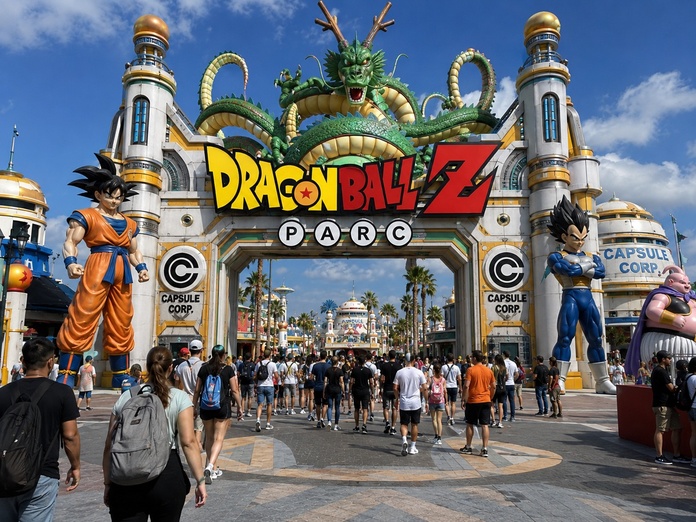
With the exception of the Dragon Ball Z park, which is expected to rise on the site of the ephemeral Mirapolis, closed only four years after its opening in 1991, nothing has leaked about the themes of the other sites.

“I believe more that this is a coup, taking advantage of an opportunity, rather than a proper policy. In any case, I see neither vision nor coherence, but only a willingness to do what can be done in the context we find ourselves in.

On the one hand, we do not really have a tourism policy, if the words have any meaning; on the other hand, everything happens as if climate warming did not exist.

This is a decision that could have been justified in the 20th century]i”, laments Rémy Knafou, geographer and author of the book “Hypertourism, Tourism Tested by Its Excess”.

This announcement naturally raises questions about its funding by a state not really respecting human rights overall, nor freedom of the press.

To read: Emmanuel Macron: “Become the first sustainable destination by 2030”

Moreover, this project runs counter to French aspirations, reaffirmed by Serge Papin, to make France the world’s leading sustainable destination. An accolade whose measurement remains unknown, even as our country seeks ever more international travelers.

Thus, this is the official death certificate of the declared will to make France the world’s leading destination for sustainable tourism, because there are contradictions that cannot be hoped to overcome.

While I can understand that, given the budgetary situation we are in, one is not picky about the available solutions.

But then, we must stop banging on about sustainable tourism and admit that tourism is, for the State, merely a tool to rebalance the balance of payments and a crutch to compensate for macroeconomic policy mistakes“, denounces him.


“As soon as there are grand projects, everyone says they should not be done”, according to Jean Viard

These remarks align with those of Jean Pinard and many other players in institutional tourism.

For reminder, last year the Paris Île-de-France destination drew nearly 50 million visitors, including 23 million international visitors, out of the 102 million welcomed in France.

On the subject of financing these parks and given the very limited means of the French State, it would be better to put them into hospitals, schools, research, thus into the essential missions of the State.

It must be clear, we would have dreamed of a structural project for our regions.

There exists, moreover, a point in favor of this investment: building on the Mirapolis site, which collapsed 35 years ago.

It is fallow. There is a need to awaken this place, which could be structuring for Val-d’Oise and northern Paris, but also for Hauts-de-France, I insist“”, this senior official asserts positively.

For Jean Viard, even more enthusiastic, it is important to celebrate these announcements.

Already, at the Aix-en-Provence Economic Meetings, the sociologist had drawn the audience’s attention, notably the many political leaders present, to the indispensable reinchantment of our future, in order to make it desirable and to give hope to the younger generations.

While the media regularly discuss a possible war with Russia, a global economic crisis, France’s decline or even AI that could replace many jobs, this announcement appears as a breath of fresh air.

The great danger in France is that whenever there are grand projects, everyone says not to do them, for various reasons. The project will create many jobs, it will reuse a site that collapsed, this is sustainable tourism development.

We cannot live without pleasure, and a society lives around these moments of pleasure. Without that, it collapses. After that, we can try to ensure they have less environmental impact, or at least different kinds of impacts.

Then the previous big park is none other than Euro Disney, which, with modern technology, valorizes European tales of the 18th and 19th centuries. With Dragon Ball Z, we are in modernity, with a newer theme.

These are places of the future


“Competition with Disney and Astérix is a sensitive point”

The stubborn Gaul is also the first to praise amusement parks, whether in the Île-de-France region or beyond.

Are we moving toward a standardized tourism industry?

The center of social bonding has shifted from work to leisure time. So, in a century, we have invented a whole range of activities, such as amusement parks. What draws people to these places is a complete product, family-friendly, that speaks to both parents and children. You can sleep there and eat there.

Moreover, these are safe places; that’s what is sold, a bit like holiday villages.

This will also help increase tourist revenues. The problem in France is that we have not managed to create activity around tourism. Americans have very few tourists, but it brings in twice as much money as ours.

We have not managed to modernize our facilities since the creation of ski and seaside resorts. We must shake all this up, even if it means with foreign capital“, analyzes Jean Viard.

Moreover, for the sociologist, this type of investment should also help bring cultures closer, offer greater openness to Saudi Arabia and, who knows, one day fight climate change, because it will be everyone’s business.

While we await that miracle, the construction of three new parks, in the direct orbit of Disneyland Paris and Parc Astérix, raises questions for Dominique Hummel, former president of Futuroscope.

The question of competition with Disney and Astérix is one of the sensitive points.

The project is evidently aimed at several million annual visitors. Certainly, the chosen positioning will likely target new audiences, grow the global market, and boost the attractiveness of the Île-de-France area.

Parks operate in an offer-driven economy! But there will also be cannibalization. And among the success factors, accessibility finally matters“, concludes the former executive of the Compagnie des Alpes.

Water Parks: A Mixed Future [ABO]


Alors qu'on dénombre 65 millions de visiteurs dans le monde, l’explosion des parcs aquatiques, notamment dans les régions désertiques, est-elle raisonnable ?  - DepositPhotos.com, timonko

CroisiEurope


Dream with us! There was a time when a stay in Marrakech was reserved for the few: in the Mamounia salons, at the casino for a festive evening, in the Palmeraie for a tennis match, near Jemaa el-Fna square to drink mint tea on a terrace, and even more so inside the Club Méditerranée’s walls…

A destination of elitist rank par excellence, Marrakech, the pink city, at the foot of the snow-capped Atlas Mountains, was a place that triggered fantasies…

But I’m talking about a era when the city counted only a handful of charming hotels, very few resorts, a few regular daily flights from Europe, a mellah, souks perfumed with spices and leather tanned and studded by artisans with millennial know-how…

In short! In Marrakech, one wandered under flamboyants and jacarandas in Guéliz, taking care to avoid little donkeys and yellow taxis that bobbed along in search of a client…

Different times, different customs and different motivations for a rare tourist whose numbers rose in spring, dimmed during summers that were too hot, or celebrated a New Year’s Eve around a true “pastilla” made with pigeon meat!

In 1980, Marrakech welcomed one to two million visitors.


Marrakech : a spectacular boom

What happened? Over the last ten years, it is clear that Morocco decided to accelerate its development in tourism.


Spotted by a jet set hungry for insider experiences, Marrakech, like the rest of the country, has allowed the proliferation of numerous luxury hotels and riads (mostly upscale) distributed by European tour operators to a growing clientele seeking rest, a mild winter climate, and the authenticity of the Cherifian Kingdom.

Spreading more and more, increasingly congested by relentless traffic and with the arrival of roughly 8 to 10 million visitors, the destination features a hotel stock that has exploded, rising from about 150 hotels to 2,000 today.

This has shifted the pink city from a high-end tourism image to a more mass-oriented tourism, drawn by a mosaic of more playful than cultural offers, nearer to a theme park than a patrimonial destination.

Among media mentions, a recent M6 program highlighted the surge of water parks as a genuine cash cow for families, with no fewer than 38 parks, about a dozen large ones, at all price points, with or without lodging, competing in imagination and technical prowess to diversify their entertainment offerings.

The mere slides were insufficient, as Oasiria, the largest of Marrakech’s parks, offers 58 slides across 8 pools – including a wave pool that makes it the largest in Africa.

With very affordable rates, these parks are also accessible through time-based entries (2 hours, for example 18 euros), with or without lodging, in 5-star accommodations or camping…

Yet, behind this undeniable commercial success that will likely keep Marrakech among the world’s most coveted destinations, lie grave environmental problems, notably the risk of water shortages.

According to a piece in the Moroccan daily Médias24, despite heavy winter rainfall, the levels of groundwater and dam water (especially around Marrakech) have not risen enough to look to the future with optimism.

Thus, Oasiria operates 7,500 cubic meters of water for its pools spread across ten hectares, representing a staggering 7.5 million liters of stored water, equivalent to several thousand days of domestic consumption for a Moroccan family.

In addition to the initial filling, one must also compensate for evaporation at 40°C, clean the filters, water the green spaces, launder linens, refresh the water, ensure air conditioning… and do the same for hundreds of hotel pools, villas, and ten major golf courses into which 10 million air travelers flow annually, i.e., 28,000 travelers per day spread across 90 to 100 flights daily.


The Market Reports study on the evolution of consumer demand for parks notes a 47% rise in family group attendance and a 29% increase in indoor hybrid facilities. We are looking at 65 million visitors worldwide across 1,200 parks!


On the Emirates side, activity is ramping up too

If the southern Moroccan jewel now delights families with children, the United Arab Emirates are not to be outdone.

Eager to expand and diversify their clientele, they anticipate 15 to 20 large water parks if one includes independent large water parks, those integrated into hotels and resorts, and grand aquatic tourist complexes.

In Dubai alone, Aquaventure Waterpark is regarded as one of the world’s largest water parks, boasting more than 100 attractions.

Wild Wadi Water Park, near the Burj Al Arab, Legoland Water Park, Jungle Bay Waterpark, Laguna Waterpark… draw a large share of regional, European, and Asian visitors thanks to a very family-friendly all-inclusive offering.

In Abu Dhabi, more cultural in tone, parks are fewer in number but Yas Waterworld, for instance, a vast 15-hectare park, offers more than 40 attractions.

In the other emirates, a few new attractions are also beginning to emerge. While Saudi Arabia has likewise positioned itself on this family, regional, and international market with an increasingly spectacular and costly array of entertainments—almost pharaonic.

Once again, the water challenge persists, but so does the question of women’s attendance that remains to be fully addressed.

Should we split aquatic space in two? Should we share opening hours by gender?

Given the country’s ambition to become one of the world’s largest destinations, it seems more openness is indeed underway.

But for water, desalination plants, wastewater recycling, and restrictions will not suffice for long. And again (as we can see today), the future is not decided and far from assured.


Europe does not hold back


In France, Aquascope sets the tone for the future

Named “Best water park in the world” by Thea Awards, during a prestigious ceremony in Hollywood, the Aquascope, located in the Futuroscope park, is organized into three domains, spread over a 6,000 m2 area.

It features wave pools, slide races, and eight impressive slides including the “Matrix”, a rafting ride aboard oversized tubes.

More than anything, combining the best of technology, the Aquascope, with its attraction “The Abyss of Light”, makes it possible to experience cinema while staying in the water and floating amid all kinds of water movements.


Worldwide, the USA and Asia-Pacific

With more than 1,200 water parks in operation globally, including 345 located in North America, the Asia-Pacific region has also witnessed the fastest expansion of water park developments, accounting for 38% of new openings between 2022 and 2024.

As for the pioneers—the United States—they are approaching saturation, boasting 117 outdoor water parks and 45 indoor water parks. Florida alone is home to 29 major parks, including Disney’s Typhoon Lagoon, which welcomed over 1.6 million visitors in 2023.

One could also mention Las Vegas, where casinos no longer suffice to keep the cash registers ringing. With an 8% drop in attendance, the gaming capital is also betting on water-based attractions.

But you still have to make the trip! Marrakech, as you may have gathered, remains far more accessible.

Until when? That is the question indeed. And once again, perhaps it would be wiser not to delay too long in recognizing the seriousness of the situation.


Next-generation attractions

To keep audiences coming back, manufacturers are rolling out next-generation attractions, such as intelligent slides with biometric monitoring and interactive customization of experiences.

In 2024, 14 models of water slides were equipped with integrated VR headsets. The combination of physical sensations and digital experiences boosted the popularity of the rides by 46%.

Wave-simulation pools using AI algorithms to calibrate models are now installed in 11 countries.

Lazy rivers with synchronized music and AR environments were launched by three companies between 2023 and 2024. ProSlide, for its part, unveiled six new hybrid rides combining vertical drops and wave motion

See the site: www.iaapa.org


Photo Josette Sicsic

Journalist, consultant, speaker, Josette Sicsic has been observing the changes in the world for over 25 years to analyze their impact on the tourism sector.

After developing Touriscopie for more than 20 years, she remains at the forefront of current affairs where she decodes the present to forecast the future. On the site www.tourmag.com, in the Futuroscopie section, she publishes several prospective and analytical articles each week.

Contact: 06 14 47 99 04

Email: [email protected]