

Edgar Suites, the real estate operator, has just completed a full restructuring of an old youth hostel to establish its new Paris address.
Spread over 780 m² within a Haussmannian-style building, this project marks a new milestone in Edgar Suites’ development strategy.
The rehabilitation works were carried out with the aim of integrating the establishment into the heart of Folie‑Méricourt, a neighbourhood in the 11th arrondissement known for its dynamism, creative galleries and independent shops.
Located near Canal Saint-Martin, Place de la République and the Haut-Marais, the residence offers, from some of its apartments, views of the leafy Jules-Ferry square, the Paris rooftops, as well as on monuments such as the Eiffel Tower or the Sacré-Cœur.
« With the Jules Ferry Residence, we continue our ambition to reinvent urban hospitality through places of stay designed to meet the new patterns of travel », explains Xavier O’Quin, president and co-founder of Edgar Suites.
« This first implantation in the 11th arrondissement (…) also illustrates our will to transform existing buildings to create addresses fully integrated into their environment. »
Beyond heritage enhancement, this opening is accompanied by an environmental approach: the residence aims to obtain the international Green Key label.
Spread over 780 m² within a Haussmannian-style building, this project marks a new milestone in Edgar Suites’ development strategy.
The rehabilitation works were carried out with the aim of integrating the establishment into the heart of Folie‑Méricourt, a neighbourhood in the 11th arrondissement known for its dynamism, creative galleries and independent shops.
Located near Canal Saint-Martin, Place de la République and the Haut-Marais, the residence offers, from some of its apartments, views of the leafy Jules-Ferry square, the Paris rooftops, as well as on monuments such as the Eiffel Tower or the Sacré-Cœur.
« With the Jules Ferry Residence, we continue our ambition to reinvent urban hospitality through places of stay designed to meet the new patterns of travel », explains Xavier O’Quin, president and co-founder of Edgar Suites.
« This first implantation in the 11th arrondissement (…) also illustrates our will to transform existing buildings to create addresses fully integrated into their environment. »
Beyond heritage enhancement, this opening is accompanied by an environmental approach: the residence aims to obtain the international Green Key label.
When Contemporary Design Meets Art: the AMCA Oval Signature
The visual identity of the address was developed jointly by Edgar Suites’ interior design team and the AMCA Oval studio, founded by Alexis Martial and Adrien Caillaudaud.
The layout draws inspiration from the clean lines of Constantin Brancusi’s style, combining wood, metal and ceramic.
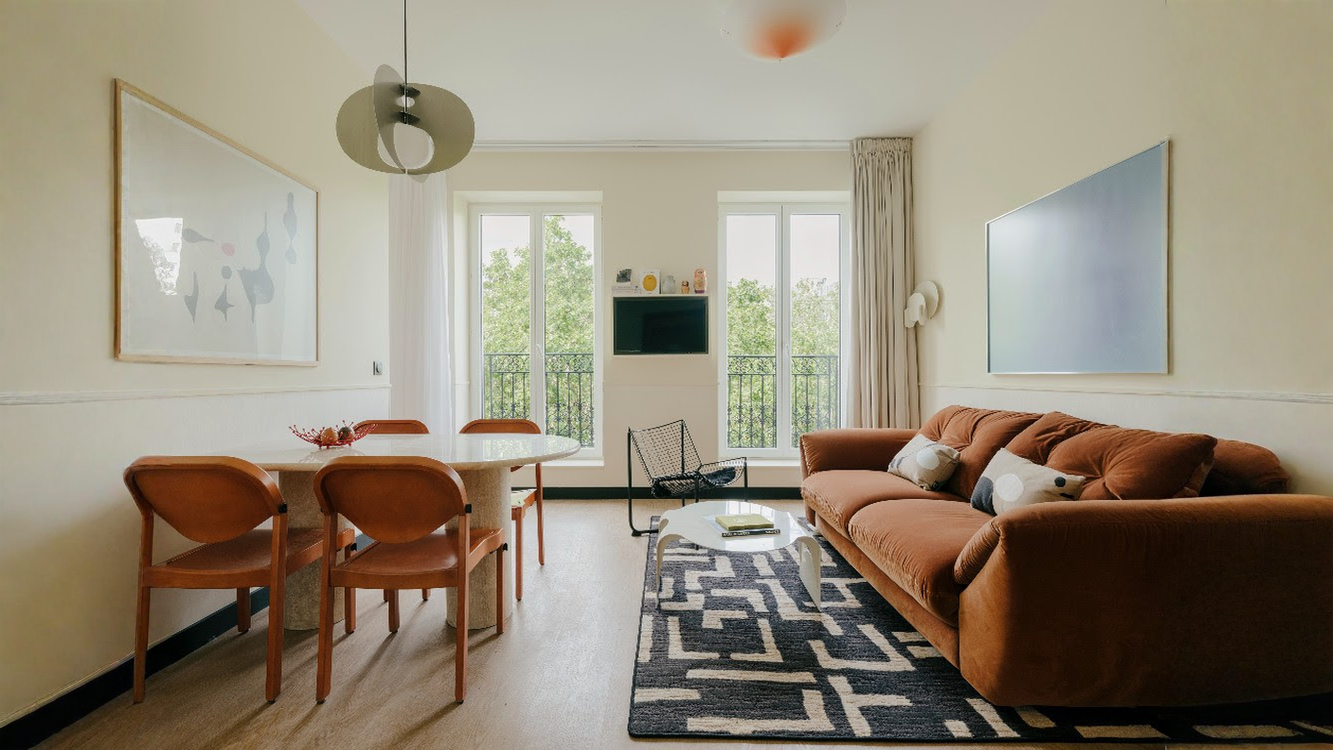
In the living rooms, the furniture comprises velvet sofas from the Edgar x AMPM collaboration, carpets with black-and-white geometric patterns, and a selection of vintage pieces.
AMCA Oval designed several series of bespoke objects for this address: oval-shaped lacquered coffee tables, orange-tinted conical light fixtures, ivory-colored Aurora wall sconces from the range, as well as cushions in Italian jacquard named “Vibrations.” The design duo also signs all the paintings and photographs on display.
In the bedrooms, the decor is more minimalist. They feature dark red lacquered headboards with integrated reading lamps, and showcase a painting on aluminum support from the collection “Neo-Vibrations.”
Finally, the bathrooms adopt a matte, solid color treatment, offered in terracotta pink or olive green, and are equipped with silkscreened mirrors by the AMCA Oval studio.
To read: Edgar Suites: a new hotel residence in Clichy
The layout draws inspiration from the clean lines of Constantin Brancusi’s style, combining wood, metal and ceramic.
In the living rooms, the furniture comprises velvet sofas from the Edgar x AMPM collaboration, carpets with black-and-white geometric patterns, and a selection of vintage pieces.
AMCA Oval designed several series of bespoke objects for this address: oval-shaped lacquered coffee tables, orange-tinted conical light fixtures, ivory-colored Aurora wall sconces from the range, as well as cushions in Italian jacquard named “Vibrations.” The design duo also signs all the paintings and photographs on display.
In the bedrooms, the decor is more minimalist. They feature dark red lacquered headboards with integrated reading lamps, and showcase a painting on aluminum support from the collection “Neo-Vibrations.”
Finally, the bathrooms adopt a matte, solid color treatment, offered in terracotta pink or olive green, and are equipped with silkscreened mirrors by the AMCA Oval studio.
To read: Edgar Suites: a new hotel residence in Clichy




 Having become an indispensable pause, free time now tends to lengthen as our societies evolve. After 1936 and the 15 days of paid holidays finally granted to workers, the third week appeared in 1956, and the fourth week was granted in 1969, within the social gains package of May ’68.