The Laurel Forest of La Gomera, a Unique Canary Islands Ecosystem


The laurisilva, or laurel forest.
This is the scientifically sounding name used to describe this type of forest, almost permanently drenched by the dense haze arising from the clouds that rise along La Gomera’s slopes.
Spread between 800 m and 1,487 m in altitude, the island’s highest point, this forest is largely included in the Garajonay National Park, created in 1981 to protect this sensitive ecosystem.
This is the scientifically sounding name used to describe this type of forest, almost permanently drenched by the dense haze arising from the clouds that rise along La Gomera’s slopes.
Spread between 800 m and 1,487 m in altitude, the island’s highest point, this forest is largely included in the Garajonay National Park, created in 1981 to protect this sensitive ecosystem.
A UNESCO World Heritage Site and Biosphere Reserve at the Heart of La Gomera
UNESCO also listed it on the World Heritage List in 1986 before designating it as a biosphere reserve in 2012.
If it stands out against the island’s otherwise dry scenery, that’s because this grove thrives under the influence of the winds, particularly under the trade-wind regime.
Coming from the northeast, they drive clouds loaded with water vapor toward the summit slopes.
They then shed their water droplets onto the trees and shrubs, forming a humid subtropical undergrowth of incomparable plant wealth.
If it stands out against the island’s otherwise dry scenery, that’s because this grove thrives under the influence of the winds, particularly under the trade-wind regime.
Coming from the northeast, they drive clouds loaded with water vapor toward the summit slopes.
They then shed their water droplets onto the trees and shrubs, forming a humid subtropical undergrowth of incomparable plant wealth.
A Three-Hour Hike Through Garajonay’s Humid Forest
In order to observe the phenomenon up close, head to el monte, the name locals of La Gomera give to this high-altitude forest.
From the island’s west and the village of Arure, a nearly 3-hour hiking route forms a loop and starts at the hamlet of Acardece.
As you rise through the different levels of the laurisilva, the opening stretch of the route, facing south, reveals a beautiful scrub vegetation, blending heathers and various shrubs.
From the island’s west and the village of Arure, a nearly 3-hour hiking route forms a loop and starts at the hamlet of Acardece.
As you rise through the different levels of the laurisilva, the opening stretch of the route, facing south, reveals a beautiful scrub vegetation, blending heathers and various shrubs.
Primary Forest Landscapes Shaped by the Trade Winds
At the entrance to Garajonay National Park, the landscape changes radically.
The path suddenly plunges into a dense forest formed by arborescent heathers, holly, laurels, and nearly twenty other tree species.
Initially dry in appearance, it becomes more humid as you ascend along the route, gradually leaving behind the southern influence to face winds coming from the north.
The path suddenly plunges into a dense forest formed by arborescent heathers, holly, laurels, and nearly twenty other tree species.
Initially dry in appearance, it becomes more humid as you ascend along the route, gradually leaving behind the southern influence to face winds coming from the north.
Mosses, Ferns and Lichens: a Tolkien-esque Atmosphere
At the place called Raso de la Bruma, the trail crosses a road and leans distinctly toward the north. A new atmosphere!
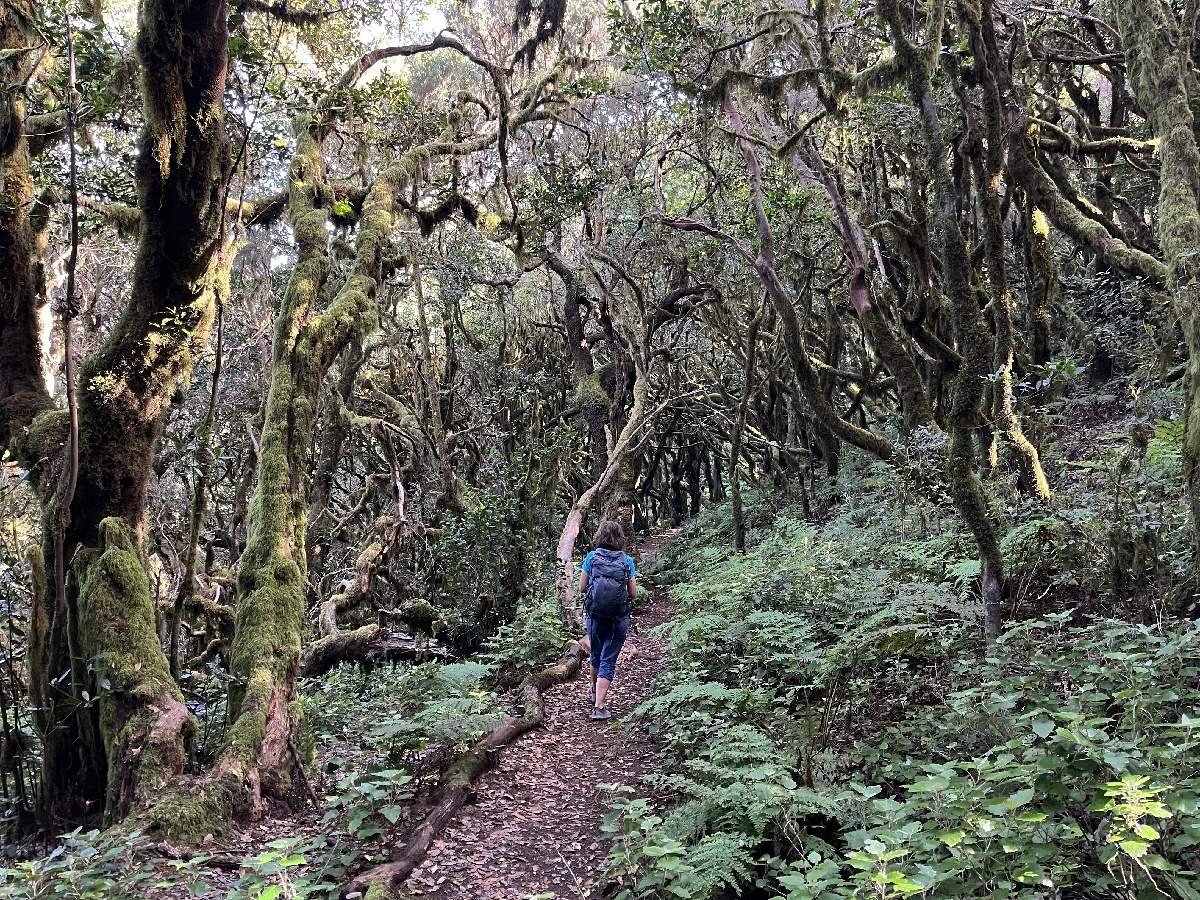
The twisted trunks and the branches of heathers, some specimens reaching up to 20 meters tall—a sort of world record—are wrapped in moist mosses and lichens.
Mixed with fern-covered soils, this emerald fuzz creates a Tolkien-like landscape, in a surprisingly cool freshness.
The twisted trunks and the branches of heathers, some specimens reaching up to 20 meters tall—a sort of world record—are wrapped in moist mosses and lichens.
Mixed with fern-covered soils, this emerald fuzz creates a Tolkien-like landscape, in a surprisingly cool freshness.