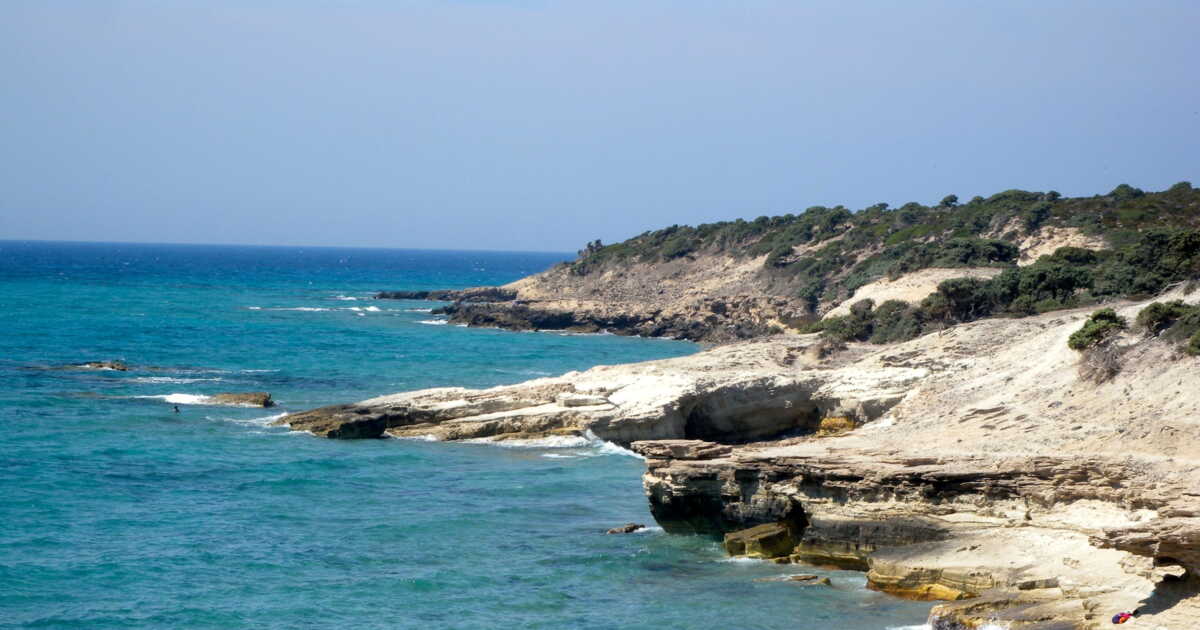
What if your next property lay in the heart of the Aegean Sea, far from crowded seaside resorts? In the Dodecanese archipelago, southeast Greece, the island of Stroggilo is up for sale for the “modest sum” of €4.5 million. This territory of roughly 21.9 hectares features three natural beaches, vegetation all year round, and ruins of ancient structures. Still untouched by any modern development, it offers its future owner the opportunity to imagine a real estate project in the midst of a preserved environment.
Three beaches and natural resources to envision a bespoke project
At first glance, Stroggilo stands out for its coastline and landscapes that remain largely free from construction. According to the listing published on the specialist site Private Islands Inc, the island has three natural beaches, including a 110-meter stretch of fine sand located on a sheltered section of the coast. A setting that could appeal to a buyer eager to create a private retreat or a high-end tourism establishment.
The clear waters surrounding the island also invite swimming, diving, and a range of water activities. Its geographic position could moreover make it a jumping-off point for exploring nearby islands, particularly in the Lipsi and Arki archipelagos.
But Stroggilo’s appeal goes beyond its beaches. The island has a natural water source that, according to the real estate listing, could be rendered potable through a basic filtration system. Stone ruins, remnants of an old house, and a well are also present on the site. These elements could prove valuable in future urban-planning steps, even if they do not guarantee obtaining building permits.
Electrical power access could also be considered. The neighboring island of Marathos has an electrical network to which Stroggilo could potentially be connected. The technical and administrative feasibility of such a connection would still need to be established.
The property listing presents Stroggilo as a “blank canvas” for a buyer wishing to design a project tailored to the landscape. It specifically mentions the possibility of a private residence or an eco-friendly tourist establishment, two options that would require preliminary studies and the appropriate authorizations.
An isolated island, yet accessible from nearby archipelagos
With its approximately 21.9 hectares, Stroggilo offers a substantial space for those seeking an island property in the Mediterranean. Its isolation is a defining feature, however: the island currently has no modern amenities and thus requires an assessment of access, supply, and development conditions before any project.
To reach it, a private boat or a boat-taxi connection from Patmos or Leros could be considered. The latter has an airport offering daily connections to Athens, which facilitates travel from the Greek capital. The tourist island of Kos, better known to travelers, lies about 45 nautical miles away, roughly 83 kilometers.
The regional setting constitutes another argument advanced by the seller. The proximity to Patmos is a draw for lovers of religious and historical heritage. Some sites on the island are inscribed on UNESCO’s World Heritage list, such as the Monastery of Saint John the Theologian and the Cave of the Apocalypse, which adds cultural appeal to this part of the Aegean Sea.
Listed at €4.5 million, Stroggilo is thus aimed primarily at a buyer with a sizeable budget ready to consider a long-term investment. The seller highlights the possibility of developing an exclusive property in a preserved Mediterranean setting, or of keeping the island as a private natural space.
One crucial caveat remains: the island’s still-undeveloped status does not mean that all desired constructions will be permitted. Before transforming Stroggilo, its future owner will need to verify zoning rules, environmental constraints, and the practical conditions for connecting to infrastructure.