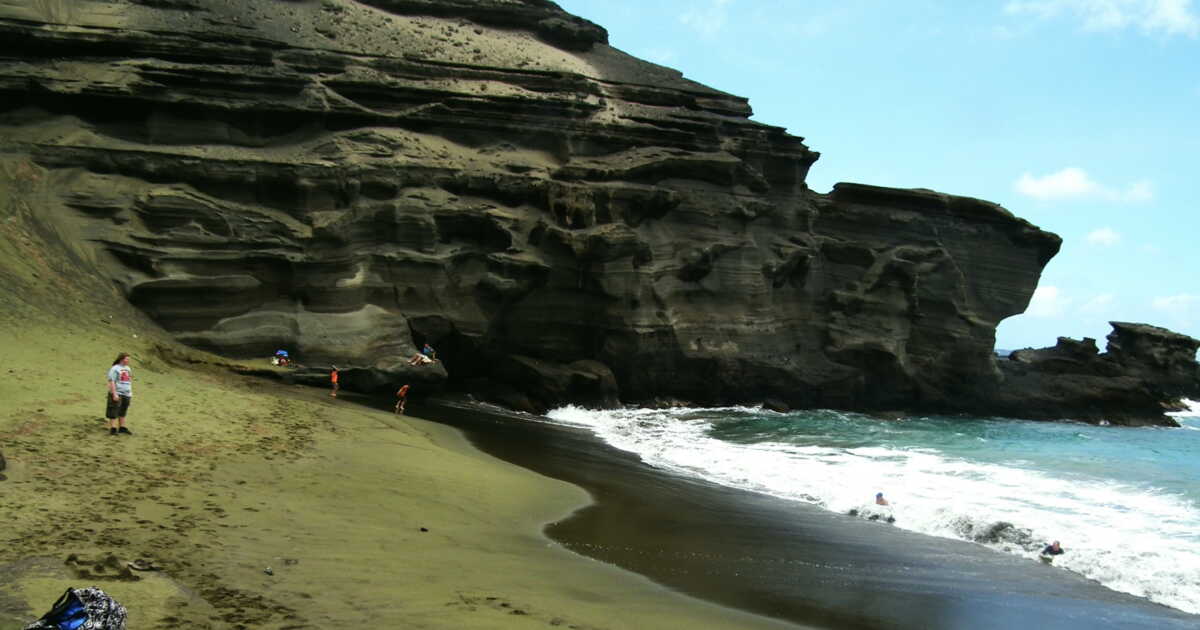
On the island of Hawaii, a beach captivates both geologists and travelers seeking extraordinary landscapes. The reason, its color… green! At first glance, its sand seems artificially dyed by its striking hue. Yet this spectacular setting is entirely natural. Located in the southern part of the Big Island, Papakōlea Beach is among the very few green-sand beaches known on the planet, an exceptional geological phenomenon that draws visitors from around the world each year.
A Spectacular Color Born from an Ancient Volcano
At Papakōlea Beach, also known as Mahana Beach, the sand does not display the white hues typical of tropical shores, nor the black tones often linked to Hawaii’s volcanic scenery. Here, the coastline presents a striking green shade, visible along much of the bay.
Contrary to what one might think, this color does not originate from algae or marine vegetation. It is tied to the presence of olivine, a mineral rich in magnesium and iron, commonly found in volcanic rocks. Nicknamed the “Hawaiian diamond,” this stone is a product of the volcanic activity that shaped the archipelago for millennia.
The beach lies inside the Pu’u Mahana volcanic cone, formed after a Mauna Loa eruption around 49,000 years ago. With the crater gradually eroding, olivine crystals accumulated on this portion of the coastline. Heavier than other volcanic particles, they remained trapped in place while lighter sand was swept away by the ocean.
Today, this mineral concentration still gives rise to several shades of green along the shore. This phenomenon remains extremely rare: Papakōlea Beach would be among the only four green-sand beaches in the world. The others are located in Norway, Guam, and the Galápagos Islands.
A Demanding Hike Before Reaching the Beach
Exploring this unusual beach, however, requires a bit of effort. Papakōlea Beach is indeed situated in the Ka‘ū region, near South Point, the southernmost point of the island of Hawaii. From Kailua-Kona, plan for roughly 1 hour 30 minutes to 2 hours of driving by taking Highway 11 south.
Upon arriving near the designated car park, the final stretch of the journey is on foot. Visitors must traverse about four kilometers along a rugged trail that runs along the Pu’u Mahana volcanic cone. The route is known for exposure to strong winds and heat, demanding good preparation before departure.
It is thus recommended to wear sturdy footwear, use reef-safe sunscreen, and bring enough water for the round trip. Access to the beach is then gained via a steep path down to the sand level.
Once on site, the landscape offers a striking contrast between the volcanic cliffs, the Pacific Ocean, and the green reflections along the shore. Yet this natural site remains particularly protected. It is illegal to remove sand from Hawaiian beaches. Visitors are also urged to take their trash with them to preserve this fragile environment.
Despite the challenging trek, Papakōlea Beach continues to fascinate travelers seeking rare and spectacular places. Between geological curiosity and an almost unreal backdrop, this Hawaiian beach ranks among the most unique landscapes in the United States.
