

The project of Grand Hyatt Miami Beach takes a new step.
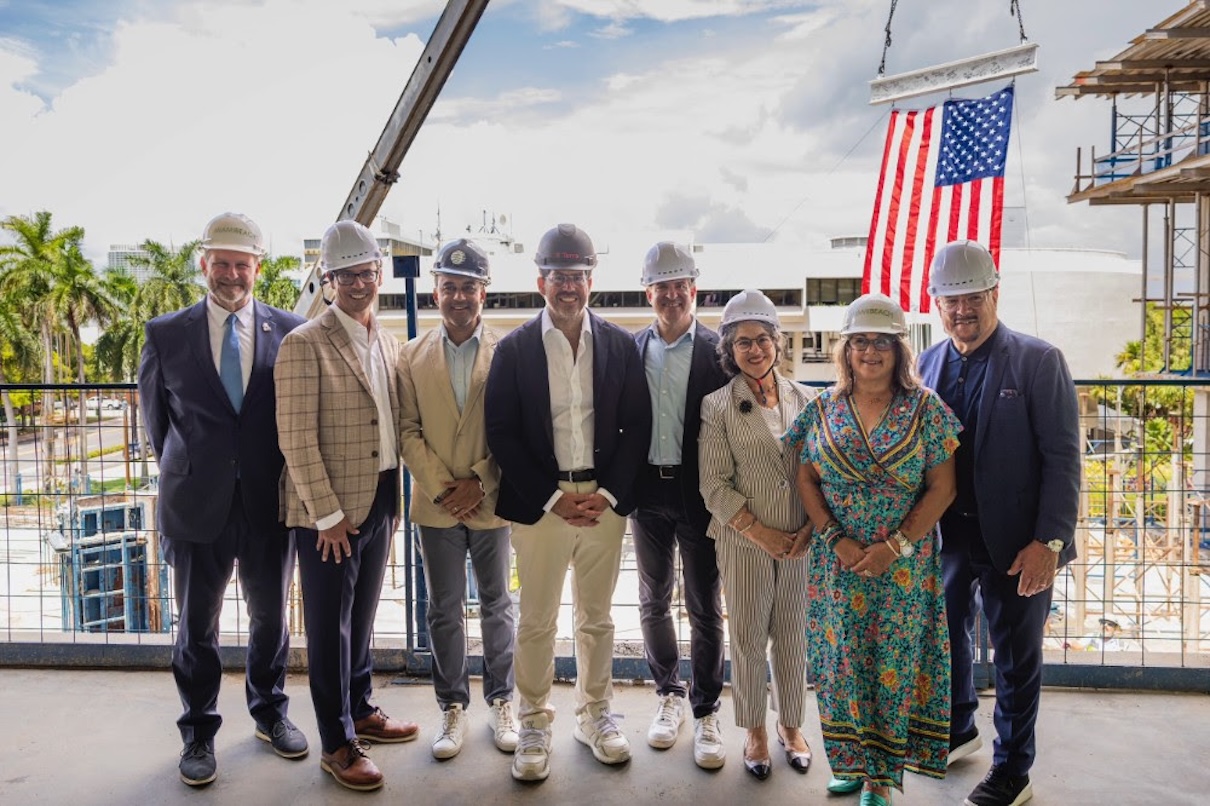
On July 28, public and private partners gathered around the project celebrated the laying of the last beam of the future hotel, located in the immediate vicinity of the Miami Beach Convention Center.
With 800 rooms, the establishment is expected to open its doors by the end of 2027 and become the convention center’s flagship hotel.
Its direct connection to the complex, via a climate-controlled walkway, should enable Miami Beach to enhance its capacity to host large-scale professional events.
On July 28, public and private partners gathered around the project celebrated the laying of the last beam of the future hotel, located in the immediate vicinity of the Miami Beach Convention Center.
With 800 rooms, the establishment is expected to open its doors by the end of 2027 and become the convention center’s flagship hotel.
Its direct connection to the complex, via a climate-controlled walkway, should enable Miami Beach to enhance its capacity to host large-scale professional events.
A hotel designed for the convention market
Located at the corner of the 17th Street and Convention Center Drive, the Grand Hyatt Miami Beach will be directly accessible from the Miami Beach Convention Center, recently renovated.
The future establishment will feature 12 floors of guest rooms, including 50 suites, as well as four levels dedicated to meetings and events.
In total, it will offer around 10,220 m² of meeting spaces, to which will be added a Grand Lawn of nearly 740 m² installed on the fifth-floor terrace-garden.
The offering will be complemented by two pools, a fitness center with spa facilities, a Grand Club, a signature restaurant and a bar-lounge.
Près des deux tiers des chambres disposeront par ailleurs d’un balcon, avec pour certaines des vues sur l’océan Atlantique ou la baie de Biscayne.
Le projet prévoit également environ 1 580 m² d’espaces commerciaux au niveau de la rue, ainsi que de nouveaux espaces publics et des cheminements destinés à favoriser les déplacements à pied et à vélo.
The future establishment will feature 12 floors of guest rooms, including 50 suites, as well as four levels dedicated to meetings and events.
In total, it will offer around 10,220 m² of meeting spaces, to which will be added a Grand Lawn of nearly 740 m² installed on the fifth-floor terrace-garden.
The offering will be complemented by two pools, a fitness center with spa facilities, a Grand Club, a signature restaurant and a bar-lounge.
Près des deux tiers des chambres disposeront par ailleurs d’un balcon, avec pour certaines des vues sur l’océan Atlantique ou la baie de Biscayne.
Le projet prévoit également environ 1 580 m² d’espaces commerciaux au niveau de la rue, ainsi que de nouveaux espaces publics et des cheminements destinés à favoriser les déplacements à pied et à vélo.
A strategic infrastructure for Miami Beach
For local business tourism players, the arrival of the Grand Hyatt should respond to growing demand. 28.3 million visitors were welcomed to Miami and Miami Beach in 2025, according to data released by the Greater Miami Convention & Visitors Bureau.
David Whitaker, president and CEO of the Greater Miami Convention & Visitors Bureau, believes that the hotel connected to the convention center could notably enable the destination to position itself for new international events.
According to him, several major conventions and trade shows that had not previously taken place in Miami Beach would now express interest in the destination.
The project also follows a $640 million investment in renovating the Miami Beach Convention Center.
For Freddie Peterson, the center’s general manager, the future hotel thus represents the missing piece of the complex to have both event infrastructures and lodging capacity suited to large international gatherings.
David Whitaker, president and CEO of the Greater Miami Convention & Visitors Bureau, believes that the hotel connected to the convention center could notably enable the destination to position itself for new international events.
According to him, several major conventions and trade shows that had not previously taken place in Miami Beach would now express interest in the destination.
The project also follows a $640 million investment in renovating the Miami Beach Convention Center.
For Freddie Peterson, the center’s general manager, the future hotel thus represents the missing piece of the complex to have both event infrastructures and lodging capacity suited to large international gatherings.
An urban project beyond hospitality
Led by Terra and Turnberry, with Hyatt operating the establishment, the project also aims to participate in transforming the Convention Center district.
Designed by architect Bernardo Fort-Brescia of Arquitectonica and built by Balfour Beatty, the Grand Hyatt is set to improve connections with the main attractors of Miami Beach, notably Lincoln Road, the Miami Beach Botanical Garden, the Bass Museum, the Miami City Ballet and the arts district.
New public spaces, pedestrian promenades, bike-share stations and better connections to public transportation are also planned. These developments are intended to support the city’s sustainability and resilience goals.
For Hyatt, which continues its expansion in major international destinations, the project should also strengthen its presence in the big-event segment.
Designed by architect Bernardo Fort-Brescia of Arquitectonica and built by Balfour Beatty, the Grand Hyatt is set to improve connections with the main attractors of Miami Beach, notably Lincoln Road, the Miami Beach Botanical Garden, the Bass Museum, the Miami City Ballet and the arts district.
New public spaces, pedestrian promenades, bike-share stations and better connections to public transportation are also planned. These developments are intended to support the city’s sustainability and resilience goals.
For Hyatt, which continues its expansion in major international destinations, the project should also strengthen its presence in the big-event segment.
 Published by Amelia Brille TourMaG.com Editor
 View all articles by Amelia Brille


Add TourMaG to your Google News feed