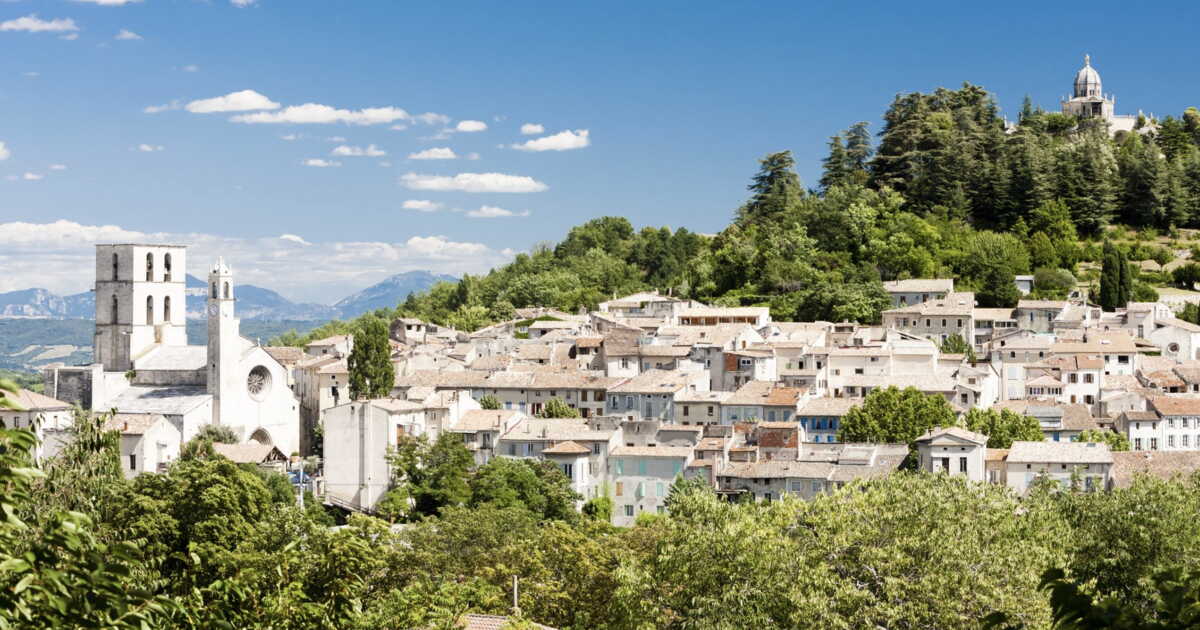
Approximately twenty kilometers north of Manosque, the country of Forcalquier plays a central role in Giono’s work. Not so much for the ancient county town, though splendid, which clings to its limestone spur like ivy to an old trunk. But rather for the surrounding countryside, which inspired him with numerous scenes of rural life.
The atmosphere of a rural Provence
Admittedly, these wind-swept plateaus are rather bare, compared to the ones the author described in The Song of the World and The Man Who Planted Trees, at a time preceding the Thirty Glorious Years, when they were the stage of a world dominated by peasants. But today you can still recover there the atmosphere of the harsh earth, tough to work, which pervades Giono’s work. “The region surrounding Forcalquier is the writer’s land of friendship. There he rubbed shoulders with painters Lucien Jacques and Serge Fiorio who, like him, draw inspiration from this rural and peasant Provence”, explains Christian Morzewski, president of the Friends of Jean Giono.
The stroll begins in Saint-Maime, another village perched on rock. The path quickly races toward the heights, passes a XIIth-century chapel, then follows the crest. On the horizon, the peaks of the Écrins massif silhouette themselves like flint. Down below, a few vine stocks can be seen. The last remnants of a viticultural tradition far more developed in the writer’s era. In addition to cereal farming, livestock, and gypsum quarry exploitation, grape wine brought some wealth to the region. But it required the hard work of men.
Today farmers are few and far between
Along the roadside, Jean-Claude Tarsac, 80 years old, lifts from his enormous hands stones at the edge of his sunflower field. “When I was young, there were still a hundred of us working the land here. Today, the farmers are counted on the fingers of one hand”, sighs the man, still sound of mind and body.
The path runs beside an old stone building: La Margotte. Now transformed into a guesthouse, this Provençal farm with a tile roof and red shutters was Giono’s. The writer visited it often, by bicycle or by coach. He employed farm workers there, sometimes put his own hands to the earth, and there he wrote, in one month, A King Without Entertainment (1947).
Technical sheet and nearby
Technical sheet: loop starting from Saint-Maime, 15 km and 270 m of cumulative ascent.
Nearby: go see the Mourres, astonishing stone mushrooms just north of Forcalquier.
👉 “In Giono’s footsteps: four hikes along the writer’s prose to follow the author in his country of the heart”, an article to be found in GEO Special Issue No. 133 for June-July 2026, “France, our favorite summer walks”, on newsstands ✨
➤ If you love GEO, then to miss nothing, discover our subscription plans to receive GEO at home every month with ease.
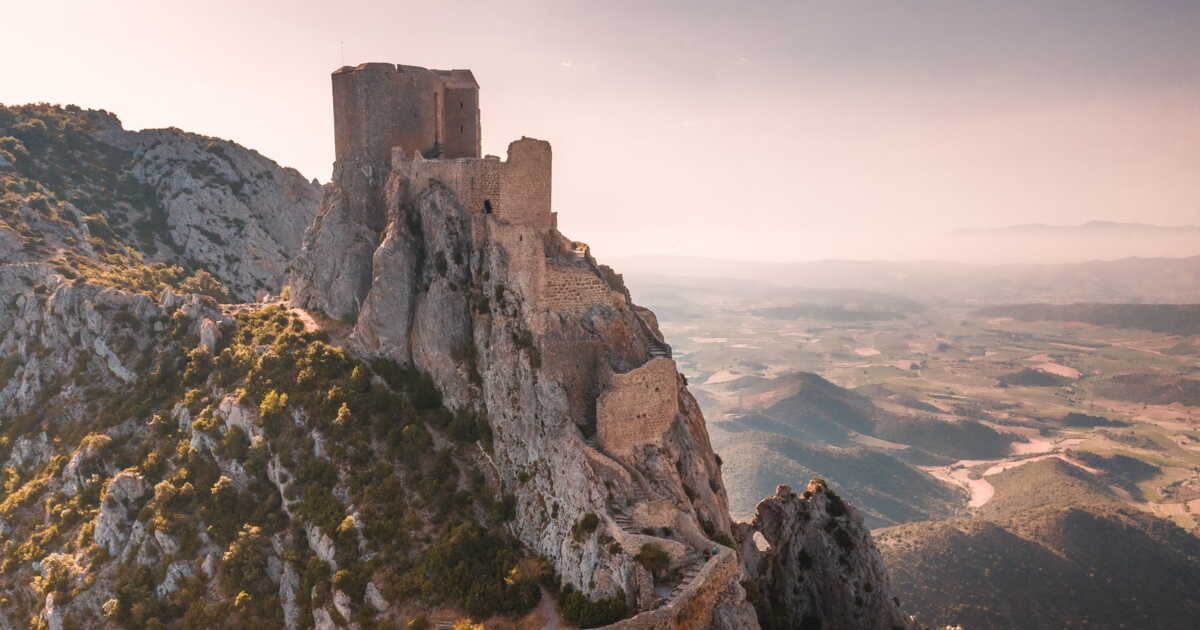
To be moved by these millennia-old stones nestled in the High Corbières, you must rise early. At dawn, indeed, but the effort is rewarded by the sight of the first sunbeams caressing the façade of the Château de Quéribus, perched on its pog (“piton rocheux” in Occitan) overlooking the Aude village of Cucugnan, 120 inhabitants. This eagle’s nest, scarred by cannonball impacts, lends itself perfectly to this play of early morning light.
From this overlook, reached by skirting the ramparts, an breathtaking panorama unfolds: to the east, the medieval tower of Tautavel, with, further away, the vast blue of the Mediterranean; to the south, the snow-capped peak of Canigou; to the west, the Ariège peaks of the Pyrenees; and, right opposite, to the northwest, seven kilometers away as the crow flies, tucked away on a ridge cloaked in arbutus trees and evergreen oaks, another fortress: Peyrepertuse, barely discernible as its walls and towers blur with the crenellations of the limestone crest.
Peyrepertuse (“pierre percée” en occitan languedocien), 800 mètres d’altitude, accueille 100 000 visiteurs par an sur ses remparts.
Quéribus and its four brothers in arms—Peyrepertuse, thus, and also Puilaurens, Aguilar and Termes—form the strategic ensemble known as the “five sons of Carcassonne.” These stone sentinels punctuate the ridgelines that weave between the Corbières massif and the Pyrenean foothills, near the medieval citadel. Radiating from it, the traveler discovers, for a weekend, this line of defense erected by Saint Louis in the 13th century to lock the kingdom’s border. And it offers a medieval getaway amid rugged reliefs, vertigo-inducing gorges, vineyard plains, and fortified villages.
Ambiance mystérieuse
Less than two hours by road from the ramparts of Carcassonne, Quéribus often marks the starting point of this escape. “This castle was a lookout, explains Bruno Schenck, a winemaker and deputy mayor of Cucugnan, who has been working for more than thirty years to renovate this historic monument. It is nicknamed the Finger of God because of its verticality.” This was the last bastion to fall: in 1255, eleven years after Montségur’s burning, the fortress still sheltered the Albigeois, those “heretics” hunted by the Inquisition, under the protection of the Languedoc lord Chabert de Barbaira. The site then became a royal stronghold, used to watch over the border with Aragon.
Bon à savoir
A small revolution is underway: the designation “Cathar castles” is giving way to the “royal fortresses of Languedoc.” Some lament the loss of a name steeped in mystery and identity, but historians remind us of an archaeological truth: the Cathars never built these citadels. It was Saint Louis who, in the 13th century, after the crusade against the Albigeois, ordered these giants of stone to be erected on the ruins of former lordly residences (castrums) to defend the border with Aragon. Today, eight of these military constructions hope for UNESCO inclusion on the World Heritage List. Verdict in July 2026.
Eight centuries on, each of these stone giants harbors a singular, mysterious atmosphere. Notably at Puilaurens, which sits at the heart of a forest of pines and holm oaks. The fortress, seventy kilometers from Carcassonne, rises at 697 meters on Mount Ardu, at the crossroads of the Boulzane and Fenouillèdes valleys.
“One must imagine that at the time of the castrum [the fortified village surrounding the citadel], there was no forest; everything was cultivated”,
explains Karine Duhil, the person in charge of the monument, as she makes her way up toward the first switchbacks. These thick, tusk-shaped walls were designed to slow down attackers. The structure blends so intimately with the rock that one struggles to distinguish human handiwork from nature. “The works carried out under Saint Louis are recognizable in the dressed stones, more regular than those of the vestiges of the original castrum”, notes Karine Duhil.
An hour and fifteen minutes by road from both Puilaurens and Carcassonne, perched on the southern slope of the Corbières massif, another fortress, abandoned after its military role ended, dominates the village of Termes, bathed by the Sou river. The fortress had been heavily degraded before benefiting from restoration campaigns led by the municipality and passionate volunteers. “Destroyed in 1653, the castle had been left to ruin; only the cruciform window of the chapel remained,” explains Michel Séguy, president of the association safeguarding the building. “We have been working for forty years to help visitors grasp the site’s original layout.”
Un vaisseau fantôme
Overlooking vineyards and hills 30 kilometers from Termes, the walls of Aguilar follow the shape of the rocky spur on which they stand. Nicknamed the Little Carcassonne, the castle mimics in miniature the Aude fortress, with its defensive towers and its polygonal enclosure. Here one is immersed in the stark light of the Corbières, which makes the white stones blaze, then steps into the shade of an ancient olive tree, before continuing on and reaching, 25 kilometers further, the most spectacular of the five fortresses: Peyrepertuse.
Hidden along the crest, the roughly 300 meters of rampart blend with the rock, evoking a ghost ship. “It is a true city; its construction spans several centuries”, explains Agnès Daubrege, guide of the castle. The best way to enjoy this poetic detour is to ascend the sixty or so steps of the “Saint-Louis” staircase, carved into the rock. From the terrace of the Sant-Jordi chapel, one can glimpse the Verdouble, this “river that unfolds its meanders over the stones”, which Claude Nougaro sang about. So, in the quiet of the mountaintops, vertigo takes on a new form. And one understands that these citadels, once ramparts against the enemy, have become promontories from which to embrace the world.
À Cucugnan, village rendu célèbre par une nouvelle d’Alphonse Daudet, le moulin d’Omer, datant du XVIIe siècle, a été réhabilité en 2003 et remis en marche en 2006.
Nearby to visit
Master Baker
Don’t tell Roland Feuillas that he’s merely making bread. Cucugnan’s baker (photo above) has put the village’s lordly mill back into service to craft “100% natural” loaves from ancient wheats. His School of Bread, right beside his shop, lets you learn all about sturdy sourdoughs that release flavors and about wood-fired baking. lesmaitresdemonmoulin.com
Rushing waters
Between Puilaurens and Quéribus, the Agly has carved the limestone to forge narrow gorges and basins suited for canyoning. On the rock face, the Saint-Antoine de Galamus hermitage, built into the cliff at 376 m above sea level, is accessible on foot. From the parking lot at the gorge’s entrance, follow the prepared trail winding up to the small sanctuary clinging to the cliff. gorgesdegalamus.fr
➤ Article paru dans le magazine GEO n°568, “Barcelone, l’atelier à ciel ouvert d’Antoni Gaudí”, de juin 2026.
➤ You like GEO ? Then to make sure you don’t miss anything, discover our subscription plans to receive GEO every month at home with ease.