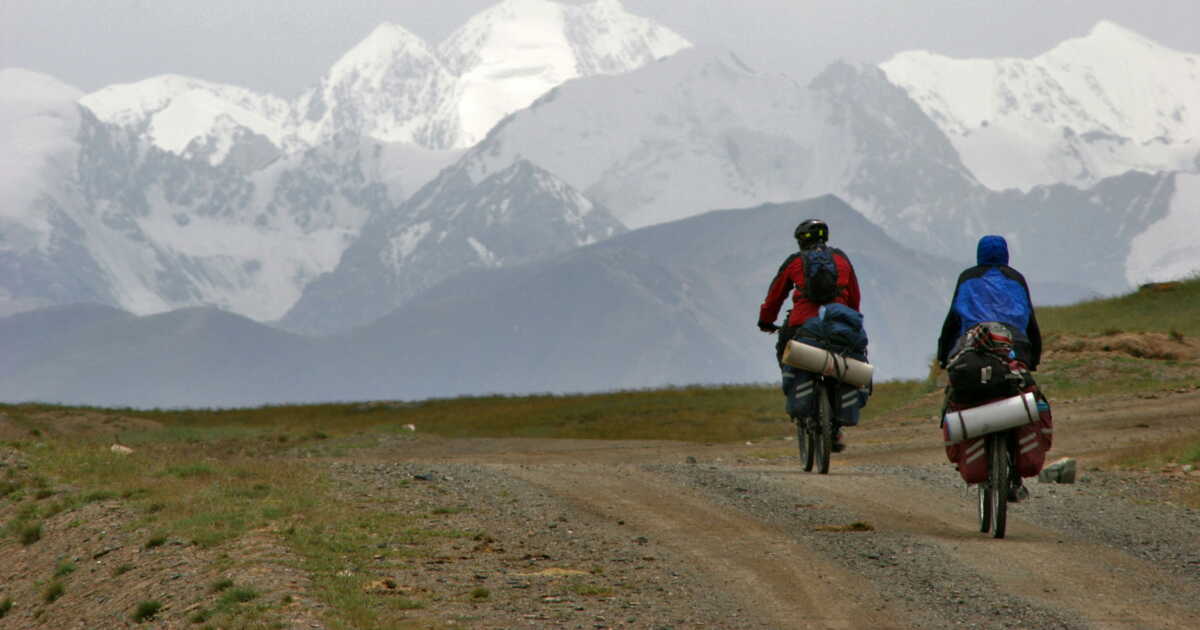
Crossing Iran by bike, hitchhiking across South America, or linking Russia and Portugal by running… Social networks are now filled with content creators sharing their extraordinary travel projects. Among them is Ian Andersen, an American who crossed the Iranian border by bicycle as part of a 16,000-kilometer journey from Portugal to Japan. In June 2025, the young man shares videos of his crossing in a country that the United States does not recommend traveling to.
On June 13, Israeli strikes against Iranian sites upended his itinerary. The cyclist found himself alone, his guide no longer able to guarantee his safety, and he eventually left the country via Azerbaijan with the help of an assistance program. “I knew the risks and I still went,” he told the New York Times, which looked at the dangers of the popularization of these extreme travelers.
@ridewithian Huge thanks to my friend @lavenam for helping me get an Azerbaijani visa—and to the U.S. Embassy in Baku for the emergency green light to enter the country. I’m out, and truly grateful for all your prayers, messages, and support. It’s an honor to have you following this journey and caring about my wellbeing out here in the Middle East. The most harrowing part of the day was the exit interviews with Iranian officials at the border. No footage of that (for obvious reasons) but I’ll write more about it soon on Substack if you’re curious. And finally, to my Iranian guide Reza—there’s no one I’d rather have had by my side. I’m out—but the conflict is just beginning. I’ll be keeping normal Iranians and Israelis in my thoughts. Especially the younger generation of Iran, who keep paying the price for decisions made by their fathers and grandfathers. There’s a phrase in Persian that roughly means: “the forgotten generation.” That feels true. The journey continues soon. Thank you again. -Ian Fast facts: Total distance: ~10,000 miles (16,000 km) Key gear: stove, tent, patch kit, cigs Today’s distance ridden: 0 miles (0 km) Total distance ridden: 4,328 miles (6,980 km) Currently in: Astara, Azerbaijan
♬ original sound – Ian Andersen – Ian Andersen
Bold travelers despite warnings from their governments
For safety experts, these expeditions pose dangers that go beyond adventure sports. In some countries, travelers also expose themselves to risks of arbitrary arrest, surveillance, searches of their electronic devices, or espionage charges. Medical evacuation, when possible, can cost hundreds of thousands of euros. For certain parts of the world, the United States even goes so far as to advise travelers to provide a DNA sample, or even to draft a will.
Yet these warnings do not seem to deter some travelers questioned by our American counterparts. Some argue that official advisories reflect primarily a government approach to safety and that simply respecting the laws and the locals is enough to limit risks. They also stress that they obtained the necessary visas before departure.
A travel trend that glosses over reality
Authorities, however, remind that a positive testimonial on social media never guarantees safety. “Alert levels reflect real cases. We work with the families of people arbitrarily detained. It can break lives”, remarks a spokesperson for the U.S. State Department. The main issue lies not only in the adventure itself, but in the image it projects on social media. According to neuroscientist Jay Van Bavel, internet users eventually identify with the creator.
They then feel that this type of journey seems more accessible than it really is. American authorities thus remind that travel advisories are based on real situations and not on hypothetical scenarios. They warn against the lure of trusting accounts from content creators claiming that “everything went smoothly”, while their services sometimes have very limited means to intervene in countries rated at the maximum alert level.