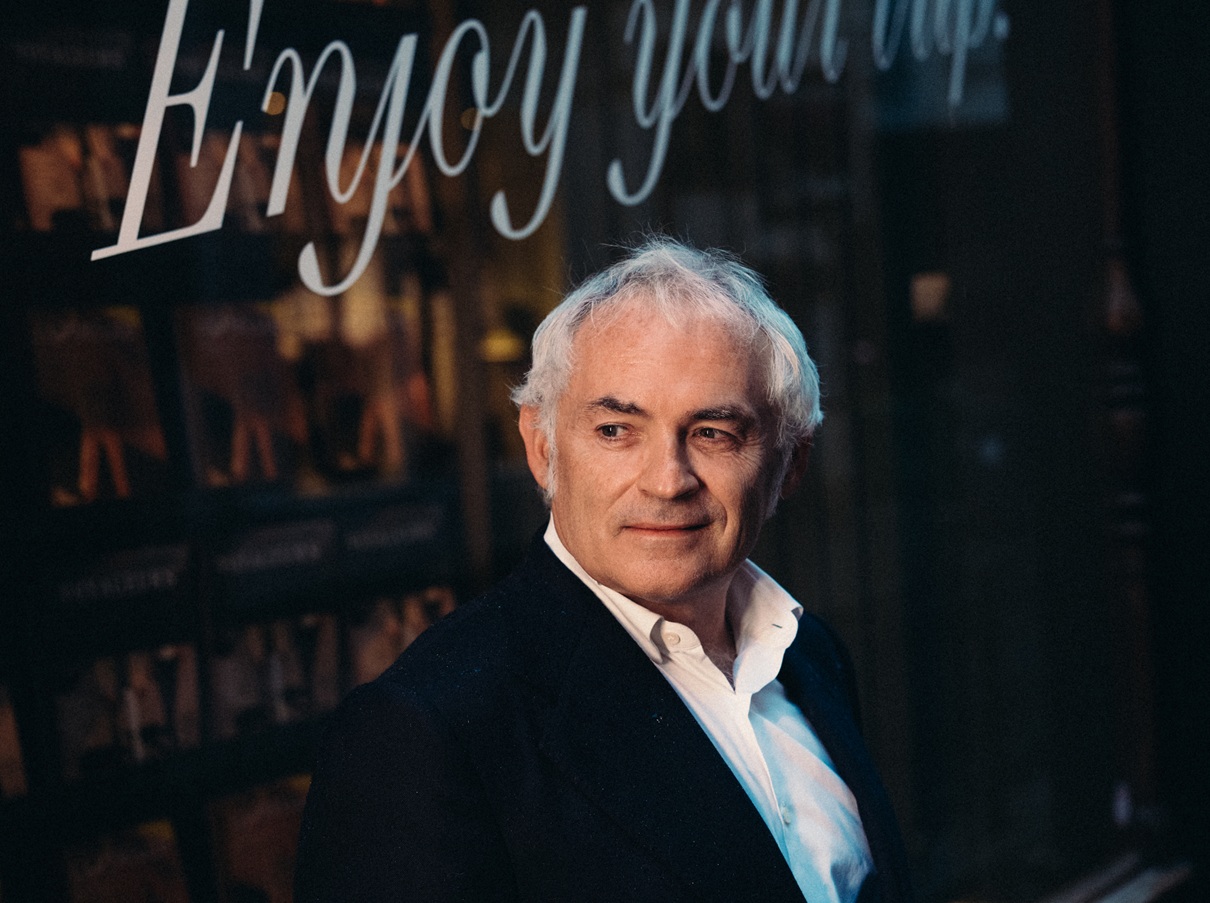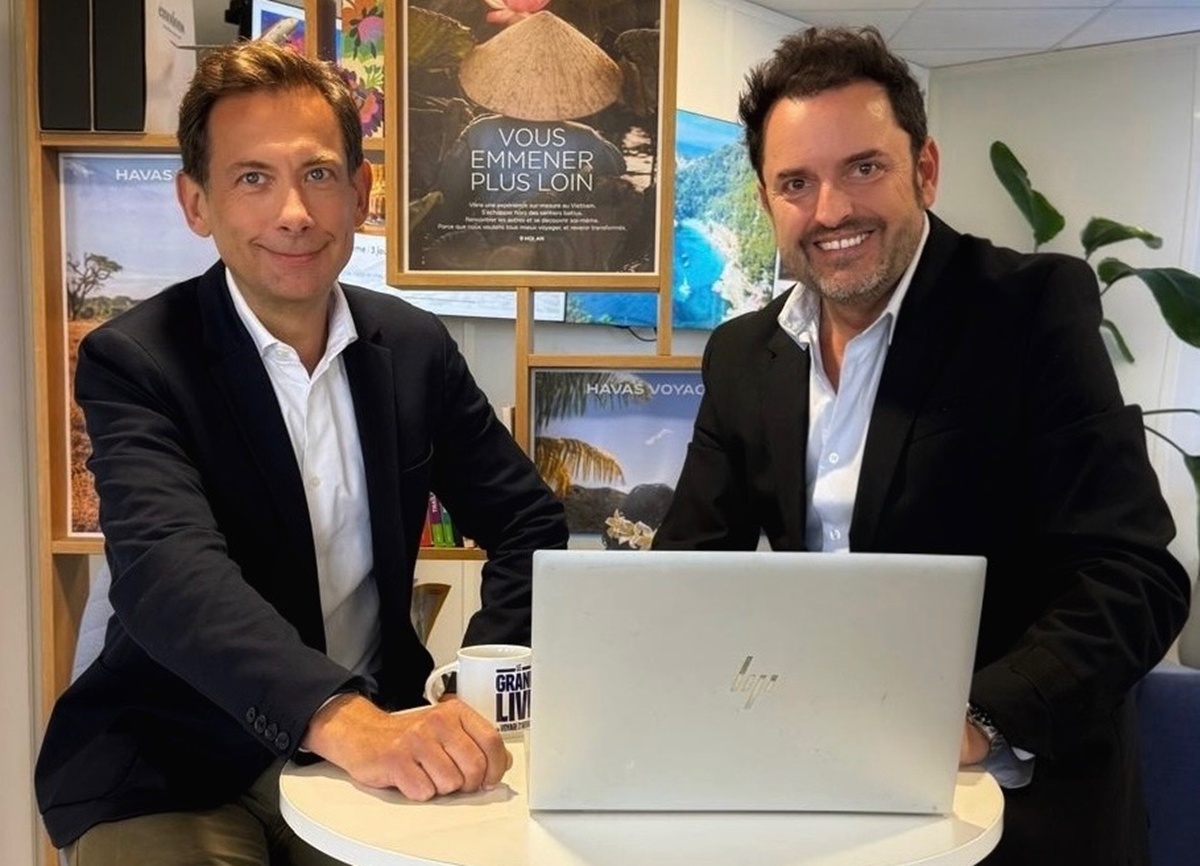


TourMaG – At the start of the year, the organizational chart of Marietton Développement was revised and you were promoted. Could you briefly remind us of the current organization?
Grégory Baumann: Indeed, I previously held the position of Deputy Chief Executive Officer of Havas Voyages. When Christophe Jacquet was named CEO of the Marietton group, which owns Havas Voyages, Laurent Abitbol entrusted me with the keys to the company.
This led to an internal reorganization. Among the main changes, we recruited Fabrice Allion as head of the leisure network, because he has extensive retail experience. He has worked for brands such as Zadig & Voltaire, Des Petits Hauts, Décathlon, Lacoste and Apple, and he is also a travel enthusiast.
His arrival enabled us to draw on the best retail practices.
Fabrice Allion: I joined Havas Voyages to energize a network of nearly 200 integrated agencies: 176 Havas and 13 Auchan Voyages.
TourMaG – What about the franchised network?
Grégory Baumann: It is Arnaud Abitbol who keeps the leadership of the franchise, because the relationship is historic, the franchisees value it and it works very well. There is therefore no reason to change the organization. Overall, the network comprises 350 integrated and franchised agencies.
Alongside Fabrice’s arrival, we strengthened the leadership of the business travel division—business trips account for 50% of our activity—by recruiting two people: Cyril Pellegrin as Commercial and Marketing Director and Brice Nicolas who leads all operations as well as our 17 BTCs—our business desks—across France.
Supporting business travelers in an inflationary context
 TourMaG – Why such a reorganization?
Grégory Baumann : It aligns with our ambition and the growth we want to pursue.
On the business travel side, first of all, we want to continue to embed our DNA—service in a highly digitalized profession—and anchor this service offered to travelers and businesses.
Our creed is to take care of business travelers and corporate budgets. And for that, we need the best market experts and robust technologies. That is how we operate today.
TourMaG – How does that translate in practice?
Grégory Baumann : Historically, we were well known in the SME market. Gradually, we are positioning ourselves for large accounts. We recently signed a deal on the French market worth 30 million euros.
Our ambition is to meet the expectations of our clients as the market evolves. To do that, we organize two to three times a year round-table discussions with them. We invite them to our headquarters and give them a voice. This allows us to set the roadmap for the coming months and years. We are launching this week our major client satisfaction survey.
TourMaG – What are the current concerns of your business clients?
Grégory Baumann : The ability to maintain their budgets in an inflationary context. It is therefore up to us to assist them in their travel policy, but also to enable them to access the best content.
Today, we are the leading French network in terms of NDC fare sales: one out of two Air France tickets sold by Havas Voyages is an NDC ticket. Not everything is perfect yet, but the system works sufficiently well for us to offer it to all our clients.
We also offer them other services: we have updated our content with Amadeus Cars, expanded our rail offer with foreign companies; and we take care of all compensation requests in the event of flight delays.
The “Specialist” program facing clients who have become “know-it-alls”
TourMaG – What about the leisure segment?
Grégory Baumann : Havas Voyages is a premium brand in the market, with an ADN, a reputation, 80 years of experience. The most important for us is that this reputation endures for years and years.
Our ambition is to offer our clients the finest possible experience in travel agencies, emphasizing “the art and the way” we conduct our trade.
The art lies in our teams, their expertise, their experience, their passion. But we cannot rely solely on art; it’s important to have the manner—the best methods to deploy in an agency to ensure the customer experience is perfect from start to finish.
We work with our teams on the entire customer relationship, from the first appointment to the signing of the travel project, to provide the response or travel plan that best meets the client’s criteria and requirements.
When I speak of method, I mean asking the right questions to understand what the client who walks into the agency wants. Also, understanding how the client has traveled in the past, what they liked, what they would like to experience again or not.
To determine what their ideal trip looks like, you must understand who you are dealing with and avoid pushing a costly product at all costs. This is not our way of working. We want to create moments, moments of experience.
Our second focus is specialization. Our clients have become “know-it-alls”; they want to be the drivers of their travel projects. They no longer walk into the agency saying: “I want to go to Indonesia.” They arrive saying: “I want to go to Bali. I’d like to spend two to three days in Ubud, but I also want to visit Seminyak and perhaps one of the Gili Islands, preferably Gili Trawangan.”
It is in these moments, because they have become know-it-alls, that they need even savvier experts who can tell them: “Rather than Trawangan, given your preferences, go to Gili Air, go to Lombok, two days in Ubud will be enough, but you should instead experience this other region, etc.”
For this, we must have the best market experts.
Of the 400 Travel Planners in the Havas Voyages network, 70 are trained on specific destinations as part of our “Specialist” program. We connect them in particular with clients who arrive via “leads,” i.e., people who search the web for how they could be assisted with their trip.
TourMaG – So this is a remote matchmaking?
Fabrice Allion : Yes, the process occurs in two steps: the client contacts our call center or asks questions on the website chat for Havas Voyages, then they are redirected to the specialist who best masters the destination. If they have, for example, a travel project in Polynesia, they can schedule an appointment with one of our specialists.
An average basket above 4,000 euros
TourMaG – Won’t you refer the client directly to Austral Lagons, the group’s in-house tour operator?
Grégory Baumann : No, we will send them to a Travel Planner at Havas Voyages.
But, speaking of synergies, we still benefit from the expertise of our tour operators to train our specialist teams. Conversely, our TOs adapt their products based on client requests, via the feedback from our Travel Planners.
I would also like to emphasize that our “Specialist” program has not seen a drop in activity. On the contrary, we plan to double our sales this year. It is truly a program that works, that is extremely dynamic.
We are still far from exploiting all the potential, but we feel that it is a market need and we want to respond to it with our brand.
TourMaG – What is the average basket at Havas Voyages?
Grégory Baumann : For the leisure segment, it is over 4,000 euros. And over 8,000 euros within the scope of our “Specialist” program. Even though we sell everything—from packages, circuits, short breaks, cruises, etc.—and we are present across all market segments, the brand’s positioning remains premium.
TourMaG – Fabrice, you’ve been in the travel sector for just a few months…
Fabrice Allion : I am still learning a lot: the names, the technical terms, between air and land.
I draw energy from the teams. Our 400 employees are all driven by a passion for travel. I have managed different networks, I have worked for Decathlon France, Zadig & Voltaire, Lacoste, I opened the first Apple Store in France.
Here, the difference is that instead of selling products that provide instant pleasure, we sell emotions, happiness, moments. It is a totally different philosophy and it takes a lot of time. Buying a jacket takes ten minutes. Buying a trip requires reflection, trust, and building a connection. Having people in your teams who are passionate is extraordinary.
TourMaG – What methods have you put in place since your arrival?
Fabrice Allion : My job is to help our agencies travel better for our clients: longer, more often, farther in the spirit, with different experiences, travel details, lifestyle, discoveries off the beaten track.
It is really about helping agencies better serve our clients, because when the trip is successful, the client, in their mind, keeps coming back.
I’ll cite Nathalie, head of the Laval agency. She has been with us for 40 years, in the same agency. When I went to meet her, I also met a client. I asked him why he came to that agency. He replied: “I don’t go to this agency. I come to see Nathalie.” It is extremely important. Once you have made a client travel and they are happy, they come back to see the person because they trust them.
Grégory Baumann : I’ll pick up your example with another anecdote. In September, I was in Versailles. A lady entered the agency with a bouquet of flowers and offered it to Christine, who was surprised and said: “That isn’t my birthday.” The client replied: “No, but the trip I experienced was magical.”
Our clients entrust us with what they hold most precious: their time — they do not have much — and their money, to be with their family and friends. When a Travel Planner can understand them well and, each time, make them live wonderful experiences, the relationship becomes strong.
A new identity on social networks
 Published by Anaïs Borios Journalist – TourMaG.com
See all articles by Anaïs Borios


Add TourMaG to your Google News feed 
Lu 1368 fois
Note
New comment :
In the same section :
<
>
>
Thursday, October 22, 2026 – 06:55 Destination singulière : les îles Fidji, paradis des mers du Sud [ABO]
|
Thursday, October 22, 2026 – 06:52 Edutours: what ROI for tour operators and destinations? [ABO]
|