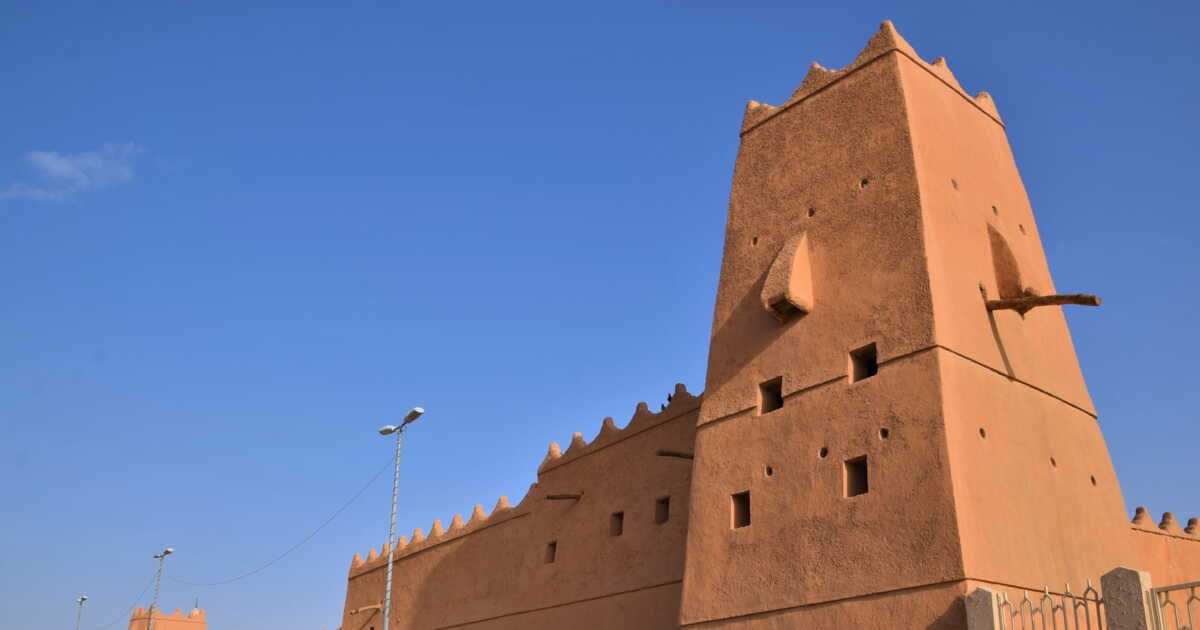
Watchtowers perched on ridges, stone villages blending into the rock, earthen mounds beneath palm groves… all here seems to prolong the geology of the southwestern Saudi highlands, a vast territory lying between Hejaz and Yemen, comprising the Asir, Al-Bahah, Najran and Jizan provinces. In these rugged reliefs (the Sarawat mountains, the highest range in the Arabian Peninsula, crest above 3,000 meters in southern Asir), inhabitants have fashioned an exceptional architecture that natural isolation has miraculously preserved. No one can say exactly how old this know-how is—two or three centuries, perhaps more.
A refreshed tradition
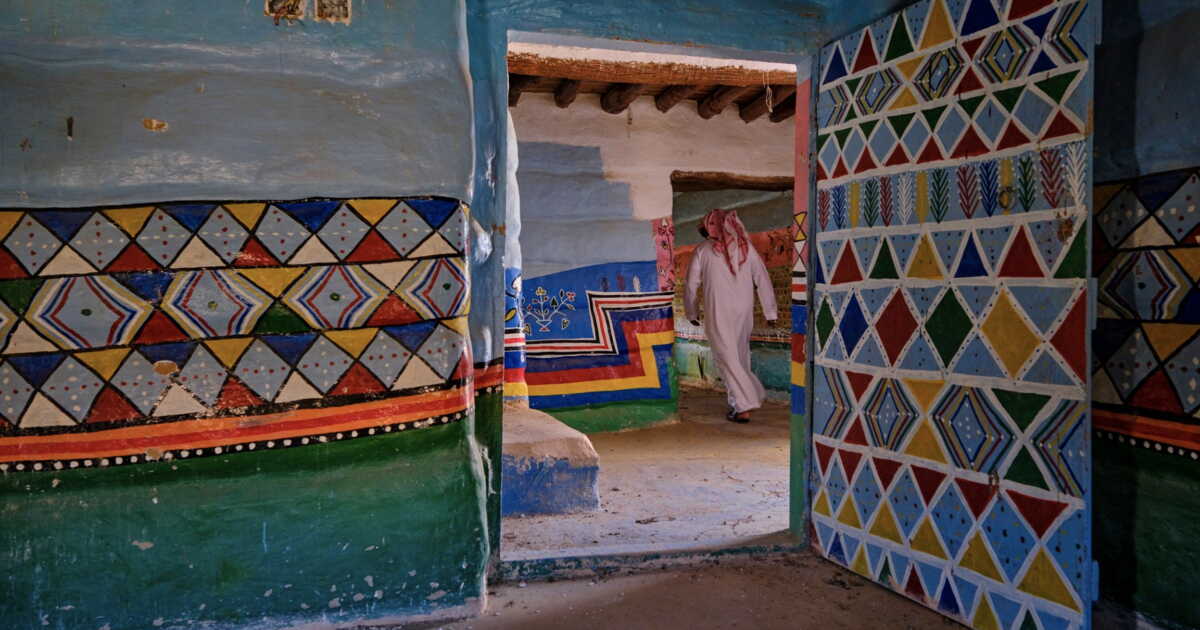
Inside these tower-houses with a skyline-like look, it is the women who expressed their talent on walls, stairs, door frames, painting geometric motifs in bright colors. This art, called al-qatt al-asiri (al-qatt meaning “to cut horizontally”), born in the privacy of homes and handed down from mother to daughter, was inscribed in 2017 on UNESCO’s intangible heritage list. After decades of neglect, residents, artisans and public authorities are working to restore their colors to these treasures.
With fragments of rock, coal and blades of grass in hand, Afaf bin Dajem al-Qahtani shows her young students how, in the past, women created their natural pigments. She recalls the gestures of her mother and aunt, who used only three colors: ocher, red and white. Afaf, for her part, has chosen to evolve with the times. In her Abha studio, the capital of Asir province, this 45-year-old artist now paints with acrylic colors that give her greater creative freedom. She claims “a rebellious form of al-qatt”, liberated from tradition.
The art by Women
In her Abha studio, Afaf bin Dajem al-Qahtani works to transmit the essence of this centuries-old art to young girls attending an initiation course. Afaf has always painted the al-qatt (pronounced “al-gatt”), like most women from Asir. Then, at a workshop organized by the Saudi Ministry of Culture in 2018, she had a revelation. “I realized that as a woman, I could pursue a career as an artist,” she says. “That had never crossed my mind before.” Before, the practice stayed within the home. “In our mothers’ time, decorating the house was a natural, almost necessary activity, a way to express the family’s social status,” she continues.
The al-qatt, a compulsory subject in the school curriculum
Afaf was invited to participate in the Dubai World Expo 2020, where she first presented her works to the public, alongside other female artists from her region.
Today her works sell for between 7,000 and 10,000 euros. Al-qatt is now a mandatory subject in the school curriculum. UNESCO welcomed Afaf bin Dajem al-Qahtani in Paris in September 2025 during the 7th Summit on Creativity in Education.
For a long time invisible in public life, in the region as in the rest of the kingdom, women who carry on this art are now pushed to the forefront. “It is a feminine art that opens the way to the renaissance of a cultural identity, explains the artist in hesitant English, whose smile is visible behind the black niqab covering her from head to toe. We, women, experience it as a major advance in our status. Ten years ago, this seemed impossible. The world is changing, and so is our country.”
Afaf recalls a time when the practice of al-qatt was deemed old-fashioned by younger generations, relegated to the realm of grandmotherly occupation. Today, about fifty women practice it professionally. Previously, the intricacy of motifs, the mastery of the line and the variety of colors testified to the richness of the home. The motifs—diamonds, triangles, chevrons, parallel lines, mihrab (the Islamic prayer niche)—stylishly represent surrounding nature or tribal adornments.
From Abha, King Abdullah Road heads southeast. Remains of old villages line the route. Sometimes the thrill of discovery gives way to disappointment when the beautiful earthen city glimpsed in the distance turns out, on-site, to be unbearably empty. Roofless houses, walls cracked by vegetation… Yet in a few homes, the colors endure.
Saudi soft power backed by substantial budgets
Arriving in Al-Wadeen, about thirty minutes from Abha, one first wanders through alleys strewn with debris, where only the screeches of wild baboons fill the air. The wind slams iron doors and sends plastic bottles swirling in a dust storm. No soul in sight. Then, around 4 p.m., a drone of engines breaks the silence, voices rise, and the village comes to life again. As if from a fairy tale, a group of men and children sits on a carpet in front of a earthen house. The family of Nasser al-Zouberi, a 32-year-old serviceman, shares cardamom-scented coffee and a few dates. The clatter of bells from sheep returning from pastures can be heard. “I work in Sarat Abidah, an hour’s drive from here, but I’ve returned to live in my native village, to tend my sheep and grow my vegetables, like my ancestors,” explains Nasser. “Back then, my parents applauded when old houses were demolished to build a road. My generation, however, seeks to reconnect with our roots.” Nasser has restored the family home with his own hands, like many of his neighbors who also hope the entire village will soon be restored.
This enthusiasm is recent: “Until the 2020s, no one paid attention to abandoned villages,” testifies Nasser. The turning point came in the wake of Vision 2030, an ambitious program launched in 2019 by “MBS,” Crown Prince Mohammed bin Salman, to diversify the economy of the world’s leading oil exporter. Beyond the Al-Ula mega-projects, the Red Sea project, and the organization of the 2034 World Cup, the reform drive also aims to valorize regional cultures. A facet of Saudi soft power that is less publicized than others, but also supported by substantial budgets.
Archaeologists, building engineers and historians are mobilized
Thus, Vision Aseer, launched in 2021 and endowed with 12 billion euros, aims to make Asir a premier tourist destination. “It is by relying on its cultural identity and by restoring its rich heritage that we will render Asir attractive”, emphasizes Adel Nasser al-Badawi, general director of the Culture and Heritage department of the Asir Development Authority. In their Abha offices, around a hundred men and women—archaeologists, building engineers and historians—work with him, drafting plans and examining satellite images. On the screens flash photos of ruined buildings, restoration estimates, sketches of the future. No fewer than 259 villages are currently under study for renovation. Beside them, teams from the Heritage Commission, attached to the Ministry of Culture, scour the region, supervise projects, train artisans, support and financially assist owners who want to restore their houses. Heritage Commission panels with QR codes are ubiquitous on stone walls. For two years now, the effects are visible. The historic heart of Abha, the villages of Al-Yanfa, Rijal, Al-Tabab, Al-Namas and Thee Ain are regaining color.
The al-qatt al-asiri, symbol of the region’s reawakening, also helps the Asir government assert its cultural exceptionalism within the kingdom. These drawings with complex compositions no longer stay confined to interiors. They are now found everywhere: perfumeburners, terracotta pots and dallah (Arab coffee pots) wear them, lined up on market stalls. This polychromy even crosses walls, brightening the façades of houses, hotels and restaurants with colored bands that break the mineral monotony of the landscapes.
One hour east of Al-Wadeen, the village of Al-Khalaf gradually comes back to life as well. It stands out against the surrounding fields with its high earthen walls lined with protruding flat stones, an ancient technique to divert rainwater and prevent erosion. Sitting on a bench covered with sheep skins and topped with vibrant patterns, General Ali Mohamed al-Qahtani, 60, trained at the Saint-Cyr military academy, recounts in flawless French how he left his village in 1979 at the age of 15 and did not return until retirement.
The general recalls that the Friday market was once among the region’s busiest. But in the 1980s, the oil boom disrupted far more than the economy. “It was a shock to our way of life,” he says. “Money appeared and, overnight, our old houses seemed too cramped for our families. People wanted more space, more light. Everyone, including my parents, began building more comfortable houses, of course, but without any link to our former architecture. They became cubes without form or color.”
Over 1,200 motifs catalogued
The uncle of General Ali Mohamed, the writer Ahmed Abodehman, born in Al-Khalaf in 1949 and who died in Paris last December, echoed this nostalgia in his beautiful autobiographical novel The Belt (Gallimard, 2000): “Families […] had left the village for the city, while keeping their houses, their fields and all their ties according to the tribal code that regards those who abandon everything and cut their roots as renegades.”
The al-qatt, long confined to the female sphere, is gradually winning the hearts of men as well, as seen in Ibrahim al-Almaai, who welcomes visitors in jeans and a T-shirt in his Abha studio, surrounded by his oversized canvases. This retired 55-year-old former firefighter, a self-taught artist whose value now exceeds 30,000 euros, did not discover al-qatt through a woman but by observing the paintings on old abandoned houses. “The spark came when I visited my grandparents’ house in Rijal,” he says. “I was struck by these sophisticated motifs that weave together.”
Since then, with camera and notebook in hand, Ibrahim roams the ancient villages, meticulously documenting each motif. He has catalogued more than 1,200: “Some houses are on the verge of collapse, but their walls still speak to us. Each painting is a silent account of identity and family memory.” Ibrahim hopes to complete his inventory and publish the very first book cataloging the motifs of al-qatt.
As Asir regains color, the region attracts more Saudis for the summer. Eager to escape the stifling heat of cities and the coast to breathe the brisk mountain air, they arrive, amazed, at a destination that feels “above the clouds,” as the tourism signs proclaim. A world apart with a fertile culture, far from Riyadh, Mecca, and Jeddah. Like a reminiscence of the “Happy Arabia” that once stirred the Romans.
Field return
Onze reporters, Tuul (journalist) and Bruno Morandi (photographer), are forever in search of wonder. In Asir, they confess to feeling they lived a unique experience. “In the abandoned villages, we felt like Indiana Jones tracking a hidden treasure,” confides Bruno. “We opened the doors of houses and found extraordinary paintings.”
Both were touched by the warm welcome of the region’s Saudis: “People were curious about our presence and invited us into their homes spontaneously,” recalls Tuul. As a woman, I was pleasantly surprised.”
➤ Article published in GEO magazine no. 570, “Cambodge,” August 2026.
➤ If you love GEO, then to miss nothing, discover our subscription plans to receive GEO every month at home with ease.