Experience the Real Australian Bush Life Near Darwin at This Lodge

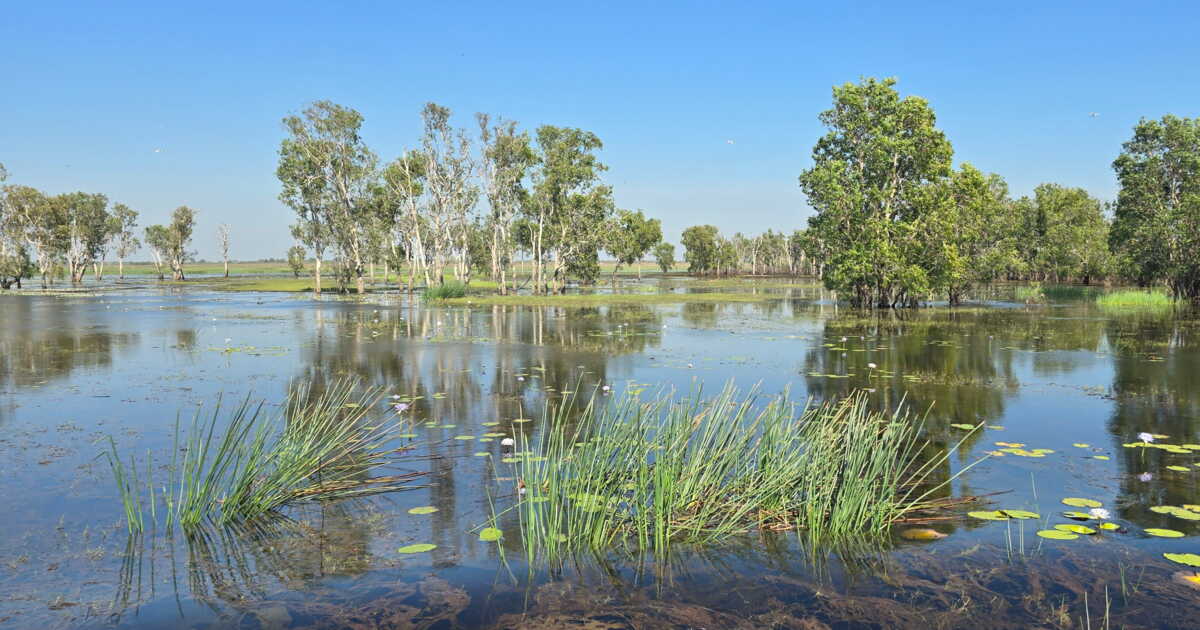
After a stretch of red dirt road, less than two hours from Darwin, the landscape gradually reveals a different face. Fences fade into tall grasses, termite mounds rise in the middle of the plains, and wetlands become the realm of birds and crocodiles. In June, while we were filing a report in the Northern Territory, we discovered the Finniss River Lodge, nestled at the heart of a vast cattle operation. An immersion accessible right at the core of Australia’s Top End.

In a Real Australian Family Station

The Finniss River Lodge story begins with Leo Venturini in 1987, when he purchases this enormous property spanning more than 20,000 hectares. Nearly forty years later, it still belongs to the family and functions first and foremost as a cattle station typical of the region, with around 4,500 head of cattle. Since 2022, however, the family business has diversified with the creation of the lodge, steered by his granddaughter, Olivia.

Staying at the Finniss River Lodge thus means stepping into the workings of a genuine cattle station. The wet season measures its reach. When rains push the water levels up by several meters, the roads can disappear under the floodwaters and cut the property off from the rest of the world. An airstrip enables the arrival of a small plane, and a helipad is also planned for helicopters. Large tanks collect rainwater, enabling the lodge to be entirely autonomous in its water supply.

With six rooms only and a pool facing the floodplains, the place can accommodate at most a dozen guests. Two guided excursions are organized each day, in the morning and late afternoon, and the small capacity makes it possible to travel with a guide in a very small group, or even individually. The station can be explored by 4×4 or by boat, observing the animals, discovering the different ecosystems of the property (floodplains and wetlands, paperbark forests, wooded savannas, pockets of rainforest, and coastal and mangrove zones) or learning about the station’s work. Depending on the season, one can witness the cattle gathering, see the animals move through the enclosures, or participate in certain tasks.

And then there is the “Cows and Canapés.” At sunset, visitors join a small group for the pre-dinner apéritif with a group of fewer than a hundred cattle selected for their particularly sociable temperament. The cows come of their own accord, seeking strokes, and some do not hesitate to lick hands or legs. A rather unconventional way to discover Brahman cattle, recognizable especially by the shoulder hump and their long ears. Native to tropical regions, they endure the intense heat and the harsh conditions of northern Australia.

From Giant Termite Mounds to Crocodiles, Wildlife to Discover

But the cattle are far from the only animals encountered here. The lodge’s guides are invaluable allies for discovering this wildlife: with so few visitors, you can take the time to pause, observe, and above all learn things that would easily escape an untrained eye. Without a guide, a termite mound might be just a big dirt bump at the edge of a track. But with someone who knows the bush, it becomes the starting point for a true lesson on insects, their organization, and the architecture of their habitat.

Did you know, for instance, that some Top End termite mounds reach six to eight meters tall, growing by about a meter every ten years? Inside, the termites construct a genuine network of galleries that allows them to regulate temperature naturally. Heat enters through certain parts of the mound, air circulates through the galleries, and exits through other openings. This natural ventilation system keeps interior temperatures much steadier, despite the scorching heat outside. This architecture is all the more remarkable because it is built and maintained continuously by tiny insects.

And these structures serve other species as well. The forest kingfisher (Todiramphus macleayii) uses the termite mounds to install its nest. To carve the entrance, the small bird darts at the wall with its beak leading, striking repeatedly in violent blows. And as our guide explained, it is this same bird that inspired an invention seemingly unrelated to the Australian bush: the nose of the Japanese Shinkansen.

In the 1990s, engineer Eiji Nakatsu sought to solve a problem faced by high-speed trains: when they entered a tunnel, they produced a large pressure wave that caused a deafening roar as they exited. By studying the shape of the kingfisher’s bill, particularly its streamlined profile, he conceived this principle to design the nose of the Shinkansen 500. The new shape significantly reduced the pressure wave and noise, while improving the train’s energy efficiency.

Even around the lodge, there’s no need to search far to find other inhabitants. At dawn and dusk, wallabies are everywhere, while Corella cockatoos number in the dozens in front of the rooms. More generally, the property is a paradise for birdwatchers, its wetlands and papyrus swamps hosting more than 1% of the world’s population of certain water birds (such as the semipalmated canaries), which classifies the site as an aquatic ecosystem of high conservation value.

Then comes the crocodile, the undeniable star of the Top End. On the property, you can observe the two species present in northern Australia: the saltwater crocodile (Crocodylus porosus) and Johnston’s crocodile (Crocodylus johnstoni). The former is decidedly more aggressive and imposing. It can live in freshwater, brackish, or marine waters. The latter, smaller, stays mainly in rivers, billabongs, and freshwater wetlands. In an airboat, the guide also explains how the station’s inhabitants live with these predators.

A coexistence that comes with its share of surprises: it is not uncommon to see cattle wading into water bodies, despite the presence of the reptiles. There are even occasions when cows are killed by them. But when temperatures rise, they do not hesitate to venture into the water, where they find both cooling and food.

Near Darwin, the Finniss River Lodge thus offers a concrete glimpse into the daily life of the extreme north of the country, between cattle farming and wildlife. A first approach before continuing on to Litchfield and Kakadu National Parks.
Darwin: The Australian City Where the Outback, Aboriginal Culture, and Asia Meet

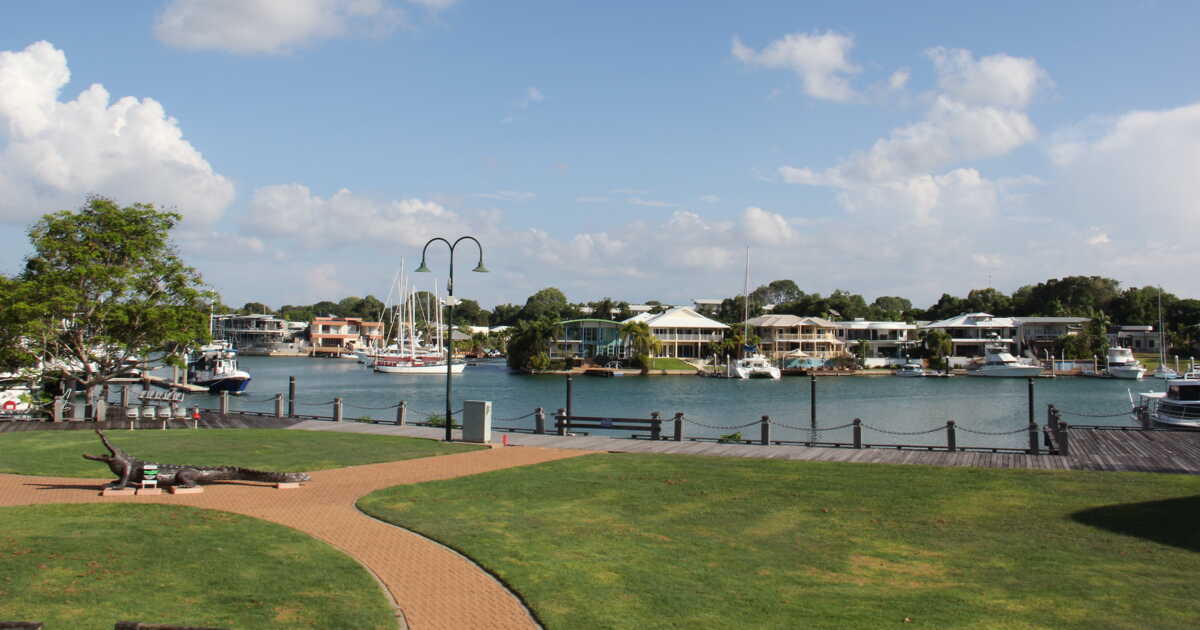
At the extreme north of Australia, Darwin doesn’t resemble any other capital city in the country. We discovered this city in the Northern Territory during a June report, in the heart of the dry season. Between Aboriginal heritage, influences from Asia, a turbulent history and wild nature on the city’s doorstep, Darwin has a character all its own. A destination deserving of time to linger.

Darwin is the capital of the Northern Territory, a vast region at the center and north of Australia that spans more than 1.4 million square kilometers. The city sits in the Top End, the territorial north, on the edge of the Timor Sea, close to Southeast Asia. It is even closer to Jakarta than to Canberra. With a little over 80,000 residents, Darwin has the scale of a mid-sized city rather than a major Australian capital.

Darwin, a Small Capital Marked by Its History

Its location gives it a tropical climate that largely shapes local life, altering how people live with the changing seasons. The dry season, from May to October, brings hot but pleasant days, little rainfall, and limited humidity. The wet season, from November to April, is characterized by intense heat, high humidity, heavy rains, and violent storms. But to understand Darwin, one must look further back. Long before Europeans arrived, the region was inhabited by the Larrakia, the “Saltwater People”, whose territory stretched around the port and coastline.

They maintained exchanges with neighboring peoples, such as the Tiwi, the Wagait, and the Wulna, while navigators from present-day Indonesia had been frequenting these shores for centuries. The European history of the town begins in the 19th century. In 1839, the HMS Beagle enters the port now called Darwin Harbour. Its commander, John Lort Stokes, christens it in honor of his former voyage companion Charles Darwin. The naturalist, however, never actually visited the region. Thirty years later, a European settlement is founded under the name Palmerston. Then the discovery of gold at Pine Creek in 1871 accelerates the city’s development.

Darwin also holds memory of two catastrophes that deeply shaped its history. On February 19, 1942, during World War II, Japanese forces bombarded the town, marking the first air attack on the Australian mainland. About 250 people were killed and several hundred more were wounded. Today, the Darwin Military Museum and several historic sites allow visitors to revisit this major chapter of Australian history.

Then, on the night of December 24–25, 1974, Cyclone Tracy wrecked the city. Much of it was destroyed and tens of thousands of residents had to be evacuated. The reconstruction that followed transformed Darwin and partly explains its current architecture, which is far newer than that of many other Australian cities. To discover this history, a guided tour can be particularly interesting. Darrel Trueman of Darwin Gourmet Tours offers itineraries dedicated to World War II, to gastronomy, and to street art.

A City Where Cultures Meet

Its history partly explains why Darwin is today one of the most multicultural cities in Australia. More than 60 nationalities and 70 different ethnic origins are represented here. This diversity is reflected in the restaurants, markets, and events that fill the year. It’s hard to grasp it better than by tasting laksa. This spicy Southeast Asian noodle soup has become a real institution in Darwin, to the point that the city dedicates an international festival to it every year. During the Darwin International Laksa Festival, restaurants, cafes, and other establishments compete over their own recipes, while locals vote for their favorite bowl.

But the most important cultural dimension is that of the First Nations peoples. The Northern Territory counts more than 100 Aboriginal languages and dialects. In Darwin, the Larrakia occupy a central place, but the city also serves as a gateway to the many cultures of the Top End. This cultural richness today translates into numerous transmission and revitalization projects. Artists, associations, communities and cultural institutions contribute to keeping languages, crafts, and traditional narratives alive.

The Museum and Art Gallery of the Northern Territory hosts the National Aboriginal and Torres Strait Islander Art Awards (NATSIAA), which highlight yearly the contemporary work of Aboriginal and Torres Strait Islander artists from the Torres Strait. The Larrakia Cultural Centre also aligns with this momentum. Its opening, announced for 2026, should allow the public to view Larrakia cultural objects that have recently been repatriated after being kept abroad for decades.

To go further, head to the Tiwi Islands. There you discover a culture different from that of the Larrakia, through a true immersion: traditional dance around the fire, presentations of history and traditions, an introduction to Tiwi motifs, encounters with artists, and a visit to a museum dedicated to the community’s history. An opportunity to better understand the impact of war on the Tiwi and the transformations their culture has undergone.

Another essential stop: Kakadu National Park, UNESCO World Heritage site for its natural and cultural riches. It’s a destination for its landscapes, wetlands and wildlife, but also for the history of the Aboriginal peoples who have inhabited these lands for thousands of years. The park shelters numerous rock art sites, including Ubirr and Burrungkuy (Nourlangie). To explore the sites with a guide, the CYAROUND agency and their guide Jack Tanner offer experiences that combine nature discovery with an understanding of First Nations culture.

From Sunset to the Bush, Experiences Not to Be Missed

Darwin can also be discovered through a multitude of experiences, sometimes surprising! Among the must-sees, the sunset at Mindil Beach is an institution. At day’s end, locals and tourists gather at the market just behind the beach to buy something to eat, then settle on the sand to watch the sun disappear on the horizon. And when the spectacle ends, everyone claps. Even when it rains, the Top End doesn’t stop. The wet season is notably the season for barramundi, the emblematic fish of northern Australia, at the heart of Million Dollar Fish, a competition held in the Northern Territory.

The idea is quite wild: some barramundis are specially tagged before being released, and the fishermen who manage to catch one can win up to one million Australian dollars. For those who want to approach the fish without going fishing, the Barramundi Experience NT offers a striking and entertaining encounter with large, rescued-from-farming individuals. Some exceed a meter in length and can even be caressed and fed by hand!

And for those who love genuinely quirky experiences, Darwin has another rather surprising specialty: the Heli Pub Crawl. Offered by Airborne Solutions, this helicopter/pub tour lets you reach several venues, some of them very isolated in the wild. Between drinks, the passengers fly over the coastline, the wetlands and the tropical landscapes.

The region can also be discovered through its agricultural production. The Northern Territory is Australia’s leading mango producer, accounting for about 52% of national production. In the region, harvest time brings festivals like the NT Mango Festival, featuring tastings, contests, and culinary preparations around the fruit. A tasty way to explore one of the Top End’s iconic products.

But perhaps the most striking thing is how easy it is to leave Darwin and find yourself in nature. Less than two hours by road from the city—or 45 minutes by helicopter—the Finniss River Lodge plunges visitors into a vast wild territory. Located on a sprawling cattle station, the lodge lets guests discover the life of an Australian outpost while getting to know the local wildlife.

Crocodiles, wallabies and birds populate the surroundings, while cattle are an integral part of the experience. At sunset, you can even enjoy an aperitif among particularly friendly cows! Far from a mere stopover, Darwin deserves to be lingered over before venturing further into the Top End.