


Geek, impatient, exigeant… Who are we talking about? It should sound familiar—these are customers, of course!
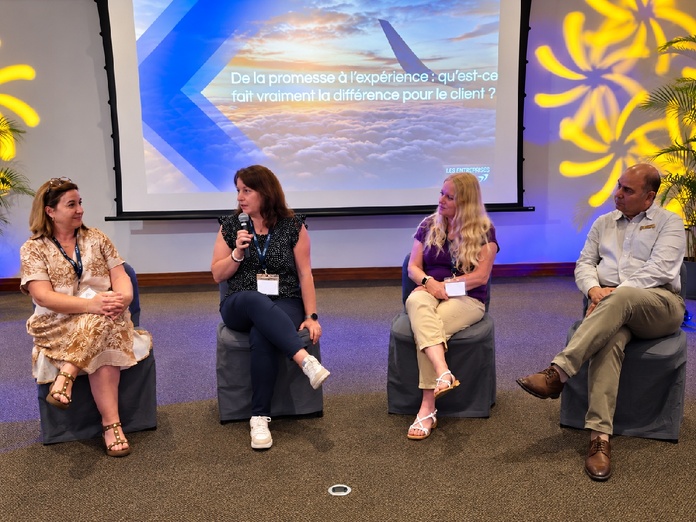
Within the framework of the Grand Est convention for Travel Businesses, held at the Shandrani Beachcomber from October 5 to 9, 2026, participants attempted to decipher the new traveler behaviors.
Geopolitical, climatic crises, technology, or inflation have altered the relationship between clients and travel operators.
More informed, more demanding, and more present throughout the journey—from planning the stay to the return—the clientele sometimes tests your nerves.
With the Internet and, now, artificial intelligence, the client has at their disposal a substantial amount of information instantaneously.
Result: “ the client has become impatient ” summarizes Sandra Fagnoni, manager of Sangio Horizons. “It would almost be desirable to have the answer before the client even asks about the destination. This creates a sense of urgency in which we should not get stuck. We therefore take the time to explain why an answer may take time, especially when it concerns a tailor-made trip.”
A More ‘Geek’ Customer, Hooked on AI
It is also more “ geek ” according to Sandra Fagnoni. “ They challenge us directly by putting our quotes into the AI ”. She cites the case of a trip to Tahiti in which the AI had identified another low-cost airline as being financially more attractive. “ But my client would not have appreciated the service of that airline.
We must therefore explain all this to the client, taking into account their expectations, and with also all the history we have of their past experiences, their family, and their requirements. ”
Myriam Missemer, head of agencies at LK Tours (Entzheim, Colmar and Munster) adds: “They have never had as much access to information as today, but they also come to agencies because they fear being overwhelmed and not getting the right information.”
Highlighting personal experience can also become a strong argument: “I’ve done it, I know,” explains Caroline Landriot, commercial delegate at MSC Cruises, who underlines the importance of being able to talk about one’s own journeys in the face of online information and AI.
For Fatima Faivre, regional director of Prêt-à-Partir, the main quality of a travel agent boils down to one word: “ pedagogy ”, which encompasses skills, experience, and the ability to explain the choices made.
“I Pay, I’m Entitled to This!”

The other major evolution concerns customer expectations, which rise in step with prices: “I pay, I’m entitled to this”, summarizes Myriam Missemer.
The phenomenon is particularly visible on medium-haul trips. According to professionals at the convention, packages have sometimes risen by 15 to 20%, while the quality of hotels has not increased in the same proportion. The client therefore arrives with high expectations, sometimes based on rates charged before the health crisis.
“When they allocate the same budget as before, clients now expect everything to be flawless, from start to finish. They also lose their bearings in relation to that,” explains the LK Tours agency manager.
Inflation is also changing the profile of clientele and the types of stays. It becomes challenging for traditional family customers—two parents, two children—to find high-season rates that fit their budget. The duration of the stay or a change of destination thus becomes a variable to adjust.
Professionals also note more tribe voyages, with several generations gathered, while seniors and regulars with substantial purchasing power remain present.
See also: Luxury travel: behind the millions, an extremely demanding profession
Travel Agents Are Increasingly In Demand
This rising demand comes with a surge in inquiries before and during the trip.“ Sometimes, for a hotel issue, the client calls us at the agency while they are in their room, instead of going down to the reception ” continues Sandra Fagnoni.
« The peculiarity of the new clients, in the end, is that they are paradoxically very assisted. Yet they have never had as much access to information as today. » adds Myriam Missemer of LK Tours.
A view shared by Caroline Landriot of MSC Cruises, who must guide agencies on increasingly precise questions: “I feel that my job today is more about supporting the agencies. I deal with clients who have very precise questions: is it better to be on port side than on starboard, for example. The agency wants to ensure it has the right answer because the client has also become more wary, more demanding, and, at times, more procedural.”
The same sentiment from MacKenzie Michel, front office manager at Shandrani Beachcomber: “At the hotel and at the destination, we immediately sense a much stronger demand, with a lot of comparisons. Today, the client does not hesitate to say: ‘the agency said this,’ which leads to more emails and calls to verify information. There is also a form of pressure, notably through TripAdvisor or Google reviews. It is especially noticeable in upgrade requests, which have become very frequent. This is not just a French phenomenon; they have long since lost their crown as the biggest complainers!”
“There is always this desire to obtain more than what was purchased. In agencies, the client regularly seeks an added service. I doubt they display this same behavior in other shops,” adds Sandra Fagnoni of Sangio Horizons.
WhatsApp, a 24/7 Link for the Best and the Worst?
This reassurance need is also felt among insurance brokers.
Boris Reibenberg, chair of the strategic committee at Xplorassur notes a 40% rise in call rates over the past fifteen years: “The problem is that a large portion of these calls concern very simple questions, such as the timing of a transfer.
In eight out of ten cases, clients reach out to us for this type of information, even though we do not necessarily have the answer.”
What also changes is access to WhatsApp, which allows the client to stay connected 24/7 from any destination. Should one share a personal number or an on-call number? The debate is open!
Régis Heitzler, founder of Voyage de Rêve in Neuf-Brisach, has chosen to keep contact via messaging, but he also relies on AI to respond: “ They can reach me on WhatsApp, but I’ve also linked the messaging to AI which lets them automatically receive answers, because we know that for 80% of the questions asked, the answers are in their travel documents. ”…


 To begin with, who are the clients? By general opinion, luxury travel is not reserved for the 51,245 people who, living in France, had a net worth above 10 million dollars in 2024.
 Published by Paula Boyer