
MTS Globe: How Real-Time Transfer Tracking Is Transforming the Customer Experience


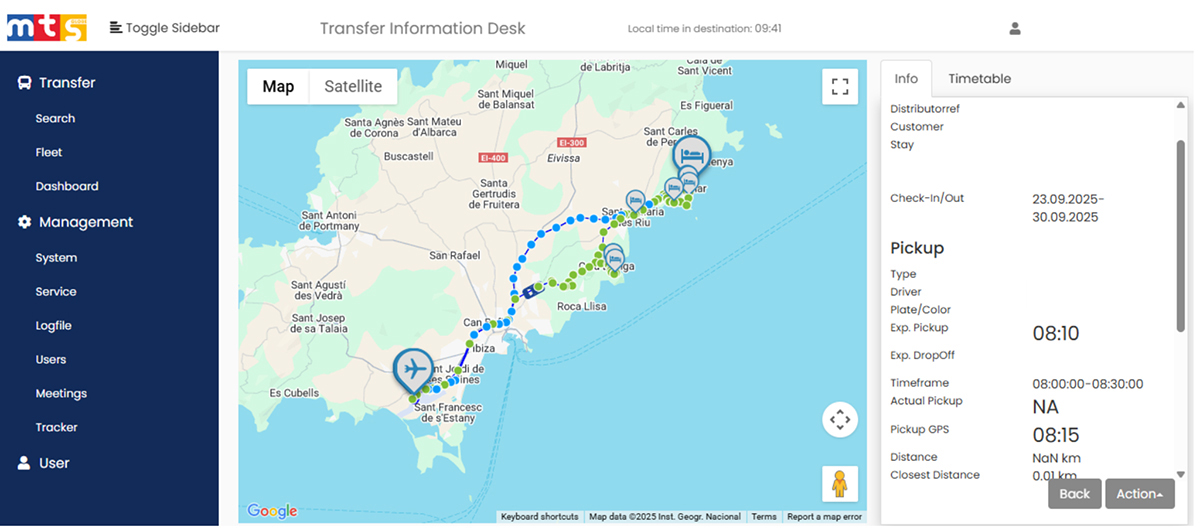
Outil de tracking de transferts MTS Globe © MTS Globe

CroisiEurope


Addressing a Universal Tourism Challenge

According to MTS Globe’s observations, nearly 90% of calls to tour operator customer service centers revolve around one question in particular: the location of the return transfer.

A simple doubt can quickly trigger a chain of communications: calling the DMC, contacting the carrier, checking with the driver… often resulting in a late response.

It is precisely to address this issue that MTS Globe developed its Transfer Tracking (real-time transfer tracking), a solution that provides visibility and peace of mind for both professionals and travelers.



Véhicules MTS Globe © MTS Globe


A technology designed for tour operators… and their clients

The system relies on a real-time transfer tracking capability, built on a Data Tracking Technology (DTT).

On the operator side, the tool provides instant access to all essential information through a simple and efficient interface. Teams can search for a transfer in seconds, by destination, client name, hotel, or case number, and offer a precise and immediate response.

Result: optimized handling of incoming requests and a significant reduction in customer service stress.

Direct integration into the traveler experience

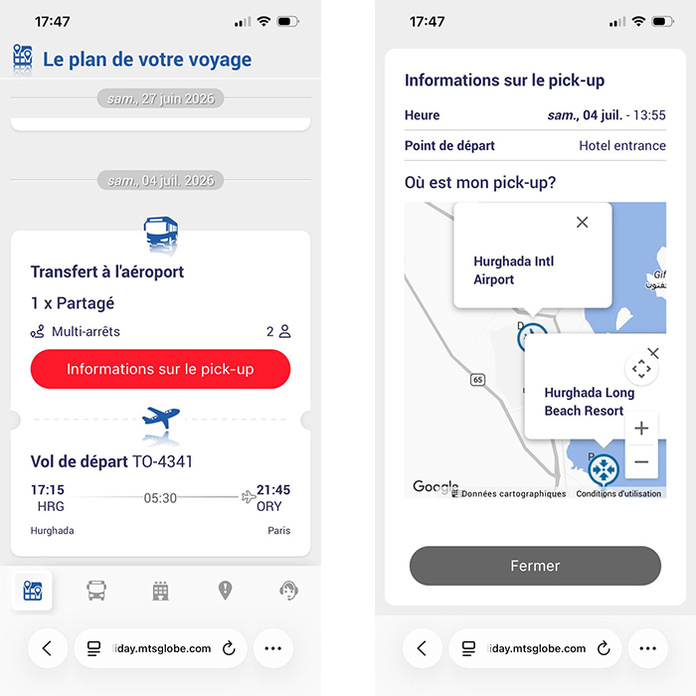
For travelers, transfer tracking is accessible directly via the MyHolidayApp app, or integrated into the tour operator’s app.

Concretely, the client receives, the day before departure, a detailed notification detailing:

  • the exact pickup time
  • the pickup location
  • the transfer route

A clear and personalized piece of information, which eliminates uncertainty and significantly enhances the perception of the service.

In short: greater customer satisfaction, better reviews, and a smoother end-to-end experience.
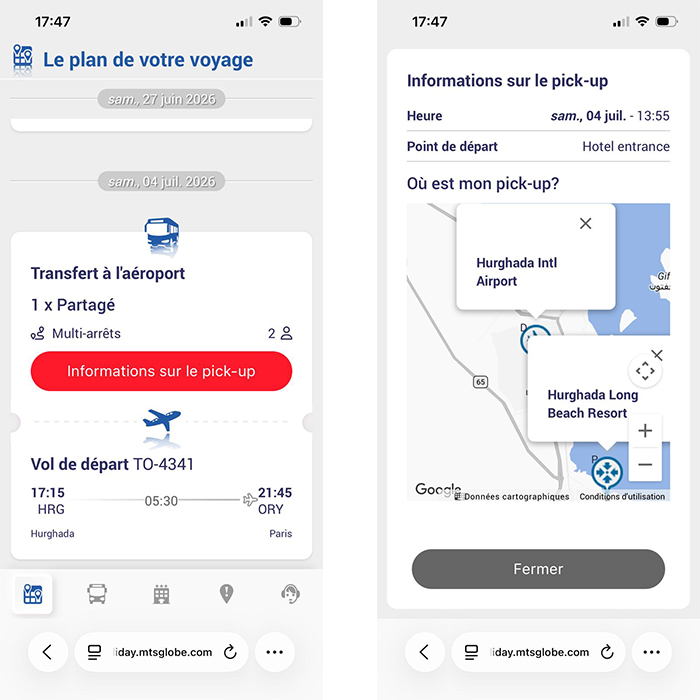

Info voyageur sur Myholidayapp, source MTS Globe / Géolocalisation du transfert sur Myholidayapp © MTS Globe


A measurable performance lever

Beyond the customer experience, transfer tracking also represents a strategic tool for MTS Globe’s partners.

The data collected is fully synchronized with the group’s Business Intelligence systems, enabling:

  • to analyze operational performance
  • to identify areas for improvement
  • to optimize processes

The results are already compelling: some partners have observed a 60% reduction in transfer-related call volume after integrating the solution.


A solution deployed at scale

Today, virtually all transfer providers across the 23 destinations operated by MTS Globe are integrated into the system.

Developed by Axis Data, the group’s internal IT company, this technology positions MTS Globe as one of the few DMCs to offer a real-time transfer tracking system at this global scale.



Contact MTS Globe

Delayed Flight and Ticket Repurchased by the Customer: Why Mediation Split the Difference [ABO]


Vol retardé et billet racheté par le client : pourquoi la Médiation a coupé la poire en deux - Depositphotos.com, dexteris

CroisiEurope


A traveler approached the Mediation following a significant delay on their return flight Tunis – Lyon in November 2024.

They requested reimbursement for the tickets repurchased in an emergency as well as compensation for the additional costs incurred.


The passenger had booked a stay in Tunisia as part of a package tour.

The return flight experienced a particularly long delay, estimated at more than 16 hours according to flight-tracking data.

Significant disruptions were reported at Tunis airport at the same time, linked to technical problems affecting operations.

Given the need to return to France on the scheduled date, the traveler purchased a ticket with another carrier for about €1,810.


What the texts say:

Legally, the Tourism Code provides that the organizer of a package tour is strictly liable for the proper performance of the services provided under the contract.



In case of non-performance of a service, the organizer must provide assistance to the traveler (accommodation, support during the wait, etc.).

The text also states that if the professional does not remedy the situation within a reasonable time, the traveler may address the issue themselves and request reimbursement of the necessary expenses. These costs must however remain proportional to the initial service.

In this case, purchasing a replacement airline ticket is justified by the need to return, but the amount is deemed high in light of the price of the initial package.

By contrast, the file shows that the assistance provided during the delay was insufficient.


What the Mediation Tourism and Travel recommends:

In these conditions, the Mediation determined that compensation was justified and recommended the partial reimbursement of the repurchased tickets to the amount of €905.07, i.e., about half of the sum spent.


Find all the practical cases from the Mediation Tourism and Travel by clicking HERE.


Bahia Principe: Two New Sub-Brands Focused on Customer Experiences


Bahia Principe propose deux nouvelles sous-marques : Bahia Principe Escape, pour les établissements réservés aux adultes, et Bahia Principe Explore, qui s’adresse aux familles et aux groupes - Photo : Bahia Principe

IFTM prenez RDV avec TourMaG


The Bahia Principe Hotels & Resorts group announces a revamp of its visual identity and brand architecture, with the introduction of two new sub-brands centered on guests’ expectations.

This evolution takes place as part of its integration into Hyatt’s portfolio, through the joint venture with the Piñero group.

As part of this transformation, Bahia Principe abandons its former categories (Grand, Luxury, Sunlight and Fantasia) in favor of two new sub-brands.

The first, Bahia Principe Escape, groups adult-only properties, with a promise focused on wellness, fine dining, and targeted entertainment experiences.

The second, Bahia Principe Explore, targets families and groups, with hotels designed to foster shared experiences. This category notably includes thematic properties, inherited from the former Fantasia line, which lean toward immersive and creative worlds.

Some properties thus change their names to fit this new logic.


A Modernized Visual Identity

Alongside this reorganization, the brand has revised its visual identity.

Its iconic sun symbol has been modernized to fit digital usage and an international audience, while preserving its historic DNA.

This evolution is accompanied by the launch of the new positioning “Fully & Freely”, which aims to encourage travelers to experience their holidays at their own pace, while immersing themselves in the culture of the destinations.

This revamp occurs within a strategic context marked by the rising prominence of the joint venture between Hyatt and the Piñero group. Bahia Principe thus becomes the ninth brand in Hyatt’s Inclusive portfolio, and the eleventh all-inclusive brand of the group.

More than 20 Bahia Principe resorts have also joined the World of Hyatt loyalty program, reinforcing the brand’s international visibility and access to a global clientele.

For Julio Pérez, CEO of Bahia Principe Hotels & Resorts, this new architecture reflects an evolution in line with the current traveler expectations: a clearer, more accessible offering and better aligned with contemporary tourism practices.


Amelia Brille Published by Amelia Brille TourMaG.com Editor
See all articles by Amelia Brille

  • picto Linkedin
  • picto email
Add TourMaG to your Google News feed Google Actualités icône  

Steering Uncertainty: Could Customer Relationships Be Your Best Market Sensor?


© HDB Solutions

Top of Travel


Chaque jour, des milliers d’interactions entre voyageurs et acteurs du tourisme révèlent des signaux précieux. Encore faut-il savoir les capter, les analyser et les transformer en décisions et avoir le temps de s’y consacrer.

L’incertitude est devenue la nouvelle norme du tourisme

Le tourisme a toujours été exposé aux crises. Mais ce qui change aujourd’hui, c’est leur fréquence et leur simultanéité.

Un événement géopolitique peut impacter une destination en quelques jours. Une vague de chaleur peut rediriger des flux entiers. Une variation du pouvoir d’achat modifie immédiatement les arbitrages.


Résultat : les comportements deviennent instables, parfois incohérents d’une semaine à l’autre.

On observe par exemple :

● des clients qui comparent beaucoup puis réservent au dernier moment

● des destinations abandonnées soudainement sans raison rationnelle

● des demandes de destinations fluctuantes en fonction du contexte politique national et mondial

● des demandes très précises suivies d’aucune conversion

Les historiques ne suffisent plus à expliquer ces mouvements.

Pour les acteurs du travel, cela complique tout :

● prévoir devient incertain

● pricings plus risqués

● distribution plus difficile à optimiser

Continuer à piloter uniquement avec de la donnée passée, c’est accepter d’avoir toujours un temps de retard et aucune garantie pour votre prochaine haute-saison.


La relation client : un observatoire en temps réel des signaux faibles

Pendant que les tableaux de bord regardent le passé, la relation client, elle, capte le présent.

Un conseiller qui enchaîne les appels le voit immédiatement :

● les questions changent

● les hésitations évoluent

● les objections se répètent

● les cas complexes apparaissent

Un exemple simple : une hausse soudaine des questions sur les conditions d’annulation n’est jamais anodine. Elle traduit souvent un doute, une inquiétude parfois même un frein massif à la conversion.

Même chose pour :

● des clients qui demandent “et si jamais…”

● des demandes très orientées budget

● ou au contraire un retour vers des offres plus premium mais sécurisées

Ces signaux arrivent avant la réservation ou avant la non-réservation.

Et ils sont précieux.

Mais il y a un deuxième niveau de lecture, encore plus intéressant.

Aujourd’hui, les voyageurs ne cherchent plus seulement une réponse rapide. Ils attendent :

● qu’on les rassure

● qu’on les guide

● qu’on leur simplifie une décision devenue complexe

Autrement dit : de l’expertise et de la personnalisation.

Et c’est précisément là que tout se joue.

Car si l’IA permet d’absorber du volume et de répondre vite, elle atteint ses limites dès qu’il faut :

● comprendre une hésitation implicite

● adapter un discours à une situation personnelle

● ou simplement sentir qu’un client n’est pas prêt à réserver

Ce type de lecture repose encore largement sur l’intuition, l’expérience et l’émotionnel.

Structurer ces échanges (canaux, motifs, analyse) reste essentiel. Mais ce qui fait la différence, ce n’est pas seulement la donnée.

C’est la manière dont elle est interprétée et utilisée.


Transformer l’incertitude en opportunité grâce à une organisation agile

Avoir des signaux, c’est une chose. Les exploiter rapidement en est une autre.

Sur le terrain, le problème est souvent le même : l’information existe mais elle circule mal.

Les équipes relation client observent des tendances.

Le marketing travaille de son côté.

Le revenue management ajuste ses prix parfois sans lien direct avec ce qui se dit côté client.

Résultat : des décisions justes mais trop tardives.

Les organisations les plus avancées fonctionnent différemment.

Elles raccourcissent les cycles :

● remontée rapide des insights

● partage transversal

● capacité à tester et ajuster rapidement

Concrètement, cela permet de :

● détecter un changement de comportement dès son apparition

● comprendre ce qui bloque

● ajuster immédiatement (offre, discours, conditions…)

La technologie, bien sûr, accélère ces processus. L’intelligence artificielle permet de structurer et analyser à grande échelle.

Mais elle ne décide pas à votre place.

Et surtout, elle ne ressent pas.

Dans un environnement incertain, la capacité à interpréter, arbitrer et prendre une décision reste profondément humaine.

C’est cet équilibre, entre puissance technologique et intelligence terrain, qui crée de la performance.

L’incertitude ne disparaîtra pas. Elle va continuer à s’intensifier.

La vraie question n’est donc plus : comment l’éviter ?

Mais plutôt : comment mieux vivre avec et organiser au mieux mes équipes ?

Les acteurs du tourisme qui s’en sortent le mieux ne sont pas ceux qui ont toutes les réponses. Ce sont ceux qui restent connectés à la réalité du terrain.

Et cette réalité, elle s’exprime tous les jours dans la relation client.

En la considérant comme un simple support, on passe à côté.

En la traitant comme un capteur stratégique, tout change.


© HDB Solutions

On comprend plus vite.

On décide plus juste.

On s’adapte sans attendre.

Chez HDB Solutions, c’est exactement cette conviction qui nous guide :

la performance ne viendra pas d’une meilleure prévision, mais d’une meilleure lecture du présent.

Aujourd’hui, cette lecture s’appuie plus que jamais sur l’humain et des process métiers maîtrisés, une expertise stratégique à part entière.


Overseas Territories: Airlines Seek to Overcome Customer Inertia


Air Caraïbes, French bee et Air Austral ont ainsi annoncé le maintien intégral de leurs programmes de vols  - Depositphotos.com @Pakhnyushchyy

Dream Yacht


Just like Air France this week, Air Caraïbes and French bee, the Dubreuil Aéro group’s airlines, have confirmed the full maintenance of their flight programs for the summer of 2026.

The two carriers state they have taken all necessary measures to secure their fuel supplies and guarantee their long-haul connections. They specifically cover services to the Caribbean, Guyana, the Indian Ocean, North America, and French Polynesia.

To allow travelers to book their holidays with confidence, the two companies are launching an exceptional “fee-free changes” campaign from June 4 to June 17, 2026.

This measure applies to all tickets purchased during this period, for journeys scheduled between July 5, 2026 and March 27, 2027.

Customers will be able to make one free modification up to the departure of the initial flight, subject to a possible fare adjustment if the new chosen flight is more expensive.

The arrangement covers all fares and travel classes offered on the long-haul networks of the two airlines.


Air Austral also expands its flexibility policy

On its part, Air Austral has also announced an exceptional commercial measure designed to offer greater flexibility to its passengers.

From June 4 through June 30, 2026 inclusive, all tickets purchased for destinations operated by the airline may be changed without penalty, regardless of the fare and booking class chosen.


This policy covers the airline’s entire network, both long-haul and medium-haul.

Notably affected are the flights between Réunion and Paris, Mayotte and Paris, as well as the connections to Bangkok, Mauritius, Madagascar or all Indian Ocean destinations served by the airline.

To read: Tour operators grappling with uncertainty, between waiting-and-seeing and relaunch plans

Through these initiatives, the airlines aim to respond to travelers’ concerns in an international context marked by numerous uncertainties.

By guaranteeing their flight schedules while offering greater flexibility on bookings, Air Caraïbes, French bee and Air Austral seek to secure travel intentions for the months to come

and provide greater visibility to their customers, whether they travel for personal, family or business reasons.


Amelia Brille Publié par Amelia Brille Rédactrice TourMaG.com
Voir tous les articles d’Amélia Brille

  • picto Linkedin
  • picto email
Ajoutez TourMaG à votre flux Google Actualités Google Actualités icône