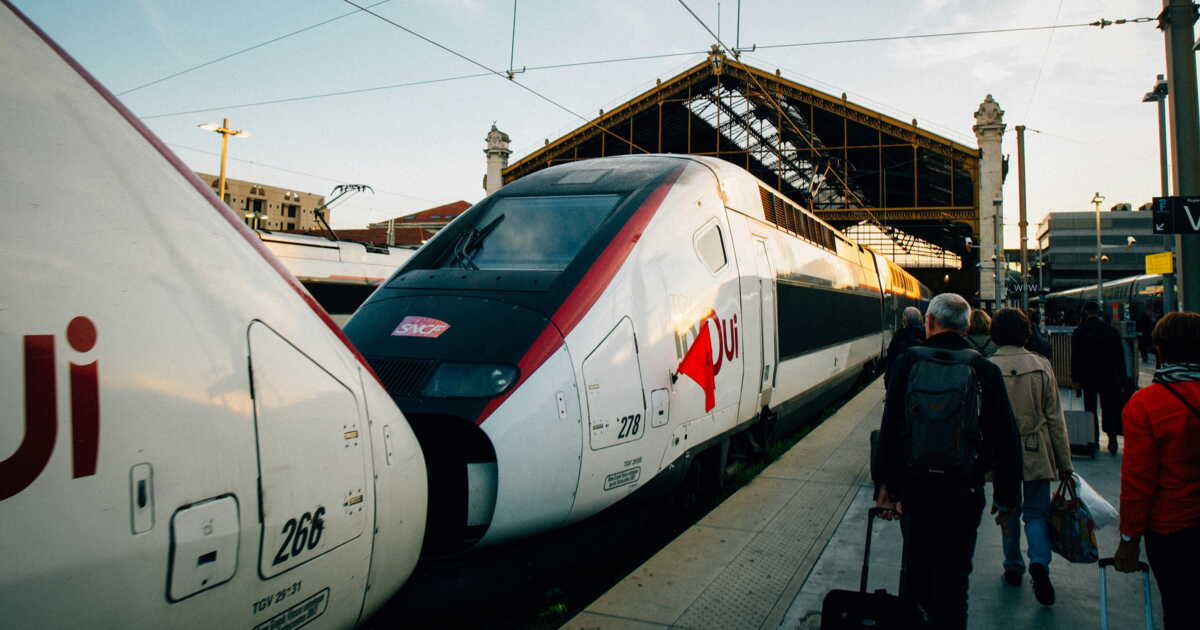
Christmas Travel: Should You Book SNCF Train Tickets This Wednesday to Save Money?

The countdown is officially underway. On Wednesday, September 30, 2026, SNCF opens its ticketing for the Christmas and New Year period. With advertisements and reminders on its app, the French company is urging travelers to book their tickets as soon as possible to secure the best prices. But is that really the best approach?

According to a study from the reservation platform Trainline, relay by RMC, travelers could save up to 30% on a train ticket by booking as soon as the booking opens. Especially since this period is extremely busy in transport, most French people travel to spend the holidays with family. Trains fill up quickly and the prices of remaining tickets tend to rise.

Which dates are the most popular for train travel in December 2026?

According to data from another journey-booking platform, Kombo, December 18, 19, 24, 25 and 26 will be the most sought-after travel dates this year. They correspond to the Friday and Saturday of the school holidays and the days surrounding Christmas, which falls on a Friday this year. Sundays December 20 and 27 and the period from December 30 to January 3 will also be highly sought after.

By booking early, you will therefore have more choice regarding the type of train you will take, the number of connections, or your seat in the carriages. In addition to avoiding price spikes as the holidays approach, you will also gain in comfort. If you wait too long, you risk ending up with pricier tickets on less comfortable trains, or even not being able to sit next to your loved ones.

Several tips to avoid paying more for your ticket than your neighbor

If you want to plan even further ahead, know that the European companies operating in France do not start selling tickets on the same date as SNCF. The Italian company Trenitalia, which offers trips toward the southeast from Paris, including to Lyon, has already released its tickets. The company Eurostar, which goes to London, Belgium, the Netherlands and some German cities as well. The German, Swiss and Spanish companies, they should open reservations in mid-October.

To pay less, don’t hesitate to compare prices across the different companies on dedicated platforms, to place options – valid for one week on InOui trains – so that the price does not change while you refine your departure plans, and to book rather quickly. If your train is sold out, you can still join a waiting list via SNCF or platforms like traincomplet.fr which, for a fee, try to find a last-minute seat on these apparently full trains.


In Singapore, Trading Screen Time for a Book Can Earn You Money

Whether it’s replying to messages or checking emails, watching a series or a movie, or shopping online, screens now hold a central place in our daily lives. A new way of living that sometimes pushes us to neglect activities that were once essential, such as outdoor activities, social interactions, or books and reading. To address this phenomenon and encourage its citizens to detach from their phones, computers, or televisions, Singapore has designed a program that pays them for reading a book.

Money, an Incentive for Reading

Since the start of September 2026, the Singaporean government has launched a program aimed at paying its citizens who dedicate at least fifteen minutes per day to reading a book. The objective? To counter doomscrolling, the practice of endlessly scrolling through posts on social networks, sometimes for hours on end. The scheme also aims to protect young people from the anxiety-inducing content they can be exposed to on the Internet.

Singapore also hopes that this program will improve its citizens’ concentration, critical thinking, and imagination. The principle is simple: readers can accumulate points, later converted into cents. As The Guardian explains, 50 daily reading sessions on a government site are needed to earn 1 Singapore dollar. A session of 15 minutes or more indeed yields 20 virtual coins, while you must accumulate 1,000 to obtain one dollar. Only one reading session is allowed per day.

A program that thus requires a certain degree of diligence if one truly hopes to pad their wallet. “We live in a world of extraordinary abundance of content, information and stimuli. At any moment, we can scroll through hundreds of titles, watch a video, or get a summary. We know that habits are built through small, regular actions. That is why we start with a simple objective: read 15 minutes a day. On the bus, before bed, or during lunch”, stated Melissa Tam, the director of the National Library Board in the columns of the Straits Times.

Singapore Is Not New to Financial Incentives

The program, carried out by the National Library Board (NLB), an agency that administers Singapore’s public libraries and falls under the Ministry of Digital and Information Development, aims to reach 150,000 users by September 2027.

Despite the government’s concerns about reading, fifteen-year-old Singaporean students recently topped the global reading rankings as part of the 2025 Programme for International Student Assessment (PISA), ahead of China and Taiwan.

As surprising as it may seem, Singapore is not new to using financial incentives to influence the behavior of its citizens. Indeed, the city-state had already employed this method to encourage Singaporeans to walk and meet their daily step goals in exchange for supermarket vouchers.

Travel for Less: Outdated Tips That Could Cost You Money

Traveling without blowing your budget doesn’t necessarily mean systematically choosing the cheapest option. Some tips widely shared on the Internet no longer have much effect, while other strategies can genuinely reduce the bill. The destination, dates, transportation, and meals offer several ways to save, provided you know where to look. Travel experts reveal strategies that can truly make a difference, without sacrificing all comfort on your vacation.

Leverage Flexibility to Lower Travel Costs

To pay less, the first instinct is often to choose a destination and then search for the best fare to get there. Yet, proceeding in the reverse order can be much more advantageous. Jesse Neugarten, founder and CEO of Dollar Flight Club, considers that flexibility regarding the destination is the most effective way to bring down the bill. “Being flexible about where you’re going is by far the biggest lever”, he told Travel + Leisure. Rather than sticking to a single city, it can be worthwhile to compare several destinations and keep the one that offers the most attractive tickets.

This method is particularly useful for travelers who haven’t fixed their itinerary yet. Flight comparators allow you to visualize fares to several destinations and spot gaps sometimes considerable. It can also be worthwhile to compare nearby “secondary” airports, even if that means driving, bus, or train for tens of kilometers.

The timing of the trip constitutes another important lever. The most convenient departure and return days are also often the most sought after. Shifting your stay by a day or two can then be enough to obtain better rates. “Everyone is trying to maximize their vacation days today”, explains Travel + Leisure’s Jimmy Yoon, head of analytics at Point.me. So, being flexible about the days you depart remains worthwhile. A person who can travel outside the most popular dates thus has an extra advantage when booking.

This flexibility is also useful for travelers who use points or miles. Availability with these programs is limited, so booking well in advance generally allows for a wider choice. Conversely, people with very flexible schedules can sometimes take advantage of last-minute openings, especially during the week preceding departure.

Ditch Outdated Tips and Watch Small Expenses

Not all online recommendations deserve to be followed, however. Clearing your cookies or using a private browsing window before searching for a plane ticket does not lower the price. Jesse Neugarten is categorical: “Clearing your cookies and booking in private browsing does nothing, and it has never really helped.” Even the famous recommendation to buy your ticket on Tuesday afternoon is no longer considered a reliable rule. It would be tied to an era when airlines posted promotions themselves in a way very different from today.

On-site, savings can also come from expenses you might not think about when planning your trip. Chauffeur-driven car journeys, for example, can quickly add to the bill. Jimmy Yoon recommends prioritizing public transport, especially in European and Asian cities where networks are often well developed, fast, and affordable.

He also suggests comparing several platforms before booking a tour or activity. The same experience can be offered at different prices across sites, with occasional promotions likely to further reduce the bill. Travelers who have credit cards offering rewards programs can also check if some offers provide an extra discount.

Food, finally, is a category where it’s easy to modulate spending. Rather than multiplying expensive restaurants, it’s better to identify the meals for which an extra expense is truly worth it. A lunch at a fine dining establishment can notably let you discover its cuisine for a price lower than that of dinner. For other meals, local markets and food halls offer another way to sample a destination’s specialties without dedicating a large portion of the budget to every meal.

And cheaper isn’t always the most economical. A flight ticket of 59 euros can become far less attractive after adding a bag and choosing a seat. “Once you add a bag and seat selection to a 59-euro ticket, you often exceed the price of a standard economy ticket with a traditional airline”, notes Jesse Neugarten. In some cases, a slightly higher fare can therefore avoid a cascade of surcharges and offer more flexibility. A logic summarized by Jimmy Yoon: “It all depends on knowing where it’s worth splurging to keep the trip comfortable, rather than trying to cut costs everywhere”.