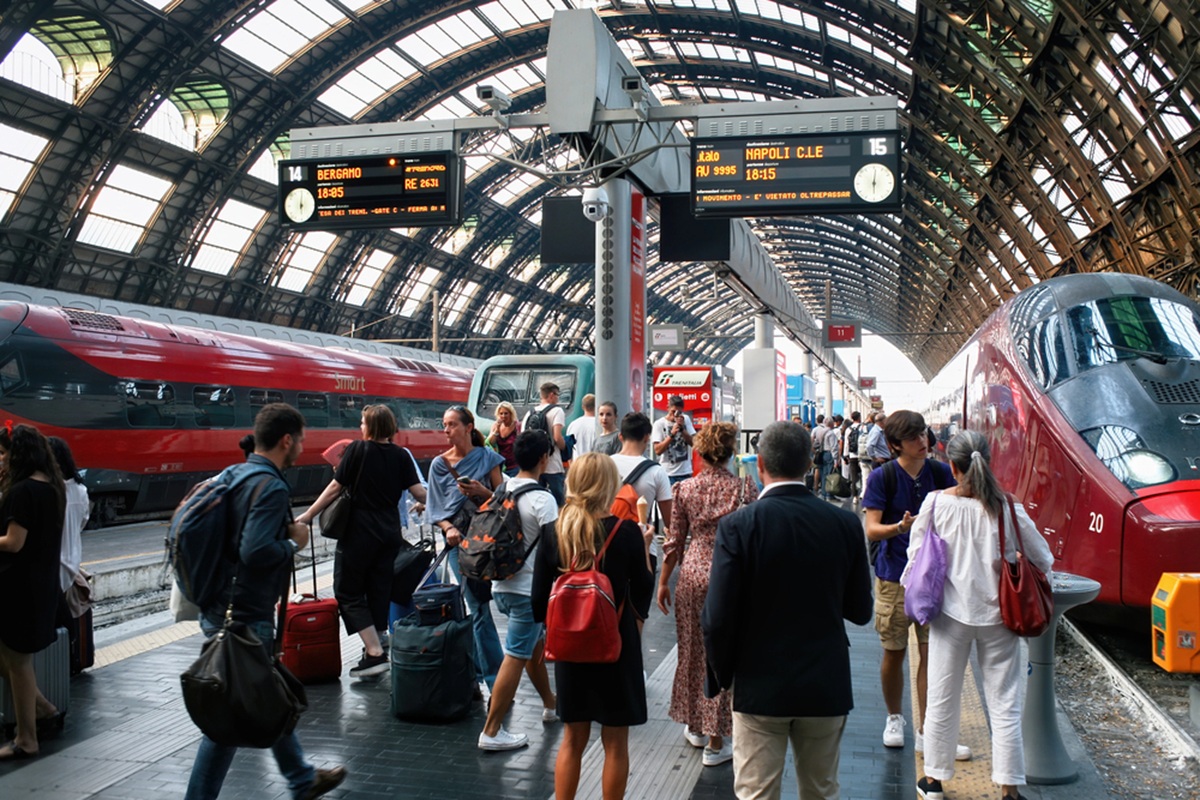


Rail travel is gaining ground, especially for trips within France.
At Déclic Evasion, rail stays rose by 16% between 2024 and 2025. « This evolution is explained by the increase in stays in France since the health crisis, the reduction of certain domestic air links and the development of alternatives such as Ouigo », explains Olivier Bernard.
The arrival of Trenitalia on Paris-Marseille has also helped to energize certain routes.
At Versailles Voyages, Myriam Tord also notes a progression, even though the train started from a long way off. « We progressed because we were almost starting from zero. The train wasn’t really something that was offered before. »
For her, the turning point comes from personal experience: after completing the Trans-Canada journey between Toronto and Vancouver, she discovered the train as a genuine travel experience.
At Quartier Libre, the assessment is more mixed. The tour operator has been offering since 2025 a train option to Scotland, but it accounts for about 10% of sales on that destination. « It’s a nice calling card, but it remains limited in volume », says Stéphane Dossetto.
At Déclic Evasion, rail stays rose by 16% between 2024 and 2025. « This evolution is explained by the increase in stays in France since the health crisis, the reduction of certain domestic air links and the development of alternatives such as Ouigo », explains Olivier Bernard.
The arrival of Trenitalia on Paris-Marseille has also helped to energize certain routes.
At Versailles Voyages, Myriam Tord also notes a progression, even though the train started from a long way off. « We progressed because we were almost starting from zero. The train wasn’t really something that was offered before. »
For her, the turning point comes from personal experience: after completing the Trans-Canada journey between Toronto and Vancouver, she discovered the train as a genuine travel experience.
At Quartier Libre, the assessment is more mixed. The tour operator has been offering since 2025 a train option to Scotland, but it accounts for about 10% of sales on that destination. « It’s a nice calling card, but it remains limited in volume », says Stéphane Dossetto.
What are the arguments for selling train travel?
The primary argument is the experience. For Myriam Tord, train travel should not be presented solely as an alternative to air travel: « It is a different way to travel. »
The train lets passengers take their time, enjoy the scenery and discover a destination in a different way. It is particularly well suited to Canada, Scotland, Switzerland, or Italy.
Professionals also highlight the comfort: arriving in the city center, no baggage constraints, and less waiting before departure — the train offers a different kind of simplicity.
For Olivier Bernard, the train is also appealing for leisure groups. The conditions offered by SNCF on Inoui trains provide greater flexibility for CSE clients, especially regarding registrations and cancellations.
The ecological argument remains present, but it is not always enough. Stéphane Dossetto believes that practicality should also be addressed: « We talk a lot about carbon footprint, but we forget about comfort. »
The train lets passengers take their time, enjoy the scenery and discover a destination in a different way. It is particularly well suited to Canada, Scotland, Switzerland, or Italy.
Professionals also highlight the comfort: arriving in the city center, no baggage constraints, and less waiting before departure — the train offers a different kind of simplicity.
For Olivier Bernard, the train is also appealing for leisure groups. The conditions offered by SNCF on Inoui trains provide greater flexibility for CSE clients, especially regarding registrations and cancellations.
The ecological argument remains present, but it is not always enough. Stéphane Dossetto believes that practicality should also be addressed: « We talk a lot about carbon footprint, but we forget about comfort. »
What are the barriers?
The first obstacle remains the rail offering. Olivier Bernard specifically points to the weakness of province-to-province links. “From Marseille, the availability of direct TGV services remains insufficient.”
For international destinations, connections also complicate sales. Stéphane Dossetto cites the example of Scotland: from Paris, the journey is possible, but from some regions in France, the accumulation of changes makes flying more attractive.
Price also remains a topic. On certain destinations, particularly in the face of low-cost carriers, air travel preserves an advantage.
Customer habits are another brake. Many still appreciate the comfort of a coach trip where they have nothing to manage. « Customers love the cocoon of the coach: they drop their luggage and don’t have to deal with anything », explains Stéphane Dossetto.
Finally, the management of disruptions worries agencies. « If a train is canceled, you have to find another solution: another train, a hotel, a new arrangement. After-sales service is more complicated », remarks Myriam Tord.
For international destinations, connections also complicate sales. Stéphane Dossetto cites the example of Scotland: from Paris, the journey is possible, but from some regions in France, the accumulation of changes makes flying more attractive.
Price also remains a topic. On certain destinations, particularly in the face of low-cost carriers, air travel preserves an advantage.
Customer habits are another brake. Many still appreciate the comfort of a coach trip where they have nothing to manage. « Customers love the cocoon of the coach: they drop their luggage and don’t have to deal with anything », explains Stéphane Dossetto.
Finally, the management of disruptions worries agencies. « If a train is canceled, you have to find another solution: another train, a hotel, a new arrangement. After-sales service is more complicated », remarks Myriam Tord.
What about the tools?
Professionals deem rail tools still inadequately adapted.
For Myriam Tord, the problem also relates to knowledge: « For air travel, we go to Amadeus and it’s quite simple. For trains, you have to know the providers. »
Solutions exist, such as Rail Europe or Resaneo, but they remain little known to agents.
In the group market, expectations are even higher. Olivier Bernard particularly regrets the late opening of sales and the absence of a functional Ouigo group tool.
He also believes it is necessary to improve features: management of traveler typologies, changes in headcount, or seat selection.
Beyond digital tools, human support remains essential. For Déclic Evasion, having a dedicated BtoB contact at Inoui is a real asset during group sales and in case of unforeseen events.
For Myriam Tord, the problem also relates to knowledge: « For air travel, we go to Amadeus and it’s quite simple. For trains, you have to know the providers. »
Solutions exist, such as Rail Europe or Resaneo, but they remain little known to agents.
In the group market, expectations are even higher. Olivier Bernard particularly regrets the late opening of sales and the absence of a functional Ouigo group tool.
He also believes it is necessary to improve features: management of traveler typologies, changes in headcount, or seat selection.
Beyond digital tools, human support remains essential. For Déclic Evasion, having a dedicated BtoB contact at Inoui is a real asset during group sales and in case of unforeseen events.
How can train sales be improved?
For the professionals surveyed, the priority is to better promote the product.
« It has to be tested », says Myriam Tord. According to her, an agent who has traveled by train will be more capable of conveying the experience to the client.
Training is therefore an important lever, as is a shift in the way rail travel is sold. The train should not be presented solely as an ecological solution, but as a new travel experience.
It is also necessary to facilitate marketing: better visibility of availability, tools more suited to agencies, and a clearer offer.
Finally, remuneration remains an issue. Olivier Bernard recalls that rail travel retains a commission-based system, unlike air travel, but he believes current levels are insufficient.
The train is thus making progress in agency catalogs, but it has not yet become a sales reflex. To gain ground against aviation, it will need to continue improving its tools and, above all, its ability to appeal beyond the environmental argument.
« It has to be tested », says Myriam Tord. According to her, an agent who has traveled by train will be more capable of conveying the experience to the client.
Training is therefore an important lever, as is a shift in the way rail travel is sold. The train should not be presented solely as an ecological solution, but as a new travel experience.
It is also necessary to facilitate marketing: better visibility of availability, tools more suited to agencies, and a clearer offer.
Finally, remuneration remains an issue. Olivier Bernard recalls that rail travel retains a commission-based system, unlike air travel, but he believes current levels are insufficient.
The train is thus making progress in agency catalogs, but it has not yet become a sales reflex. To gain ground against aviation, it will need to continue improving its tools and, above all, its ability to appeal beyond the environmental argument.