Agencies: 10 Tips to Sell the Train More Effectively [ABO]


1. Identify the Right Clients and Focus on Practicality

Agences : 10 conseils pour mieux vendre le train - Depositphotos.com Auteur studiostoks

Hurtigruten


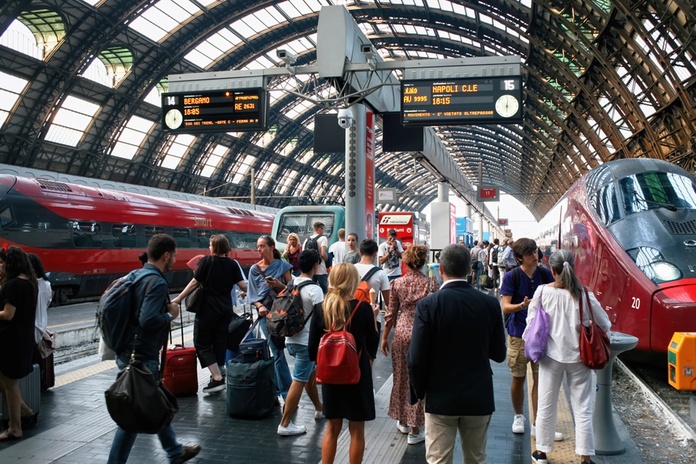
The train should not be presented solely as an eco-friendly alternative to flying. Families, travelers who value autonomy, environmentally conscious customers, or those looking to avoid airport constraints constitute good targets.

« Typically, for a family, the train is incredibly simple. You arrive in the city center rather than being far from the airport and having to pay again for a shuttle. », notes Hugo Bazin, cofounder and CEO of Tictactrip and Very Train.

Olivier Bernard, founder and partner at Déclic Evasion, also highlights « the ease of access and comfort », notably with a booking window of only 30 minutes before departure for TGV INOUI, as well as « the high frequency of TGV INOUI or OUIGO services, which offers great flexibility in planning ».


The train can also meet the expectations of travelers seeking more autonomy. « A well-prepared train journey, with a good travel diary, is still well structured », recalls Laure Jacquet, director of Discovery Trains, an agency specializing in train travel.


2. Turn the Journey into an Experience

The train can be more than just a means of transport: landscapes, night trains, scenic itineraries, or historic trains can build a genuine experience.

« The primary motivation of train travelers, at least those who go through an agency, is not ecology nor love of rail travel. These travelers mainly want to experience a different kind of journey. », observes Laure Jacquet.

« People love the train, adds Hugo Bazin. We can walk, use the restrooms, work, read… You’re not in a car where you must stay focused, and you’re not in the plane where you have to arrive very early.

The travel advisor can also rely on destinations that are close and easy to access : Brussels, Amsterdam, Geneva, London or getaways in France. « Brussels, it’s under two hours by train and you arrive in the center » illustrates Hugo Bazin.


3. Favor One Carrier

Avoid, when possible, multiplying carriers on the same itinerary.

« If one carrier manages the route, they will be more easily able to offer a solution in case of a missed connection », explains Laure Jacquet. Her advice: « choose the same company from start to finish ».


4. Allow Plenty of Time for Connections

Caution is especially important in Germany.

« On all routes in Germany, plan generous connections, truly generous », insists Laure Jacquet. When possible, it’s even better to allow a layover night rather than a too-tight connection.


6. Check Timetables and Stations


7. Anticipate Disruptions

Train canceled or a compromised connection: « above all, don’t panic », advises Laure Jacquet. The first instinct should be to head to the railway company’s ticket counter.


« They are aware. They know that a train has been canceled and they already know if there is a solution », she explains. For the agency, the key is therefore to anticipate difficulties and identify the right contacts.


8. Rely on an Aggregator or a Specialist

Distribution remains a major hurdle. « The first obstacle to selling trains through an agency is the lack of offers, such as a truly dedicated B2B platform for trains with an agency account », says Hugo Bazin.

For complex cases, it’s better to depend on a specialist. « Trains aren’t straightforward », he concedes.

Aggregators can serve as an entry point for beginner agencies. « Aggregators are handy », confirms Laure Jacquet, especially to simplify managing multiple carriers. But « as soon as you become a specialist, it’s better to go through the carriers’ own sites ».

Discovery Trains represents Austrian trains (ÖBB) but also Canadian Via Rail Canada, Swiss trains (CFF/SBB) and the Swiss Travel System.

Read also: Travel Agencies: Is Train Travel Easier to Sell than Air Travel?


9. Sell a Package Rather than a Ticket

The low remuneration of base tickets remains a hurdle. « Today, SNCF pays travel agencies or resellers very little », notes Hugo Bazin. Hence the value of building a comprehensive offer.

« If we talk about a complete package, it becomes interesting », he explains. Train, accommodation, and activities can create more value and margin. Very Train thus announces an average commission of 8 to 12% on the overall package, while circuits published on the Discovery Trains site are commissioned at 10% for agencies.

For Olivier Bernard, rail travel is also a compelling product for groups and works councils. « The group terms for SNCF INOUI trains allow adaptation to organizational constraints with more flexible registration deadlines and better control of financial risks in case of partial cancellations. »


10. Get Training and Start Simple

Training remains essential to master the specifics of rail travel. Laure Jacquet invites agencies to participate in Travel Talk organized by Discovery Trains on October 8, 2026.

« We want to overturn preconceived notions. Well-sold, the train is a pleasant and profitable product, provided you know its codes and know how to showcase this experience », she insists.

The right approach for a starting agency: begin with simple itineraries, train and learn, and don’t hesitate to rely on a specialist when the project becomes more complex.


Find all articles in our series “Very Special Agent – The Pro’s Practical Guide” by clicking this link.


Caroline Lelievre Written by Caroline Lelievre Journalist – TourMaG.com
See all articles by Caroline Lelievre

  • picto Twitter
  • picto Linkedin
  • picto email
Add TourMaG to your Google News feed Google Actualités icône

Hervé Bellaïche (Catlante): Travel Agencies Are Our Main Growth Engine


TourMaG – The summer is drawing to a close. What assessment do you make of the 2026 season?

Hervé Bellaïche : The assessment is fairly positive, at least above our expectations. We were concerned because market trends suggested a difficult market that had trouble stabilizing.

In the end, we recorded a large number of last-minute bookings, about 20% more than usual. We also achieved an excellent August, the best in five years. So we are very commercially satisfied.

Travel agencies have been a great help and today constitute our main growth engine.

Beyond the commercial results, what matters most for Catlante is the customer experience, the quality of service and overall satisfaction. And in this regard, feedback is consistently excellent. Clients come back telling us they spent fantastic holidays, sometimes even “the best holidays of their lives.” That is what motivates us to go even further and to make the brand more widely known.

TourMaG – Travel agencies have thus embraced the cabin-cruise concept on a catamaran. How did you develop this distribution network?

Hervé Bellaïche :
A few years ago, Catlante was nearly exclusively sold direct. We found a second growth engine with travel agencies, thanks to the work undertaken for about two years to develop distribution networks.

It wasn’t necessarily easy. When you have a history of operating primarily through direct sales, you have to learn to work with a network of endorsers. I’ve been in the tourism industry for 20 years and for 20 years I’ve advocated this growth channel. I’m therefore very pleased that we managed to implement it at Catlante.

In the first half of the year, we’ve seen an 80% growth in travel agencies. It’s working very well, with two phenomena: some agencies are literally exploding their sales, with three- to fourfold increases over their previous level, while others still haven’t jumped aboard and are stagnating.

Our analysis is that some agencies have understood the appeal of this new type of vacation, which is popular, while others have not yet integrated this evolution.

TourMaG – The travel sector has faced the consequences of geopolitical tensions in the Middle East. Has your product proven particularly resilient?

Hervé Bellaïche :
Yes. In summer, around 90% of our production is in the Mediterranean. We have many departures from the Marseille coast, up to Saint-Tropez, but also from Corsica toward the north and southern Corsica, or Italy.

We also have departures from Palma to Minorca and Majorca in the Balearics. So these are mainly close-to-home trips. We also have a few trips to the Seychelles, which were more affected by the difficulties related to the Middle East.

Our product is resilient and even acted as a kind of travel refuge.

Some agencies have called us saying they had clients initially planned for long-haul trips or even within France, in areas hit by storms or fires, who had to rethink their plans. That perhaps explains part of the last-minute bookings.

We notably had a few families who had planned to go to the Landes region, Cap-Ferret for example, and who ultimately redirected to a Catlante trip.


TourMaG – What is the current split between cabin cruises and privatizations?

Hervé Bellaïche :
Catlante indeed does two kinds of offerings. We invented this cabin-cruise model: essentially sharing a boat, somewhat like a guesthouse on the sea. Our vessels are specifically designed for this, with plenty of space.

Clients frequently tell us they have met amazing people while still being able to live their own life. The act of sharing the boat can be a first hurdle at the time of booking, but once aboard, the initial hesitation completely fades away.

Today, roughly two-thirds of our activity comes from the cabin product. A couple, two couples or a family can take one, two or three cabins on the six cabins each boat offers. We have six cabins per boat, with a crew of two to three people.

The remaining one-third corresponds to groups or families who come together and privatize the boat.

TourMaG – Cabin cruising remains a niche product. Is it becoming more mainstream?

Hervé Bellaïche :
I can’t speak for the entire industry, but at Catlante we sense strong demand.

I believe this owes more to the way Catlante operates than to a general democratization of the sector. The company has been around for 23 years and, for 23 years, we have focused on the same thing: cabin-catamaran cruises, whether cabin-based or privatized, with crew.

Our know-how, our methods and our approach help us build client loyalty. We operate at smaller volumes compared with large tour operators—probably 10, 20 or 50 times less. We handle between 6,000 and 10,000 passengers per year.

We perform our activities in a professional manner. It is craftsmanship on a grand scale. We always depart with 12 people. Each departure is precisely shaped, personalized and customized. Yet we manage to run roughly 500 departures per year.

TourMaG – What are your prospects for the winter season 2026-2027 and which destinations will you offer?

Hervé Bellaïche :
The Caribbean is at the heart of our winter activity. The Grenadines stand out as a particularly fantastic destination to discover by boat and by catamaran.

We also propose tours around Martinique, Guadeloupe, Saint-Barthélemy and Antigua and Barbuda. We have a whole range of Caribbean destinations that lend themselves especially well to catamaran vacations.

We reach incredible lagoons, moving from paradise beaches to paradise beaches, from secret coves to secret coves. It is quite amazing.


TourMaG – How does the winter season look commercially?

Hervé Bellaïche :
Like many players, we’ve fallen a bit behind. We had a lot of momentum for the summer and managed to maintain it. For the winter, however, we sense a tendency toward last-minute bookings.

We still have quite a bit of availability for this winter. This does not overly worry us, but the activity will need to take off at the start of the autumn term. We look forward to the rentrée to boost sales and ensure that clients join us this winter.

We also tend to extend the summer season into September, or even late September, with departures in Corsica, the Balearics and more generally in the Mediterranean. We then begin the Caribbean season around mid-November. That gives us a little time to fill the order book.

TourMaG – 2027 will be an election year in France. Are you worried about the presidential elections?

Hervé Bellaïche :
Not at all. What could actually worry us is purchasing power.

We remain with prices that, relative to the product’s quality, are very well positioned. In our satisfaction surveys, which we analyze in great detail, a large number of clients tell us that the value for money is incredible.

Nevertheless, we do not want to raise prices to keep the product accessible. We prefer to increase the number of boats and grow our customer base rather than raise rates.

We are not, either, in a discounting framework. We have never done it and we will never do it.

One can be concerned about the situation of French clients and their purchasing power. On the other hand, I do not think that the fact that people must vote or fear what is going to happen will stop them from travelling. The experiences from previous years have shown us that this kind of context did not have a drastic impact on the travel industry.

TourMaG – What will be Catlante’s next engagements with tourism professionals?

Hervé Bellaïche :
We obviously continue all our familiarization tours and our actions with professionals. Our salespeople travel across France to meet travel agencies.

We are increasingly organizing familiarization trips and ship visits. It’s enough to contact Catlante and our sales team to arrange this kind of event.

We have put a lot of work into this area this year. We welcomed around 2,000 people, including nearly 500 travel agents aboard our ships to discover our product.

We will also be present at the IFTM, even though we will unfortunately not have a stand, as we do not yet have the budgets required or the critical size to do so. We will also be present at the Grand Pavois in La Rochelle at the end of September, at Cannes for the Nautical Fair, and at the Paris Boat Show in November.

Finally, we will organize in the coming months an evening bringing together our clients and our most loyal agencies, as well as a few partners and friends, to allow everyone to meet.

Because travel, too, is about that. At Catlante, it is about meeting, sharing and exchanging.

In a world that is very disconnected, what we advocate with Catlante is reconnecting with nature, switching off the phone, real reconnection and reconnecting with oneself. We want to connect and reconnect clients with one another.

FRAM Launches Selfcare to Automate Flight-Cancellation Management for Travel Agencies


FRAM lance Selfcare pour automatiser la gestion des annulations de vols des agences - Depositphotos.com  Auteur visuals6x

TAP Air Portugal


A few weeks after unveiling the project at the Convenc’Tour of the CEDIV, FRAM unveils a new tool for travel agencies.

The tour operator announces the launch of Selfcare, a new tool integrated into its BtoB FRAMPRO platform, designed to simplify the management of flight cancellations.

This feature addresses a recurring issue driven by the rising disruptions in air travel, which heavily involve travel agencies and the teams of tour operators.


In a first phase, the tool concerns Stay (holidays) files

Specifically, Selfcare enables agencies to receive cancellations communicated by airlines more quickly, immediately access the available re-protection options, and confirm with their clients the chosen option on the spot, without prior revalidation by FRAM when the processing is automated.

The aim is to shorten processing times for cases while allowing the tour operator’s teams to focus on the more complex scenarios. When automatic processing is not feasible, the file is forwarded to the Service Avant Départ.

In this initial phase, the tool covers Stay dossiers for which a reprotection solution is available. Other cases will continue to be handled by FRAM teams.


FRAM: empowering agencies with autonomy and responsiveness

The group plans a gradual scaling of the system. By the end of 2026, nearly all FRAM and Plein Vent files affected by this type of processing should be integrated into Selfcare.

« Our partners asked for more autonomy and responsiveness when a flight is canceled.

Selfcare directly answers this expectation. It is a useful innovation, built from their feedback. And this is only the first step: we will continue to enhance Selfcare in the coming months
», states Cyrille Fradin, president of Groupe Karavel-FRAM.


Up to 50 euros covered per person in case of air re-protection

In parallel with this technological evolution, FRAM announces a commercial measure aimed at reducing the financial impact of transport changes.

In the event of an air reprotection, the tour operator will now cover up to 50 euros per person for any additional transport costs. This contribution will be directly added to the file to lessen the traveler’s out-of-pocket amount and to facilitate securing departures.

This announcement comes amid a context where air disruptions have heavily strained the entire distribution chain in recent months.

At the Convenc’Tour of the CEDIV held in June, Jean-Christophe Guillin recalled that FRAM had recorded 3,800 PNR cancellations between April 1 and August 31 due to the conflict in the Middle East.

These figures illustrate the scale of the processing to be managed and the need to automate part of the processes.

Travel Agencies: Is Train Travel Easier to Sell Than Plane Tickets?


Si les ventes de billets de train progressent en agences, il reste encore de nombreux freins à son développement - Depositphotos.com, frimufilms

Costa Rica


Rail travel is gaining ground, especially for trips within France.

At Déclic Evasion, rail stays rose by 16% between 2024 and 2025. « This evolution is explained by the increase in stays in France since the health crisis, the reduction of certain domestic air links and the development of alternatives such as Ouigo », explains Olivier Bernard.

The arrival of Trenitalia on Paris-Marseille has also helped to energize certain routes.

At Versailles Voyages, Myriam Tord also notes a progression, even though the train started from a long way off. « We progressed because we were almost starting from zero. The train wasn’t really something that was offered before. »

For her, the turning point comes from personal experience: after completing the Trans-Canada journey between Toronto and Vancouver, she discovered the train as a genuine travel experience.

At Quartier Libre, the assessment is more mixed. The tour operator has been offering since 2025 a train option to Scotland, but it accounts for about 10% of sales on that destination. « It’s a nice calling card, but it remains limited in volume », says Stéphane Dossetto.


What are the arguments for selling train travel?

The primary argument is the experience. For Myriam Tord, train travel should not be presented solely as an alternative to air travel: « It is a different way to travel. »

The train lets passengers take their time, enjoy the scenery and discover a destination in a different way. It is particularly well suited to Canada, Scotland, Switzerland, or Italy.

Professionals also highlight the comfort: arriving in the city center, no baggage constraints, and less waiting before departure — the train offers a different kind of simplicity.

For Olivier Bernard, the train is also appealing for leisure groups. The conditions offered by SNCF on Inoui trains provide greater flexibility for CSE clients, especially regarding registrations and cancellations.

The ecological argument remains present, but it is not always enough. Stéphane Dossetto believes that practicality should also be addressed: « We talk a lot about carbon footprint, but we forget about comfort. »


What are the barriers?

The first obstacle remains the rail offering. Olivier Bernard specifically points to the weakness of province-to-province links. “From Marseille, the availability of direct TGV services remains insufficient.”

For international destinations, connections also complicate sales. Stéphane Dossetto cites the example of Scotland: from Paris, the journey is possible, but from some regions in France, the accumulation of changes makes flying more attractive.

Price also remains a topic. On certain destinations, particularly in the face of low-cost carriers, air travel preserves an advantage.

Customer habits are another brake. Many still appreciate the comfort of a coach trip where they have nothing to manage. « Customers love the cocoon of the coach: they drop their luggage and don’t have to deal with anything », explains Stéphane Dossetto.

Finally, the management of disruptions worries agencies. « If a train is canceled, you have to find another solution: another train, a hotel, a new arrangement. After-sales service is more complicated », remarks Myriam Tord.


What about the tools?

Professionals deem rail tools still inadequately adapted.

For Myriam Tord, the problem also relates to knowledge: « For air travel, we go to Amadeus and it’s quite simple. For trains, you have to know the providers. »

Solutions exist, such as Rail Europe or Resaneo, but they remain little known to agents.

In the group market, expectations are even higher. Olivier Bernard particularly regrets the late opening of sales and the absence of a functional Ouigo group tool.

He also believes it is necessary to improve features: management of traveler typologies, changes in headcount, or seat selection.

Beyond digital tools, human support remains essential. For Déclic Evasion, having a dedicated BtoB contact at Inoui is a real asset during group sales and in case of unforeseen events.


How can train sales be improved?

For the professionals surveyed, the priority is to better promote the product.

« It has to be tested », says Myriam Tord. According to her, an agent who has traveled by train will be more capable of conveying the experience to the client.

Training is therefore an important lever, as is a shift in the way rail travel is sold. The train should not be presented solely as an ecological solution, but as a new travel experience.

It is also necessary to facilitate marketing: better visibility of availability, tools more suited to agencies, and a clearer offer.

Finally, remuneration remains an issue. Olivier Bernard recalls that rail travel retains a commission-based system, unlike air travel, but he believes current levels are insufficient.

The train is thus making progress in agency catalogs, but it has not yet become a sales reflex. To gain ground against aviation, it will need to continue improving its tools and, above all, its ability to appeal beyond the environmental argument.


PromPerú Trains Travel Agencies in Marseille


Louis Roche, PDG de ProDesti, a animé à Marseille une session de formation « Connaisseur du Pérou » organisée par PromPerú à destination des agences de voyages - DepositPhotos.com, pawopa3336

CroisiEurope


After obtaining the Qualiopi certification and strengthening its portfolio of specialized trainings, ProDesti continues its development in the tourist destinations segment. This time, PromPerú has called on the organization to train travel agencies in the Marseille region, with a clear objective: to improve their expertise of the destination.

A free training session for on-site travel agencies.

For almost four hours, participants alternated between presentations of the destination, exchanges of experience and technical questions.

An approach faithful to ProDesti’s philosophy, which prioritizes trainings led by active tourism professionals and centered on the commercial realities of agencies.

“PromPerú’s objective is really to showcase Peru in the Marseille region, to help travel agents better master the destination and thus sell it better.”, explains Luis Roche, CEO of ProDesti and trainer on Peru and Chile.


A Destination That Goes Beyond Machu Picchu

The program notably covered the country’s different regions, the circuits, the visits to Machu Picchu, the railway connections, the domestic flights, as well as possible extensions.

Throughout the training, Luis Roche sought to dispel the image of Peru being limited to Machu Picchu. “There are many things to explore beyond Machu Picchu. It should be noted that two-thirds of the country is jungle.”, he recalls, by highlighting the regions of Iquitos, Madre de Dios, Chachapoyas and also the sites of the Moche and Lambayeque civilizations.

The objective is also to give travel advisers concrete arguments to tailor their recommendations according to their clients’ profiles.

The questions, moreover, addressed very operational topics: the various circuits to Machu Picchu, the categories of trains, or the domestic air services.


A Highly Advanced Training

Present at this session, Barbara Roussel, director of Voyages Couture, believes that this type of training provides real added value. “We already know the destination, but this gives us access to all the information. Even when we are experienced, it remains valuable. It makes us much more confident and brings additional expertise.”, she explains.

The professional also underscores the quality of Luis Roche’s intervention: “It is an extremely advanced training. It is not generic; we go into the detail of the circuits. The instructor is passionate and engaging, and it makes you want to discover the destination.”

According to Luis Roche, Peru also possesses strong commercial arguments. “It is a destination that is sold almost all year round, between March and November. It has the best value-for-money in South America.”, he notes, before adding: “Peruvian gastronomy is clearly a major selling point for French travelers.”

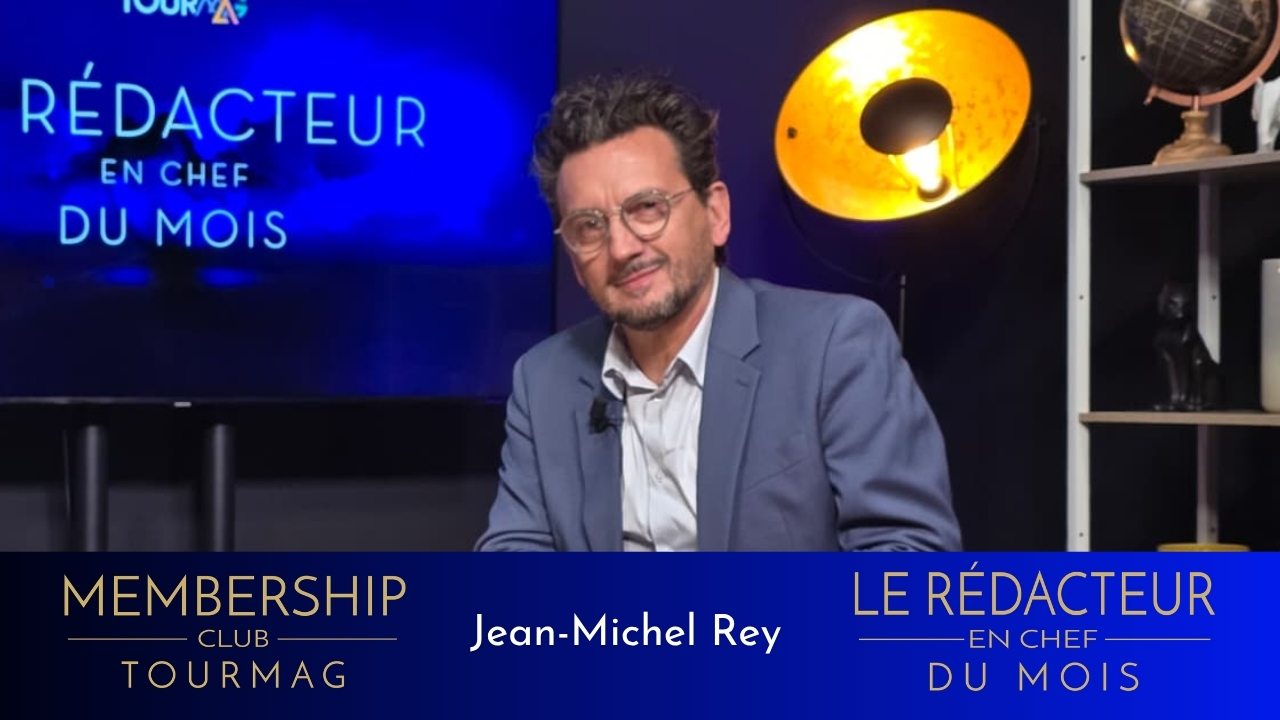
Jean-Michel Rey (Digitrips): Simplifying Travel Agencies’ Day-to-Day Operations


TourMaG – You joined Digitrips a few months ago, after a long career in tourism. What inspired you to begin this new chapter?

Jean-Michel Rey: It’s been several years now that I’ve been active in this industry, where I had the chance to perform a variety of roles. This diversity of experiences has given me a lot of knowledge, and I’m delighted to share it with Digitrips, which I joined at the beginning of April.

Why Digitrips? It’s a company that has always piqued my interest. I have followed its development in recent years with close attention, especially since I already knew several members of the management team.

That was additional encouragement to follow its news. I knew this company was in tune with the times, and I was not mistaken. Today, I’m discovering a company driven by very strong momentum.


TourMaG – Digitrips is a distinctly tech-oriented company, whereas you come more from tour operating, distribution or even accommodation…

Jean-Michel Rey : Precisely, Digitrips brings together a lot of talent and diverse skills.

Today, the company rests on three main areas of expertise: the air activity from MisterFly, the hotel sector with HResa, and the technology developed by Koedia.

These three entities are now united under the Digitrips brand. It is a multifaceted company, operating in several lines of business.

And I’m fortunate to have practiced nearly all of these roles before, but in different companies. Today, I can find them all within a single structure.


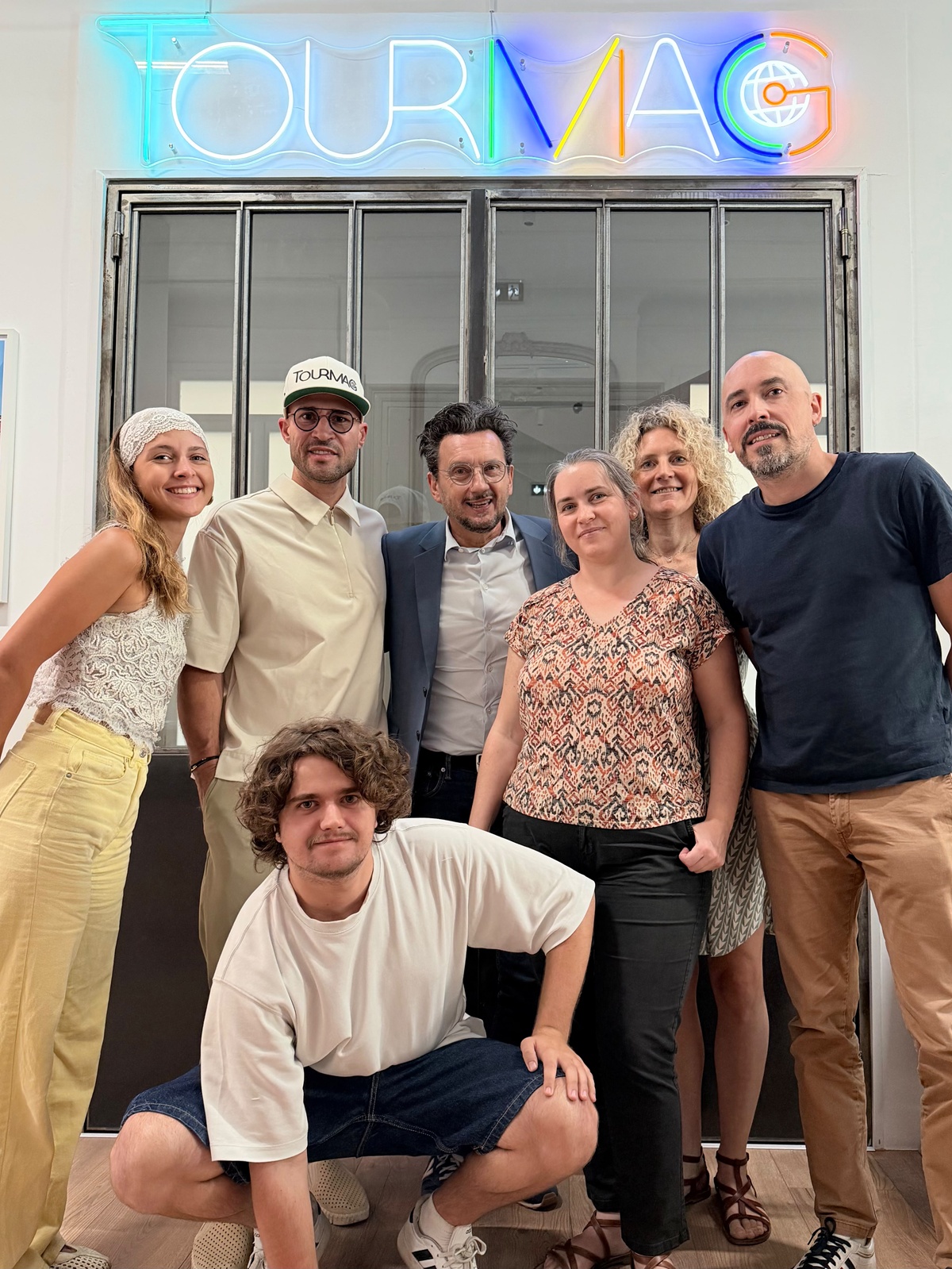
Jean-Michel Rey surrounded by TourMaG editorial staff - XP Photo

TourMaG – The Middle East conflict has significantly disrupted the market since late February. How did Digitrips navigate this period?

Jean-Michel Rey:
In terms of air activity, we obviously faced a crisis period. We had to organize repatriations with our partners, travel agencies and tour operators, in a context that was never straightforward. It was also essential for airlines to cooperate.

Next, we entered a period of wait-and-see. Air bookings slowed a bit, but ultimately less than we feared, despite higher ticket prices.

In terms of accommodation, where we specialize in leisure stays, we paused more than in business travel, which remains largely domestic and thus was less affected.

However, we are recording double-digit growth in a particularly promising activity for us: the dynamic package.


Digitrips: “We want to keep enriching the dynamic package”

TourMaG – Is the dynamic package a major focus of development?

Jean-Michel Rey :
Yes, of course. We want to continue enriching this solution with new features and new possibilities for travel agencies.

Today, I no longer need to persuade anyone of the value of the dynamic package. Everyone now understands its benefits.

For the client, it guarantees a trip fully customized by their travel agent. For the agent, it’s the ability to manage their margin, to freely choose their products while relying on a reliable partner for organizing the trip.

It is therefore a product that provides both security for agencies and real resilience.

TourMaG – The market seems to be rebounding since June. Do you also see this recovery?

Jean-Michel Rey :
We did observe it in June, following a May that had been very weak, which was fairly expected.

Since the start of July, the trend has been somewhat less favorable. We aren’t really witnessing the last-minute rush of reservations that some might have anticipated. The business should rather build up gradually.


TourMaG – Over the course of your career, have you observed a significant shift in the expectations of travel agencies?

Jean-Michel Rey :
Yes, mainly driven by technology, which is now present throughout our industry.

We practice a profession where the human relationship remains essential. It’s important to preserve that dimension. But technology also brings us a lot in terms of time savings, productivity and profitability.

Our challenge is therefore to offer solutions that are increasingly comprehensive while staying easy to use.

We regularly conduct barometers with our client agencies. One of our latest surveys showed that a travel agent could use up to eight different tools during a single workday, from Google to their back-office.

Our aim is precisely to leverage our proprietary technology, which we develop entirely in-house, to simplify their daily lives and offer them a true one-stop shop, whether they want to book a flight, a hotel, or both.


A new partnership with Selectour on the accommodations side


Hotel central: Digitrips Pro partner of GIE ASHA

Since July 1, 2026, the group has integrated the ASHA GIE’s commercial selection as a partner hotel central, thereby giving agencies within the Selectour and Havas Voyages networks direct access to its Digitrips Pro platform.

Digitrips was already a partner of the Havas Voyages network; this agreement extends its collaboration to Selectour and thus to the ASHA GIE. The agreement also provides for the integration of DIGITRIPS solutions within the payment centers of the group and a gradual rollout across the entire Selectour ecosystem.

The group will also strengthen its presence at the major events organized by the Selectour and Havas Voyages networks, whether at sales force meetings, congresses, or promotional activities.

This partnership marks a new milestone in the development of DIGITRIPS within the French tourism distribution. The trust placed today by the GIE ASHA confirms the relevance of our vision: to develop innovative technologies and high-quality product and service offerings that meet the needs of travel agencies,” says Nicolas Brumelot, cofounder and president of DIGITRIPS.

We are convinced that the integration of DIGITRIPS will strengthen our accommodations offering and provide our agencies with a powerful, easy-to-use solution tailored to the expectations of our advisers. This partnership fully aligns with our strategy of selecting the best tools to serve our networks,” states Laurent Abitbol, president of GIE ASHA.

Pegasus Trains: The Company That Loves Tour Operators and Travel Agencies [ABO]


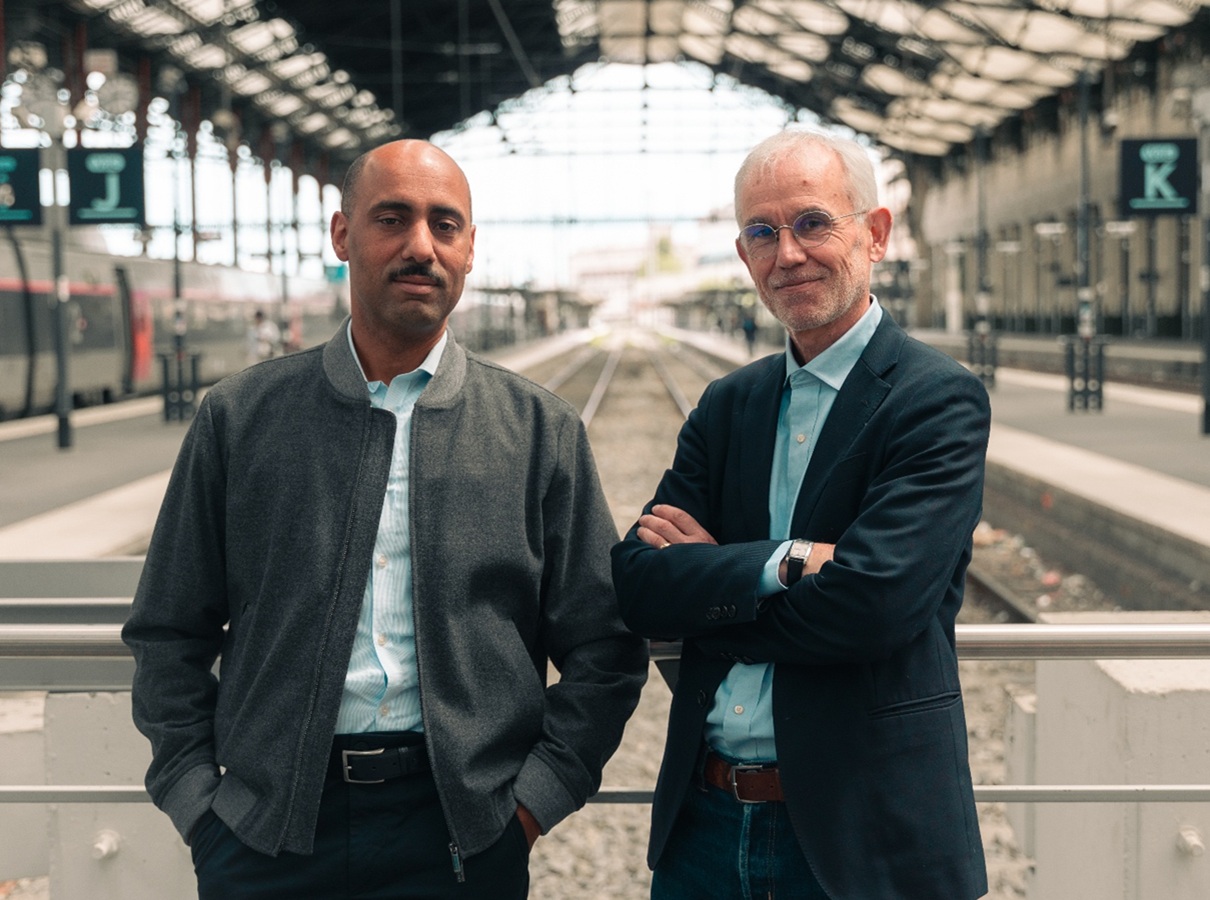
David Mascorda et Guillaume de Marcillac, les deux fondateurs de Pegasus Trains - Crédit photo : Emile Rivet

CroisiEurope


Nobody knows it, or almost, but the SNCF is not the only French railway company operating on our soil.

In fact, lurking in the shadow of its big sister, there is nevertheless a company that owns a train and has been running since winter 2025.

At its head, a familiar face in the tourism industry: Guillaume de Marcillac. He is known as the former CEO of TravelFactory and as a former financial head of Egencia and Karavel-Promovacances. He now wears the hat of train chief, leading Pegasus Trains.


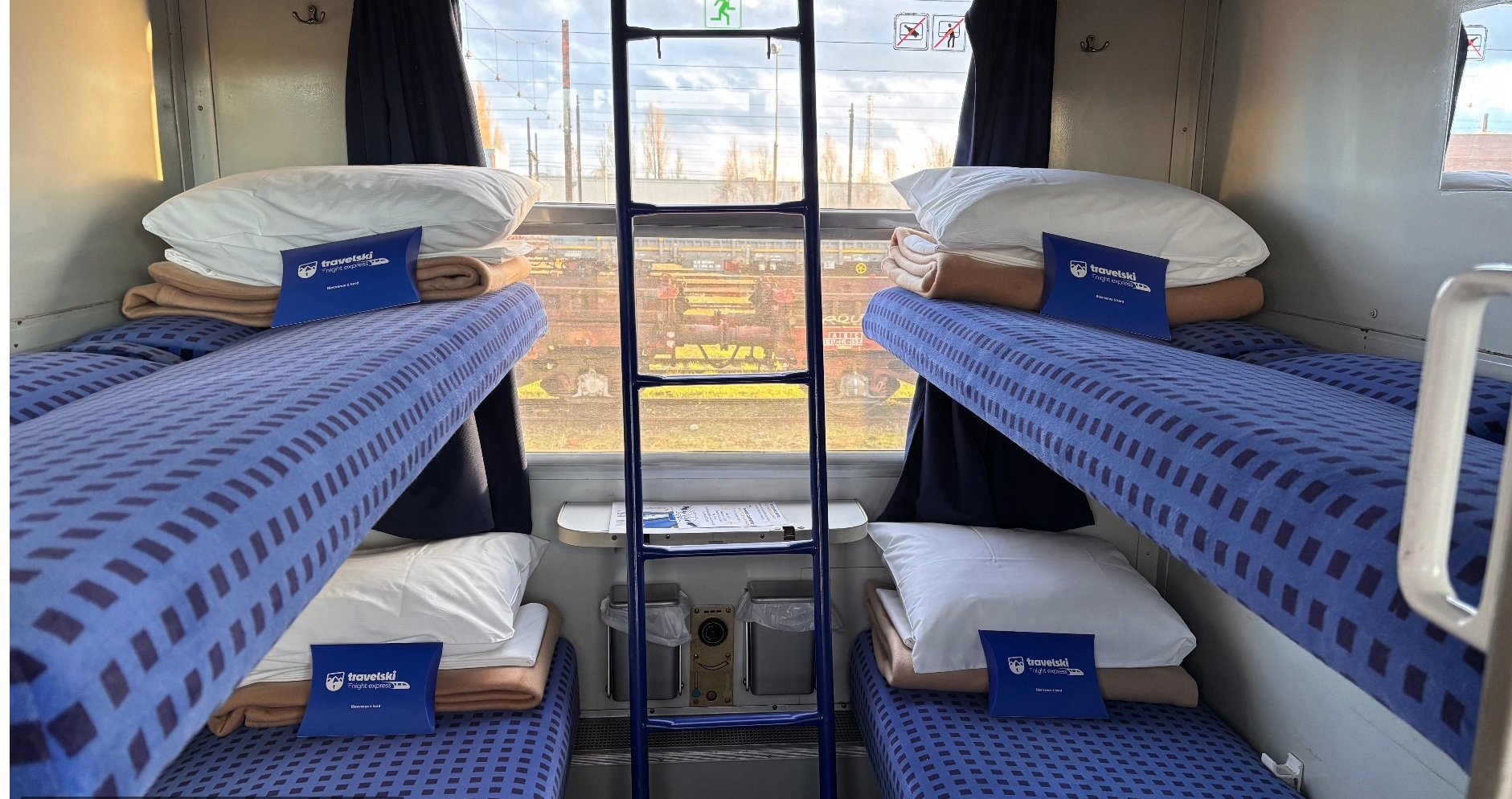
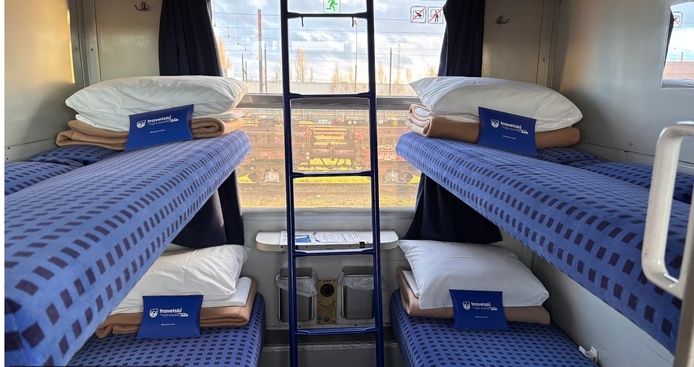
After a first trial run with his previous employer during the launch of the Travelski Express, to redeploy the Eurostar between London and Bourg-Saint-Maurice, Guillaume de Marcillac decided to take off and thus create his own railway company.

The first challenge was to find rolling stock. “We combed across Europe to find owners willing to lease cars and a locomotive. It required a lot of work to locate and negotiate equipment coming from different places.

Our dining car comes from the Netherlands, the sleeping cars come from Baden-Württemberg, and the locomotive from France.

There are very substantial entry barriers in rail, which explains the very small number of new entrants
“, explains the fortunate cofounder of Pegasus Trains and owner of a train set.


Pegasus Trains: “We are in slow travel,” not a high-speed train

The second hurdle was securing homologation to run the trainset in France.

We are a railway company, but I do not use the term ‘railway company’, which is a legal term. Indeed, there are three statuses in the railway world.

The first is that of an authorized candidate, which means you are recognized as credible by SNCF Réseau and SNCF Gares & Connexions. You are an official interlocutor for these companies.

The second status is called the railway license. A bit like the registration for travel agencies, it is a recognition granted by the Ministry of Transport and Bercy, based on having sufficiently strong equity and certain management characteristics.

The last grade, the highest, is the security certificate of the railway company. It is a complex process, which takes time to obtain,” he explains.

To read: Rail Charter Service: what if you charter trains?

With the license in hand, Pegasus Trains thus cannot have its trains operated by its own crews. The company must recruit staff who hold this certificate.

To find drivers, it is enough to go through SNCF or freight operators also authorized to carry passengers. There are also European operators whose core business is to hold this safety certificate, as is the case with European Sleeper.

We are in a sense an orchestrator, with the equipment on one side, the locomotive on the other and the driver. We assemble all these building blocks.

We are also in slow travel. We do not offer high speed, like TGVs or Frecciarossa. We can, in one night, travel 1,300 km.


Pegasus Trains: “We will have two train sets in operation” by the end of 2026


Pegasus Train devrait sortir de la montagne pour desservir le littoral l'été prochain - Crédit photo : Pegasus Trains

Thus, Pegasus Trains offers a journey that is slower than the TGV, but with the merit of being decarbonized.

Each train set has a capacity of between 300 and 650 passengers, depending on client needs. It includes a dining car.

The trains have an international vocation, even though they cannot travel to the United Kingdom, as the Channel Tunnel requires very specific features reserved for Eurostar.

These are trains that have already been renovated by their owner, with whom we have an agreement for the long term.

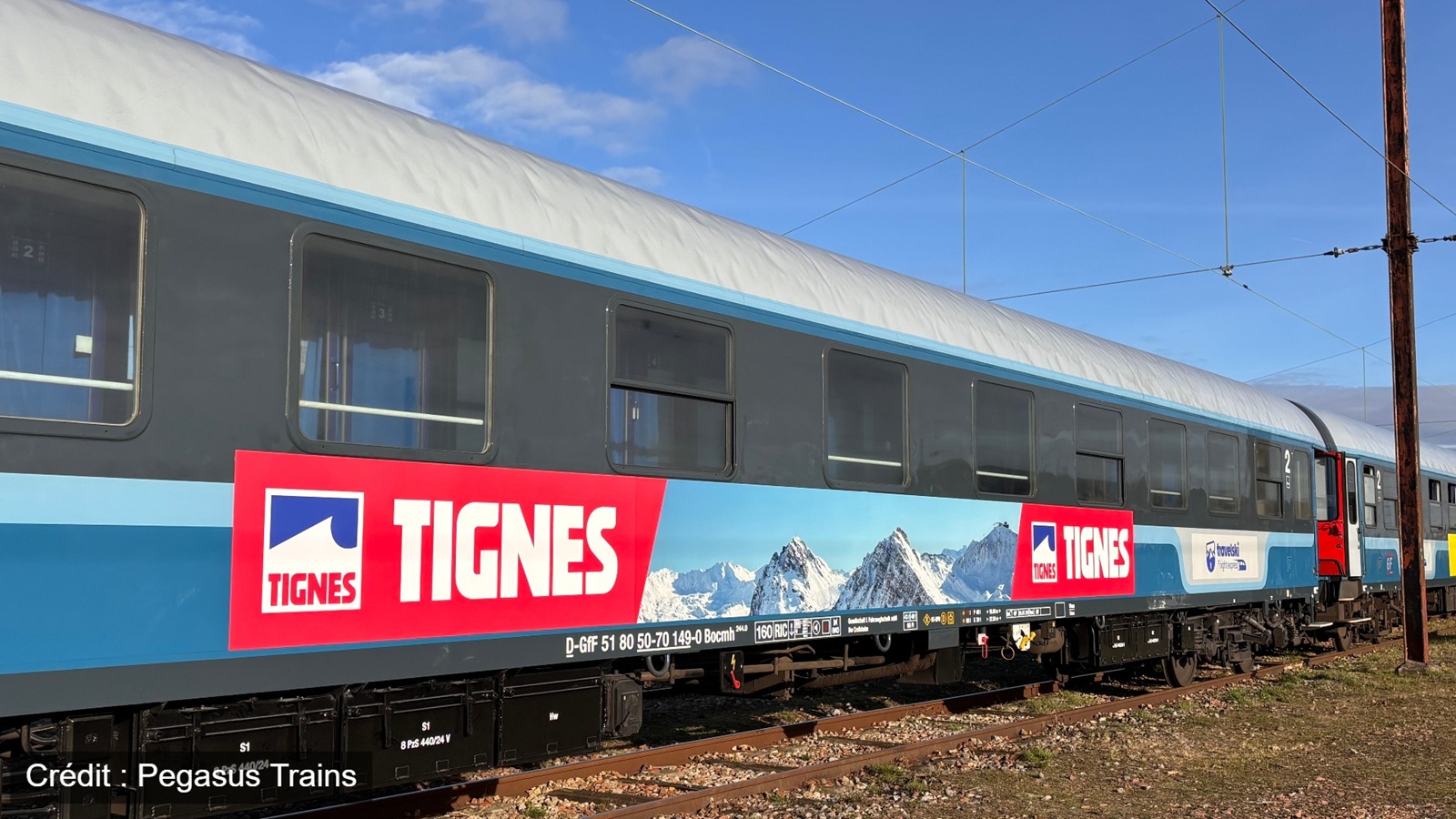
The rolling stock is not our property, so we cannot make modifications. However, it is possible for us to do a lot of exterior and interior decoration. Our trains also serve as a communication platform
“, continues Guillaume de Marcillac.

Consequently, the train becomes a marketing element for destinations and tour operators, such as Travelski.

Duly noted, buoyed by this success, after two winters of chartering for the winter-sports tour operator, the railway company aims to grow its fleet.

Our vision is that, gradually, our fleet will grow and our project is to gradually own our own trains, which we will renovate ourselves. That takes time.

Starting at the end of 2026, we will ramp up and have two train sets in operation,
rather than the single one we have today


Pegasus Trains is set to leave the mountains and serve the coast next summer


Pegasus Train : "nous allons nous adresser aux agences de voyages" et aux TO - Photo : Pegasus Trains

The first train will continue to operate between Paris and Bourg-Saint-Maurice, while the other will have a more European destiny.

The second train will depart from Amsterdam, then stop in Rotterdam, Antwerp and Brussels-Midi, before heading into the Alps.

It is intended for Dutch, Belgian, and also a little for British travelers, as Eurostar stops at Brussels-Midi.
We are in full preparation for its deployment, and once again, the Compagnie des Alpes has pre-booked it under a multi-year contract.

They are very satisfied with the initial rotations that have taken place
“, congratulates the cofounder of Pegasus Trains.

To read: Agencies, how to sell the train better?

If the rakes will run in Travelski colors for weekend rotations, weekday rotations are being considered for the rolling stock on the Paris-origin line.

A product that will be more aimed at travel agencies, group organizers, and tour operators. Departures will occur every Tuesday evening and returns on Wednesday mornings.

Our business model is not only to operate in winter but also to operate in summer, thus year-round.

Currently, we are talking with other tour operators for spring and summer 2027, in order to serve territories beyond the French mountains
“, reveals Guillaume de Marcillac.

Pegasus Trains could venture out to sail along the coast, serving urban destinations, or even offering trips abroad next year.

It must be said that this kind of product fits perfectly with events and the various festivals that take place in winter as well as in summer.


Recruitment in Travel Agencies: A Market Still Under Pressure


Au sein des réseaux de distribution, les difficultés de recrutement persistent. Essentiellement sur les postes d’agent de voyages et commercial groupes.@depositphotos/rawpixel

CroisiEurope


« Our recruitment needs are recurring, primarily for sales advisors, due to a natural turnover inherent to tourism », explains a HR manager within a network of distribution agencies.

This difficulty is amplified in certain geographic areas that are less attractive. « In some sectors, notably in the East, we receive very few applications », confirms Aurélie Hébrard, administrative HR assistant within the Salaün group.

The lack of experienced profiles sometimes significantly lengthens recruitment timelines.


Attractiveness of the profession, volatile youth and inadequate training

Beyond the simple lack of candidates, agencies face a deeper issue: the attractiveness of the job. Young generations struggle to envision themselves in a sedentary role at an agency.

“Today’s youth have trouble wanting to stay eight hours a day behind a desk. They need space and mobility”, observes Aurélie Hébrard.

Another major hurdle is the mismatch between initial training and field realities. The Tourism BTS, often cited, is considered too general and not sufficiently professionalizing.
“Young people discover the profession only once on the job and some abandon during the probationary period, because they did not expect a job that complex,” testifies Céline Gleizes, HR manager of the Eden Tour network. Today, we have to teach them everything, even after a BTS, a bachelor’s degree or a master’s.
The lack of understanding of the profession remains strong: demanding customer relations, mastery of destinations, administrative constraints and commercial skills form a package often underestimated by candidates.


Training, diversifying channels and elevating the professions

In response to these findings, companies are implementing multiple strategies to attract and secure recruitment.

« We have implemented a welcome pack with specific bonuses for positions open for more than six months in tight zones », explains the HR manager of a large network. The brand also relies on specialized job boards such as TourMaG to obtain more targeted applications.

The brand also invests in visibility of the professions: presentations in schools, job dating, career videos featuring employees and a referral program, convinced that « employees are the best ambassadors ».

For its part, Eden Tour has chosen internal training, despite the time investment that this entails. « It takes between six months and a year to be fully operational, depending on profiles », notes Céline Gleizes. The network also favors professional training, such as those from Selectour Academy, deemed closer to the needs of agencies.

In a market that remains tight, tourism players share a common conviction: recruitment will rely as much on adapting training as on a better valuation of a demanding profession, often idealized but still too little known.


Caroline Lelievre Published by Caroline Lelievre Journalist – TourMaG.com
See all articles by Caroline Lelievre

  • picto Twitter
  • picto Linkedin
  • picto email
Add TourMaG to your Google News feed Google Actualités icône

Recruitment: Top 6 In-Demand Careers in Travel Agencies and Tour Operators


Recrutement : découvrez le Top 5 des métiers les plus porteurs chez les agences et tour-opérateurs ! - Depositphotos.com fentonroma143@gmail.com

CroisiEurope


Despite a clear rebound since the pandemic, the travel operators sector has not yet returned to the recruitment volumes seen in 2019.

Valérie Dufour, Head of TravelJobs, the Employment section of TourMaG, notes that the number of job offers remains significantly below the pre-COVID years.

This is explained by a deep restructuring of the agencies’ business models, the integration of digital technology, and a structural decline of certain traditional roles that took longer to regain their pre-crisis weight,” she explains.

The international and political context in France has also influenced recruitment.


“The difficulty of recruiting for operational roles has never been as high as today”

Even though the overall volume of offers has declined, the challenge of filling operational roles has never been greater, notes Valérie Dufour. The market faces an imbalance between numerous positions to fill—travel advisors, ticketing clerks, agency managers—and a small pool of qualified CVs.

Recruiters highlight a lack of specific technical skills, notably proficiency with reservation tools (GDS/Amadeus), as well as a need for general culture and advisory ability.” emphasizes the head of TourMaG’s Employment section.

The recruitment bottleneck is also cultural. Current candidates prioritize quality of life and flexibility. Teleworking, which has fully integrated into organizations with the COVID-19 pandemic, has become an almost systematic demand for support and ticketing roles. Finally, work-life balance is a consideration for many applicants.
To attract talent, companies must now offer upskilling plans and a hybrid organization. However, this evolution complicates recruitment for large traditional agencies, which sometimes struggle to adapt their roles and hours” summarizes Valérie Dufour.

She adds that firms are seeking increasingly specific skills: “The personalization of travel and tailor-made experiences are skyrocketing, as is the management of ever more complex situations (visas, multi-segment itineraries), becoming growth drivers for tour operators, which requires more precise competencies from staff.

Other sectors are buoyant. Group travel operators, for example, are seeing strong activity and hiring. In this context, technicians and group travel sales professionals are in demand.

Another significant impact on job profiles is the rise of travel recommendations and content on social networks such as Instagram or TikTok, which is shifting customer expectations. “Some influencers are even becoming advocates—this forces agencies/tour operators to rethink their marketing approach to stay attractive. They are seeking employees who also possess these skills.” adds the employment expert.


Top 6 in-demand roles in 2025-2026

In this context of transformation, certain profiles remain highly sought after:

Travel Advisor: The pivot of distribution, indispensable for creating tailor-made trips.

Travel Product Manager: A profile sought by tour operators to design differentiated offers (ecotourism, adventure, niche).

Luxury / Premium Specialist: A growing segment that requires highly specialized client expertise.

Digital & Marketing Expert: To respond to the increasing influence of social networks (TikTok, Instagram) in the purchasing process.

Ticketing Clerk, Transport Manager and Back-office: Technical roles essential to the operational reliability of agencies.

Sales and Group Travel Technician: The salesperson is responsible for developing and selling tailor-made trips for groups (associations, companies, local authorities…). The group travel technician designs, organizes, and coordinates trips for groups (associations, schools, businesses…).


TravelJobs 2026: new tools to smooth the market


Valérie Dufour responsable de TravelJobs

Facing these recruitment challenges, matchmaking services are evolving on TourMaG. TravelJobs will roll out in 2026 customized sourcing services for recruiters, going beyond simple job postings diffusion.

This approach includes targeted headhunting by geographic area and activation of alumni networks and professional associations. The objective is clear: provide visibility to candidates on sometimes unpublished opportunities while ensuring employers access to qualified and immediately operational profiles.

Learn more :

Email : [email protected]

Phone : +33 6 99 07 16 66

AtlasProtect.io Launches Geopolitical and Legal Monitoring Platform for Travel Agencies


AtlasProtect.io lance une plateforme de veille géopolitique et juridique pour les voyagistes - Photo AtlasProtect.io

CroisiEurope


In an international context marked by growing instability, geopolitical crises, rapid regulatory changes, and climate-related uncertainties, Chloé Rezlan, co-founder of the law firm Adeona Avocat·e·s, launched AtlasProtect.io in collaboration with Stanislas Lucien: a platform presented as the first geopolitics SaaS solution specifically designed for travel operators.


“In general, tourism law often acts reactively, only after a crisis has occurred. AtlasProtect.io’s ambition is precisely to reverse this logic by providing anticipatory tools.


Our mission is to give back control to travel professionals by turning uncertainty into decision intelligence. We do not sell data; we provide the clarity and confidence needed to plan, sell, and operate with complete peace of mind,”
explains Chloé Rezlan.

AtlasProtect.io thus aims to centralize and automate advanced legal, analytical, and security capabilities.


The platform targets a wide range of players

The platform targets a broad spectrum of actors: travel agencies, tour operators, Travel Management Companies (TMCs) and event organisers (MICE).

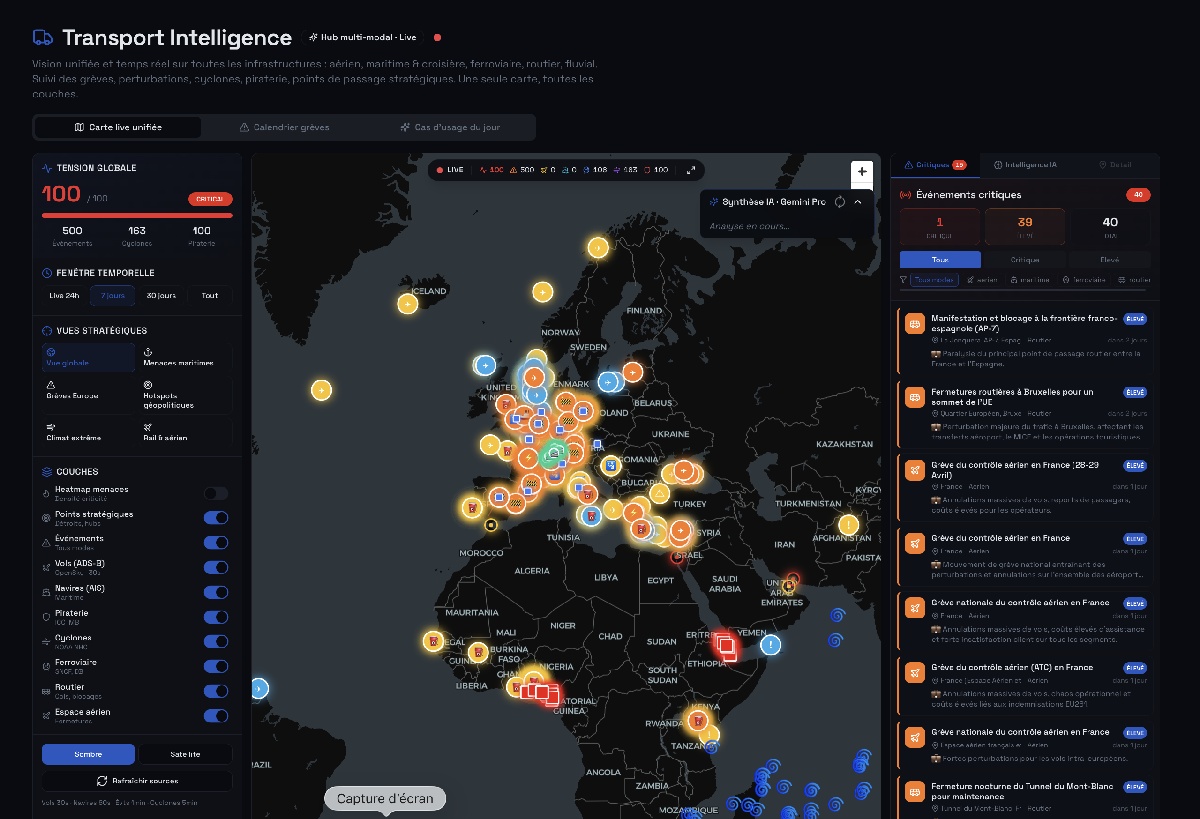
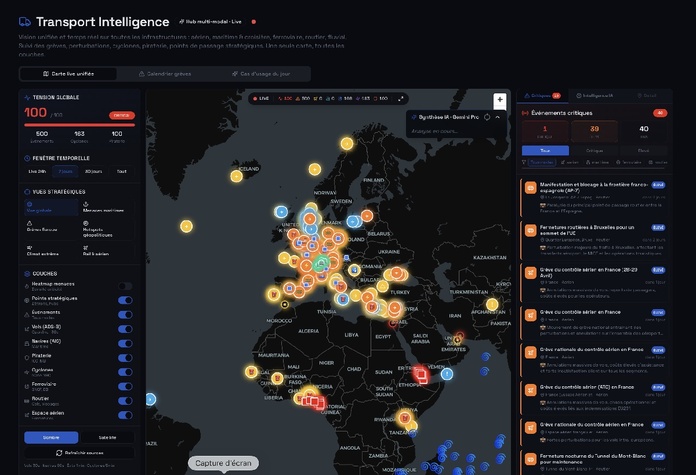
The solution is structured around a command center, named Atlas Live, which offers a real-time view of the situation across 195 countries.

To do this, the solution relies on more than 10,000 sources, “monitored 24/7”.

Concretely, the solution tracks all kinds of events: airport closures, social movements or natural disasters, and enables visualization of risk zones at a fine scale (neighborhoods, ongoing protests) while integrating entry formalities constraints or health protocols.

Everything is done to ensure the data is as reliable as possible“, insists Stanislas Lucien.


Eight modules to anticipate crises and a legal AI assistant


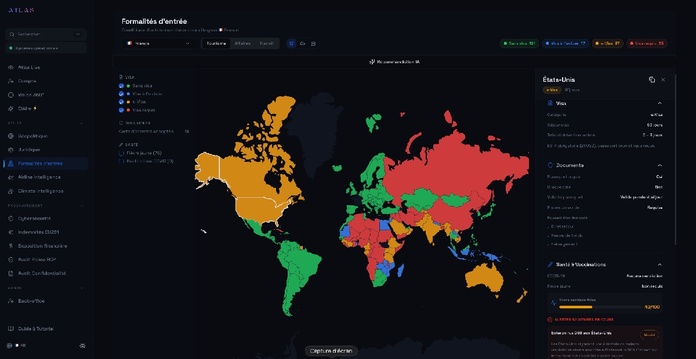
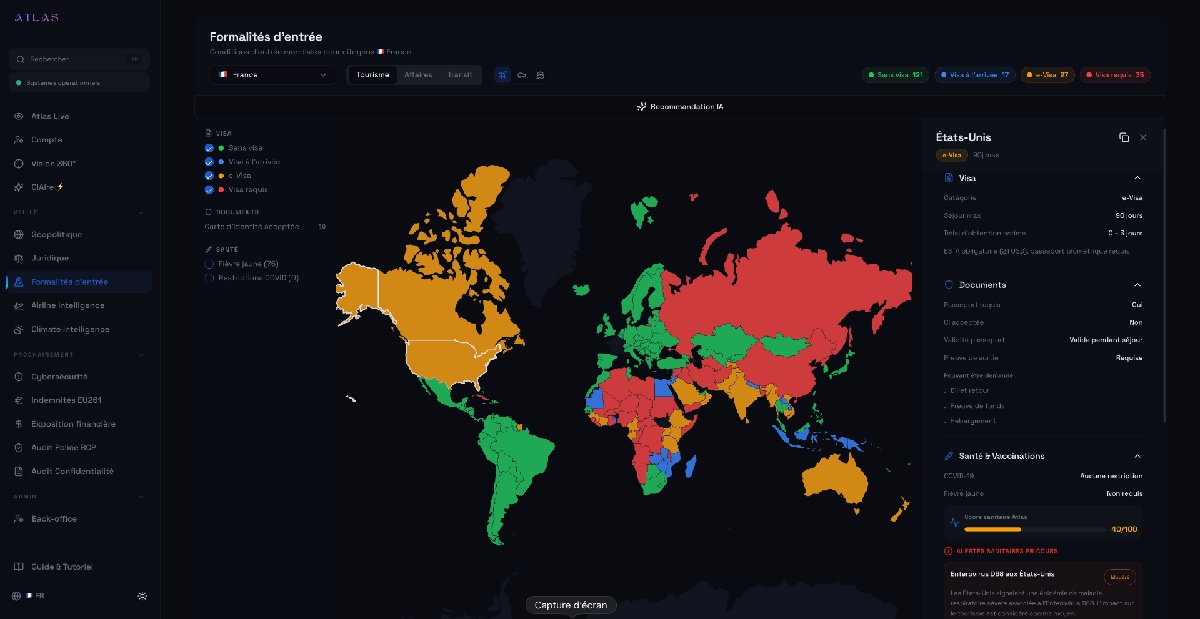
La plateforme intègre également un module dédié aux formalités d’entrée, avec des informations actualisées sur les exigences de visas, passeports, conditions sanitaires ou encore réglementations douanières selon les destinations et les nationalités des voyageurs. - Photo AtlasProtect.io

AtlasProtect.io is thus organized into eight modules.

Alongside the Global Tourism Risk Index, which allows scoring 195 countries based on dozens of criteria (security, political stability, health, climate…), users will notably access geopolitical monitoring and legal watch.

The platform also integrates a module dedicated to entry formalities, with up-to-date information on visa and passport requirements, health conditions, and customs regulations depending on destinations and travelers’ nationalities.

Another facet is devoted to tracking transport disruptions. The solution aggregates data on delays, cancellations or incidents affecting airlines, but also some rail or maritime networks.

Professionals can also benefit from an AI assistant named Claire, designed to answer the most frequent questions, especially regarding cancellations, exceptional circumstances, or information and advisory obligations. “This AI agent was created from my legal analyses and interpretation of various jurisprudences,” explains Chloé Rezlan, who ensures the reliability of her tool.

A module also enables climate risk analysis, with monitoring of extreme weather events and certain phenomena likely to impact tourism operations.

Alongside these tools, contract analysis and a review of the terms and conditions are also offered to identify risky clauses, liability gaps, or potential regulatory non-compliances.


The platform also offers traveler geolocation features through a dedicated mobile app, in a “duty of care” framework, allowing operators to track travelers who have activated the service and to send real-time alerts if an event occurs nearby.

This initiative comes amid growing regulatory pressure on travel distributors and producers, as several recent court decisions have underscored strengthened obligations to inform, advise, and remain vigilant for professionals in the sector.

An introductory price of 199 euros excluding VAT per month, with no long-term commitment.