7 Practical Ways to Reduce Your Carbon Footprint [ABO]


1. Start by measuring your carbon footprint


7 leviers concrets pour réduire son empreinte carbone - Depositphotos.com Studiostock

PONANT


Avant de définir un plan d’action, encore faut-il savoir d’où viennent les émissions. Un bilan carbone permet de distinguer celles liées au fonctionnement de l’entreprise de celles générées par les voyages vendus à ses clients.

For Jean-Christophe Guérin, who started reflecting on the topic after the Covid crisis, the first step is to establish a baseline. « When you step on the scale, it means that at some moment you take a snapshot and you need a number », he explains.

Inutile pour autant d’attendre de disposer de données parfaites pour commencer. « S’il n’y a pas de chiffre en face, ça ne marche pas. On peut se raconter ce qu’on veut », insiste le président d’ATR.

List the main emission sources, gather the available data, and identify areas of uncertainty. For a small organization, an initial estimate may be enough to start the process, with the possibility to refine it later. The aim is to understand where the most significant emissions lie.


2. Set concrete goals and track progress

<img src=”https://www.tourmag.com/my/tourmag/site/version2020/regie-video/pixel.png” width=”1″ height=”1″ style=”border:0px” id=”debloquage_article_abonnement”>Once the balance is established, it’s essential to prioritize. Trying to tackle every issue at once risks dispersing efforts. The company can begin with the highest-emitting areas, then set measurable objectives and a timeline.

Jean-Christophe Guérin thus worked from a reference year to track the evolution of his company’s emissions. He recommends watching the results over time and comparing them to economic activity.

« We need to give ourselves a zone for progress », he explains. For him, this approach should not be limited to a theoretical reduction of emissions: it should also help think about how the company will continue to create value.

Choose a few indicators to monitor regularly: emissions tied to the marketed trips, business travel, energy consumption, or the volume of printed materials. Define a reference year and set realistic targets for different milestones. A simple dashboard, regularly updated, is preferable to commitments that are hard to track.


3. Rethink trips, not just offices

For a professional who designs or sells travel experiences, the main lever isn’t necessarily inside their offices. It can also lie in how itineraries are built, how activities are selected, and how clients are advised.

Jean-Christophe Guérin cites the example of safaris in Africa sold under his Wild Life brand. The daily cost of parks often prompts travelers to limit their stay to a few days. His approach is to enrich the program with other experiences: local immersion, wildlife and flora discoveries outside the parks, meetings with NGOs, or cycling activities.

The objective is notably to encourage clients to extend their stay and to better discover the territory. « We look at the average length of stays by destination, and we target selling more days », he explains.

The rationale is also economic: having already flown long-haul, extending the stay can generate more value on site without adding a new international flight. The total impact, however, depends on transport, accommodation, and additional activities.

Practical advice: review catalog itineraries. Can unnecessary travel be limited, back-and-forth trips avoided, longer stops favored, or activities added that don’t require extra transport? The aim is to offer coherent stays, rather than adding experiences merely to show a responsible approach.


4. Change the travel habits of teams

Reconnaissance trips, business meetings, and commercial travels are part of the sector’s daily life. But their frequency and organization deserve scrutiny.

In his company, Jean-Christophe Guérin has notably revised the rules for reconnaissance trips. « I require that everyone can do one reconnaissance per year », he explains. He is also quite reserved about multi-day familiarization tours: « I don’t learn anything in four days. »

Conversely, when an employee is already traveling to a destination, prolonging their stay to work remotely can sometimes avoid a new trip later. The leader cites the case of a colleague who went on reconnaissance to Botswana, whom he prefers to keep longer on site to work remotely and enjoy the destination more.


6. Involve the teams in the process


7. Integrate the transition into the commercial strategy

Reducing your carbon footprint isn’t limited to a list of internal measures. For tour operators, agencies, and other travel professionals, the approach also questions the business model and the products offered in the medium term.

Jean-Christophe Guérin invites companies to project themselves five to ten years ahead. « Change isn’t for 2027 », he cautions, referring to 2035 and 2050 milestones. He believes it’s necessary to anticipate sector changes, especially those related to energy and fuel costs.

This reflection can also lead to gradually evolving the offer. Rather than sharply opposing two travel models, the company can test lower-emission itineraries, develop stays in France and Europe, or facilitate train travel when connections permit.

The ATR president also notes that professionals should not exclude travelers’ emissions from their consideration. « The question of a client’s plane ticket upon arrival at a destination must be included. Otherwise, we are looking the other way », he stresses regarding the carbon footprint of receptive operators.

A credible approach relies on concrete choices and tracked results, not just marketing arguments. Professionals who wish to embark on this path can reach out to ATR, which offers its members a carbon journey including a training webinar, a carbon assessment, and a reflection on emission reductions.


Retrouvez tous les articles de notre série “Agent Très Spécial – Le Guide Pratique du Pro” en cliquant sur ce lien.


Caroline Lelievre Published by Caroline Lelievre Journalist – TourMaG.com
See all articles by Caroline Lelievre

  • picto Twitter
  • picto Linkedin
  • picto email
Ajoutez TourMaG à votre flux Google Actualités Google Actualités icône

Hoteliers: How to Reduce Your Dependence on OTAs with Google Ads [ABO]


Google Ads amplifie ce qui existe, mais lancer des campagnes sans avoir réglé les fondations revient à payer pour envoyer du trafic vers une expérience qui ne convertit pas - DepositPhotos.com, bigtunaonline

CroisiEurope


OTAs charges range from 15% to 25% per booking.

Booking.com typically bills between 15% and 18%, but the effective commission can reach 25 to 30% when promotional visibility tools are activated simultaneously.

On 100 euros of revenue, a hotel that relies exclusively on OTAs pays back between 15% and 30% to platforms that do not know its clients, do not retain them for the hotel, and whose ranking rules evolve independently of its will.

Yet one must be honest about what OTAs bring. For a property at its launch phase, lacking notoriety or seeking to fill rooms in low season, they remain indispensable visibility channels. For a hotel without internal marketing resources or the ability to nurture a client base, they do this work for the property, at a high but predictable cost.

In 2025, the share of bookings via OTAs reached 63.4% of the independent lodging market (Elloha, March 2026), and 71% for tourist furnishings in 2024 vs 53% in 2019 (Etourisme.info, September 2025).

Aiming for a 50/50 mix is an ambitious yet attainable objective for an independent who commits to it, and building this autonomy gradually is a much more solid strategic decision than a abrupt break with platformss that continue to fill a useful role.


The demand is there, on Google


Source: google.com

57% of travelers begin their search for accommodation on Google before finalizing on Booking (RoomRaccoon / Google, 2026).


These prospects have dates, a rough budget and a real purchase intent, and they represent exactly the demand that a well-structured Google Ads campaign can capture upstream.

Direct-booking customers also tend to show higher average cart values and longer stays than those who go through OTAs (Prostay, January 2026), and unlike a Booking guest whose data cannot be used to commercially approach them for a future direct reservation due to the platform’s terms, a direct customer joins the property’s customer base and can be retained over time.


Non-negotiable prerequisites

Google Ads amplifies what already exists, and launching campaigns without having set the foundations is like paying to drive traffic to an experience that does not convert. Four conditions must be met:

– a fast and mobile-friendly website with a smooth booking journey ;

– an online booking engine that works with real-time rates and availability ;

– direct rates at least equal to OTA rates, because showing a higher price does not encourage changing habits ;

– a complete and well-rated Google Business listing, from which Google pulls the facilities, photos and reviews shown in its results.

One missing point is enough for the advertising budget to generate clicks that do not convert into bookings.


How Google Ads works for a hotel

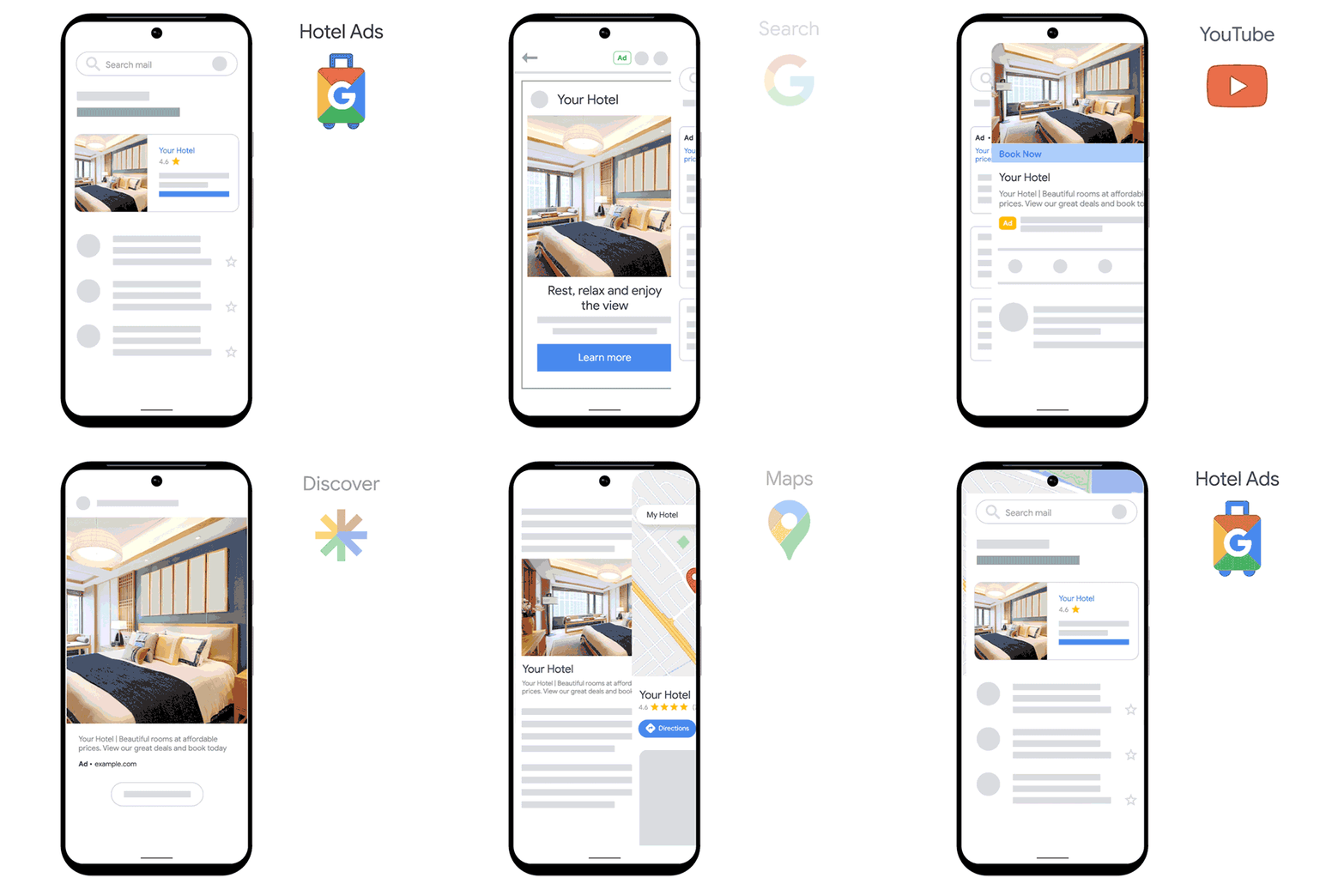
Two devices operate in parallel. Classic Search displays text ads when a traveler types “hotel [destination]” into Google, with a click that takes the prospect directly to the property’s site. This is the most direct lever to capture an intent to purchase as it occurs.

Google Hotel Ads displays your real-time rates and availability on Search, Maps and Google Travel, allowing the traveler to compare your price with OTAs before clicking to book on your site.

Google also offers free booking links, visible under paid ads, that generate additional traffic at no extra cost per click, provided you have a Hotel Center account, the interface that centralizes the property’s rates and availability, properly configured.

To activate this mechanism, the booking engine must be connected via a certified integration partner. The main compatible tools in France: D-EDGE, number 1 in Europe with more than 5,000 French hotels, SiteMinder, Mews, RoomRaccoon and Cloudbeds.

If you already work with one of them, the connection can in most cases be activated directly from your dashboard, without technical development.


The Budget and a Field Example


Meta or ChatGPT Ads in parallel: the brand-awareness lever

Google Search captures intent at the decision moment, Meta and ChatGPT Ads intervene upstream in the inspiration phase.

A well-crafted visual in retargeting of site visitors who did not book, or in prospecting audiences similar to existing clients, generates brand familiarity that directly improves the conversion rate of Search campaigns.

Both channels address different moments in the journey and reinforce each other rather than competing.


What a direct customer is really worth over time

The cost of acquiring a customer through Google Ads smooths out thanks to loyalty. A direct customer can be contacted again before their next season via email or newsletter and can rebook without additional advertising spend, as long as the establishment maintains this relationship over time.

Google Ads targets properties that have gathered the conditions to benefit from it: a high-performing site, a functional booking engine, competitive rates, a well-kept Google listing, and the ability to nurture a long-term customer relationship.

It is a lot of conditions, and it would be dishonest to deny it. But for those who meet them, every direct booking generated is a commission that stays with the establishment.


In Brief

– Between 15% and 30% commission per booking: this is what most independent hotels pay OTAs to fill their rooms.

– 57% of travelers begin their search for accommodation on Google before finalizing on Booking.

– Google Ads enables capturing this direct intent, at the exact moment it appears, and bringing the traveler back to your own booking engine.

– A Parisian property at €300 per night moved from 100% OTA to a mix of 60% Booking / 40% direct bookings in 6 months. This rebalancing has concrete prerequisites: a minimum of €2,000 per month, a performing site, competitive direct rates and a functional booking engine.


Sources

– Elloha.com – Dependency of independent accommodations on OTAs, March 2026

https://blog.elloha.com/2026/03/29/independants-pourquoi-votre-dependance-aux-otas-peut-encore-grimper-en-2026/

– Etourisme.info – Share of direct reservations for tourist furnished accommodations 2019-2024, September 2025

https://www.etourisme.info/se-dirige-t-on-vers-la-fin-de-la-reservation-directe-pour-les-hebergements-touristiques/

– Headsonpillows.com – OTA commissions: rates, costs and strategy 2026

https://headsonpillows.com/direct-booking-vs-ota/

– Prostay.com – Direct bookings vs OTAs: value per available room, January 2026

https://www.prostay.com/fr/blog/statistiques-sur-les-reservations-dhotels-2025-apercu-et-tendances-du-marche/

– RoomRaccoon.fr / Google – 57% of travelers start their search on Google

https://roomraccoon.fr/integrations/google-hotel-ads/


Photo : A. Houizot

Adrien Houizot is a Google Ads consultant who has specialized exclusively in the travel and tourism sector for eight years.

After having worked in several digital marketing agencies, he now supports B2C & B2B travel agencies, hoteliers and providers of tourist activities.

He is the founder of Monsieur Travel Marketing.


Tourism and Climate: 5 Practical Actions to Reduce Your Company’s Carbon Footprint [ABO]


Il faut vraiment voir la transition écologique comme un formidable levier d'innovation et d’adaptation - DepositPhotos.com, duiwoy

MSC Croisières


This summer, it’s hard to open a newspaper without encountering a climate-related story.

The megafires have devastated Gironde, fires have multiplied in several regions of France, water restrictions linked to a drought are taking hold for good… All these events remind us that climate change is no longer a distant scenario. It is already shaping our territories, our landscapes, and our tourist activities.

And as if that weren’t enough, July 2026 has become the hottest month ever recorded in France, after a June that was already historic!

Tourism is on the front line. It suffers directly from climate disruption: shaken seasons, closures of natural sites, tensions over water resources, evolving traveler expectations…

But it also contributes. According to the latest estimates from the Service des données et études statistiques (SDES), the carbon footprint of tourism consumption in France reached 75 million tonnes of CO₂e in 2023.

Movements alone account for 65% of this footprint, making it by far the primary lever of action for the sector.

The think tank The Shift Project also notes that 85% of the distances traveled by the French for their trips still rely on fossil fuels. A finding that shows the scale of the challenge… but also the numerous opportunities for innovation for the sector!

So, faced with these figures, what do we do? Where to begin? First good news: reducing your carbon footprint does not mean giving up travel. No, it’s mostly about rethinking certain practices.

And second good news: not all actions have the same impact. The goal isn’t to change everything at once, but to focus your efforts on the emission sources that matter most. And for that you will need to calculate your carbon footprint!


Measuring to Act More Effectively

Reducing your carbon footprint without a metric is a bit like hiking without a map: you move forward, but it’s hard to know if you’re heading in the right direction.

Tools such as the Bilan Carbone® (created in 2004 by ADEME and carried since 2011 by ABC, the Association for the Low-Carbon Transition), or the GHG Protocol help identify the main emission sources and set action priorities.

Expect not to obtain a perfectly precise figure. The carbon footprint assessment is mainly about understanding where the largest impacts lie so you can invest your time and resources where they will be truly useful.

And now that you have a solid starting point, we can really begin!


1. Act on mobility, the first lever of decarbonization

Unsurprisingly, transport represents the main emission source in tourism.

For many, this is where the biggest gains lie. Of course, a hotel or a travel agency doesn’t always choose the transportation mode for their clients. However, they can influence their decisions.

Some action options :

– highlight train itineraries during the booking process

– offer discounts or benefits to travelers arriving by soft mobility

– develop partnerships with public transport networks or bicycle rental operators

– install charging stations for electric vehicles

– encourage business trips by train whenever possible.

Internally, we can also rethink staff travel through carpooling, a sustainable mobility allowance, or telework when missions allow.

The goal here is not to ban flying or driving, but to offer more alternatives and to make the leaner choices easier and more attractive!


2. Reduce energy consumption in buildings

Hotels, restaurants, campsites, holiday residences, or visitor sites: buildings also account for a substantial share of greenhouse gas emissions.

Good news: many actions can reduce both the carbon footprint AND energy bills at the same time!

Among the most effective levers :

– gradually replacing lighting with LEDs

– improving thermal insulation

– optimizing heating and cooling systems

– installing occupancy sensors in common areas

– regularly monitoring energy consumption to identify drifts.

The most significant investments can be integrated into an energetic renovation strategy over several years. Again, the key is to progress step by step.


4. Buy differently


5. And finally, never forget the digital realm!

Online booking, marketing campaigns, websites, social networks, artificial intelligence… digital technology has become essential in our daily lives and for work.

Unfortunately, because digital isn’t something tangible, its environmental impact is still largely unknown.

Without giving up (of course) on digital tools, it’s possible to adopt a more restrained approach :

– lighten your website and remove unnecessary content

– limit video on your site and on social networks

– extend the life of IT equipment

– limit the storage of superfluous data

– use AI tools when relevant, prioritizing high-value uses.

To learn more about the environmental impact of digital technology, especially AI, I recommend the article “Artificial Intelligence: The Real Environmental Cost of the AI Race” by Bon Pote, and participating in or organizing workshops like The Fresque du Numérique and The Battle of AI.


Bonus idea: getting certified to accelerate your transition

When a company wants to structure its environmental approach, a question sometimes arises: should we aim for a label? The answer is usually yes… provided you don’t treat the label as an end in itself.

A label is not intended to “greenwash” a company. Its real value lies elsewhere: it helps to structure the approach, set objectives, measure progress, and commit to continuous improvement.

For tourism professionals, it also serves as a trust signal to travelers, partners, and employees.

Depending on your activity, several frameworks can guide you :

– La Clef Verte is today the leading international environmental label dedicated to tourist accommodations and restaurants ;

– for tour operators, the ATR label – Acting for Responsible Tourism – highlights agencies committed to a demanding approach to environmental, social, and economic responsibility ;

– companies with an international presence can also look to Travelife, recognized in the sector ;

– you can also rely on cross-cutting standards such as ISO 14001, Engaged CSR (AFNOR) or B Corp, which help structure a global sustainability strategy.

Whatever standard you choose, the essential remains the same: use the label as a tool for progression, not as a mere showcase.

Finally, don’t forget a crucial factor: the people. Raise awareness among your employees and your travelers!

You can find some tips in two previous articles: “10 essential awareness workshops in tourism” and “Responsible travel: how to engage without guilt?”


Reducing Your Carbon Footprint: An Opportunity to Reinvent Tourism

For a long time, ecological transition was seen as a sequence of constraints: new regulations, investments, changes in habits…

Today, it’s essential to view it as a formidable lever of innovation and adaptation.

Of course, reducing your carbon footprint helps limit your impact on the climate. But it’s also an opportunity to control energy consumption, strengthen ties with local actors, offer more authentic experiences, and meet the expectations of a clientele that is increasingly attentive to these issues.

And no, reducing your carbon footprint does not mean doing less tourism. It’s about tourism that is more resilient, leaner, and more desirable.

Each company will progress at its own pace. What matters is to start, to measure progress, and to keep learning.

As always, the best low-carbon strategy is not the one that promises perfection, but the one that becomes a durable part of the company’s daily life!


Key takeaways for tourism professionals

– start by identifying your main emission sources before multiplying actions.

– transport, energy, food, purchases, and digital are the main levers for reduction.

– training your teams is essential to sustainably transform practices.

– support your travelers with simple and positive solutions rather than guilt-inducing messages.

– CSR labels provide an excellent framework to structure your approach and showcase your commitments.

– the low-carbon transition is not only a response to climate change: it’s also an opportunity to strengthen resilience, attractiveness, and competitiveness of your business.


Find all articles by Camille Le Guilloux by clicking here.


Camille Le Guilloux - DR

Expert in Responsible Marketing, Camille Le Guilloux is on a mission to inspire, equip, and guide companies toward more ethical and sustainable marketing practices.

Having become an impact-driven infopreneur and facilitator of various CSR awareness workshops (Climate Fresk, 2 Tons Workshop, Ocean Fresk, Fresk of the New Narratives), she now helps businesses and business-school students implement effective and responsible strategies.

Website: www.kerezenn.com