
Hoteliers: How to Reduce Your Dependence on OTAs with Google Ads [ABO]


Google Ads amplifie ce qui existe, mais lancer des campagnes sans avoir réglé les fondations revient à payer pour envoyer du trafic vers une expérience qui ne convertit pas - DepositPhotos.com, bigtunaonline

CroisiEurope


OTAs charges range from 15% to 25% per booking.

Booking.com typically bills between 15% and 18%, but the effective commission can reach 25 to 30% when promotional visibility tools are activated simultaneously.

On 100 euros of revenue, a hotel that relies exclusively on OTAs pays back between 15% and 30% to platforms that do not know its clients, do not retain them for the hotel, and whose ranking rules evolve independently of its will.

Yet one must be honest about what OTAs bring. For a property at its launch phase, lacking notoriety or seeking to fill rooms in low season, they remain indispensable visibility channels. For a hotel without internal marketing resources or the ability to nurture a client base, they do this work for the property, at a high but predictable cost.

In 2025, the share of bookings via OTAs reached 63.4% of the independent lodging market (Elloha, March 2026), and 71% for tourist furnishings in 2024 vs 53% in 2019 (Etourisme.info, September 2025).

Aiming for a 50/50 mix is an ambitious yet attainable objective for an independent who commits to it, and building this autonomy gradually is a much more solid strategic decision than a abrupt break with platformss that continue to fill a useful role.


The demand is there, on Google

Source: google.com

57% of travelers begin their search for accommodation on Google before finalizing on Booking (RoomRaccoon / Google, 2026).

These prospects have dates, a rough budget and a real purchase intent, and they represent exactly the demand that a well-structured Google Ads campaign can capture upstream.

Direct-booking customers also tend to show higher average cart values and longer stays than those who go through OTAs (Prostay, January 2026), and unlike a Booking guest whose data cannot be used to commercially approach them for a future direct reservation due to the platform’s terms, a direct customer joins the property’s customer base and can be retained over time.


Non-negotiable prerequisites

Google Ads amplifies what already exists, and launching campaigns without having set the foundations is like paying to drive traffic to an experience that does not convert. Four conditions must be met:

– a fast and mobile-friendly website with a smooth booking journey ;

– an online booking engine that works with real-time rates and availability ;

– direct rates at least equal to OTA rates, because showing a higher price does not encourage changing habits ;

– a complete and well-rated Google Business listing, from which Google pulls the facilities, photos and reviews shown in its results.

One missing point is enough for the advertising budget to generate clicks that do not convert into bookings.


How Google Ads works for a hotel

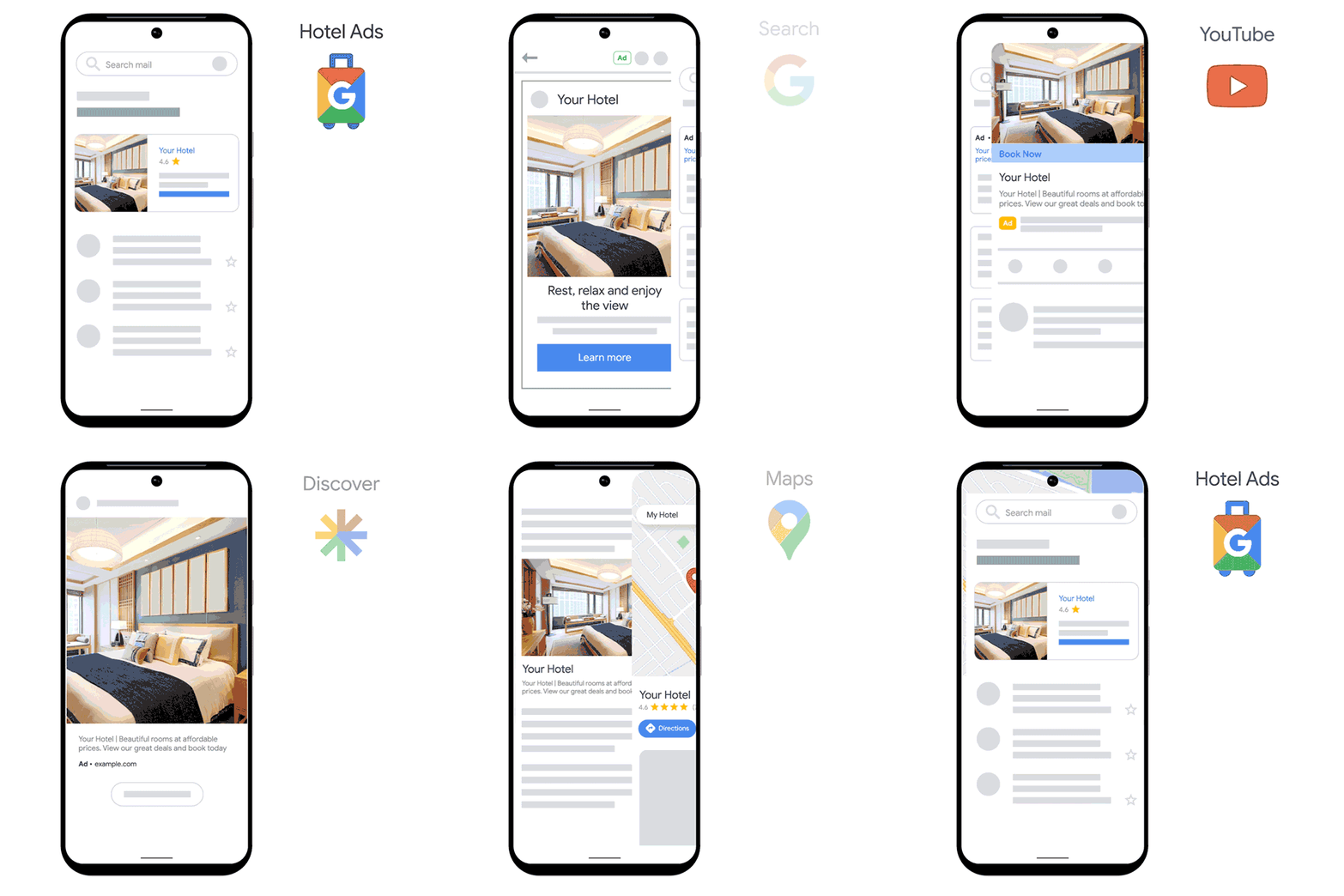
Two devices operate in parallel. Classic Search displays text ads when a traveler types “hotel [destination]” into Google, with a click that takes the prospect directly to the property’s site. This is the most direct lever to capture an intent to purchase as it occurs.

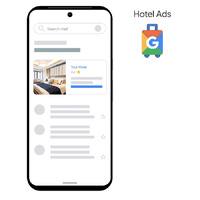
Google Hotel Ads displays your real-time rates and availability on Search, Maps and Google Travel, allowing the traveler to compare your price with OTAs before clicking to book on your site.

Google also offers free booking links, visible under paid ads, that generate additional traffic at no extra cost per click, provided you have a Hotel Center account, the interface that centralizes the property’s rates and availability, properly configured.

To activate this mechanism, the booking engine must be connected via a certified integration partner. The main compatible tools in France: D-EDGE, number 1 in Europe with more than 5,000 French hotels, SiteMinder, Mews, RoomRaccoon and Cloudbeds.

If you already work with one of them, the connection can in most cases be activated directly from your dashboard, without technical development.


The Budget and a Field Example


Meta or ChatGPT Ads in parallel: the brand-awareness lever

Google Search captures intent at the decision moment, Meta and ChatGPT Ads intervene upstream in the inspiration phase.

A well-crafted visual in retargeting of site visitors who did not book, or in prospecting audiences similar to existing clients, generates brand familiarity that directly improves the conversion rate of Search campaigns.

Both channels address different moments in the journey and reinforce each other rather than competing.


What a direct customer is really worth over time

The cost of acquiring a customer through Google Ads smooths out thanks to loyalty. A direct customer can be contacted again before their next season via email or newsletter and can rebook without additional advertising spend, as long as the establishment maintains this relationship over time.

Google Ads targets properties that have gathered the conditions to benefit from it: a high-performing site, a functional booking engine, competitive rates, a well-kept Google listing, and the ability to nurture a long-term customer relationship.

It is a lot of conditions, and it would be dishonest to deny it. But for those who meet them, every direct booking generated is a commission that stays with the establishment.


In Brief

– Between 15% and 30% commission per booking: this is what most independent hotels pay OTAs to fill their rooms.

– 57% of travelers begin their search for accommodation on Google before finalizing on Booking.

– Google Ads enables capturing this direct intent, at the exact moment it appears, and bringing the traveler back to your own booking engine.

– A Parisian property at €300 per night moved from 100% OTA to a mix of 60% Booking / 40% direct bookings in 6 months. This rebalancing has concrete prerequisites: a minimum of €2,000 per month, a performing site, competitive direct rates and a functional booking engine.


Sources

– Elloha.com – Dependency of independent accommodations on OTAs, March 2026

https://blog.elloha.com/2026/03/29/independants-pourquoi-votre-dependance-aux-otas-peut-encore-grimper-en-2026/

– Etourisme.info – Share of direct reservations for tourist furnished accommodations 2019-2024, September 2025

https://www.etourisme.info/se-dirige-t-on-vers-la-fin-de-la-reservation-directe-pour-les-hebergements-touristiques/

– Headsonpillows.com – OTA commissions: rates, costs and strategy 2026

https://headsonpillows.com/direct-booking-vs-ota/

– Prostay.com – Direct bookings vs OTAs: value per available room, January 2026

https://www.prostay.com/fr/blog/statistiques-sur-les-reservations-dhotels-2025-apercu-et-tendances-du-marche/

– RoomRaccoon.fr / Google – 57% of travelers start their search on Google

https://roomraccoon.fr/integrations/google-hotel-ads/



Photo : A. Houizot

Adrien Houizot is a Google Ads consultant who has specialized exclusively in the travel and tourism sector for eight years.

After having worked in several digital marketing agencies, he now supports B2C & B2B travel agencies, hoteliers and providers of tourist activities.

He is the founder of Monsieur Travel Marketing.


Fake Google Maps Reviews: Why Google Says It’s Impossible to Verify Them All

“It’s impossible”: dragged before a Burgundy court by a guesthouse victim of “fake” reviews from people who hadn’t actually tested its services, Google said on Monday “does not have the means” to verify the comments.

“Google does not verify (reviews, ed.). It’s impossible. Google has no reliable way to determine whether someone used the services” of the rated establishment, argued Sébastien Proust, a lawyer for the American giant, before the Chalon-sur-Saône court (Saône-et-Loire).

Negative reviews posted by internet users who had never stayed at the château

The world’s leading internet company was being sued civilly by a two-room guesthouse housed in the small Château de Balleure, in the hamlet of Etrigny, which has been fighting this battle for eight years. In 2018 and then in 2020, the château received two harsh ratings on Google Maps. “The impact was substantial”, recalls Raoul Salama, the owner. “A 10% drop in a rating translates to a 30% drop in revenue”, he says.

It filed lawsuits to compel Google to disclose the names, which the Dijon Court of Appeal ordered on June 21, 2022. When contacted, the fake customers admitted they had never used the château’s services. In fact, they were passing nearby and received a Google Maps push notification inviting them to rate the château, but not asking whether they had visited it. A cyclist or hiker passing near the château thus appears among the 17 contested reviews.

“Why not?” replied Google’s lawyer. “Contributors can just as well rate a monument encountered during a hike. It isn’t a fake review because these are real people who wanted to rate it”, he asserts.

Google invokes freedom of expression to justify its limits on moderation

Anyway, checking all the reviews would require Google to expend a “considerable energy” and “all poorly rated professionals would demand the removal of negative reviews. It would kill the reviews”, to the detriment of “freedom of expression”, argues Me Proust, who labels the phenomenon as “marginal”.

Asked by AFP, American Kay Dean, a former federal investigator turned expert in internet fraud, described the problem as “massive”.

“In 2025, Google itself said it had removed 292 million fake reviews. According to CQ Researcher (an American publication of reference analyses, ed.), up to 45% of internet comments are considered to come from people who have not tried a product or service”, she adds from the United States.

“These fake reviews are a scourge”, stressed the château de Balleure’s lawyer, Frédéric Hopgood. “We mislead the consumer. Beyond the château, it affects all businesses”, he added. “Google took 43 months for one, and 39 months for the other”, to remove the first two contentious reviews, in 2018 and 2020, he notes.

However, the French Law on Confidence in the Digital Economy (LCEN), which transposes a European directive, requires the illicit review to be removed “promptly”. And, since then, they have reappeared, along with about fifteen others.

Google has indeed put in place a procedure to verify reviews, but through artificial intelligence.

Yet the behemoth Google is “overwhelmed” by the phenomenon, according to the lawyer, who instead calls for a check by “a human moderator”, as TripAdvisor and Booking have done after abandoning AI for this kind of control.

More than laxity, it is a strategy Google has implemented, accuses Me Hopgood: “This is a deliberate intent: clicks on real or fake reviews drive Google’s economy”.

The ruling has been reserved for January 12.

Navan, Spain, Google: What’s New in Travel This Week


La revue de presse internationale de la semaine - Depositphotos.com Auteur serezniy

CroisiEurope


The contents of the press review for the week of September 7, 2026 :

EES: the travel sector calls for more flexibility from the EU

Navan buys BoomPop to strengthen its corporate events

Google tightens its travel engine in Europe

Trip.Gourmet unveils its 2027 global restaurant rankings

American event professionals defend technological innovation

Spain: number of travel agencies grows by 8.3%

EU: local authorities could harden rules on short-term rentals

Banks surpass travel players in loyalty

Odd! “Lake America”: the great tourism flop of Lake Ontario?


EES: the travel sector calls for more flexibility from the EU

The deployment of the European Entry/Exit System (EES) continues to draw criticism after a summer marked by queues of up to five hours at several European airports.

As the flexibility measures ended on September 6, travel professionals fear new bottlenecks and are calling for their extension, with some even urging to push the deadline to April 2027.

An article from euronews.com


Navan buys BoomPop to strengthen corporate events


Navan rachète l’acteur du MICE BoomPop. @depositphotos/T.Schneider

Navan, a business travel platform, announces the acquisition of BoomPop, an AI-powered specialist in meetings and corporate events.

The operation enables Navan to integrate meeting and event expenditures into its travel booking and expense management platform. The amount of the acquisition was not disclosed.

An info from skift.com


Google tightens its travel engine in Europe


Google restreint son moteur de recherche dédié aux vols et aux hôtels en Europe.@depositphotos/prykhodov

To comply with the Digital Markets Act (DMA) and avoid further penalties, Google is modifying certain features of its flight and hotel search engine in Europe.

The group acknowledges that these changes worsen the user experience for European users and could favor platforms such as Booking and Expedia.

Read on hosteltur.com


Trip.Gourmet unveils its 2027 global restaurant rankings


Trip.Gourmet, la marque gastronomique de Trip.com, dévoile son palmarès mondial des restaurants. @depositphotos/MamunSheikh

Trip.Gourmet, the gastronomy brand of Trip.com, unveils its 2027 ranking with 744 restaurants spread across 105 cities and 40 countries and regions.

Asia-Pacific accounts for nearly two-thirds of the highlighted establishments, while Paris and London are among the leading European cities.

Trip.Gourmet also strengthens its reservation offering, with 43,600 restaurants available for booking worldwide.

An info from traveldailynews.com


Spain: number of travel agencies grows by 8.3%


EU: local authorities could tighten rules on short-term rentals


L’UE pourrait permettre aux collectivités de restreindre les locations de courte durée. @depositphotos/rfaizal707

A European regulation proposal would give regions and municipalities more latitude to restrict short-term tourist rentals in areas facing strong housing pressures.

Restrictions could cover the number of rentals, new authorizations, or the maximum annual nights.

Source: ttgitalia.com


Banks outrank travel players in loyalty


Les cartes bancaires et programmes de fidélité des banques plébiscités par les voyageurs. @depositphotos/Valentyn_Volkov

Bank cards and loyalty programs offered by banks now top the list of programs deemed most advantageous by travelers, according to Skift Research’s Global Travel Insights.

They appeal to 32% of respondents, ahead of hotels and airlines. Online travel agencies (OTAs) trail with only 8% of votes.

Read on skift.com


Insolite ! « Lake America » : the great tourism flop of Lake Ontario?


Apple affiche désormais le lac Ontario sous le nom de « Lake America » pour les utilisateurs américains de Plans, après une décision de Donald Trump liée à son conflit commercial avec le Canada. @depositphotos/elenathewise

Renaming Lake Ontario to “Lake America” would it have triggered a tourist wave? Not really, according to hotels, tourism offices and sites surveyed by Travel Weekly, which found no influx of visitors.

Worse, Chimney Bluffs Park even recorded a slight drop in attendance. Meanwhile, American tourism continues to suffer from the decline of Canadian visitors… and the Trump administration’s tourism envoy has yet to provide his famous figures.

A story to read on travelweekly.com

Google Reduces Some Travel Search Features in Europe


Google réduit certaines fonctionnalités de recherche voyage en Europe - Depositphotos.com Auteur GekaSkr

Climats du Monde


Google began rolling out, from September 8, 2026, new search results pages in Europe to comply with the Digital Markets Act (DMA). This development particularly affects searches related to hotels, flights and transportation.

Google is revising the visibility accorded to its services such as Google Shopping, Google Flights and Google Hotels, which had been privileged in the results compared to rivals.

The American group now foregrounds an aggregation unit aimed at online travel agencies, comparison engines and meta-searches, alongside a unit dedicated to direct suppliers. Eligible aggregators can thus display their results, including photos, prices and information about the establishments.

In parallel, some features are reduced. According to Reuters, the new results feature modules with fewer details, and real-time prices are no longer shown in certain carousels.

Google says these changes degrade the user experience and could favor comparison sites like Booking.com or Expedia at the expense of companies that only have a direct link.


This evolution comes after the €460 million fine imposed on Google in July by the European Commission for favoring its own services in search results. The group had 60 days to comply, under penalties that could reach up to 5% of its daily worldwide turnover.

Google says its previous DMA adaptations have already led to a 30% drop in free and direct traffic to European businesses.

Over nearly twenty years, Google has racked up €10.38 billion in antitrust fines in the EU, according to Reuters.

Google Search Trends: What Travel Agencies Should Anticipate in 2027 [ABO]


La vraie question pour une agence de voyages en 2026 : êtes-vous présent à chaque étape du parcours de votre prospect, ou seulement à la dernière ? - DepositPhotos.com, Y-Boychenko

CroisiEurope


Your traveler will pass through Google, sooner or later. The platform accounts for more than 93% of online searches in France (StatCounter, 2025) and handles about 14 billion queries per day worldwide (SparkToro, 2025).

But reducing Google to a search engine in 2026 greatly underestimates what you are dealing with.

Sophie is searching for her trip to Brazil on Google Search, but she also watches inspirational videos on YouTube, checks itineraries on Google Maps, encounters content in her Discover feed between search sessions, and receives emails in Gmail.

Google is a complete ecosystem of touchpoints, each corresponding to a different stage of a traveler’s decision journey.

Conversational AI platforms, despite the media buzz they generate, accounted for 0.16% of total internet traffic in France in 2025 (SE Ranking, 2025).

OpenAI projects $14 billion in losses in 2026 despite $13 billion in revenue, no advertising format exists in these tools to date, and AI Overviews are not deployed in France.

Google, on the other hand, remains profitable and keeps the user within its ecosystem. Sophie might use ChatGPT in week 1 for inspiration. In week 6, when she’s looking for a reliable agency, she returns to Google.

Google is evolving, though. Short search queries of 1 to 2 words, which represented 42% of searches in January 2025, dropped to 31% by June (Kartic Ahuja, 2025).

Where a traveler used to type “Brazil circuit” in 2018, today they type “Brazil family circuit 2 kids 15 days February.” For an agency whose campaigns target only generic keywords, a growing share of qualified demand escapes them each month.


The real journey of a traveler: Sophie wants to travel to Brazil

Sophie is 38 years old, she lives in Lyon, she has 2 children. She has dreamed of Brazil for several years.

This Monday evening, lying on the sofa after putting the kids to bed, she picks up her phone and types “family Brazil trip February” into Google. She has no intention of booking tonight. She just wants to begin to see, to feel, to imagine.

Week 1. She explores. She watches YouTube videos about Rio and the Amazon, reads blogs from traveling families, accumulates references. She broadens her consideration universe without yet comparing or choosing. This is where SEO plays its role: if your agency publishes expert content about Brazil for families, Sophie may find you before she even thinks of looking for an agency. It’s the discovery lever.

Week 3. Her queries change in nature. “Family Brazil trip” becomes “Brazil circuit 15 days Rio Iguazu Amazon” then “Brazil family travel agency specialist.” She compares itineraries, eliminates options, tightens her criteria. She evaluates. Google Performance Max comes into play: automatically broadcasting your ads on all Google surfaces—Search, YouTube, Gmail, Maps, Discover and Display—it tracks Sophie as she moves across platforms and keeps your presence at every step of her thinking. It’s the lever of coverage and repetition.

Week 6. She looks for proof. “Reviews of Brazil family travel agency,” “testimonials: Brazil circuit with kids.” She reads your Google reviews, checks your Trustpilot page, opens your About page. She wants to know to whom she will entrust two weeks of family life and a budget of 12,000 euros. According to the study “Decoding Decisions” (Google / The Behavioural Architects, 31,000 real buyers), 70% of purchase decisions are influenced by factors other than price, with social proof at the top. Your customer reviews are at this stage as important as your ads. It’s the lever of reassurance.

Week 8. She types your exact name into Google. She already knows you, one way or another. Google Search captures this final intention with precision: it is the decision lever, the one most directly linked to the booking. And if she had filled out a form but didn’t finish during a previous visit, a well-targeted email could have helped bring her back. It’s the lever of the relationship over time.

“The Power of Travel 2050”, published in January 2026 by Google and Alvarez & Marsal based on billions of queries, documents this cycle: 60 to 90 days between the first search and final booking for high-value circuits.

According to Google Consumer Insights, the traveler consults an average of 38 digital sources before contacting a provider. A prospect must be exposed to a brand’s message at least 7 times before making a purchase decision (Braithwaite Communications, 2025).

Between Week 1 and Week 8, Sophie encountered several agencies. Some were present only at the final decision moment. Others had seeded touchpoints throughout her 60 days of reflection. And it is precisely toward those agencies that she sent her quotation request.

Five levers allow you to build this presence, without starting everything at once: Google Search and customer reviews first, Performance Max, then SEO and email, at the pace of your growth.


What 2026 behaviors signal for 2027 and beyond

The trends documented in this article outline a clear trajectory. Here is what a travel agency should anticipate now:

1. Tracking and data have become foundations, not options. With the gradual end of third-party cookies, agencies that have built a solid customer database—emails, on-site behaviors, booking history—will have a durable edge over competitors. A reliable measurement system is the prerequisite for any serious advertising decision.

2. AI agents will enter travel planning. Google and others are developing assistants capable of designing a complete itinerary from expressed preferences. Well-ranked, well-rated, and well-documented agencies on their destinations will be the ones these agents recommend first. That said, no algorithm will replace the judgment of an experienced travel advisor, their ability to detect what a client doesn’t yet know how to express, nor the legal guarantee and human support offered by a licensed agency in case of contingencies. AI helps to discover. The agency protects, advises, and reassures.


3. Personalization of ads will accelerate. Google possesses highly granular behavioral data. Agencies that properly feed their campaigns with their own customer data will achieve increasingly precise targeting, and acquisition costs will mechanically drop.

4. The decision cycle will shorten for strong brands. Experienced travelers decide faster when they trust. An agency with a clear brand, solid reviews, and visible destination expertise does not need 60 days to convince Sophie. She needs 20.

5. Video and UGC (User Generated Content) will become standalone acquisition levers. YouTube Shorts and immersive video formats are advancing in search and inspiration behaviors. Beyond formats, it is the authentic stories of travelers that will make the difference: a client who shares their Brazil experience in video, in a story, in a detailed review, is worth more than any studio-produced advertisement.

6. The true competitive advantage of a travel agency remains the human touch. Quality service, a well-constructed offer, a personalized experience and the ability to spread it by those who have lived it: this is where loyalty and digital word-of-mouth are built. Robert Cialdini demonstrated this with social proof; Dale Carnegie with the art of building lasting relationships: people decide with emotion before justifying with reason. Travel is a 100% emotional experience. Agencies that succeed in getting their travelers to speak, to collect UGC, to transform every satisfied client into an ambassador, build something no algorithm can buy.

Also read: Travel agencies: how much to invest in Google Ads to acquire a customer in 2026?


In brief

– Google accounts for more than 93% of online searches in France and processes about 14 billion queries per day worldwide.

– Your prospects’ search habits have evolved dramatically: searches are longer, more precise, and a traveler’s journey before requesting a quote now spans 60 to 90 days and multiple channels.

– Conversational AI tools are getting a lot of attention, but still represent only 0.16% of total internet traffic in France (SE Ranking, 2025).

– The fundamentals of Google Ads remain solid.

– The real question for a travel agency in 2026: are you present at every stage of your prospect’s journey, or only at the last one?