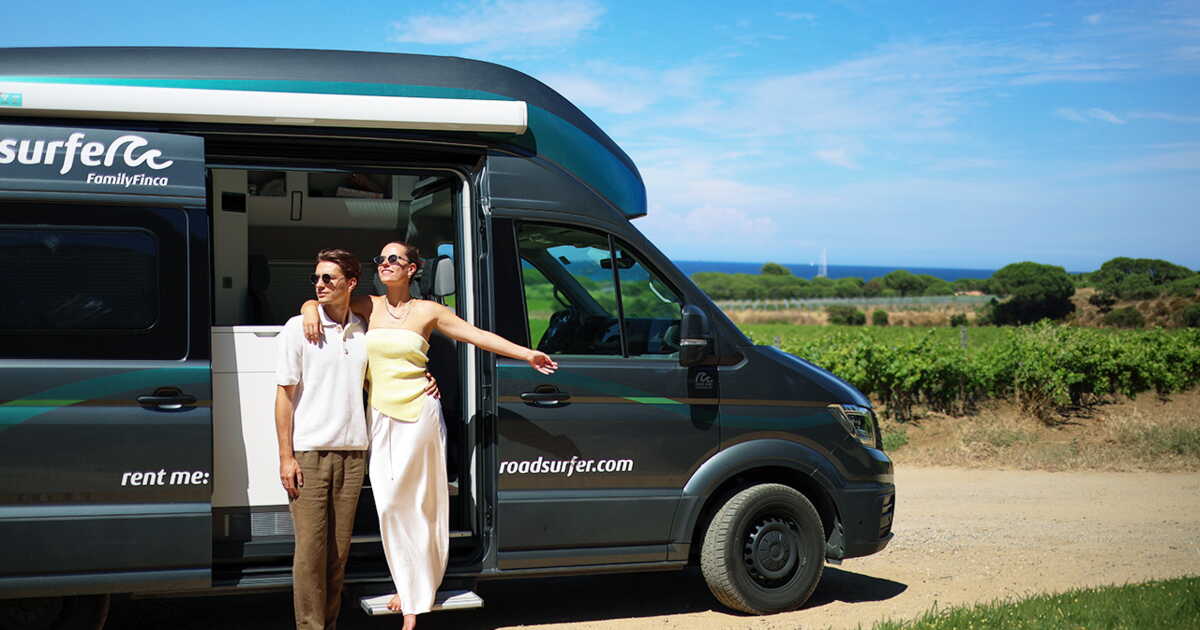
What if the best trips were ultimately those we hadn’t really planned? As spring’s long weekends approach and summer holidays loom, more and more travelers are ditching ultra-planned stays in favor of more spontaneous getaways. This is where renting a converted van, or a motorhome, emerges as the ideal solution for vacationers seeking freedom, flexibility and adventure.
In this rapidly expanding world of nomadic travel, roadsurfer has established itself as the global leader in van-based journeys. Founded in 2016 in Munich, the company now counts over 10,000 vehicles distributed across nearly 100 agencies in 16 countries. Compact vans, converted campervans, or family motorhomes: the brand offers a modern, fully equipped fleet designed to simplify last-minute departures. With unlimited kilometers and a spontaneity-driven approach, roadsurfer presents a new way of traveling, where the destination matters less than the freedom to hit the road whenever the urge arises.
The spontaneous road trip for travellers seeking freedom
Setting off without a fixed program, adjusting the route according to the weather, or extending a stop by the ocean: the road trip answers a growing desire for flexibility. In recent years, travel has transformed. Holidaymakers now seek freer experiences that can adapt to their momentary wishes.
Renting a converted van fits perfectly with this trend. In just a few clicks, you can book a equipped vehicle and hit the road a few hours later. An ideal solution for off-the-cly weekend getaways as well as last-minute summer holidays.
roadsurfer has precisely built its offering around this spontaneity. The brand relies on recent, comfortable and fully equipped vehicles, with unlimited kilometers to travel without constraint. Compact vans for a duo getaway, converted vans for several weeks on European roads, or family motorhomes — each traveler profile can find the model suited to their adventure.
To simplify organization even further, the platform also offers detailed practical sheets to help travelers choose the vehicle that matches their project. A surfing weekend on the Basque coast, a crossing of the Alps, or an improvised loop through Tuscany do not require the same needs. roadsurfer thus turns motorhome rental into a simple, fluid, and immediately accessible experience.
Offices across France and Europe for last-minute departures
One of roadsurfer’s major advantages lies in its wide network of agencies, designed to facilitate spontaneous departures. In France, travellers can pick up their vehicle near major cities and airports: Paris, Lyon, Aix-Marseille, Bordeaux, Nantes, Toulouse, Lille, Nice or Strasbourg are among the main starting bases. The Geneva agency, located in the Pays de Gex, also makes a quick escape to Switzerland or the Italian Alps feasible.
This strategic presence greatly simplifies last-minute departures. Quick spell of good weather forecast ahead? A long weekend on the horizon? It is enough to book a vehicle and head toward the destination of choice.
All of Europe becomes a playable field. Thanks to the numerous roadsurfer agencies across the continent, travelers can easily imagine a road trip spanning several countries: along the Portuguese coast, exploring the Scandinavian fjords, crossing the Dolomites, or sleeping by Croatian lakes. This improvisational freedom is now one of the main attractions of renting a converted van.
roadsurfer spots: the platform that makes spontaneous wandering easier
To improvise a road trip also means being able to easily find where to sleep. It is precisely to answer this new way of traveling that roadsurfer developed roadsurfer spots, a platform for booking unusual sites across Europe.
The concept is increasingly appealing to nomadic travel enthusiasts: spontaneously booking a unique spot at a farm, a winery, a natural space, or with a private individual, often close to preserved landscapes. Available notably in France, Germany, Italy and Spain, the platform makes it easy to combine itinerancy and lodging without having to plan every step weeks in advance.
This approach reinforces the sense of freedom that accompanies motorhome rental and van rental. A sunset facing the Atlantic, a night amid Italian vineyards, or a wake-up in front of Austrian mountains can now be improvised on the fly of the journey.
More than just a vehicle rental company, roadsurfer thus positions itself as a true facilitator of spontaneous travel. A brand capable of turning a last-minute urge for escape into an immediate adventure, with this promise that has become rare: the ability to still depart without planning every detail, simply because the road calls.
With the GEO12 code, enjoy 12% off any booking for 2026 or 2027 (minimum 3 nights). Offer valid from May 5 to June 8, 2026.
Sponsored article by Roadsurfer. The editorial team did not participate in the production of this article.