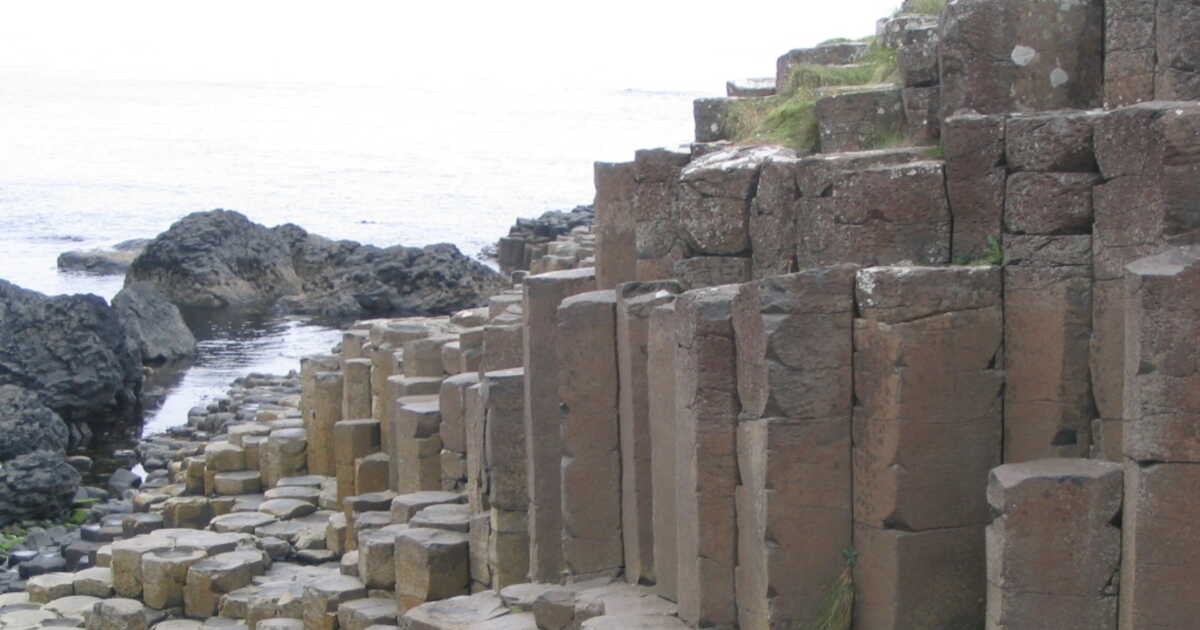
At first glance, they might look like simple lucky charms left behind by passing travelers. Yet the thousands of coins pressed into the rocks of the Giant’s Causeway, in Northern Ireland, forced conservationists to launch a particularly delicate cleaning operation. More than 20 kg of coins have already been removed from this UNESCO World Heritage site. And despite several months of intervention, thousands of coins remain trapped within the rocks.
A meticulous operation at the heart of an exceptional volcanic site
Located in County Antrim, in Northern Ireland, the Giant’s Causeway is one of the United Kingdom’s most famous geological landscapes. The site contains more than 40,000 basalt columns, formed about 60 million years ago during a volcanic activity. Molten rock flowed into the fissures of the Earth’s crust before cooling, contracting and fracturing, giving birth to these columns with their characteristic geometric shapes. The site is registered as a UNESCO World Heritage site.
It is in the interstices of these formations that visitors gradually began to wedge coins. The gesture seems to carry symbolic significance, with some tourists considering the money as a good luck charm or a sign of love. But the coins remain exposed to sea spray and humidity, and their prolonged presence in the fissures can become problematic for the rocks…
The National Trust therefore undertook their removal in May 2025, after an alert from the Geological Survey of Northern Ireland. Early observations had highlighted effects that were both physical and chemical on the basalt. The intervention required the expertise of a stone mason, Nathan Morrow. The teams could not simply pull the coins out for fear of damaging the columns. Pliers were used for those near the surface, while a jointing tool allowed access to coins wedged deeper in the cracks.
The difficulty varied greatly from one place to another. Some coins came out quickly, while the most deeply lodged ones could require more than 20 minutes of work each. In total, the operation involved around 200 hours of work. “Approximately 200 hours of work were devoted to the project”, said Cliff Henry, the National Trust’s nature engagement lead, to Need To Know.
Salt accelerates corrosion of coins stuck in cracks
But the problem is not limited to the number of coins scattered on the site. Their composition and the conditions to which they are exposed can also worsen their impact on the rock. British copper coins minted since 1992 notably have a steel core coated with copper. The 5, 10, and 20 pence coins are, meanwhile, made of steel coated with nickel. Yet these metals do not react to the environment in the same way. With humidity and especially the salt brought by sea spray, corrosion accelerates. The different metal layers can separate and expand inside the cracks, exerting pressure on the basalt.
This degradation also makes the coins difficult to identify after a few years. “The coins corrode so quickly in the salty and humid conditions of the Causeway that it becomes impossible to determine what currency they were, not to mention their date, after only a few years”, explained Cliff Henry.
The majority of recovered coins unsurprisingly came from the United Kingdom and the euro area, visitors tending to use the currency they have in their pockets. Only a portion could still serve as money, the others being too deformed or corroded.
Despite these hours of effort, the cleaning did not manage to remove everything. Several thousand coins would thus remain wedged in the cracks. Some are now too deeply buried to reach. Others are so rusted that moving them could further damage the rocks.
Cliff Henry, for his part, compares their accumulation to a carnival ride in which new coins gradually push the older ones inward. “As in a Penny Falls game in an arcade, the coins have been pushed further into the joints by the new coins hammered in at the front”, he explained.
The phenomenon could therefore continue to pose problems even after the end of the main operation, completed in June 2026. New coins have already been found after the cleaning, including 42 removed by Cliff Henry last month. The National Trust now plans to monitor the formations regularly and remove new deposits.
Informational panels have also been installed to ask visitors not to push coins into the rocks. The National Trust also plans to turn a portion of the recovered coins into objects for display to concretely demonstrate the consequences of this practice.