
In a tourism sector undergoing rapid transformation, where travelers seek ever more immersive, seamless, and personalized experiences, VOX Group has established itself as one of the most innovative technology players on the global market. For nearly twenty-five years, the group has been developing guidance and cultural discovery solutions that redefine how visitors explore cities, museums, heritage sites and major international events. Present in over 150 countries, VOX Group is today recognized as a global reference in guiding technologies, connected tourist experiences, and innovation in service of culture.
The group brings together several complementary brands: VOX, specializing in group tours and audio-guide solutions; Vox City, dedicated to autonomous itineraries for connected travelers; and Sycomore, expert in multimedia solutions and cultural mediation for museums and artistic institutions. Next-generation audiophones, multilingual content, interactive mapping, mobile applications and now AI-powered simultaneous translation: the technologies developed by VOX accompany today’s tour operators, cruise lines, museums, destinations and event organizers in creating experiences that are increasingly immersive, accessible and connected.
VOX Audiophones, a Global Benchmark for Guided Tours
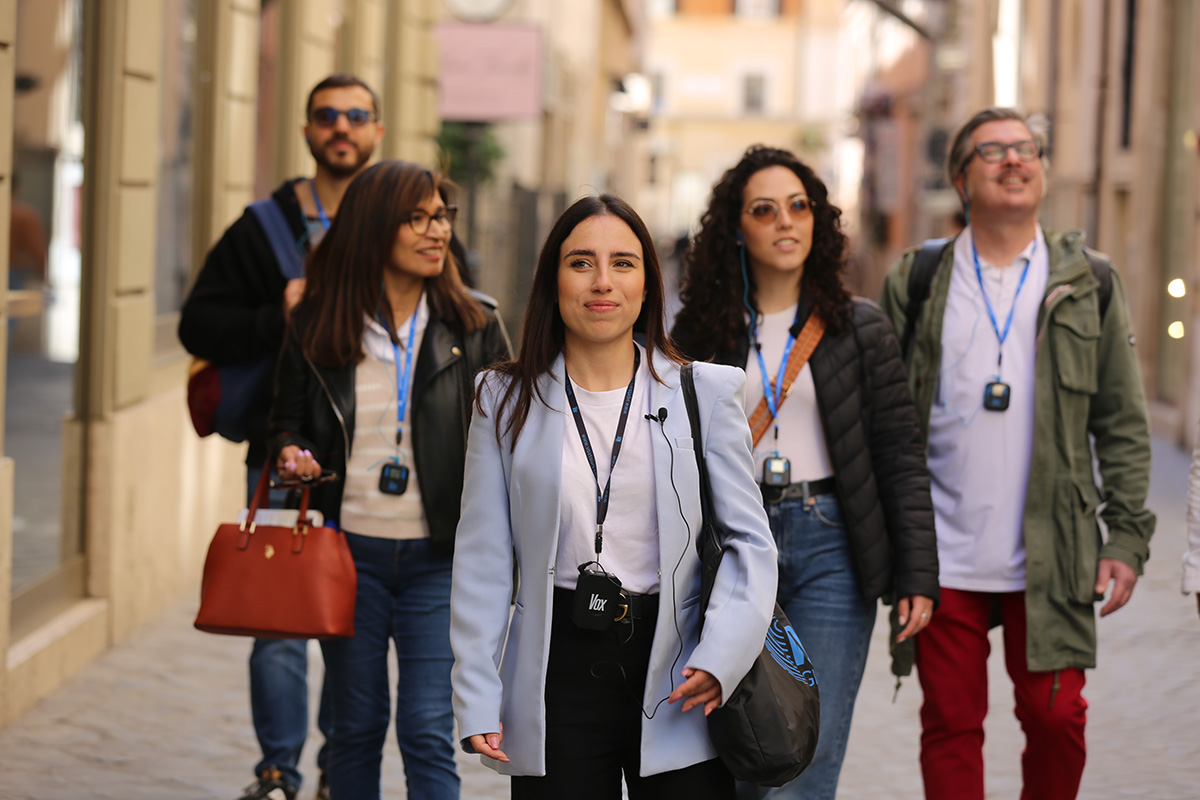
The core of VOX Group rests on its audiophone systems, which have become a global benchmark for group tours. Designed to meet the demands of modern tourist environments, VOX devices enable guides to communicate with clarity and fluency, even in highly crowded or noisy locations.
The VOX VDR radioguiding systems use patented digital radio technology operating at 1.9 GHz, a band less saturated than the conventional bands used in the market. This technology guarantees stable, interference-free transmission, with a range reaching up to 200 meters. Guides can thus continue their commentary while moving freely, without the need to continually pause the tour to regroup participants.
Beyond audio performance, VOX has developed technology designed to simplify the work of tour operators. The automatic pairing system instantly connects transmitters and receivers as soon as they are in range, significantly reducing the preparation time for tours. Smart auto-sleep features also help optimize battery life, with certain models capable of operating for up to thirty days under an average daily use of three hours.
The devices have also been designed to maximize user comfort. Lightweight, discreet, and easy to wear, they use single-use individual earphones, a more hygienic and comfortable solution than traditional headsets. This approach meets travelers’ new expectations regarding comfort, health safety, and sustainability.
In addition to audio performance, VOX’s true strength also lies in its global operational capability. With more than 55 offices across six continents, the group can quickly deliver ready-to-use equipment anywhere in the world, whether for museums, urban circuits, cruise excursions, or major international events. The devices are configured, tested, and prepared before delivery to ensure immediate commissioning. This logistical organization allows VOX partners to benefit from reliable equipment available quickly, regardless of the destination.
The VOX VDR radioguiding systems use patented digital radio technology operating at 1.9 GHz, a band less saturated than the conventional bands used in the market. This technology guarantees stable, interference-free transmission, with a range reaching up to 200 meters. Guides can thus continue their commentary while moving freely, without the need to continually pause the tour to regroup participants.
Beyond audio performance, VOX has developed technology designed to simplify the work of tour operators. The automatic pairing system instantly connects transmitters and receivers as soon as they are in range, significantly reducing the preparation time for tours. Smart auto-sleep features also help optimize battery life, with certain models capable of operating for up to thirty days under an average daily use of three hours.
The devices have also been designed to maximize user comfort. Lightweight, discreet, and easy to wear, they use single-use individual earphones, a more hygienic and comfortable solution than traditional headsets. This approach meets travelers’ new expectations regarding comfort, health safety, and sustainability.
In addition to audio performance, VOX’s true strength also lies in its global operational capability. With more than 55 offices across six continents, the group can quickly deliver ready-to-use equipment anywhere in the world, whether for museums, urban circuits, cruise excursions, or major international events. The devices are configured, tested, and prepared before delivery to ensure immediate commissioning. This logistical organization allows VOX partners to benefit from reliable equipment available quickly, regardless of the destination.
POPGuide, the Autonomous Visit Designed for Connected Travelers


With the rise of digitalized tourism and personalized experiences, VOX Group has developed POPGuide, a self-guided visit solution that turns smartphones and tablets into genuine interactive guides. Available as a mobile app, a white-label platform, or integrated directly into an existing application, POPGuide enables visitors to access multilingual audio content, interactive maps, and geolocated itineraries directly from their device. Thanks to an auto-play feature, narration is automatically triggered as the visitor approaches a point of interest, delivering an immersive and seamless experience in cities, museums, cruises, or sightseeing tours. It also works offline and can be accessed simply via a QR code, perfectly meeting the expectations of modern travelers seeking flexibility, autonomy, and customization.
For tourism professionals, POPGuide also represents an effective tool to enrich the visitor experience while reducing costs related to physical equipment, printed materials, and logistics.
The solution also includes analytics tools that track visitors’ movements, identify the most frequented points of interest, and better understand audience behaviors. These data provide destinations and tour operators with valuable insights to optimize routes, improve crowd management, and tailor offerings to travelers’ new expectations.
For tourism professionals, POPGuide also represents an effective tool to enrich the visitor experience while reducing costs related to physical equipment, printed materials, and logistics.
The solution also includes analytics tools that track visitors’ movements, identify the most frequented points of interest, and better understand audience behaviors. These data provide destinations and tour operators with valuable insights to optimize routes, improve crowd management, and tailor offerings to travelers’ new expectations.
VOX AURA, the Artificial Intelligence that Removes Language Barriers
The group’s latest innovation, VOX AURA marks a new advance in the evolution of guided-tour technologies. Unveiled at WTM London 2025, this device introduces a new way of experiencing tours for international groups. For the first time, visitors of all nationalities can follow a guide’s commentary in their own language in real time, without a smartphone, without an app, without roaming charges, and without the need for an interpreter.
Directly integrated with VOX’s radioguide systems, VOX AURA combines AI-powered simultaneous translation with the ease of use and reliability that have made the brand a global reference in tour guiding.
But the solution goes far beyond simple translation. Developed in-house by VOX Group, the technology rests on a proprietary algorithm capable of interpreting the overall meaning of a discourse rather than translating word for word. Place names, historical references, cultural expressions, or specific terminologies are thus recognized instantly, allowing guides to speak naturally while offering visitors translations that are more fluid and natural.
Designed as much more than a linguistic tool, VOX AURA fits into a broader vision of intelligent travel assistance. Ultimately, VOX Group envisions this technology as a true digital companion for tour leaders, guides, and cruise directors, able to support the logistical management of visits, adapt itineraries in real time, and help professionals deliver ever more personalized experiences.
By combining Italian engineering, global operational expertise, and cutting-edge artificial intelligence, VOX AURA aims to set a new standard of inclusive communication in the tourism and culture sectors. Beyond removing language barriers, this innovation opens up new possibilities for operators, who can now more easily accommodate international groups while offering more immersive and connected experiences.
Made in Italy and backed by VOX Group’s global logistics network, present in over 150 countries, VOX AURA embodies the group’s ambition to shape the future of guided tours through intelligent technologies.
Directly integrated with VOX’s radioguide systems, VOX AURA combines AI-powered simultaneous translation with the ease of use and reliability that have made the brand a global reference in tour guiding.
But the solution goes far beyond simple translation. Developed in-house by VOX Group, the technology rests on a proprietary algorithm capable of interpreting the overall meaning of a discourse rather than translating word for word. Place names, historical references, cultural expressions, or specific terminologies are thus recognized instantly, allowing guides to speak naturally while offering visitors translations that are more fluid and natural.
Designed as much more than a linguistic tool, VOX AURA fits into a broader vision of intelligent travel assistance. Ultimately, VOX Group envisions this technology as a true digital companion for tour leaders, guides, and cruise directors, able to support the logistical management of visits, adapt itineraries in real time, and help professionals deliver ever more personalized experiences.
By combining Italian engineering, global operational expertise, and cutting-edge artificial intelligence, VOX AURA aims to set a new standard of inclusive communication in the tourism and culture sectors. Beyond removing language barriers, this innovation opens up new possibilities for operators, who can now more easily accommodate international groups while offering more immersive and connected experiences.
Made in Italy and backed by VOX Group’s global logistics network, present in over 150 countries, VOX AURA embodies the group’s ambition to shape the future of guided tours through intelligent technologies.




 For many professionals, AI represents a disruption on a scale comparable to the web’s emergence in the 2000s or the smartphone revolution of the 2010s.