


There was a crowd in the Jardins Sainte-Victoire restaurant, inside Terminal 1 of Marseille-Provence Airport, on October 8 last.
The reason? The traditional workshop held twice a year, ahead of the summer and winter seasons.
“At every edition, more than 200 participants, airlines, travel agents, tour operators, come to honor us with their presence,” emphasized Julien Boullay, the airport’s commercial, marketing and services director, who noted that these gatherings constitute an important appointment for professionals.
The airport, which welcomed 11.3 million passengers in 2025, aims in particular to continue developing the “long-haul direct routes from Marseille-Provence”, he explained.
Corsair and United Airlines strengthen the network
The Guadeloupe was the destination highlighted at this edition, with the presence of the Guadeloupe Islands Tourism Committee and Corsair.
Objective: to showcase the archipelago to Provençal tourism professionals.
“We are here to highlight the archipelagic nature of the six islands”, summarized by Patrick Gaulin, in charge of destination promotion at the Guadeloupe Islands Tourism Committee.
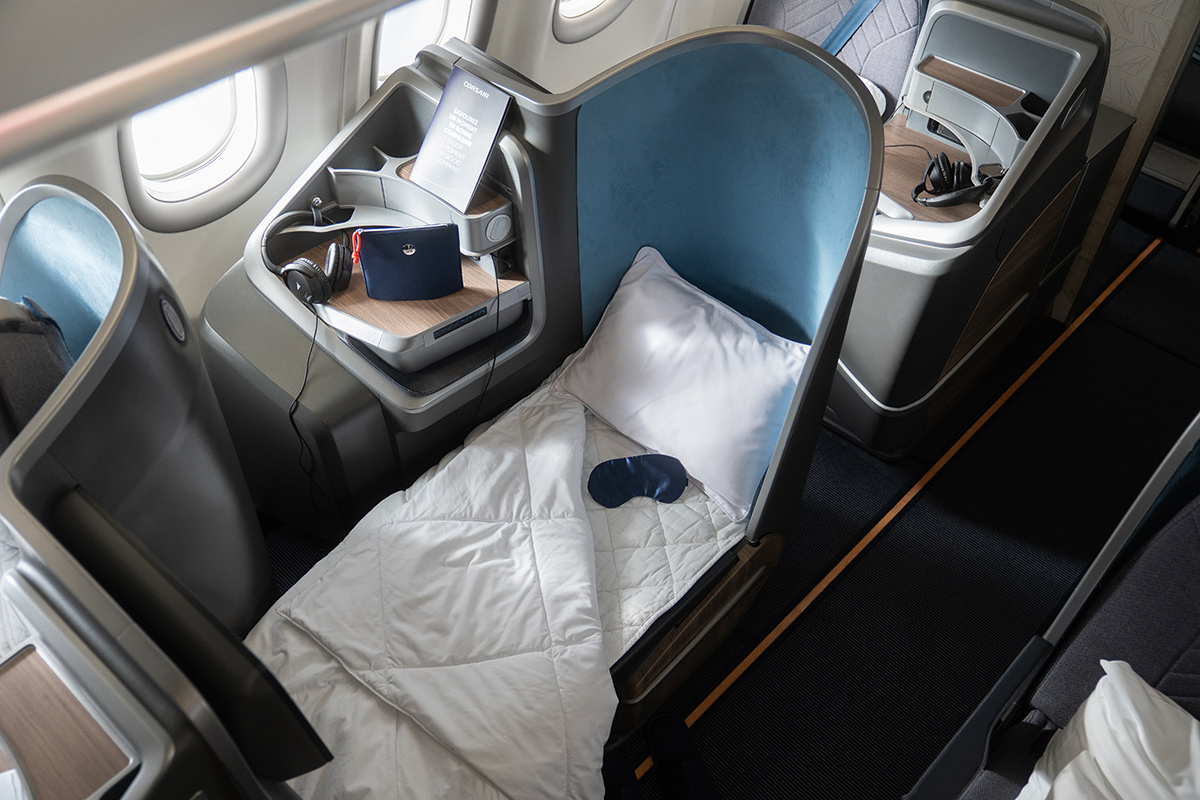
For reference, Corsair will open a direct link between Marseille and Pointe-à-Pitre starting December 15, 2026, with flights scheduled until the end of April 2027.
For Mouloud Hammar, Corsair’s regional commercial manager, this opening fits into a strategy to grow the regional network, alongside the routes to Réunion. Corsair has also launched a Toulouse–Pointe-à-Pitre connection.
The airport also highlighted the launch of the Marseille–Strasbourg route by Twin Jet starting November 3, as well as Transavia’s new destinations to Bari and Tirana for summer 2027, at a cadence of two flights per week.
Another major novelty for the platform: United Airlines will inaugurate a daily direct link between Marseille and New York–Newark starting June 5, 2027. Tickets are already on sale. The route will be operated with an Airbus A321XLR, with a scheduled flight time of 9h15.
For the moment, among the travel advisors present at the workshop whom we could question, this future connection has not yet generated bookings.
Géraldine Guillot, head of the Aix-en-Provence agency Au Temps du Voyage, notes even a slump in interest for the United States, linked in particular to the political climate and the cost of living there, which also weighs on tourism activities.
New York nonetheless remains in demand, with trips more often being considered at the last minute.
Travel agencies between expectations and caution
Among the hot topics of this evening were also Volotea’s program reductions.
According to OAG data, the airline decreased its planned schedule in France for October 2026 by 27.8% compared with what was initially published.
Amandine Pesce of the Eurafrique agency (Aix-en-Provence) notes “a limited, but real, impact on her clients,” while Sylvie Basso of Ailleurs Voyage in Trets explains “avoid booking with the airline when another option is available.”
As for Géraldine Guillot (Au Temps du Voyage), she takes a similar stance, while underscoring the limits of this strategy: on some destinations, like Venice and its Marco Polo airport, other carriers do not necessarily offer an equivalent service.
Between new routes and adapting to the vagaries of air transport, this autumn workshop thus brought airline forecasts closer to the distributors’ practical concerns.