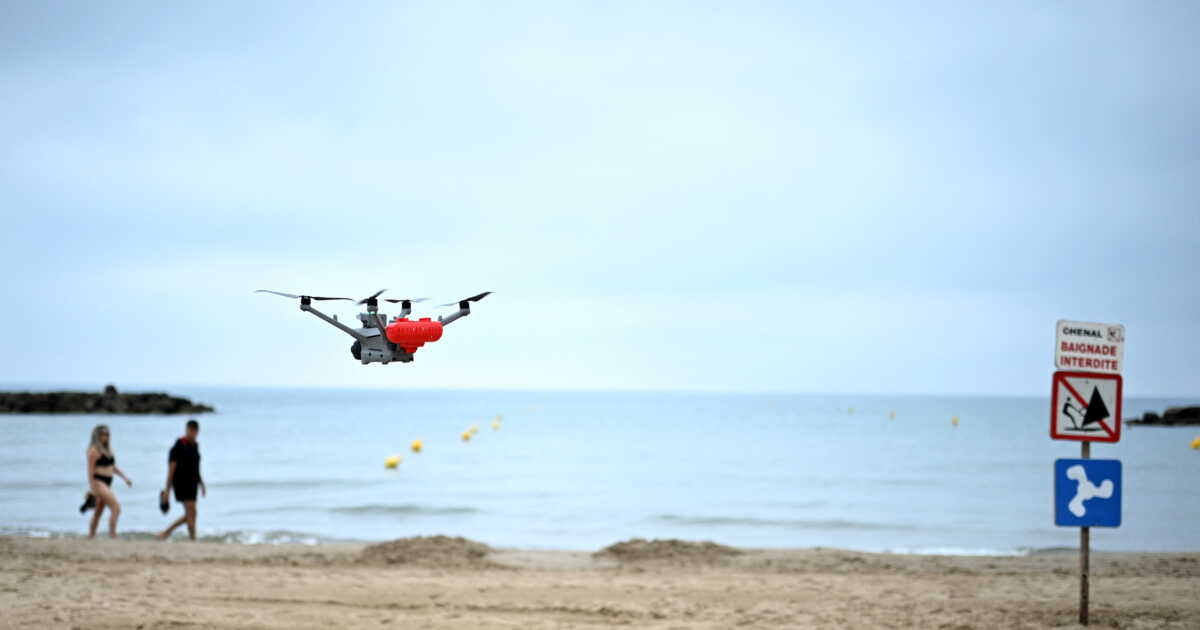
“If you’re in trouble, we will drop a buoy,” proclaims from the air an AI-powered drone, hovering a few arm’s lengths off the shore at Valras-Plage (Hérault) in southern France, where this device designed to detect drowning risks is currently being tested. The three heatwaves that have swept France since May have driven up drowning figures. In two and a half months, 274 people have died in the sea, in rivers, or in private pools, not counting non-fatal drownings that could leave serious after-effects.
Near Béziers, along the Mediterranean coast, Instadrone, a company specializing in the use of drones in industrial settings, aims to broaden its activity to monitoring bathing areas. It has thus received backing from the intercommunal authority and from the Valras station, which are financing the ongoing tests. Those tests should pave the way for the necessary authorizations within about a month, with a view to a full rollout by the summer of 2027.
An autonomous drone to detect the early signs of distress
“Dropping lifebuoys with a drone has been done for five years in the Landes region. But it was always in manual mode. We are bringing full automation,” explained to AFP by Instadrone’s founder, Cédric Botella, at the foot of the main lifeguard post, just steps from the station’s casino. The device appears as a large metal box, inside which a drone is ready to take off at any moment, day or night, notably thanks to its thermal camera.
In patrol mode, its mission is to “cover the 2.5 km stretch of beach by flying behind the breakwater, flying along the shoreline, without flying over swimmers but directing its cameras toward them, while avoiding filming people on the beach”, adds Mr. Botella, a former judicial police officer who has turned to entrepreneurship.
“If it detects erratic behavior, such as someone who ‘blocks the flow’, it will approach and send them an audio message saying that help is on the way. If needed, it will drop a buoy that inflates automatically on contact with water”, continues Botella.
Other scenario: a lifeguard spots someone in difficulty, or someone alerts them. In that case, the lifeguard, who will be trained in this new technique, will take control of the drone and send it to the exact location to assess the situation. Finally, “if during a midnight swim there is an incident, there will be an emergency number that will allow us to trigger the drone immediately and locate the person”, he also notes.
A reinforcement for lifeguards, including off-season
In cruising mode, the system costs around 2,000 euros per month for the community that adopts it, according to the entrepreneur, who hopes for its generalization. “Life has no price”, remarks the mayor of Valras-Plage, Daniel Ballester, who strongly backs the initiative and came to observe the latest tests.
“It won’t replace humans, but it opens up new ways to stay operational,” adds the official, who hopes to extend coastal monitoring to morning and evening hours and to times of the year when beaches are not watched by rescuers.
In May, the early arrival of a heat wave in France had drawn an unusual influx of visitors to the Mediterranean and Atlantic shores while beaches were not yet monitored, posing safety challenges.