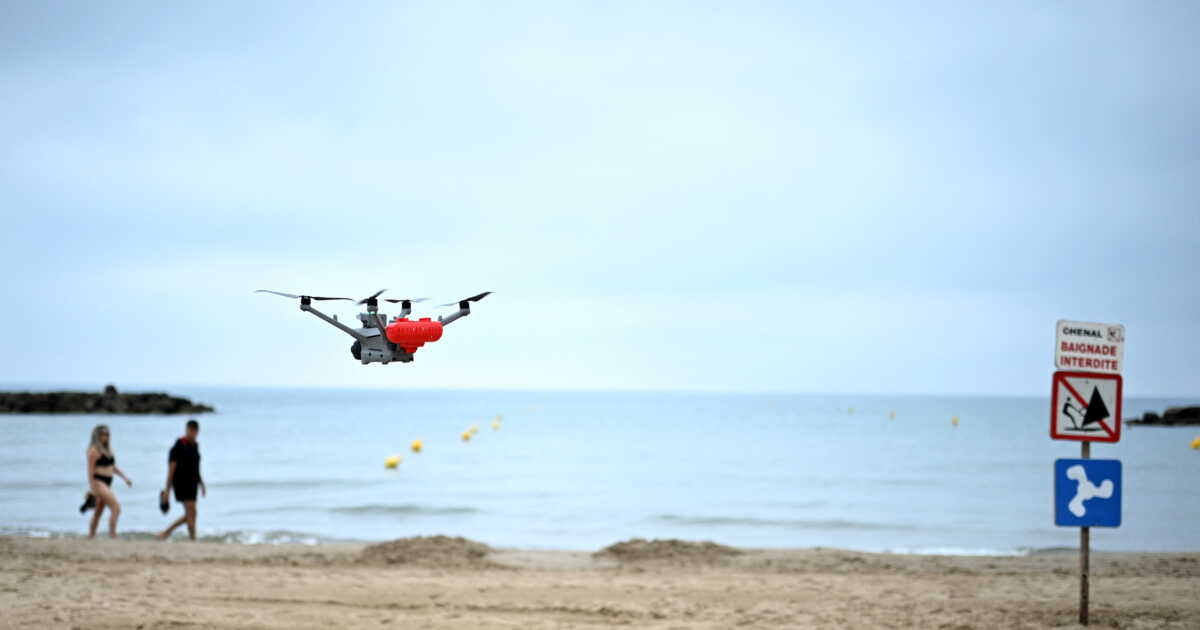
AI-Powered Drone Could Revolutionize Sea Rescue in France by Summer 2027

“If you’re in trouble, we will drop a buoy,” proclaims from the air an AI-powered drone, hovering a few arm’s lengths off the shore at Valras-Plage (Hérault) in southern France, where this device designed to detect drowning risks is currently being tested. The three heatwaves that have swept France since May have driven up drowning figures. In two and a half months, 274 people have died in the sea, in rivers, or in private pools, not counting non-fatal drownings that could leave serious after-effects.

Near Béziers, along the Mediterranean coast, Instadrone, a company specializing in the use of drones in industrial settings, aims to broaden its activity to monitoring bathing areas. It has thus received backing from the intercommunal authority and from the Valras station, which are financing the ongoing tests. Those tests should pave the way for the necessary authorizations within about a month, with a view to a full rollout by the summer of 2027.

An autonomous drone to detect the early signs of distress

“Dropping lifebuoys with a drone has been done for five years in the Landes region. But it was always in manual mode. We are bringing full automation,” explained to AFP by Instadrone’s founder, Cédric Botella, at the foot of the main lifeguard post, just steps from the station’s casino. The device appears as a large metal box, inside which a drone is ready to take off at any moment, day or night, notably thanks to its thermal camera.

In patrol mode, its mission is to “cover the 2.5 km stretch of beach by flying behind the breakwater, flying along the shoreline, without flying over swimmers but directing its cameras toward them, while avoiding filming people on the beach”, adds Mr. Botella, a former judicial police officer who has turned to entrepreneurship.

“If it detects erratic behavior, such as someone who ‘blocks the flow’, it will approach and send them an audio message saying that help is on the way. If needed, it will drop a buoy that inflates automatically on contact with water”, continues Botella.

Other scenario: a lifeguard spots someone in difficulty, or someone alerts them. In that case, the lifeguard, who will be trained in this new technique, will take control of the drone and send it to the exact location to assess the situation. Finally, “if during a midnight swim there is an incident, there will be an emergency number that will allow us to trigger the drone immediately and locate the person”, he also notes.

A reinforcement for lifeguards, including off-season

In cruising mode, the system costs around 2,000 euros per month for the community that adopts it, according to the entrepreneur, who hopes for its generalization. “Life has no price”, remarks the mayor of Valras-Plage, Daniel Ballester, who strongly backs the initiative and came to observe the latest tests.

“It won’t replace humans, but it opens up new ways to stay operational,” adds the official, who hopes to extend coastal monitoring to morning and evening hours and to times of the year when beaches are not watched by rescuers.

In May, the early arrival of a heat wave in France had drawn an unusual influx of visitors to the Mediterranean and Atlantic shores while beaches were not yet monitored, posing safety challenges.

Has Dubai Tourism Recovered After Drone Strikes?

Life in Dubai seems to have returned to its normal course, at least outwardly. While air traffic has resumed and restaurants are once again fully booked, tourists remain hesitant to visit, particularly because the emirate is still threatened by missiles and drones coming from the Gulf.

Even though most attacks have been intercepted before reaching the United Arab Emirates, fear is still present on the ground. This is why hotels, airlines and hospitality and food-service players are redoubling efforts to entice visitors to return.

Tourism stakeholders are trying to reassure visitors

CNN Travel went to meet several Dubai residents to better gauge the situation on the ground. The outlet in particular spoke with Naim Maadad, founder and CEO of Gates Hospitality, who explained that information relayed by international media did not necessarily reflect the reality on the ground. “Airports, hotels, restaurants and tourist attractions remain fully operational”, he said at first. He then stated that the main challenge was psychological.

“Travel advisories, insurance limitations and international news inevitably influence consumer behavior, even if the on-the-ground reality is very different. The sector must therefore redouble its efforts to communicate reassuring, transparent and trustworthy messages, without giving the impression of downplaying regional sensitivities,” he said. Victor Abou-Ghanem, CEO of STORY Hospitality, also stressed that travel warnings were hindering visitors’ return.

“For a family planning a vacation, a government advisory, an insurance restriction or the fear of flight disruptions can be enough to postpone a trip, even if the destination operates normally”, he recounted before adding that money was also a factor, with oil prices impacting air tickets. Economists warn that repercussions could be felt long after a durable ceasefire. They estimate that Dubai’s hotel occupancy could fall to as little as 10% in the second quarter, down from 80% before the conflict.

Measures put in place to revive tourism

In response to this decline in tourism, Dubai authorities acted by launching an ambitious set of support measures designed to speed up the rebound. Among them were the suspension of the daily hotel tax applied to upscale establishments, the removal of the 7% municipal tax on hotel and restaurant invoices, the deferral of hospitality-related sales fees, and the waiving of fees for the extension and cancellation of event permits.

The authorities also allowed hotels, serviced apartments and holiday homes to defer payment of taxes on lodging and dining for three months, easing pressure on operators as visitor numbers began to rise again. Businesses responded by offering promotions and incentives rarely seen since Dubai’s post-pandemic tourism boom.

A fashion designer based in Dubai for nearly 20 years, who asked to remain anonymous, said the scale of discounts currently offered across the emirate is unprecedented since the Covid-19 pandemic began, especially in the tourist district of J1 Beach. “Many of these places, once crowded, are now offering exceptional discounts. The city keeps functioning, people keep going out, but businesses must double their efforts for every customer,” he stated.