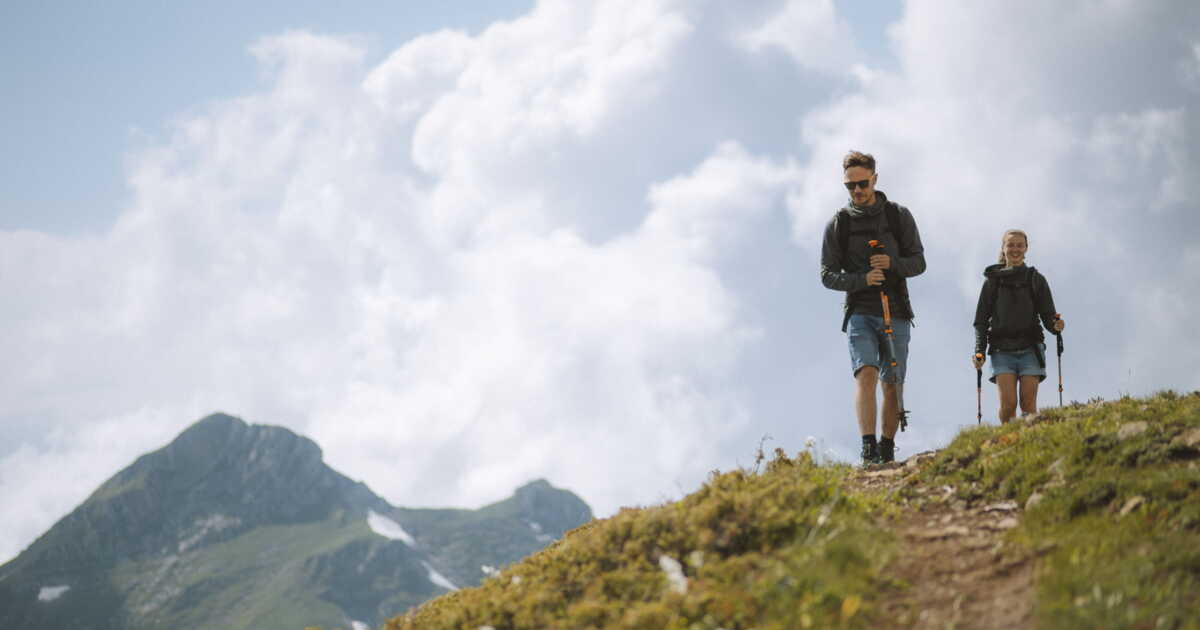
The Wolf Trail: A 3,500-Kilometer Hiking Route Across Six European Countries

Whether you’re an experienced hiker seeking a fresh challenge or simply an enthusiast looking for a pause from the frenetic pace of daily life, this new trail is tailor-made for you. The Wolf Trail spans nearly 3,500 kilometers across six European countries. It invites walkers to traverse a mosaic of landscapes, from the Polish Baltic coast to the Adriatic shore in Trieste, Italy, passing through Germany, Austria, Switzerland, and Slovenia.

Designed by the outdoor gear brand Jack Wolfskin, it takes four to six months to complete in its entirety. “Our Wolf Trail invites you to explore Europe on foot, from the Baltic Sea to the Adriatic. It blends nature and culture, and traverses Hanseatic fishing villages, the wine regions of the Palatinate and Trieste, a true cultural melting pot”, the company explained. But beware, the adventure won’t be a walk in the park. Indeed, with 78,400 meters of positive elevation to conquer, this trail presents a real challenge, especially for those who are not accustomed to long-distance hiking.

What are the essential stages of the Wolf Trail?

With 3,494 kilometers spread over seven stages across Europe, the Wolf Trail requires meticulous planning. The choice of departure window is particularly crucial, since between October and March alpine snowstorms can significantly complicate hikers’ progress. The journey begins with 428 kilometers of nearly flat terrain along the Polish Baltic coast, from Hel to Świnoujście.

Then, as the trail leaves Poland to enter Germany and then Switzerland, hikers embark on a 1,930-kilometer crossing punctuated by historic towns such as Rostock, before continuing on steeper paths toward the Austrian border. This progresses into a 392-kilometer stretch through the Allgäu Alps to Innsbruck, the fifth city in Austria, then it follows the emblematic Via Alpina, traverses the Italian Dolomites and the Triglav National Park in Slovenia. The journey culminates in Trieste, a port city where you can celebrate your arrival with a well-deserved drink facing the Adriatic Sea.

The Wolf Trail, an exceptional adventure across Europe

If you still have a few reservations, know that this new trail has been studied by Lauren Roerick, a recognized specialist in long-distance hiking. She confirmed that the route is safe and that walkers can progress with confidence without fear of getting lost along the way.

Moreover, the route is dotted with lodging options, from permitted trekking camps to mountain refuges, passing through villages where somewhat more comfortable accommodations are available. This ensures more restful nights and a full recovery before resuming the journey. The Wolf Trail thus promises to be an extraordinary adventure, capable of leaving a lasting mark on those who choose to embark on this trek.
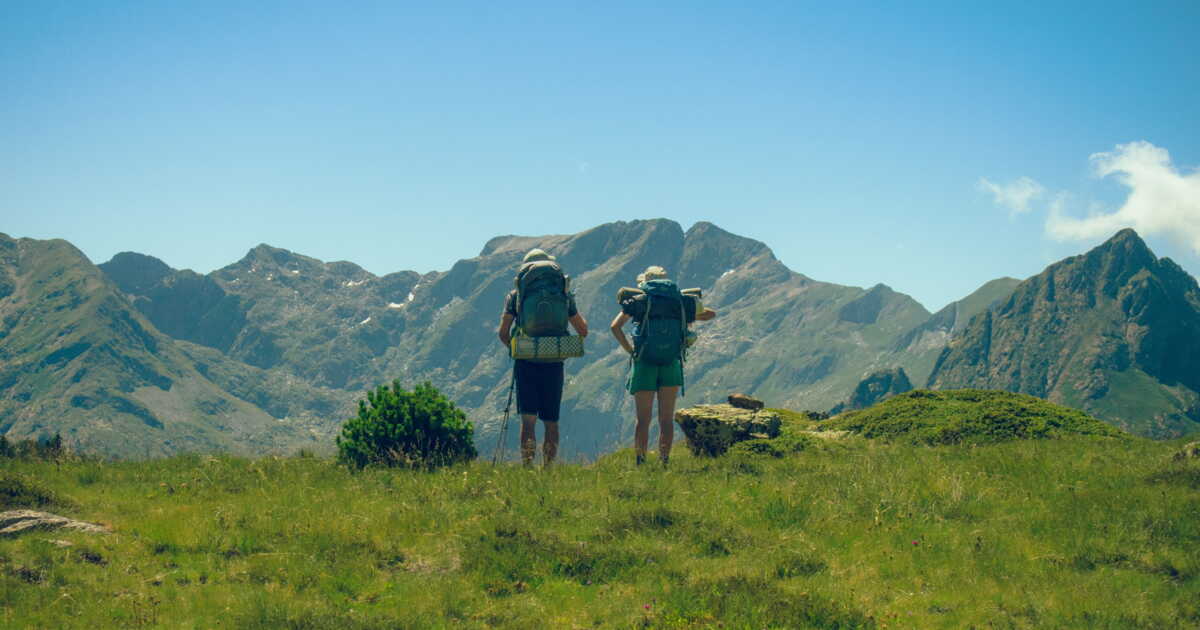
6 Breathtaking Scenic Hiking Trails for Your Summer Vacation

Summer often means vacation. While some prefer soaking up the sun by the pool, others choose to use their free time to recharge by reconnecting with nature through hiking. These active holidays are appealing to more travelers, but you still need to find the ideal place to indulge in this small pleasure. Fortunately for you, The Guardian recently highlighted six hiking trails across Europe that are worth a detour. All that remains is to pick your favourite.

Jungfrau, a mythical summit of the Swiss Alps

If you decide to tackle this hike, plan between 3 and 9 days to cover up to 119 km. Along the way you will encounter sparkling lakes, waterfalls cascading from fairy-tale valleys, and picturesque villages perched at dizzying heights. Another advantage: the entire route is served by an efficient network of postal buses, cable cars, mountain trains, and of course clearly marked trails, making progress stress-free and free to roam.

Summer is the best season to embark on a hike there, especially since trails are snow-free, huts are open, and the weather is typically stable. The new Cicerone hiking guide, The Bernese Oberland, recommends a 119 km circuit (in nine stages in the Jungfrau region, a stunning intermediate-level loop starting from the village of Grindelwald). Lodging is plentiful, and it is even possible to reserve hut spaces in advance.

Alpe Adria, a perfect blend of the Austrian Alps and Italian charm

To complete this hike of over 725 kilometers, plan between 7 and 9 days, or more. It begins at the foot of Grossglockner, Austria’s highest peak, and stretches to the Adriatic shores. If you don’t have enough time to finish it in full, a week in the Slovenian Julian Alps is an excellent alternative.

Despite breathtaking landscapes and more affordable prices than those in Switzerland or France, the Slovenian mountains tend to be quieter than other summer hotspots. It’s time to lace up your hiking boots and discover these marvelous vistas.

The Portuguese Way, ideal for reaching Santiago de Compostela

It’s wise to budget around two weeks to complete this trek and fully savor it. This coastal route leads all the way to Santiago de Compostela. The Portuguese Way to the tomb of Saint James is the third most frequented, offering a friendly atmosphere among pilgrims while remaining less crowded than the French Way. Atlantic breezes keep the air fresh, and there are plenty of chances to swim.

It crosses fishing villages and expansive stretches of golden sand, all the way to Caminha, where a boat can cross the Minho River to reach Spain. However, pilgrim inns in town cannot be booked in advance, so it’s wise to reserve hostels and private hotels ahead of time, especially in summer.

Along the Lech, a wild Alpine river between Austria and Germany

Plan between 7 and 10 days to complete this hike. This trail, rated easy to moderate, is the first to have earned the Leading Quality Trail label from the European Ramblers Association, guaranteeing the quality of its infrastructure and waymarking.

It follows the Lech from its source in the mountains, at 1,793 meters above sea level, near the Formarinsee lake in Austria, to the Lechfall waterfall in Füssen, in the Bavarian Alps of Germany, and is fully accessible from mid-June to early October. Along the way, numerous facilities line the route, including mountain villages offering comfortable accommodations, as well as historic churches and local artisans who keep traditions alive, from beer to cheese.

The Beara Way, a particularly immersive Irish hiking route

If the heat is hard to take, this hike is for you. The Beara Peninsula, in the southwest of Ireland, offers a true refuge from summer temperatures, softened by Atlantic breezes that bring a welcome natural coolness. Moreover, located below the more famous Dingle and Iveragh peninsulas, Beara partly escapes the crowds. The full Beara Way, starting and ending in Glengarriff, can be completed in about ten days.

You can also dedicate a few days to exploring a selection of the 15 circular hikes that make up the route. Among them, Ireland’s only cable car that crosses the sea to Dursey Island, for a 14.5 km loop around this largely desolate island, or the ferry crossing from Castletownbere to Bere Island, an open-air museum island housing Martello towers, cannon batteries, a lighthouse and a Viking-fortified harbor.

The impressive Kuststigen coastal trail in Sweden

A hike that will reveal Sweden like never before. The Kuststigen isn’t a continuous route along Bohuslän’s coast in western Sweden, but a collection of 44 well-marked stages, some linked together, others not, and most are easily reachable by ferry or bus.

The route highlights sapphire waters, pink granite outcrops, fishing villages with colorful façades, and part of the roughly 8,000 islands and reefs that make up this exceptional coastline. To enjoy a touch more serenity, it’s best to visit at the end of August or the beginning of September, or even in June, when temperatures stay mild and the coast is less crowded.

Hiking: 5 Must-See Itineraries to Discover Italy on Foot

They say all roads lead to Rome, and for these five, that’s precisely true. At a moment when hiking is gaining popularity — nearly 30 million French people report having practiced it in the last 12 months, making it the most widespread physical activity — here are five itineraries rich in history and culture, to walk in order to discover Italy differently. From nature trails to villages, the “Antichi cammini d’Italia” (Ancient Paths of Italy) unfold several hundred kilometers across the country, and even beyond to the heart of Europe. All converge on Latium and Rome, and all share the common aim of revealing a preserved Italy.

1/ The Via Francigena, one of the oldest medieval pilgrimage routes

A thousand kilometers through some of the most beautiful landscapes in Italy: a dream come true! The Via Francigena is one of Europe’s most attractive cultural routes. While it links Canterbury to Rome, it is its Italian section that enchants walkers from all over the world the most. From the Grand-St-Bernard Pass to the Eternal City, the Italian stretch, about 1,000 kilometers long in 45 stages, reaches its experiential heart in Latium, through the Tuscia of Viterbo. In Bolsena, on the shores of the eponymous lake, the Eucharistic miracle of 1263 inspired the feast of Corpus Domini; Montefiascone houses the Rocca dei Papi, the papal fortress; Viterbo, an ancient papal city, preserves one of the largest medieval districts in Italy; Sutri offers its Roman amphitheater entirely carved in tuff. At the end of the path, La Storta, the final stop before Saint Peter.

Basilica di Santa Margherita a Montefiascone

2/ The Saint Francis Way: between forests, villages and sanctuaries

This route, both athletic and spiritually infused, connects the most emblematic places of Saint Francis of Assisi’s life. It consists of two branches that converge on Assisi: the North Way, about 190 kilometers from La Verna where Francis received the stigmata in 1224, and the South Way, about 300 kilometers in 13 stages, which traverses Latium entirely from Rome to Assisi. In the heart of Latium, in the Valle Santa of Rieti, four Franciscan sanctuaries concentrate the memory of decisive moments in the Saint’s life: Greccio, where in 1223 Francis made the first crib in history; Fonte Colombo, where the Rule of the Order was dictated; La Foresta, the site of the grape miracle; and Poggio Bustone, where he received the revelation of the forgiveness of sins. Upon arrival in Assisi, pilgrims receive the Testimonium.

3/ The Benedictine Way: on foot, by horse or by bike through the villages of Umbria and Latium

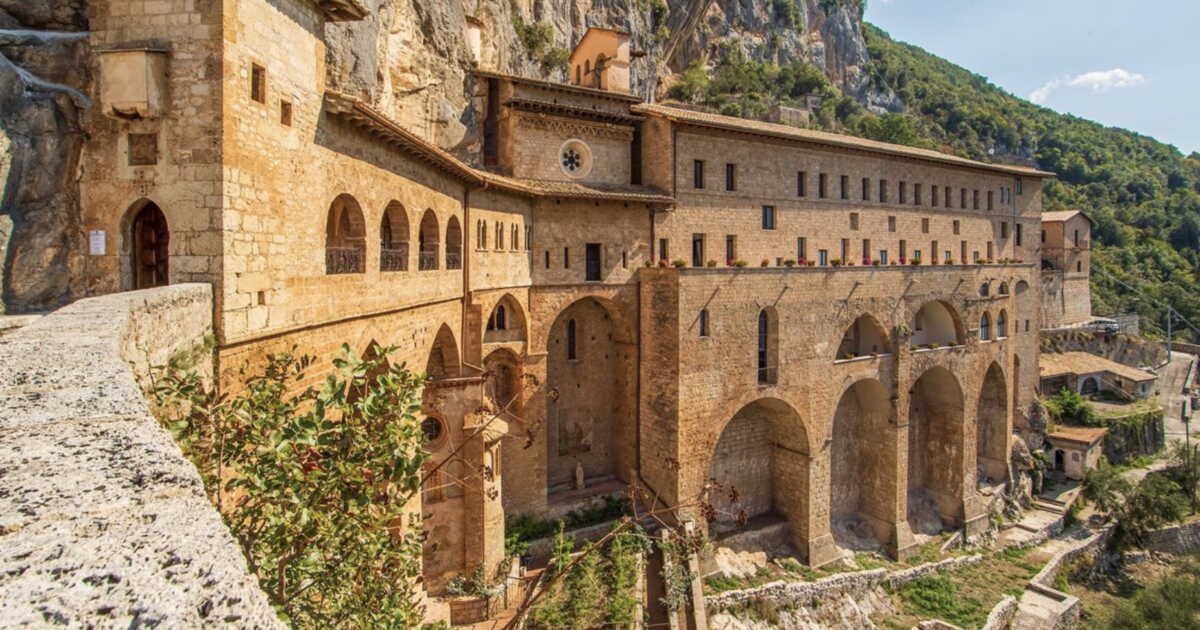
From Norcia in Umbria to Montecassino in Latium, this route exudes a singular spiritual and cultural depth. The itinerary runs about 300 kilometers in 16 stages — and it is in Latium that the longest stretch unfolds, across the Aniene Valley and the central valleys of the Apennines. In Subiaco, the Sacro Speco houses the cave where Saint Benedict lived as a hermit for more than thirty years, while the Abbey of Santa Scolastica hosted in 1465 the first active printing press in Italy. From there the path continues via Trevi nel Lazio, Casamari with its Cistercian abbey, Arpino (birthplace of Cicero), Roccasecca (linked to Thomas Aquinas) and the Melfa Gorges, before culminating at Montecassino, where around 529 Benedict founded the abbey that remains the heart of the Order. Patron of Europe since 1964.

Ponte di San Francesco,Subiaco

4/ The Romea Strata: on the traces of pilgrims from Central and Eastern Europe

The complete route follows the tracks of medieval pilgrims for over 4,700 kilometers across seven countries, from the Baltic and Central-Eastern Europe to Rome. Recognized as a Council of Europe Cultural Route on June 17, 2025, the Romea Strata comprises 245 stages and more than fifty UNESCO sites along its journey. Its Italian section spans about 1,000 kilometers in 47 stages and touches, in Latium, Bolsena, Montefiascone, Viterbo and San Martino al Cimino before reaching Rome as the culmination of the voyage. Since 2024, thanks to mapping work by a network of volunteers, the final stretch no longer joins the Via Francigena: the Romea Strata now has an autonomous entry into Rome, which defines its identity.

5/ The Via Romea Germanica: from Germany to Saint Peter in Rome, following the path of a 13th-century abbot

The Via Romea Germanica retraces the route of Abbot Albert of Stade, who walked in the 13th century from Lower Saxony to Rome. The Italian section measures about 1,050 kilometers from the Brenner Pass to Rome and joins, in Latium, the Via Francigena at Montefiascone. From that point, the two paths merge and together cross the Tuscia of Viterbo: Bolsena, Viterbo — where every September 3 the Macchina di Santa Rosa takes place, recognized by UNESCO as intangible cultural heritage of humanity —, Vetralla, Sutri and the Veio Regional Park, up to La Storta. A northern variant in Latium also passes through Civita di Bagnoregio, the famous “dying city” perched on a tufaceous spur in the heart of the Tuscia.

Along the Antichi Cammini d’Italia, each stage offers a plunge into an Italy still preserved, where history, nature and contemplation blend harmoniously. At the end of these long marches, in Rome and in Latium, it is the living heart of the country that speaks.

Mausoleo di Romolo, Roma

To learn more

Projet financé par l’Union européenne – Next Generation EU « Antichi cammini d’Italia »,
PNRR – Mission M1C3 Investissement 4.3 Intervention 274 – maître d’ouvrage MINISTÈRE DU TOURISME ITALIEN, Agence d’exécution ENIT SpA

Sponsored article by ENIT S.p.A.